A series of administrative documents from the Commissioners of the Customhouse London concerning Charles Lutwidge's memorial for a reward for services in forming improvement plans for Isle of Man customs duties and expenses incurred during the passage of the Revestment Act. Includes financial accounts of receipts and charges from May 1765 to July 1767, salary arrears, and incidental expenses. Shows the Commissioners' initial resistance to authorizing payment from customs revenue, followed by compliance after Treasury direction.
Part II of an official 1792 report by Commissioners of Inquiry examining Isle of Man revenue systems post-Revestment. Covers receipt and expenditure, customs establishments, duty systems, illicit practices, and proposals for trade relief. Includes detailed financial accounts, port structures, officer establishments, and recommendations for reform of revenue collection and harbour management.
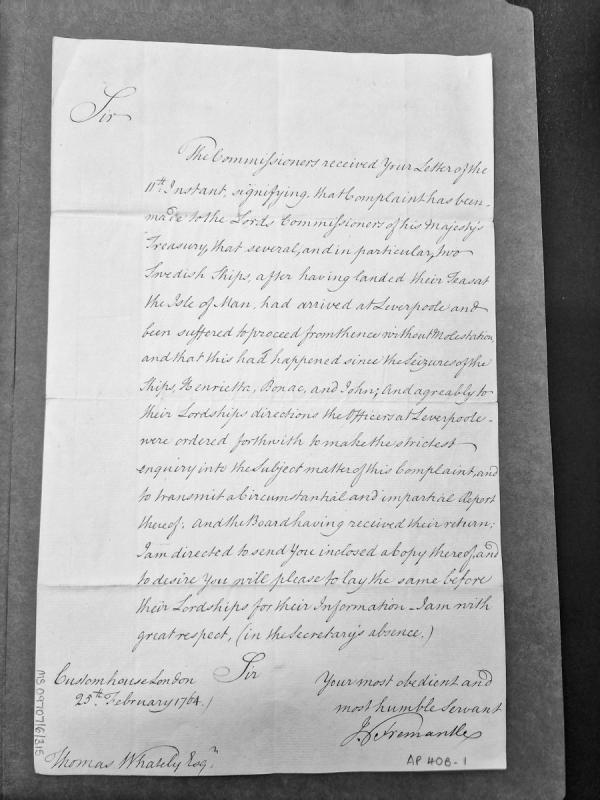
Letter from H Fremantle at the Custom House London to Thomas Whately reporting on complaints made to the Lords Commissioners of the Treasury regarding Swedish ships that landed tea at the Isle of Man and subsequently proceeded from Liverpool without molestation. The letter transmits an enclosed report from officers at Liverpool following their inquiry.
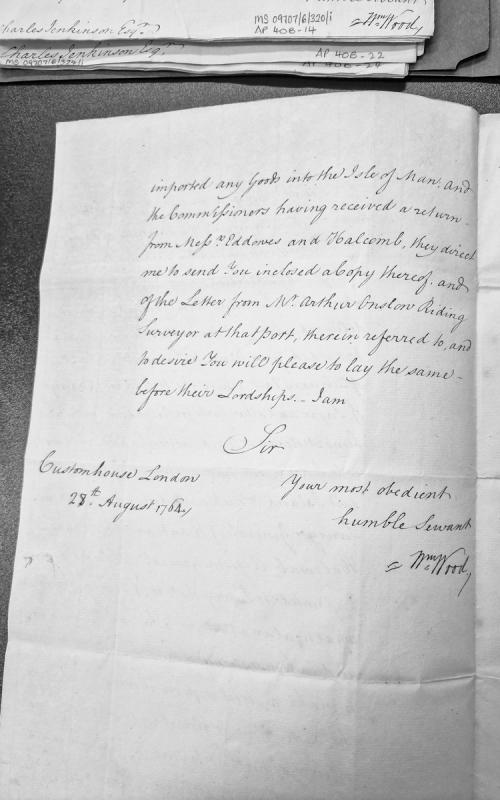
Official correspondence from the Customs House London directing the recipient to lay before their Lordships copies of returns from Messrs Addones and Halcomb regarding goods imported into the Isle of Man, together with a letter from the Riding Surveyor at that port.
Official report by Commissioners of Inquiry examining the ancient and contemporary constitution of the Isle of Man, including legislative, executive, and judicial structures. Details the House of Keys, Governor and Council, courts of judicature, and the effects of the 1765 Revestment Act on constitutional arrangements. Primary source document with extensive supporting testimony from island officials.
Pages 131–137 of the 1792 Report of the Commissioners of Inquiry into the Isle of Man, featuring David Reid's signed postscript (dated 9 April 1792) and his dissenting observations (dated 16 March 1792) on the findings of the five-man commission. Includes Reid's letters to fellow commissioners and Secretary Peace, the full instructions from Henry Dundas (8 September 1791), and correspondence relating to the inquiry. Reid's observations address carriage services, manorial vs. sovereign rights, game and unappropriated lands, and the status of the Grand Inquest post-Revestment.
Official report of the 1792 Commissioners of Inquiry examining allegations by the Duke of Atholl regarding revenue collection, duties, and property rights following the 1765 Isle of Man Revestment. Documents testimony from Manx officials and merchants on pre-1765 smuggling, customs administration, and the Duke's claims to lost revenues and rights. Directly addresses constitutional and financial consequences of the transfer of sovereignty.
Pages 101–110 of a formal 1792 Report of Commissioners of Inquiry examining the Duke of Atholl's allegations regarding loss of revenues, inadequate protection of reserved rights, and laws passed without his knowledge post-1765 Revestment. Addresses disputes over duties, game rights, waste lands, boon services, and systemic deficiencies in revenue collection and customs enforcement across the Isle of Man.
Official report by Commissioners of Inquiry examining four major allegations by the Duke of Atholl regarding the 1765 Revestment Act: (1) the Duke's family's power to increase duties; (2) rights deemed necessary for revenue security; (3) rights rendered nugatory by the Act; and (4) laws passed affecting his interests without notice. The report includes detailed analysis of specific rights (herring customs, fisheries, harbours, game, waste lands, boons and services) and systemic deficiencies in the Isle of Man Revenue Department.
Part Four of the 1792 Report of Commissioners of Inquiry into Isle of Man affairs, covering legislative reform, judicial administration, officer salaries, public buildings, harbours, and lighthouses. Discusses defects and remedies post-Revestment, including memorial from principal landowners concerning Tynwald Acts, judicial jurisdiction disputes, infrastructure decay, and harbour management failures.
Part Four of the 1791/1792 Report of Commissioners of Inquiry into Isle of Man affairs, covering legislative reform, administration of justice, officer salaries, public buildings condition, and harbour/lighthouse infrastructure. Addresses petitions from landowners regarding Acts of Tynwald, judicial reform including the Deemster and Admiralty jurisdiction, and critical infrastructure decay post-Revestment.
Formal report by David Reid (Commissioner of Inquiry) to the Lords of the Treasury, proposing sweeping administrative and revenue reforms for the Isle of Man. Covers transfer of customs management to English or Scottish Boards, officer discipline, prevention of smuggling (Geneva, brandy, tea, tobacco, salt), licensing regulations, and rejection of a warehousing scheme. Highly relevant to post-1765 Revestment governance and revenue enforcement.
Mr Reid's detailed legal and analytical observations on the Duke of Atholl's allegation that revenues from the Isle of Man were not fairly collected before 1765. Examines customs administration, smuggling, East India Company monopoly provisions, and constitutional questions regarding Parliament's authority to legislate for Man. Responds to Attorney-General's counter-arguments about the legality of pre-Revestment trade. Critical source for understanding revenue disputes and constitutional tensions underlying the 1765 purchase.
Official report by Commissioners of Inquiry examining the revenue administration, customs establishments, duty systems, and illicit practices in the Isle of Man. Covers receipts and expenditure (1790–1791), port and creek infrastructure, officer establishments and fees, duty schedules, smuggling activities, and proposals for trade relief. Directly assesses post-Revestment governance and revenue collection efficiency.
A formal record from the royal council at Bishopthorpe (York) documenting the trial and imprisonment of Henry de Bello Monte, a baron and privy councillor, for contempt and refusal to advise King Edward II on a truce with Robert de Bruce. The document is presented in both English and Latin versions, and demonstrates medieval constitutional principles regarding counsel and obedience to the Crown.
A bilingual (English/Latin) record from Rymer's Foedera documenting the trial and imprisonment of Baron Henry de Bello Monte for refusing to counsel King Edward II on a truce with Robert de Bruce. The document details the king's council assembled at Bishopthorpe near York in May 1323, including the Archbishop of York, bishops, earls, and justices. Though geographically and temporally distant from 1765, this document exemplifies medieval constitutional procedures regarding counsel, counsel obligation, and baronial privilege — concepts relevant to understanding the later constitutional debates surrounding the Isle of Man Revestment and parliamentary sovereignty.
An academic article examining how the East India Company functioned as a source of domestic state capacity, particularly in customs revenue collection from Asian trade. The paper argues that the EIC's administrative infrastructure helped overcome the British state's limited bureaucratic capacity in the 18th century, contributing approximately 30% of customs revenue expansion between 1689–1780. Directly relevant to understanding the financial and institutional context of the 1765 Revestment.
Preface and index to George Chalmers' 1782 work on comparative strength of nations, focusing on England's commercial and population statistics from customs records, shipping registers, and historical data. Discusses methodology for using Custom-house Ledger, Inspector-General of Imports/Exports records, and population estimates. Relevant for understanding contemporary analysis of trade, revenue, and national strength during the Revestment period.
This document is a collection of client testimonials and reviews praising Madeline Morgan's work as a family law attorney, particularly in divorce and custody cases. The testimonials highlight her compassion, responsiveness, legal skill, and genuine care for clients and their families.
Royal grant by Henry IV to Henry de Percy, Earl of Northumberland, conferring the Island, Castle, and Lordship of Man in perpetuity, with all associated rights, privileges, and ecclesiastical patronage, held in fee by the service of carrying the Lancaster Sword at coronations. This document establishes the Percy family's legal claim to Man and demonstrates the feudal mechanisms by which the Crown disposed of insular territory in late medieval England.
A royal charter by Henry IV granting the Isle of Man, Peel Castle, and all appurtenant lands to Henry de Percy, Earl of Northumberland, in reward for services rendered. The grant is held in perpetuity by the service of carrying the Lancaster Sword at coronations. This document establishes the feudal basis of Percy lordship over Man and is foundational to understanding the island's constitutional status before the 1765 Revestment.
A fragment of a legal document expressing concurrence with an opinion attributed to Edward Ing. The text references a document bearing an earlier date and appears to be part of a longer legal opinion or judgment.
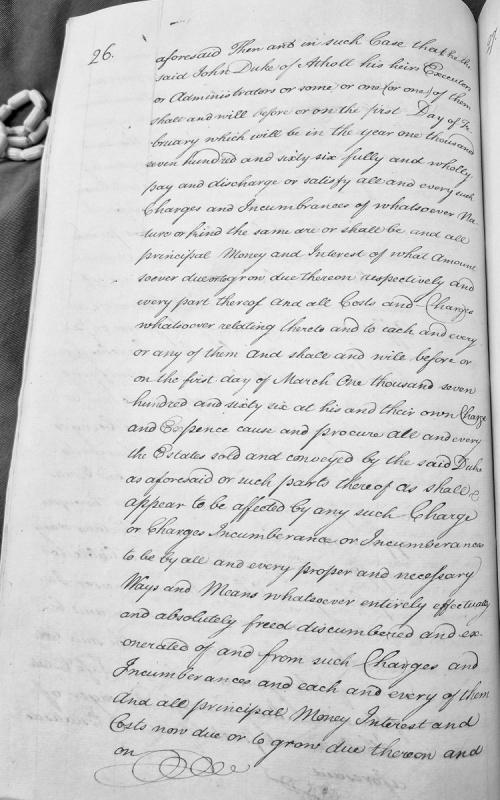
This is a fragment of a legal bond or recognisance document concerning John Duke of Atholl's obligation to discharge all charges, encumbrances, and financial obligations related to estates by specified deadlines in 1766. The document outlines conditions for freeing the estates from liens and incumbrances by March 1st, 1766.
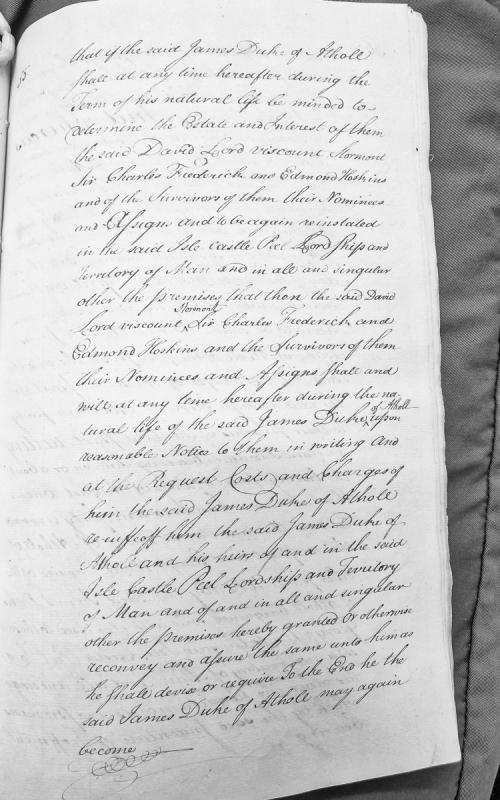
Legal document containing conditional provisions for the re-enfeoffment of the Isle of Man, Castle Peel, and associated lordships and territory. The clause specifies that David Lord Viscount Stormont, Sir Charles Frederick, and Edmond Hoskins (and their successors) may be required to return the estate to James Duke of Atholl upon reasonable written notice and at his expense during his lifetime.
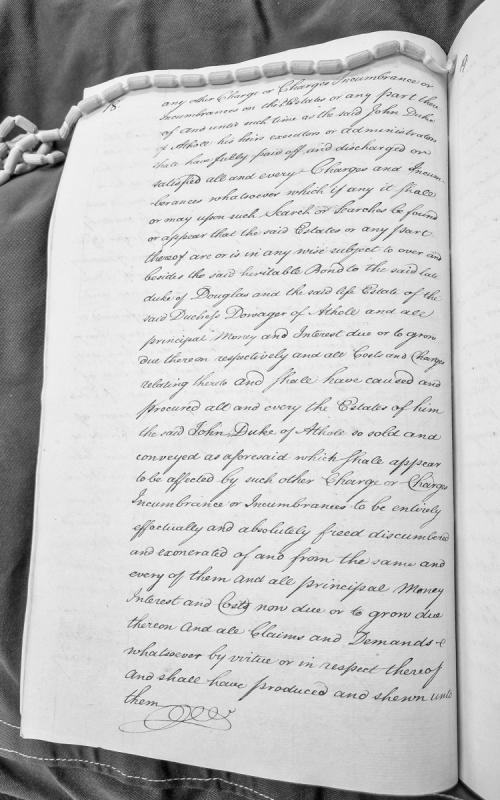
This is an excerpt from a legal document concerning the sale and conveyance of estates belonging to John, Duke of Atholl. It details conditions for clearing various charges and encumbrances, including references to a heritable bond to the late Duke of Douglas and a life estate of the Duchess Dowager of Atholl. The document outlines requirements for the complete discharge and exoneration of the estates from financial obligations.