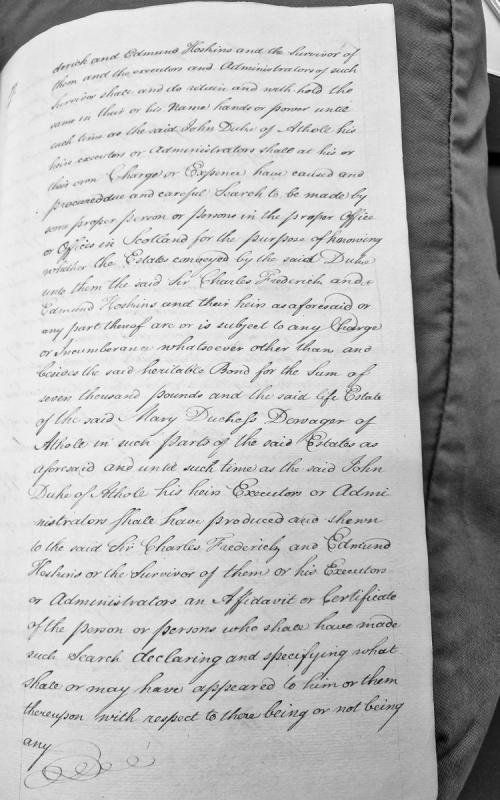
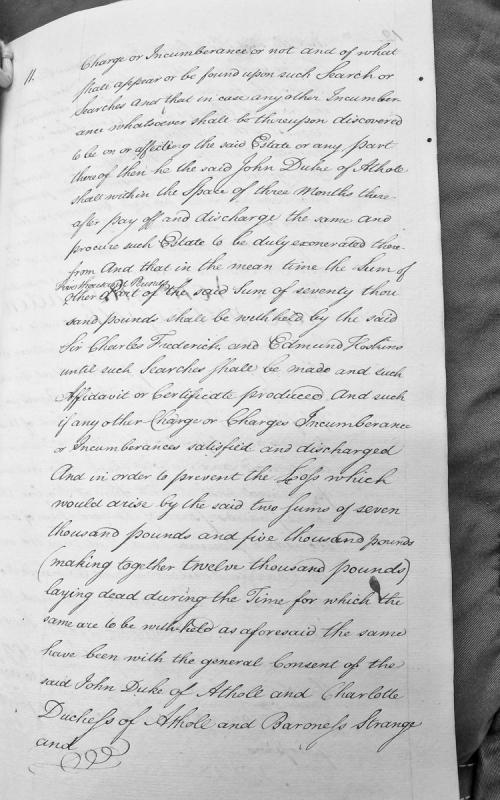
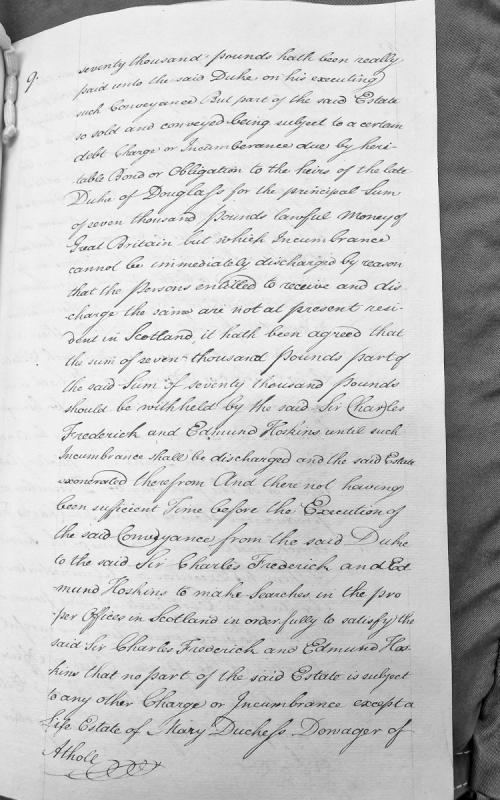
Fragment of a legal document concerning the conveyance of Scottish estates by John Duke of Athole to Sir Charles Frederick and Edmund Hoskins. The text outlines conditions requiring due search to be made in Scottish offices to verify the estates are free of charges or encumbrances beyond a heritable bond of £7,000 and the life estate of Mary, Duchess Dowager of Athole.
This is a fragment of a legal bond or recognisance documenting conditions for an estate transaction involving John Duke of Athol and Charlotte Duchess of Athol. It specifies procedures for searching the estate for charges or encumbrances, requirements for discharging any found, and arrangements for withholding sums (£5,000 and £7,000) pending completion of searches and production of affidavits/certificates.
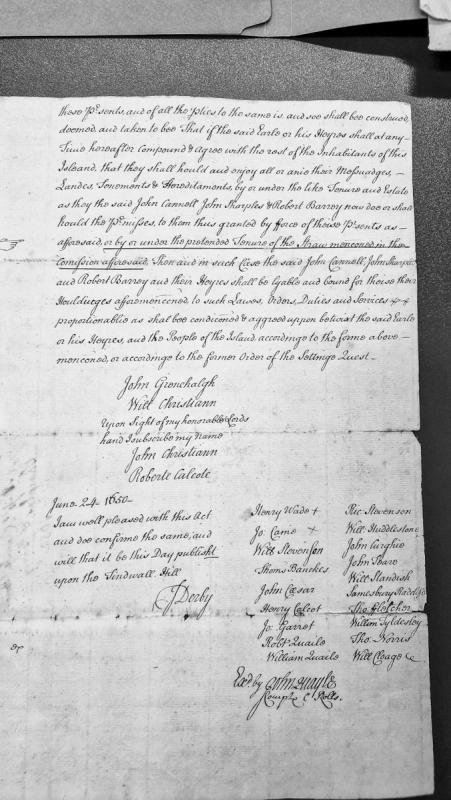
A formal administrative document confirming terms of land tenure and settlement on the Isle of Man. It addresses conditions under which inhabitants may hold properties and establishes obligations toward the Earl and the people of the island, with formal confirmation by J Derby and attestation by multiple witnesses.
William Bolts's polemical treatise on East India Company governance in Bengal, examining monopolies, administrative corruption, revenue extraction, and the Company's transformation from merchant to sovereign. Bolts advocates for Parliamentary intervention to establish justice, free trade, and proper administration. Appendix includes Attorney-General opinions (1757) on Company war powers and plunder rights. Directly relevant to understanding the constitutional and commercial issues that informed the 1765 Isle of Man Revestment and broader debates on chartered company sovereignty.
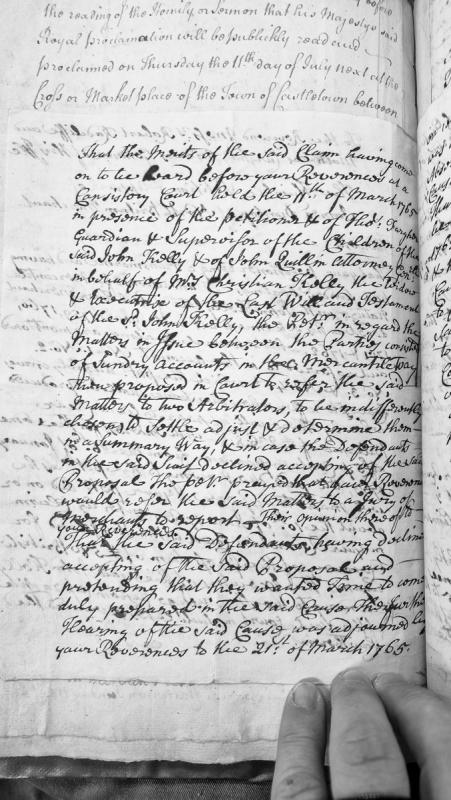
A court presentment documenting proceedings before a Consistory Court on 11 March 1765 concerning disputed mercantile accounts between parties regarding the estate of John Killey. The petitioner proposed arbitration or merchant jury review; defendants declined and sought adjournment to 21 March 1765.
A formal address from the Continental Congress to the people of Canada, urging them to join the American colonies in resisting what they characterize as tyrannical British Parliamentary measures. The document articulates grievances about loss of liberty, arbitrary government, and religious persecution under the Quebec Act, and invites Canadian participation in the defense of 'common liberty.' While primarily an American Revolutionary document, it provides comparative context for understanding constitutional and liberty arguments of the period relevant to the Revestment era's debates about Parliamentary sovereignty and colonial governance.
A bilingual (English/Anglo-Norman French) indenture from 1357 establishing truces between the King of England and the King of Scotland, explicitly naming the Isle of Man as a territory included in the agreement. The document outlines conditions for affirming and holding the truce, including oaths and letters, and names key allies including Edward de Balliol and John of the Isles. This early medieval source demonstrates the Isle of Man's strategic importance in Anglo-Scottish relations centuries before the 1765 Revestment.
A formal indenture from October 1357 recording a convention between the King of England and King of Scotland, affirming truces and their terms of payment. The document explicitly mentions the Isle of Man as part of the territorial scope of the agreement, indicating early medieval English claims to Manx sovereignty. This is relevant to understanding the constitutional and political status of Mann before the Revestment.
A bilingual (Anglo-Norman French and English) record of treaty conventions from 1355 concerning truces between the King of England and Scottish forces, explicitly naming the Isle of Man as a party to the agreement. The document references Edward III and establishes peace terms between English and Scottish parties including allies and adherents, with specific mention of the Isle of Man's inclusion in the truce provisions.
A bilingual (English and Anglo-Norman French) record of conventions establishing truces between the King of England and David de Bruys of Scotland, explicitly including the Isle of Man within the scope of the agreement. This document demonstrates the Isle of Man's status as a distinct territorial entity under English royal protection in the 14th century, relevant to understanding pre-Revestment sovereignty claims.
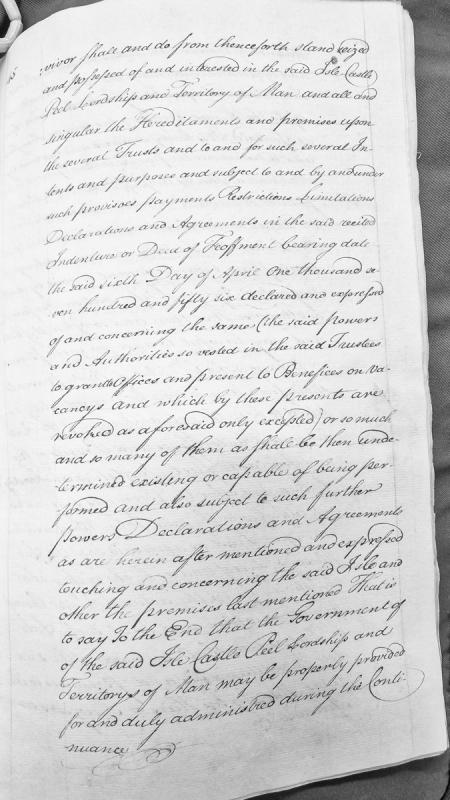
A legal document transferring seizin and possession of the Isle of Man, Castle Peel, and associated territories to trustees under specified trusts, provisoes, and restrictions as detailed in a Deed of Feoffment dated 6 April 1756. The document revokes certain powers relating to the granting of offices and presentation to benefices.
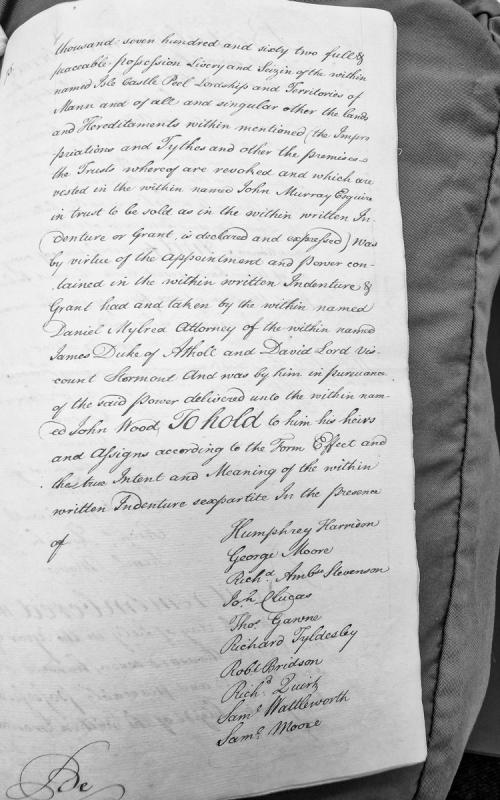
A legal conveyance document dated 1762 transferring full possession, livery and seisin of Isle Castle, Peel, Lordship and Territories of Mann to John Wood. The transfer is made by Daniel Mylrea as Attorney for James Duke of Athole and David Lord Viscount Stormont, by virtue of powers contained in an indenture and grant, with various lands and hereditaments included in the conveyance.
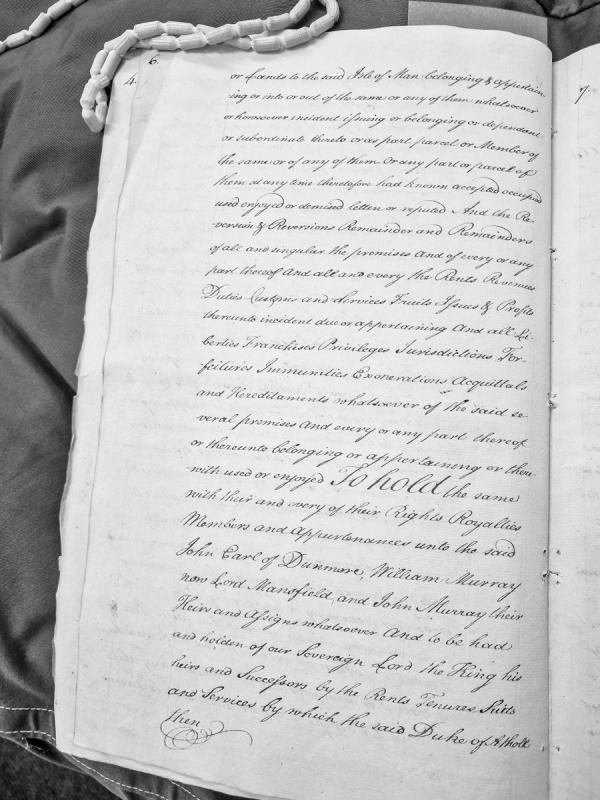
Fragment of a legal document conveying lands, properties, rents, revenues, duties, customs, services, franchises, privileges, jurisdictions, and hereditaments belonging to the Isle of Man to John Earl of Dunmore, William Murray (Lord Mansfield), and John Murray, their heirs and assigns. The document employs formal 18th-century legal language typical of property conveyances.
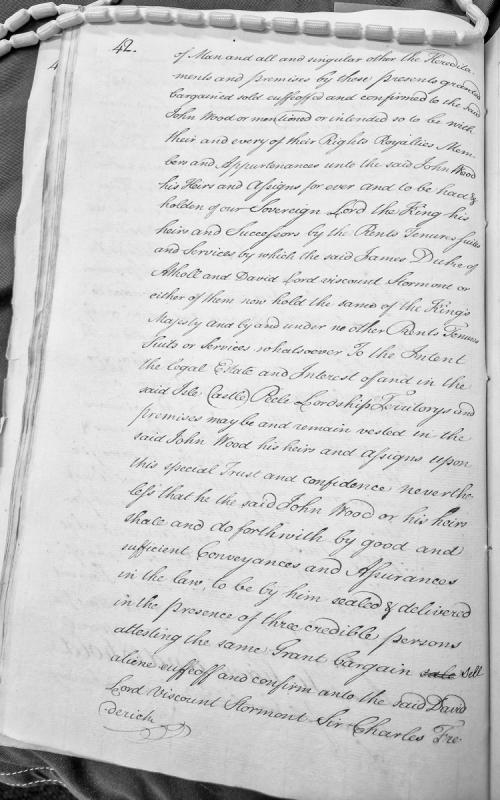
A legal document transferring the Isle of Man, Castle Peel, lordships, territories and premises to John Wood, held in trust. The document specifies that Wood must subsequently convey these properties to David Lord Viscount Stormont and Sir Charles Frederick through proper legal instruments witnessed by three credible persons.
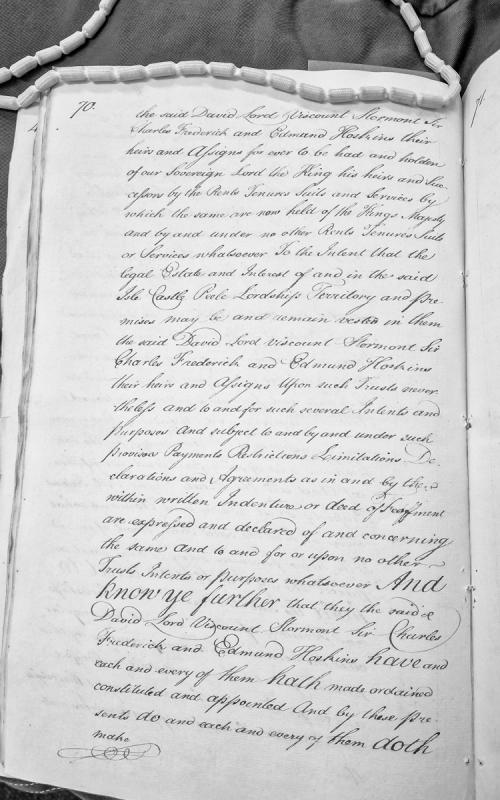
Fragment of a legal deed or settlement document concerning the conveyance of the Isle of Man, Castle Piele, and associated lordships, territory and premises to David Lord Viscount Stormont, Sir Charles Frederick, and Edmund Hoskins, held in trust under specified conditions and agreements.
A legal document detailing the sale and conveyance of a Scottish estate for seventy thousand pounds, with discussion of financial encumbrances including a heritable bond of seven thousand pounds owed to the heirs of the late Duke of Douglas, and provisions for withholding payment until the incumbrance is discharged.
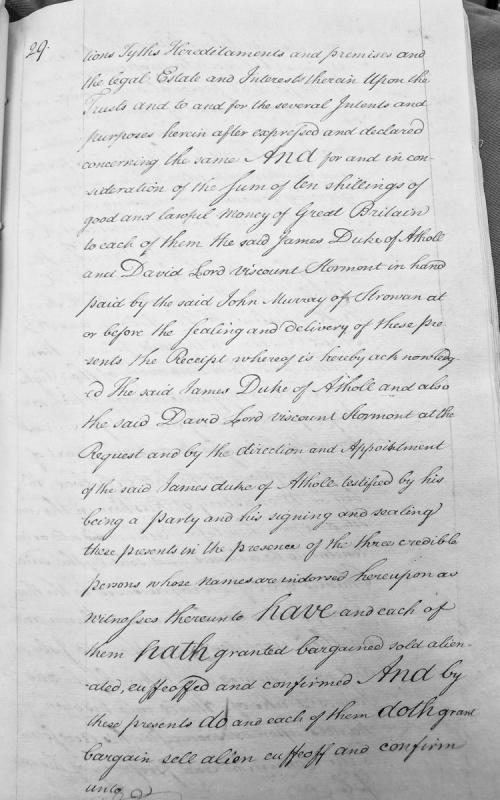
This is a legal conveyance document transferring tythes, hereditaments and premises to John Murray of Strowan. The Duke of Atholl and Viscount Stormont act as parties to the transfer, with consideration of ten shillings paid by Murray. The document establishes trusts and specifies various intents and purposes for the transferred property.
A trade journal for tobacco manufacturers, dealers, and smokers. This issue contains an article on tobacco and narcotics in Ottoman and Islamic Asia (translated from Arminius Vámbéry's 'Sittenbilder aus dem Morgenlande'), covering Turkish smoking customs, pipe culture, regional tobacco varieties (Latakia, Samsun, Roumelian), and the social role of tobacco in Ottoman society. Also includes a review of Henry Havard's 'Picturesque Holland' with references to Dutch smoking customs and pipe culture.
A commercial periodical devoted to tobacco manufacture, dealing, and smoking. The March 1877 issue (No. 84, Vol. II) contains articles on tobacco and narcotics in Ottoman Asia by travel writer Arminius Vámbéry, smoking customs among Turkish and Arab populations, descriptions of regional tobacco varieties (Latakia, Samsun, Jendische Bardar), and the cultural importance of pipes in Ottoman society. Includes promotional content for Cope Brothers & Co. tobacco products.
A bilingual (English/Latin) transcription of a 1426 diplomatic agreement between representatives of King Eric of Norway and King James I of Scotland, concerning territorial matters relating to the Hebrides and the Isle of Man. The document references earlier agreements between Magnus IV and Alexander III (undated), and between Haco V and Robert I (1312). Relevant to understanding pre-Revestment Manx sovereignty and the historical backdrop of competing claims to the island.
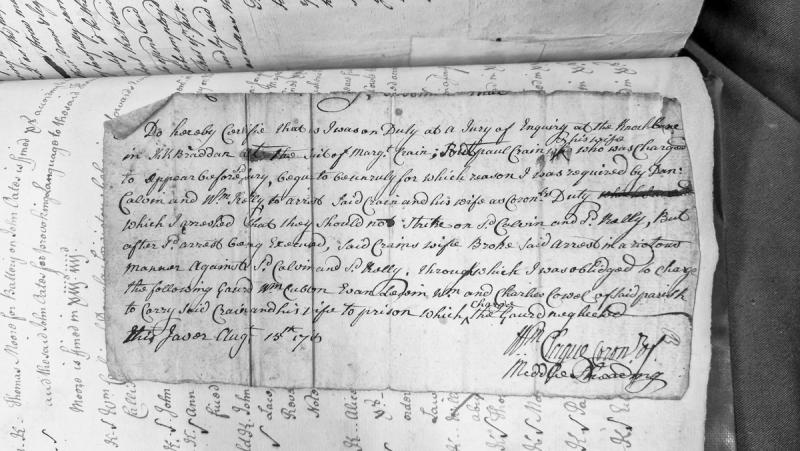
A coroner's certificate documenting events at a jury of inquiry held at Knoll Lane in Kirk Braddan. William Crigue certifies that Paul Crain and his wife were arrested for disorderly conduct before jurors Dan Calvin and William Kelly, but the wife subsequently broke arrest in a riotous manner. Crigue charged a guard to convey them to prison, which the guard allegedly neglected.
A collection of 30+ letters (MS 01798C–01828C from Manx Museum archives) between Isle of Man Governor Edward Smith, Lieutenant Governor Richard Dawson, and Westminster agent George Aust, covering the period 1783–1787. The letters document administrative issues, revenue disputes, copper coinage proposals, customs administration, harbour management, and constitutional matters following Charles Lutwidge's death in 1784. Key topics include copper coinage procurement, salary disputes, Water Bailiff appointments, and the Duke of Atholl's bills of 1780–1781.
A letter dated 30 July 1595 from Geo. Nicholson and John Cunningham to Mr Bowes, concerning warnings issued to the Isle of Man and defensive preparations. The document reflects 16th-century governance and security concerns regarding the island, predating the 1765 Revestment by 170 years but relevant to understanding long-term English authority and administration of Man.
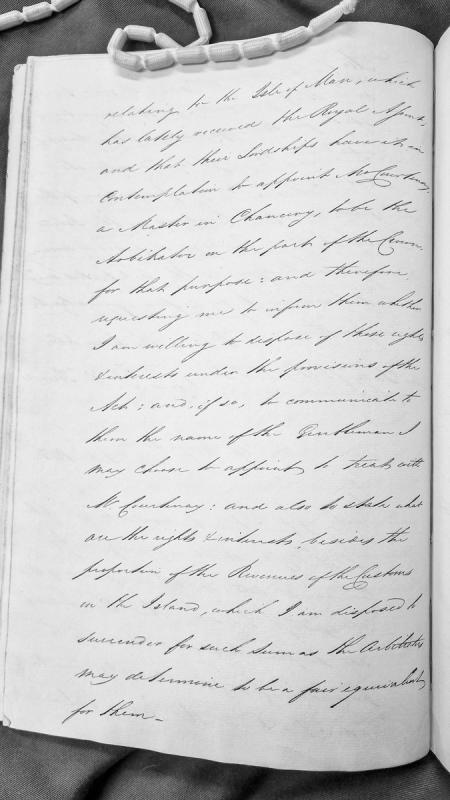
A fragment of administrative correspondence concerning the disposition of rights and interests relating to the Isle of Man under provisions of a recently enacted Act. The letter discusses the Crown's intention to appoint Mr Courtenay, a Master in Chancery, as arbitrator and requests confirmation of willingness to dispose of certain rights and interests, including customs revenue proportions.
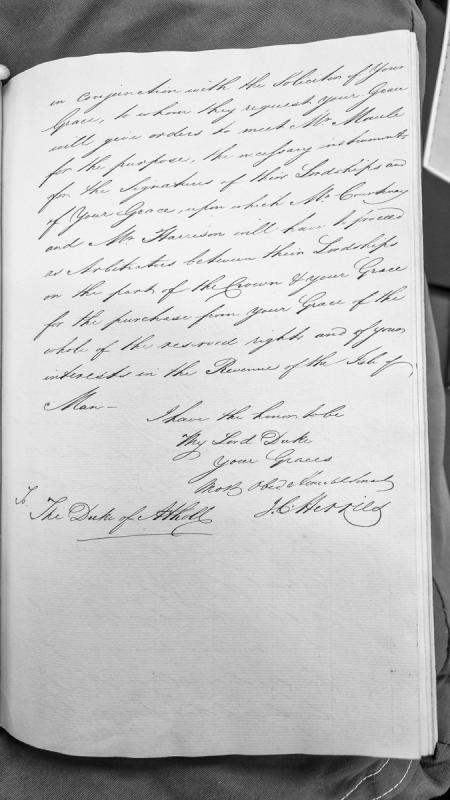
A letter fragment concerning negotiations between the Crown and the Duke of Atholl over the purchase of reserved rights and revenue interests in the Isle of Man. The correspondence references arbitrators (Messrs Courtney and Harrison) and instructs the Solicitor to prepare necessary instruments for signatures.