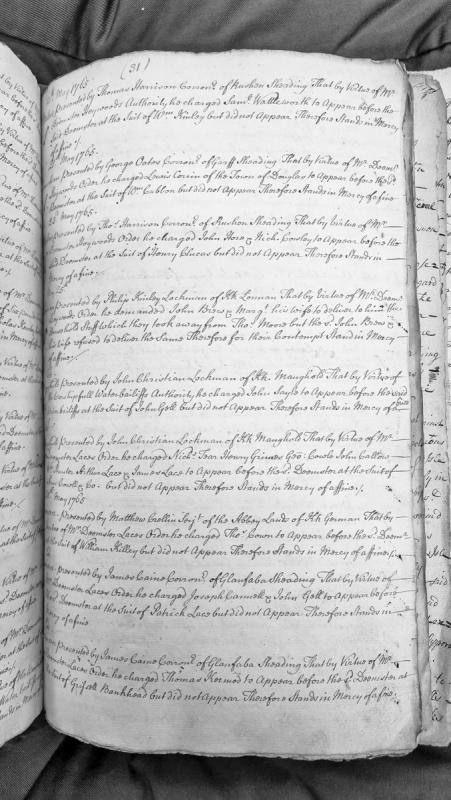
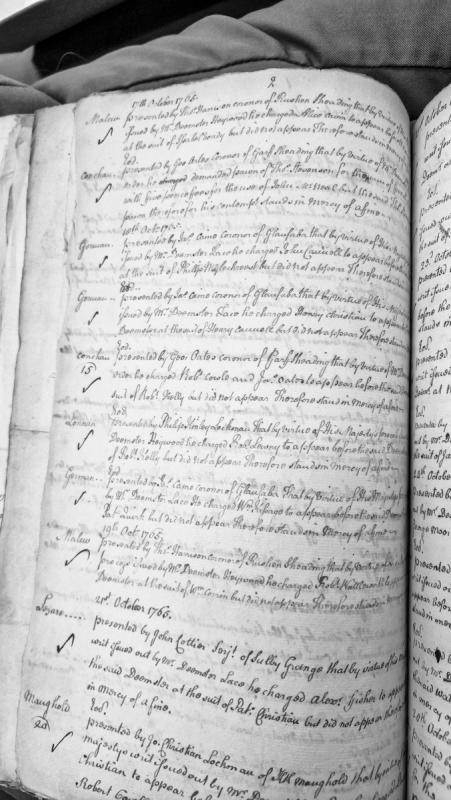
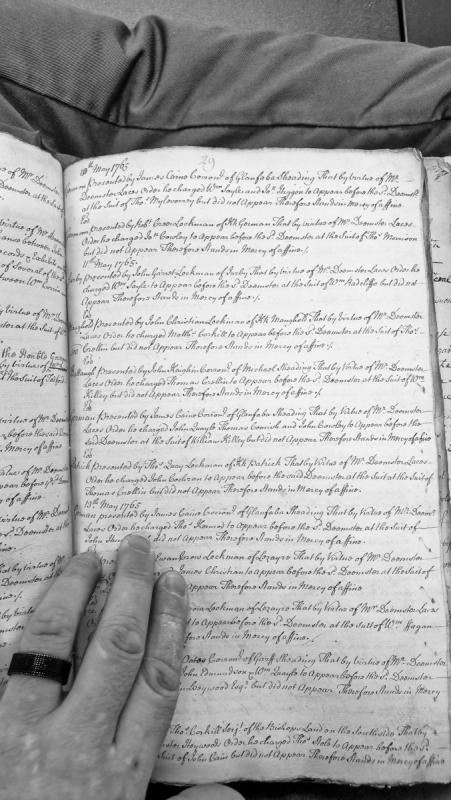
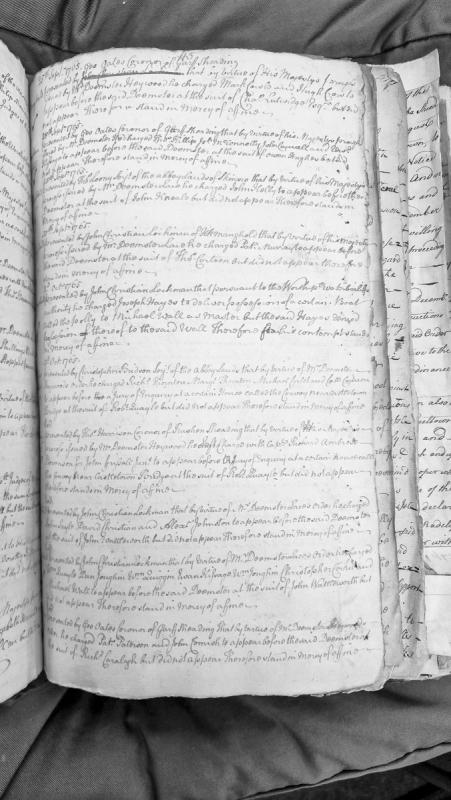
A series of court presentments documenting individuals who failed to appear before Deemsters Heywood and Lace when summoned, or who showed contempt of court. Each presentment records the charging officer, the defendant(s), the suit plaintiff, and notes the defendant(s) stand in mercy of a fine for non-compliance.
A series of court presentments from various Manx sheadings documenting cases where defendants failed to appear before the Deemsters despite being charged. The presentments were made by coronors and lockmen, with defendants standing in mercy of fines for contempt.
A series of presentments by various Lockmen and Coroners of the Isle of Man reporting that individuals charged by order of Deemster Lace failed to appear before him at the suit of various parties. Each presentment concludes that the accused stands in mercy of a fine for non-appearance.
A series of court presentments recording individuals charged by coronors and officers to appear before the Deemster or jury of enquiry but failed to do so, dating from September to October 1765. Each presentment details the arresting officer, the charged parties, the suit or order originating from a Deemster, and notes that the defendants stand in mercy of a fine for their non-appearance or contempt.
A formal marriage covenant dated 25 July 1281 between King Eric II of Norway and Margaret, daughter of King Alexander III of Scotland, wherein the Isle of Man is assigned to the King of Norway as security/compensation in the event of breach of contract. The document demonstrates medieval diplomatic practice and includes detailed provisions regarding the transfer of the Isle of Man, highlighting claims and counterclaims to Manx sovereignty by Scotland and Norway in the late 13th century.
A bilateral marriage covenant (cyrograph) from 1281 between King Alexander III of Scotland and representatives of King Eric II of Norway concerning the betrothal of Princess Margaret. The document contains conditional provisions assigning the Isle of Man to Norway as security/compensation under specific circumstances related to the marriage contract and financial obligations. Critical for understanding medieval Scottish-Norwegian relations and early claims to Man.
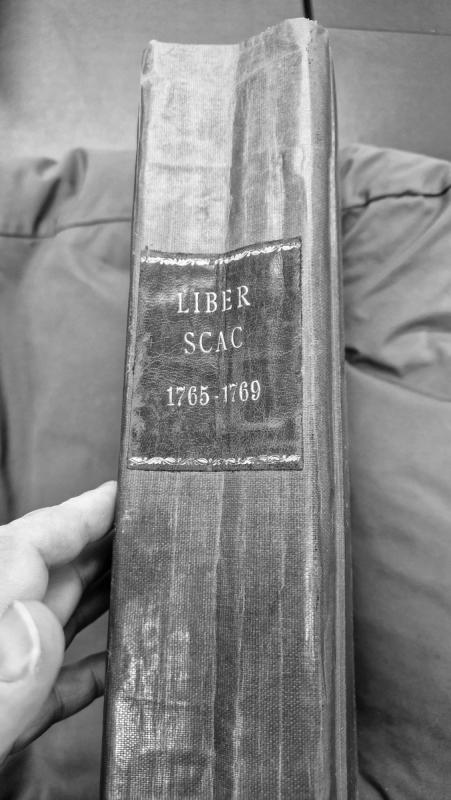
This appears to be a cover page or title page for a bound volume designated 'Liber SCAC' covering the period 1765-1769. SCAC likely refers to a court or administrative body (possibly Snaefell Court or similar Manx institution). The document establishes the scope and chronological range of the manuscript collection.
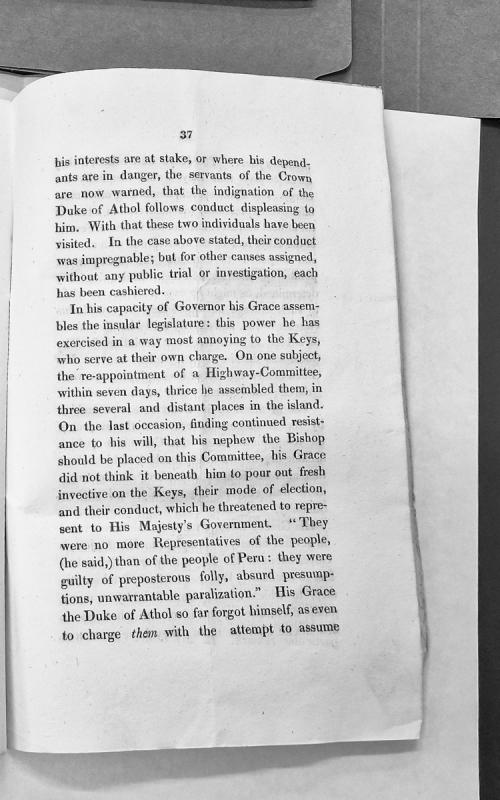
This excerpt from a printed pamphlet critiques the Duke of Athol's exercise of gubernatorial power over the Manx legislature, particularly his treatment of Crown servants and repeated assemblies of the House of Keys over a Highway Committee appointment dispute. It documents his attempts to force his nephew the Bishop onto the committee and his inflammatory rhetoric against the Keys' independence.
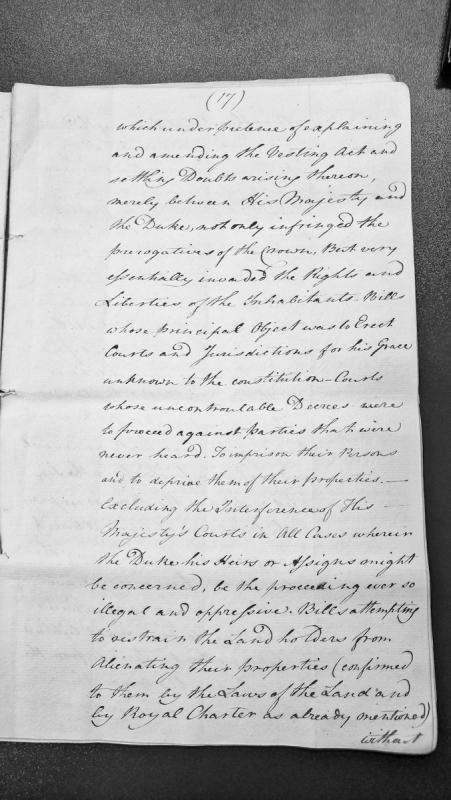
A fragment of a legal document critiquing proposed legislation that would establish courts under the Duke's authority, restricting Crown jurisdiction and inhabitants' property rights. The text argues these bills violate constitutional principles and the rights of landholders confirmed by law and royal charter.
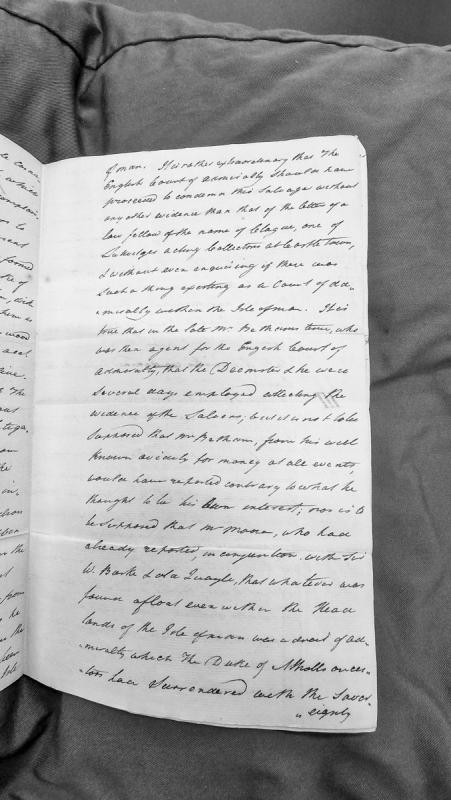
A legal document criticizing the English Court of Admiralty's condemnation of salvage based on limited evidence from a collector named Clague. The document questions the legitimacy of admiralty proceedings within the Isle of Man and references historical agents Betham and Moore, discussing disputes over droits of admiralty and the Duke of Atholl's sovereignty.
A legal document critiquing the Governor's actions, including the appointment of an Irish gentleman as an Ecclesiastical Judge without proper authority, the protection of persons guilty of breaches of peace, and the inhibition of Deemsters' attendance at the Court of Chancery contrary to established practice and the Governor's own admissions.
This is page 32 of a printed pamphlet criticizing the Governor's ('his Grace's') exercise of arbitrary power. It details two specific instances: his failure to prosecute rioters who destroyed property with impunity, and his 1822 prosecution of individuals for inoculating children despite no law forbidding the practice. The text argues the Governor substituted his will for the law.
A legal argument criticizing an Act of Parliament regarding customs enforcement in the Isle of Man, Jersey, and Guernsey. The author argues the law was hastily passed, poorly drafted, and ineffectual, citing the authority of a great lawyer (likely Lord Hardwicke, mentioned in margin) regarding the Act's failure to grant seizure powers to customs officers.
A legal opinion criticizing the removal of a judicial officer without proper trial, arguing that this undermines public confidence in the independence of the judiciary. The document references concerns about judicial appointments in the Isle of Man and their dependence on the will of the Duke of Athol and the Home Secretary, with detailed observations about related dismissals and appointments following a perjury case.
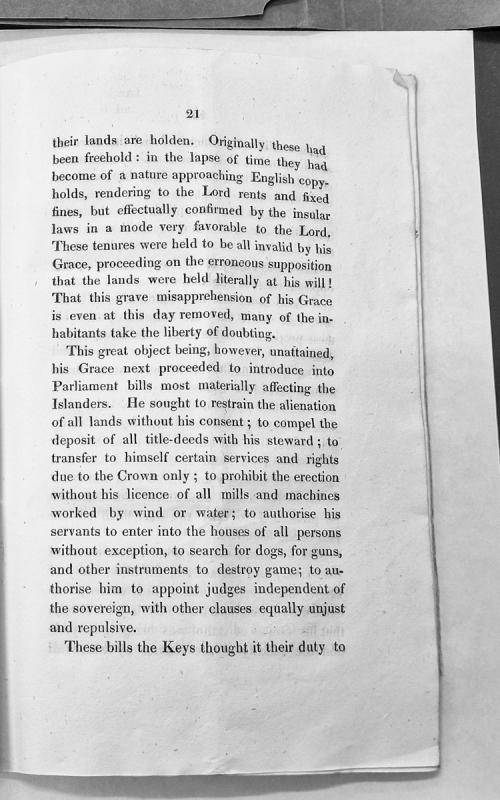
This document discusses historical land tenure systems in the Isle of Man, particularly the erroneous claims made by the Duke regarding freehold and copyhold lands. It details the Duke's attempts to introduce restrictive parliamentary bills affecting islanders' rights, including restrictions on land alienation, title deed deposits, mill licensing, and search authority.
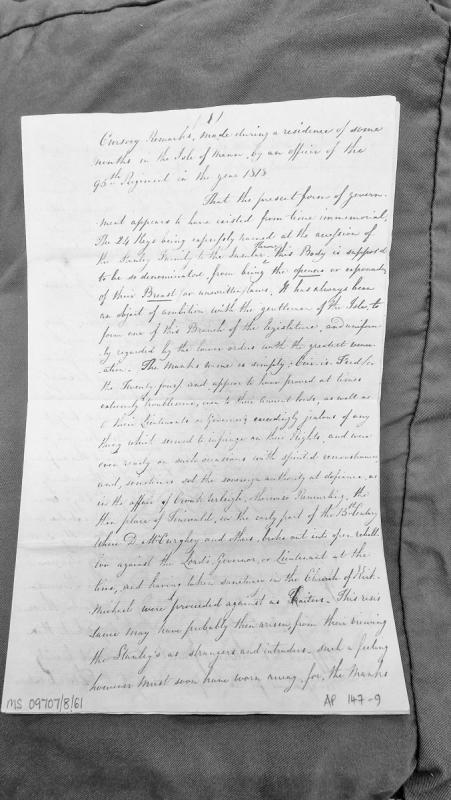
An officer of the 95th Regiment provides observations on Manx governance during a residence of several months in 1813. The document discusses the form of government, the House of Keys (24 Keys), their role as expounders of law, their influence and occasional conflicts with Lords and Lieutenants, and historical incidents including the McInghey rebellion of the 15th century.
A formal report from Custom House officers (Pelham, Mead, Musgrave, Hooper) to the Treasury recommending full annexation of the Isle of Man to the Kingdom as part of Cumberland, rather than adopting separate regulatory proposals. The report argues that annexation would be the most effective way to prevent smuggling revival and secure revenue, and situates this within the context of the 1764 purchase of sovereignty.
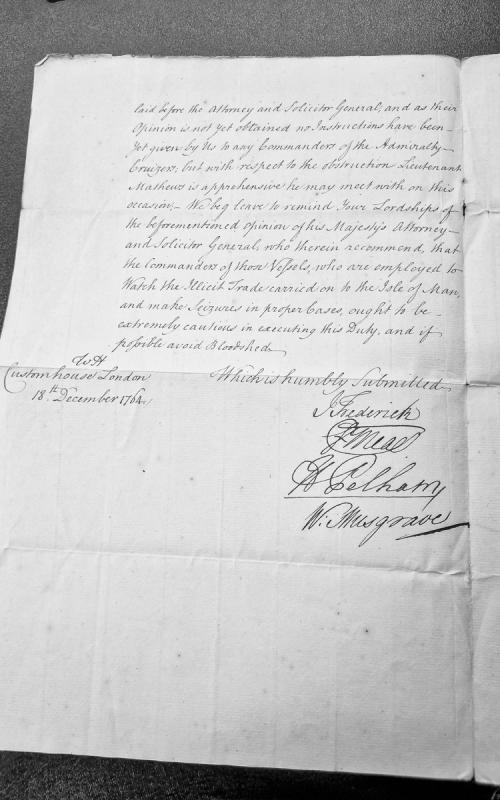
A letter from the Custom House in London dated 18 December 1764 addressing instructions to naval commanders regarding the enforcement of customs law and seizures related to illicit trade at the Isle of Man. The document references a legal opinion from the Attorney and Solicitor General recommending cautious execution of duties with avoidance of bloodshed.
A reference table comparing customs duty rates on imports and exports across four periods (1577, 1677, 1692) for the Isle of Man, distinguishing between duties charged to natives and strangers. Covers commodities including grain, livestock, textiles, and colonial goods (sugar, tobacco). Relevant for understanding the Revestment period's fiscal context and trade regulation.
A formal report from the Customhouse (signed by H. Pelham, J. Mead, W. Musgrave, and Edwd Hooper) to the Treasury Lords responding to proposals for improving Isle of Man revenue. The officers recommend full annexation to Great Britain (specifically to Cumberland) rather than implementing separate trade regulations, arguing this would prevent smuggling and integrate the island's customs administration with English ports. This represents the official revenue perspective on constitutional settlement two years after the 1765 Revestment.
Reply from the Secretaries of Customs (Frederick, Mead, Pelham, Musgrave) to the Treasury regarding instructions for naval officers seizing smuggled goods in Isle of Man ports. References an opinion from the Attorney and Solicitor General on the legal powers of customs officers to conduct seizures in Manx waters, and discusses caution required to avoid bloodshed during enforcement operations.
Reply from the Secretaries of Customs (Frederick, Mead, Pelham, Musgrave) to the Treasury regarding instructions for revenue officers and Admiralty cruizers operating in Isle of Man ports. Addresses concerns raised by Lieutenant Mathews of the Lurcher Cutter regarding seizure of tea smuggling and legal authority to conduct seizures. References Attorney and Solicitor General opinions and cautious enforcement procedures.
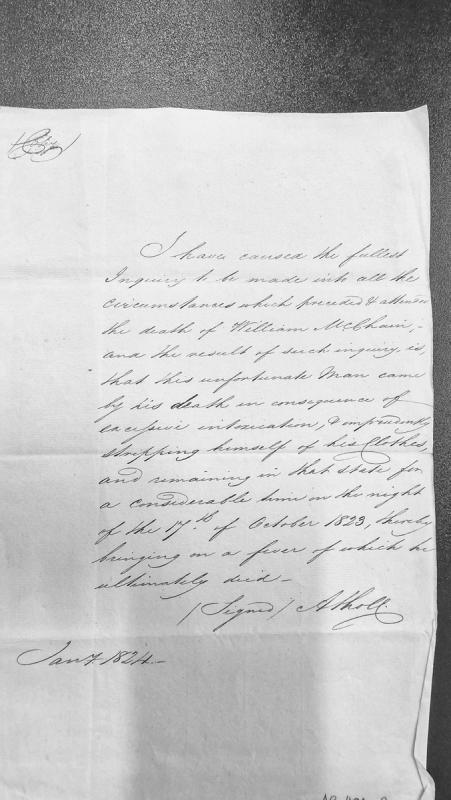
A formal legal opinion documenting the results of an inquiry into the death of William McChain. The document concludes that McChain died from fever brought on by excessive intoxication and exposure (stripping of clothes) on the night of 17 October 1823. Signed by Atholl in January 1824.
Extract from Manx Society volume 4 ('Monumenta de Insula Manniae - Vol 1'), presenting a translation/transcription of the account of King Magnus's death in Ireland from the Icelandic Sagas. The document describes the ambush and battle at Magh Coba near Downpatrick where Magnus was killed after his raid on Wales and Ireland. Relevant to understanding the medieval history and Norse sovereignty of the Isle of Man.
Appendix D from Manx Society vol. IV transcription of Monumenta de Insula Manniae, providing a detailed narrative account of King Magnus's death in Ireland derived from Icelandic Sagas. Relevant to Manx medieval history and Isle of Man's historical context under Norse rule prior to the 1765 Revestment.