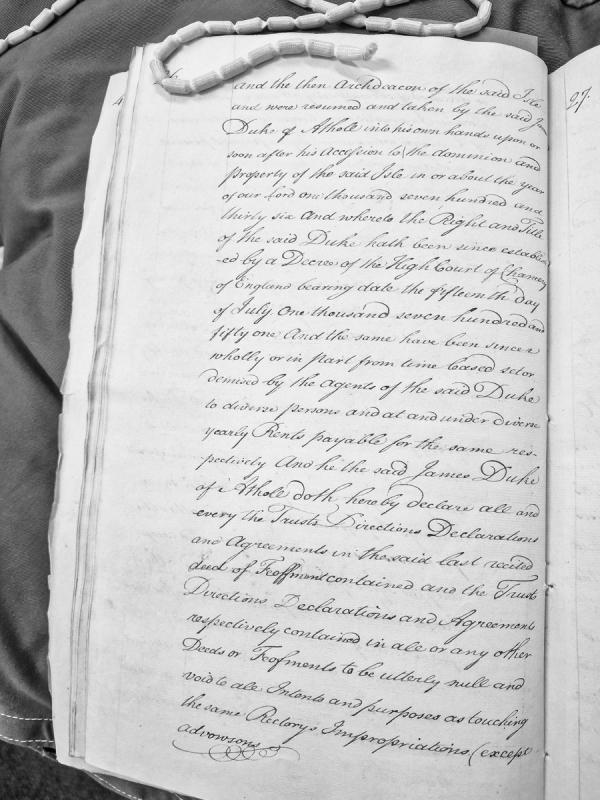
A legal document in which James Duke of Athole declares null and void various trust deeds and feoffments related to rectory impropriations on the Isle of Man. The document references his acquisition of dominion over the Isle around 1736 and a confirming Chancery decree of 1751, establishing his authority to manage and lease these ecclesiastical properties.
A formal declaration by the Bishop of Sodor, Abbot of Russyn, and Manx clergy denying that they ever acknowledged Sir Stephen Lestrop as heir to William Lestrop or delivered him the lordship of Man. The document was issued in open court at Tynwald Hill and sealed by multiple ecclesiastical and lay officials. It provides crucial evidence of disputed succession and the role of Tynwald in affirming sovereignty claims during the early 15th century.
A formal declaration by the Bishop of Sodor, Abbot of Russyn, and senior clergy of the Isle of Man, issued at Tynwald Hill, denying that they acknowledged Sir Stephen Lestrop as heir to William Lestrop's lordship of Mann or transferred any lands, offices, or franchises to him. The document establishes ecclesiastical and civil witness to succession disputes on the island in the early 15th century.
Fragment of a legal document confirming a decree by the House of Keys. The text indicates a formal judicial confirmation of a previous decision or ruling.
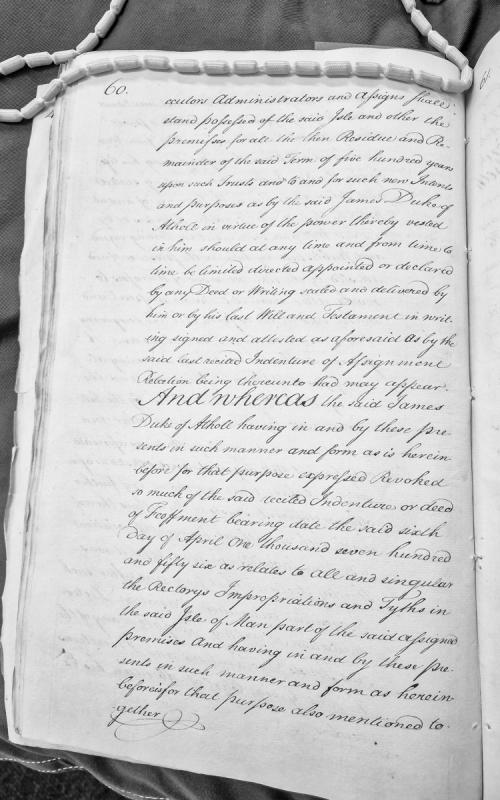
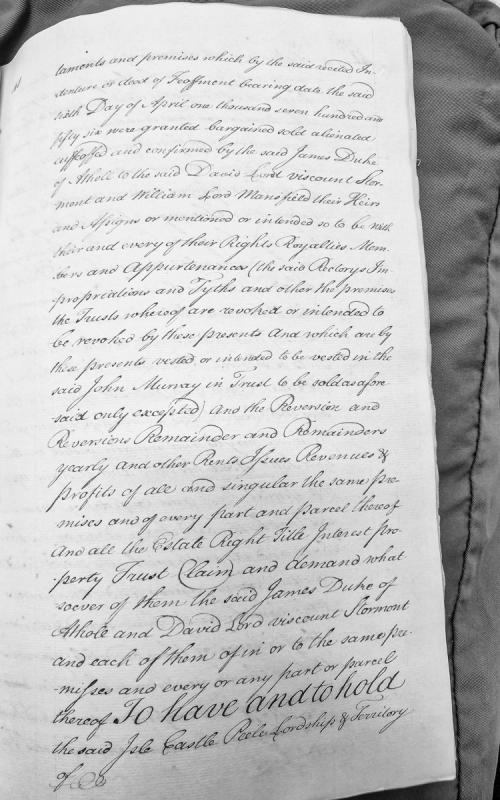
A legal document detailing the revocation by James Duke of Atholl of portions of a 1756 Deed of Feoffment relating to rectories, impropriations, and tithes in the Isle of Man. The document discusses trust arrangements and powers vested in the Duke regarding property on the Isle of Man.
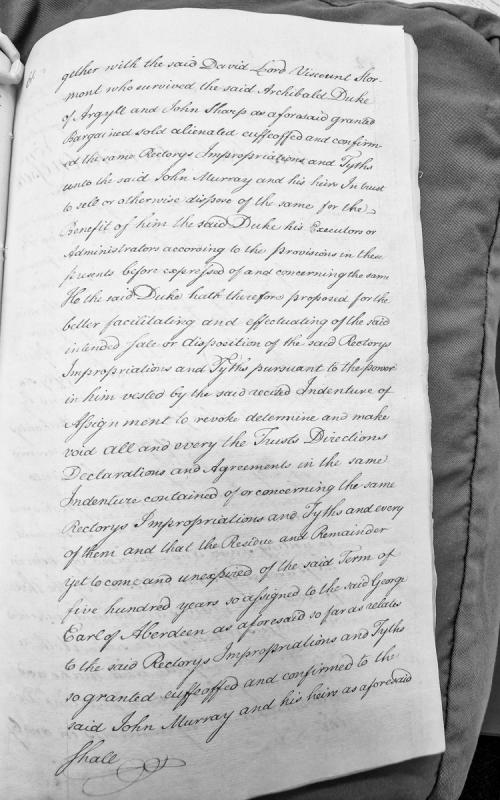
Fragment of a legal document dealing with the revocation of trusts, directions and agreements contained in an indenture of assignment concerning Scottish rectories, impropriatios and tithes. The document involves multiple parties including the Duke of Argyll, David Lord Viscount Stormont, John Murray, and George Earl of Aberdeen, and relates to powers vested in the Duke to revoke and make void certain trust arrangements.
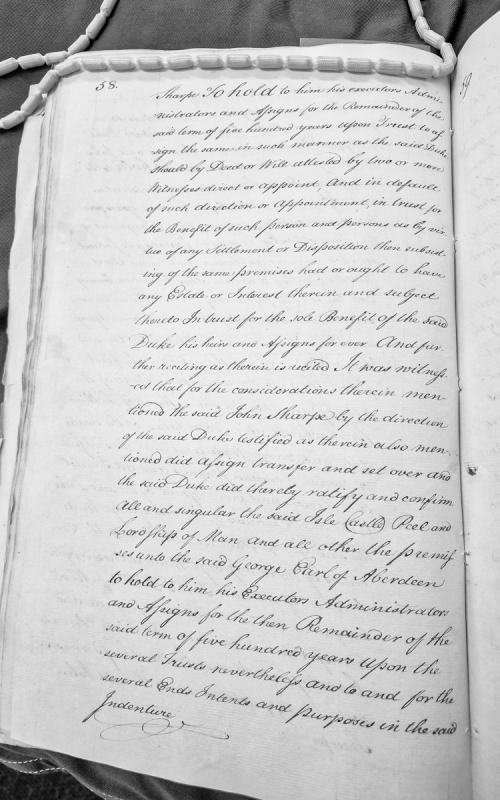
This is an excerpt from a legal deed documenting the transfer and assignment of the Isle of Man, Castle Peel, and associated lordship and premises from John Sharpe to George, Earl of Aberdeen. The document outlines trust arrangements for a five-hundred-year term, with provisions for direction by deed or will and ultimate benefit to the Duke.
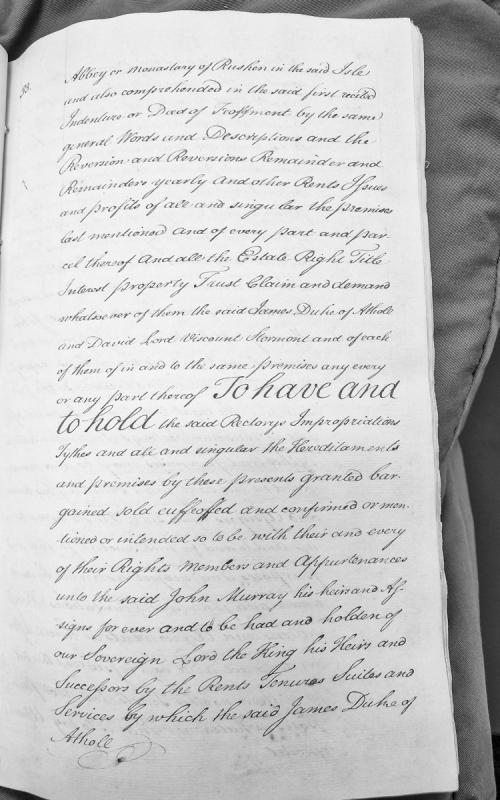
A legal document detailing the transfer of rectories, impropriations, tithes and other profits from Rushen Abbey on the Isle of Man from James Duke of Atholl and David Lord Viscount Stormont to John Murray. The document uses formal feoffment language establishing rights, reversions and remainders with full inheritance provisions.
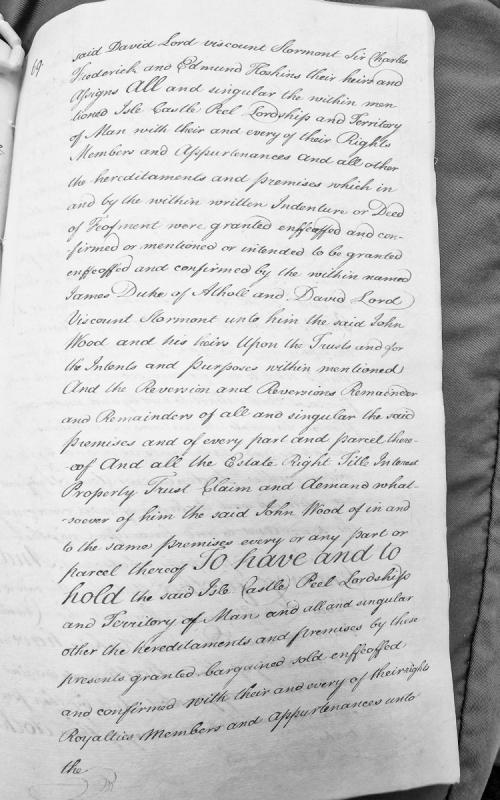
A legal deed transferring the Isle of Man, Castle Peel, lordship and territory from James Duke of Atholl and David Lord Viscount Stormont to John Wood and his heirs. The document outlines the rights, members, appurtenances and hereditaments being conveyed, with provisions for reversion and remainders of the premises.
A legal deed of feoffment dated 6 April 1756 transferring the Isle of Man, castle, pele, lordship and territory from James Duke of Athole to David Lord Viscount Stormont and William Lord Mansfield, with various rights, royalties, rents and appurtenances. The document includes trust provisions and references to ecclesiastical properties.
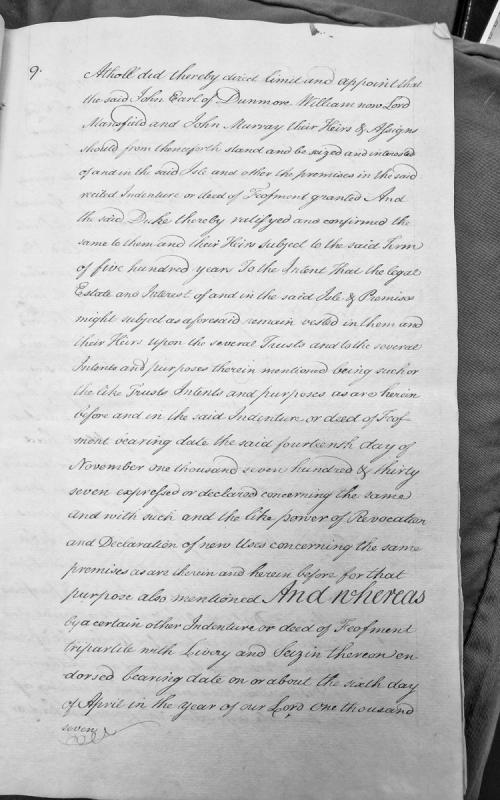
A legal document concerning the transfer and feoffment of the Isle of Man and related premises. The Duke of Atholl directs that John, Earl of Dunmore, William (now Lord Mansfield), and John Murray, as heirs and assigns, shall be seized of the Isle subject to a term of five hundred years. The document ratifies and confirms earlier feoffment terms dated 14 November 1737 and references another tripartite indenture from approximately 6 April 1700.
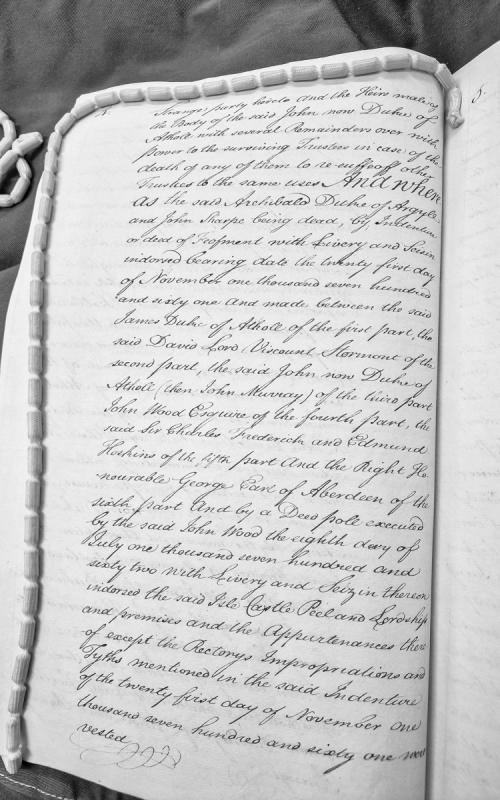
A legal document detailing the transfer of Isle of Man property (Castle Peel and Lordship) through indentures and deeds of feofment dated November 21, 1761 and July 8, 1762. The document concerns the vesting of property with various trustees and remainders to the heirs male of the Duke of Atholl.
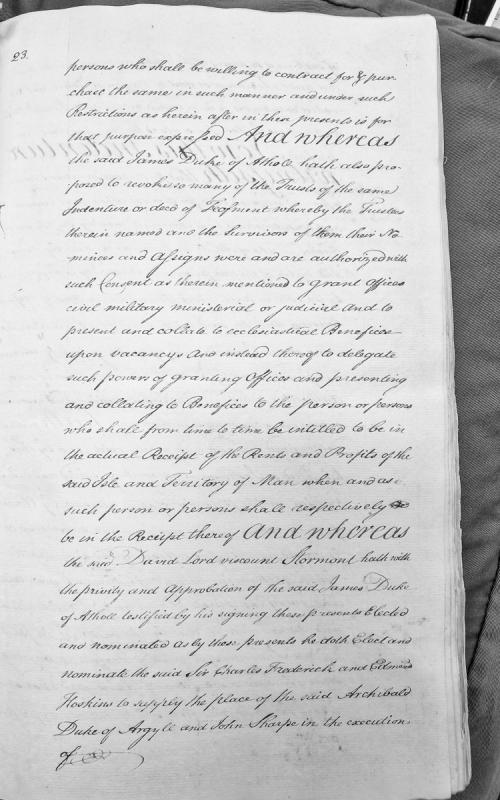
This is an excerpt from a legal document concerning the Isle of Man, specifically addressing the revocation of certain trusts established in a prior Indenture or deed of Feofment. The document details the delegation of powers to grant civil, military, ministerial, and judicial offices, and to present and collate to ecclesiastical benefices. It records the nomination of Sir Charles Frederick and Edmund Hoskins to replace the Duke of Argyll and John Sharpe.
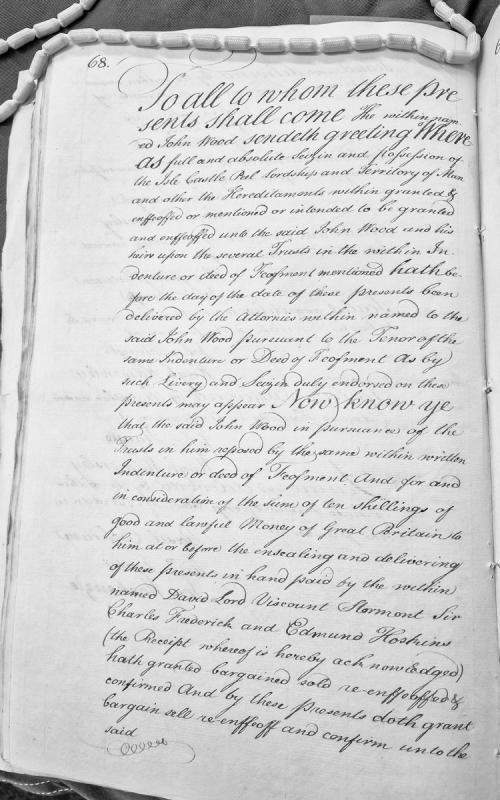
A formal deed of re-enfeoffment transferring seisin and possession of the Isle of Man, Castle Peel, lordships and territory to David Lord Viscount Stormont, Sir Charles Frederick and Edmund Hoskins. The document records John Wood's delivery of property held in trust and subsequent re-enfeoffment to the named parties for consideration of ten shillings.
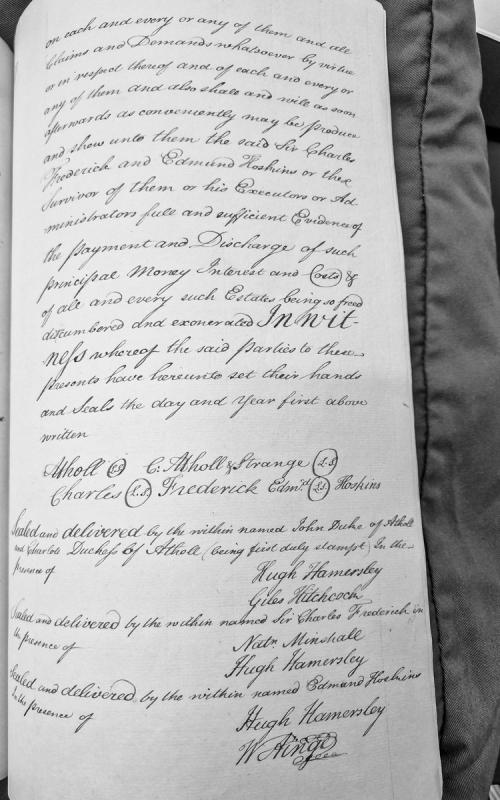
This is the closing portion of a formal legal deed or bond in which the Duke and Duchess of Atholl release claims and discharge principal money, interest, and costs owed to Sir Charles Frederick and Edmund Hoskins. The parties covenant to produce evidence of payment and discharge of estates. The document is sealed and witnessed.
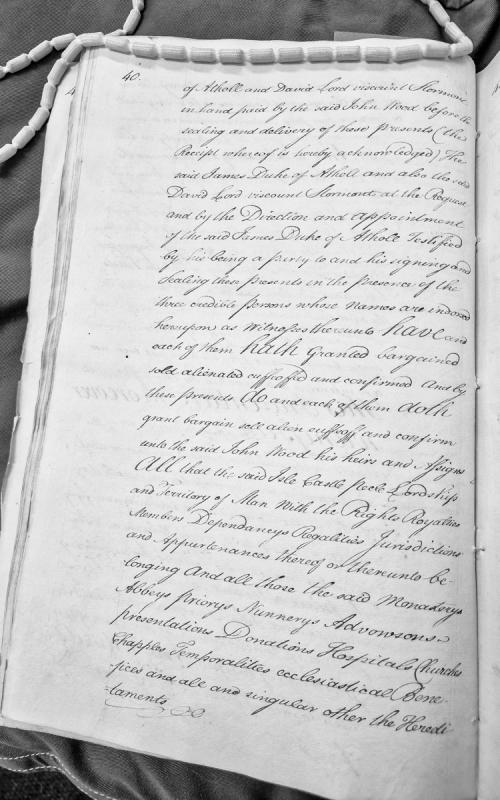
This is a formal deed of conveyance wherein James Duke of Atholl and David Lord Viscount Stormont transfer the Isle of Man, Castle Peel, and associated lordships, rights, royalties, and ecclesiastical benefices to John Wood and his heirs. The document records payment received and involves multiple witnesses.
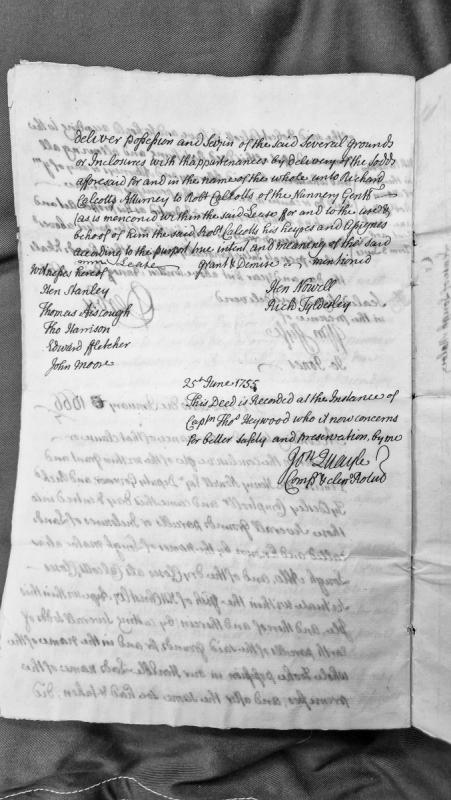
A deed recording delivery of possession and seizin of several grounds or inclosures at the Nunnery to Robert Calcotts (Gentleman) through his attorney Richard Calcotts. The document was recorded by the Comptroller and Clerk Rotulorum on 25 June 1755 at the instance of Captain Thomas Heywood for preservation purposes.
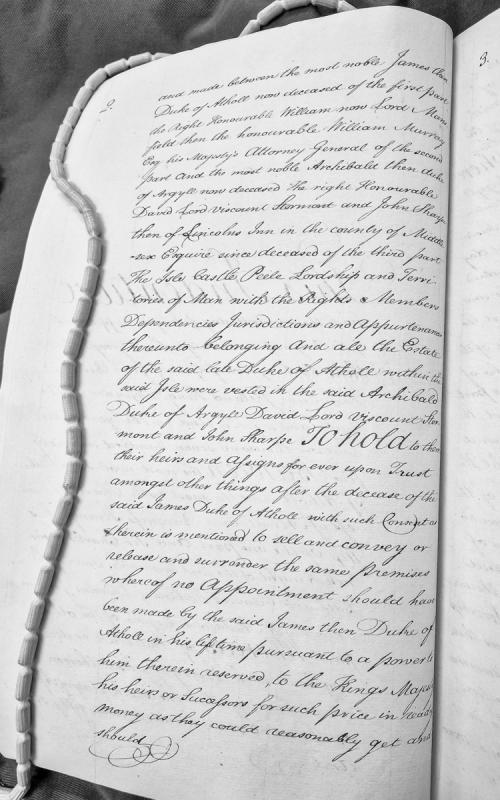
A legal document describing a trust arrangement concerning the Isle of Man, Castle Peel, and associated lordships and territories. The document establishes that these properties were vested in Archibald Duke of Argyle, David Lord Viscount Stormont, and John Sharpe as trustees, with powers to sell or convey the premises to the Crown following the death of James Duke of Atholl.
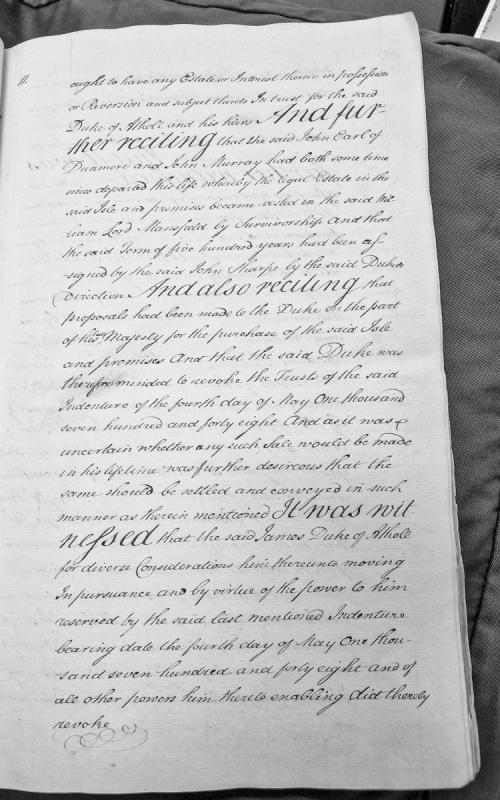
A legal document concerning the revocation of trusts established in an indenture dated May 4, 1748, relating to the Isle of Man. The document recites the deaths of John Earl of Dunmore and John Murray, the vesting of the legal estate in William Lord Mansfield by survivorship, and proposals from His Majesty for the purchase of the Isle. The Duke of Athole seeks to revoke the previous trusts and settle the premises in a specified manner.
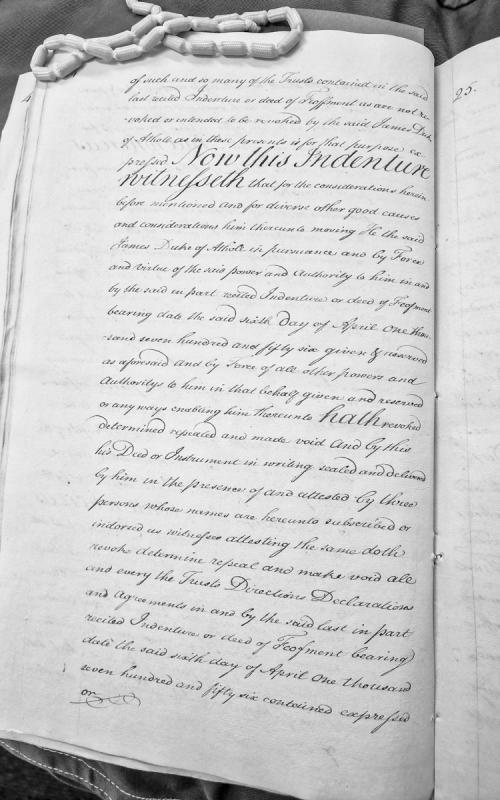
This is a formal legal indenture in which James, Duke of Athole, exercises his power of revocation to void certain trusts, directions, declarations and agreements contained in a prior deed of feoffment dated 6 April 1756. The document is executed under seal and witnessed by three persons.
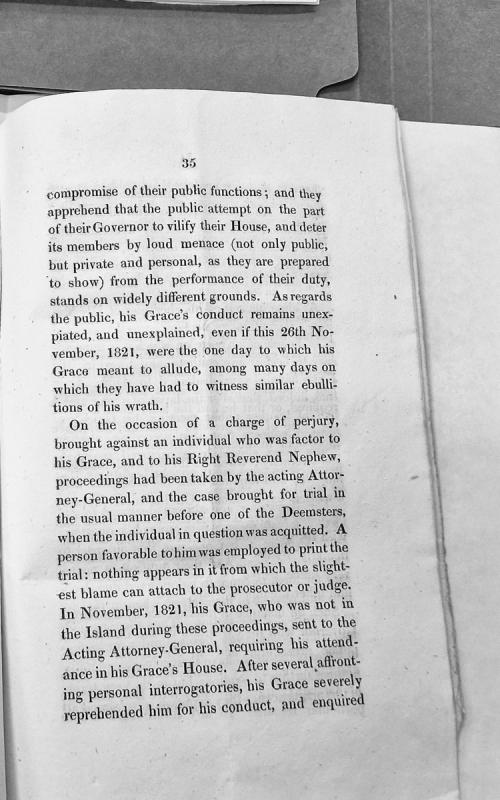
A legal or parliamentary defence document from the House of Keys responding to allegations made by the Governor (referred to as 'his Grace') regarding their members' conduct and performance of duties. The document addresses specific incidents including a perjury case and the Governor's treatment of the Acting Attorney-General in November 1821.
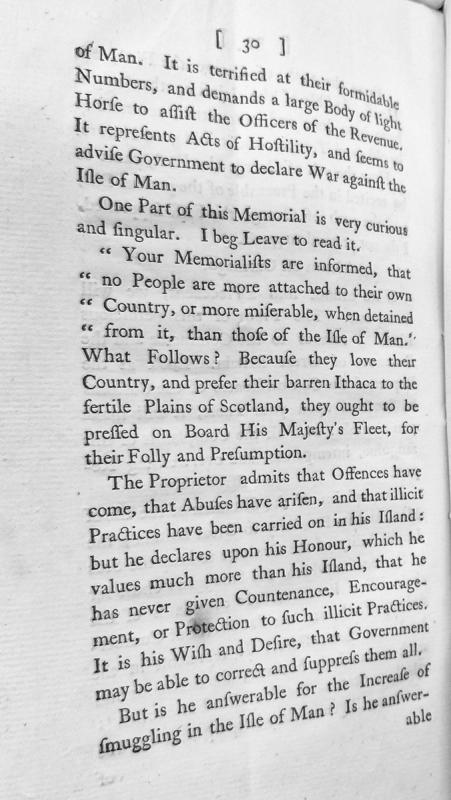
A legal or political defence document addressing a memorial that criticizes the Isle of Man and its proprietor for smuggling activities. The author defends the proprietor's honour, acknowledges some abuses exist, but denies he has encouraged illicit practices. The document critiques the memorial's logic regarding Manx attachment to their homeland and military conscription.
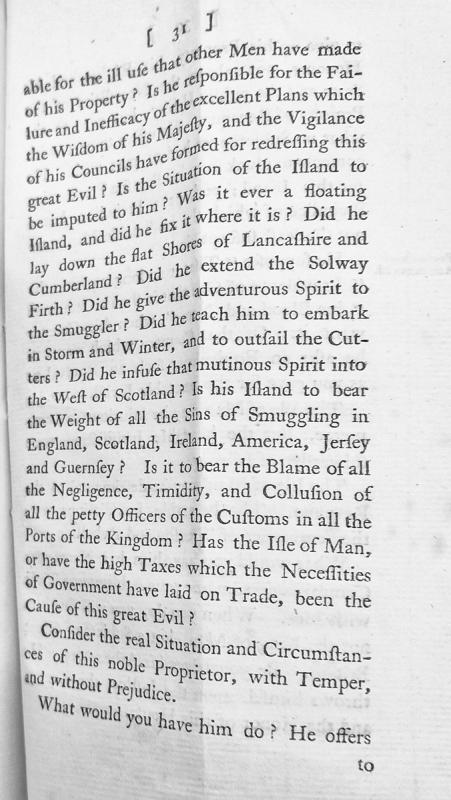
A rhetorical legal or political argument defending the proprietor of the Isle of Man against accusations of responsibility for widespread smuggling in the Irish Sea region. The document uses a series of pointed questions to argue that natural geography, government policy, and the actions of smugglers and customs officers—not the proprietor—are responsible for smuggling activities.
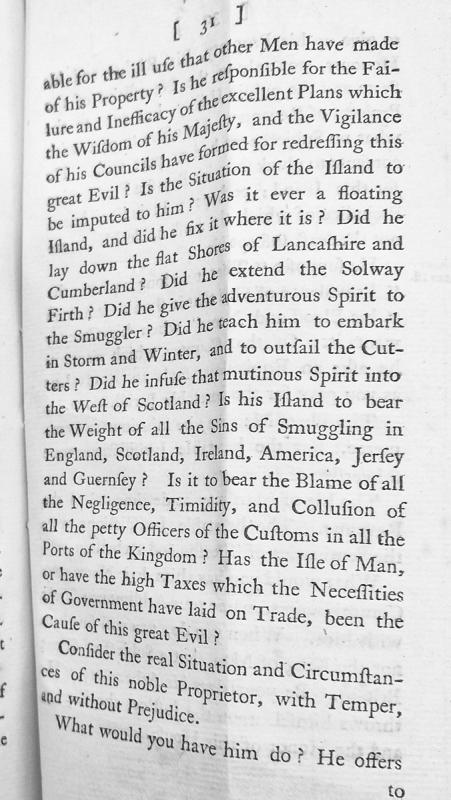
A rhetorical legal argument defending the proprietor of the Isle of Man against charges of responsibility for smuggling and contraband trade. The text uses a series of questions to argue that the proprietor cannot be held accountable for geographical circumstances, the actions of smugglers, or the negligence of customs officers across multiple kingdoms.
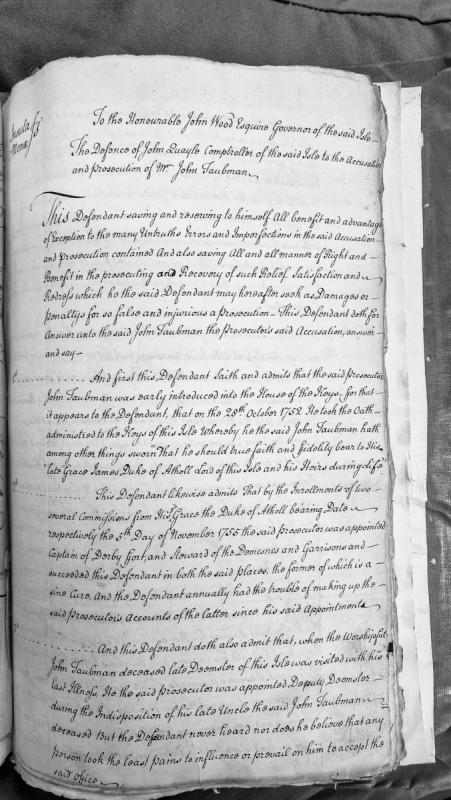
A legal defence document submitted by John Quayle, Comptroller of the Isle of Man, responding to accusations and prosecution brought by John Taubman. The defence addresses Taubman's oath to the House of Keys (28 October 1752), his appointments as Captain of Derby Fort and Steward of the Demesnes and Garrisons (5 November 1755), and his appointment as Deputy Deemster during his uncle's illness.