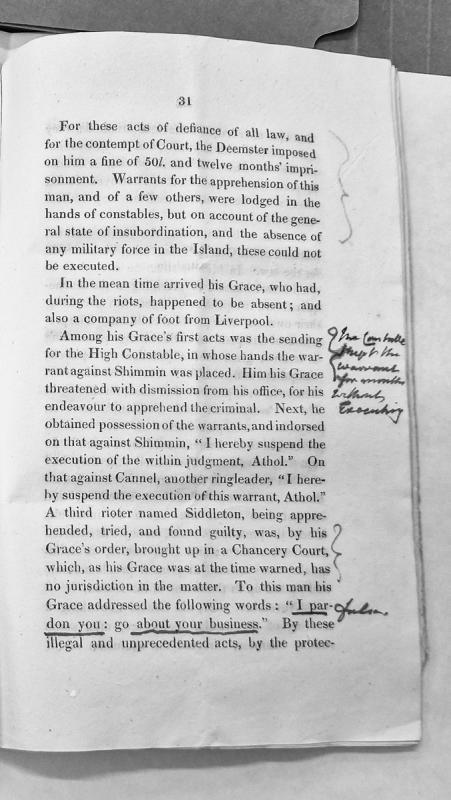
This document describes acts of defiance during civil unrest, a Deemster's sentence of a fine and imprisonment, and the subsequent interference by the Duke of Athol (referred to as 'his Grace') in the execution of court warrants against rioters including Shimmin, Cannel, and Siddleton. It critiques the Duke's illegal suspension of warrants and pardon of a convicted rioter.
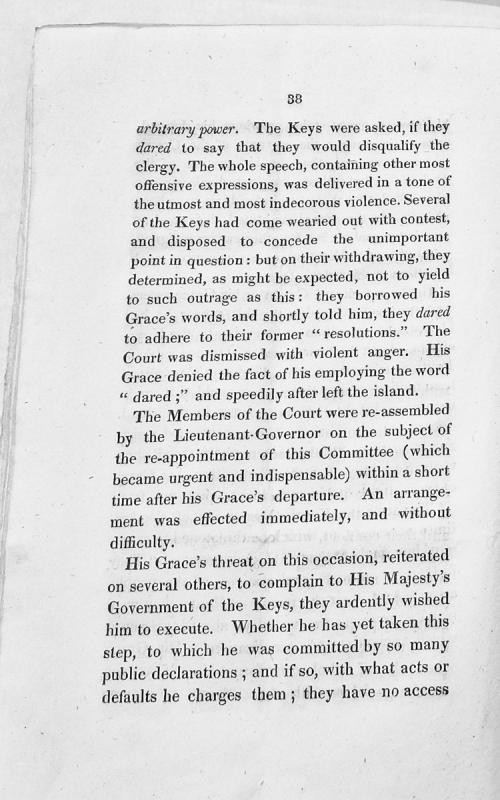
This excerpt describes a contentious exchange between the House of Keys and a high-ranking ecclesiastical figure (referred to as 'His Grace') regarding the disqualification of clergy from a committee. The Keys initially considered conceding the point but ultimately refused to yield after the cleric employed harsh language and threats, eventually departing the island.
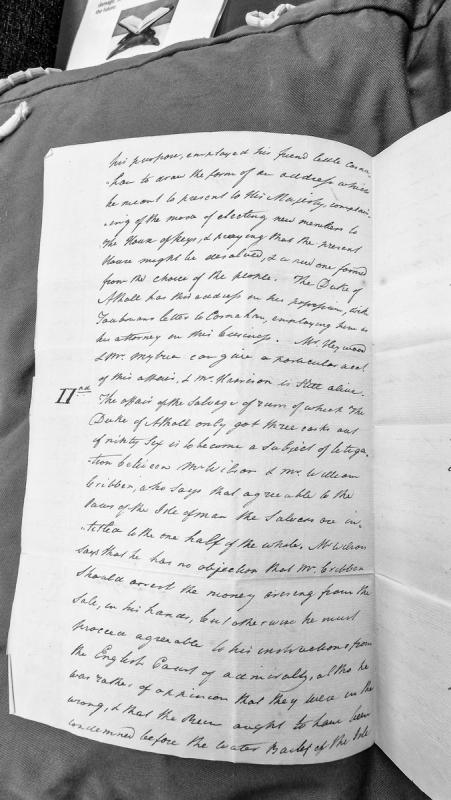
A narrative account describing two matters: first, an address prepared by Taubman (with help from Connahan) to be presented to His Majesty regarding the election of House of Keys members and requesting dissolution of the current House; second, a dispute over salvage rights for rum between Mr. Wilson and Mr. William Cribben, concerning whether salvors are entitled to half of recovered goods under Isle of Man law.
Chapter 9 from an 1811 account of Isle of Man, providing a detailed contemporary description of Douglas—the island's largest town by population. Covers the harbour (noted as the best dry harbour in the Irish Channel), infrastructure (the newly-built pier costing £22,000), population (5,000–6,000 inhabitants), amenities, religious buildings, postal service, and social customs. Includes observations on the Duke of Atholl's residences and property holdings post-Revestment.
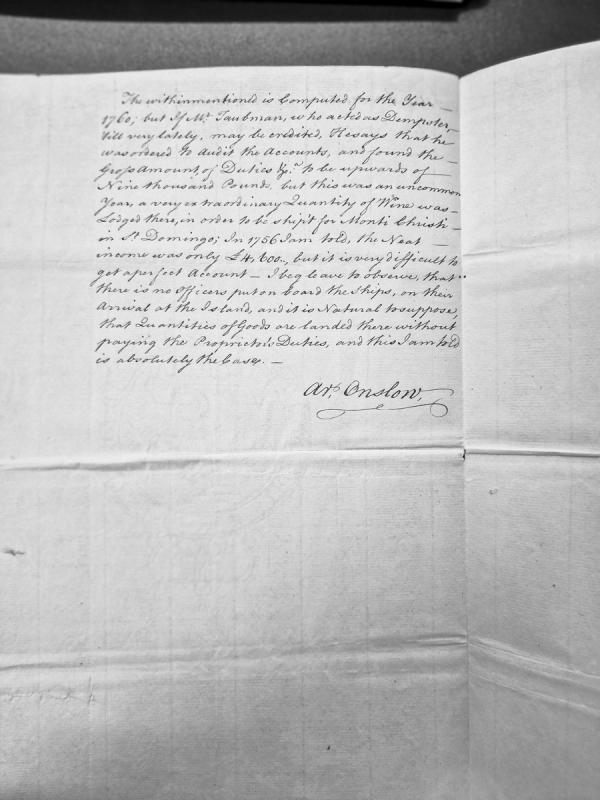
A fragment of administrative correspondence discussing the computation of duties and revenue for the year 1760. The writer references Mr. Taubman's audit findings showing gross duties exceeding £9,000, notes this was an exceptional year due to wine shipments to Monte Christi in Santo Domingo, and observes that lack of officers aboard arriving ships allows goods to be landed without paying duties.
Letter from Charles Lutwidge (Lieutenant Governor) to the Treasury Commissioners detailing a forfeiture case in the Isle of Man Court of Exchequer involving 188 pounds of tea seized in Ramsey. The case reveals constitutional tensions between Manx and English legal procedures, the intervention of local traders, and challenges to the Governor's authority. Includes critical observations on the suspension of effective revenue prosecution through appeals to the Privy Council.
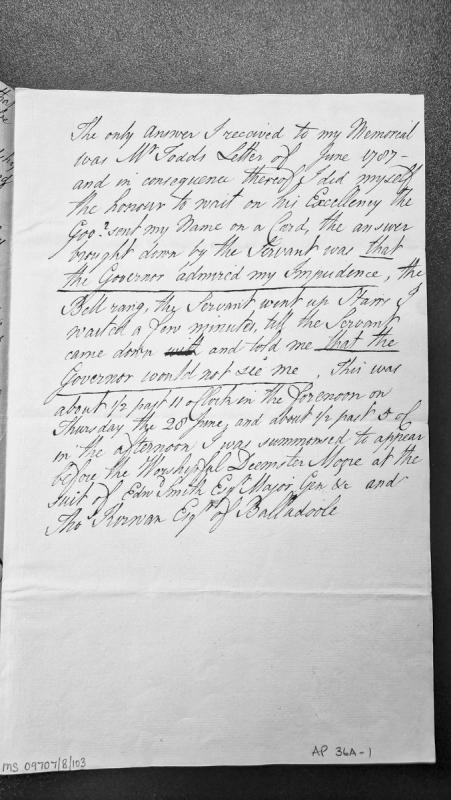
A personal account of the author's unsuccessful attempt to meet with the Governor regarding a memorial, followed by his receipt of a summons to appear before Deemster Moore in a suit brought by Edward Smith and Thomas Hornan. The document records the Governor's refusal to receive the author and the timing of events on June 28th, 1787.
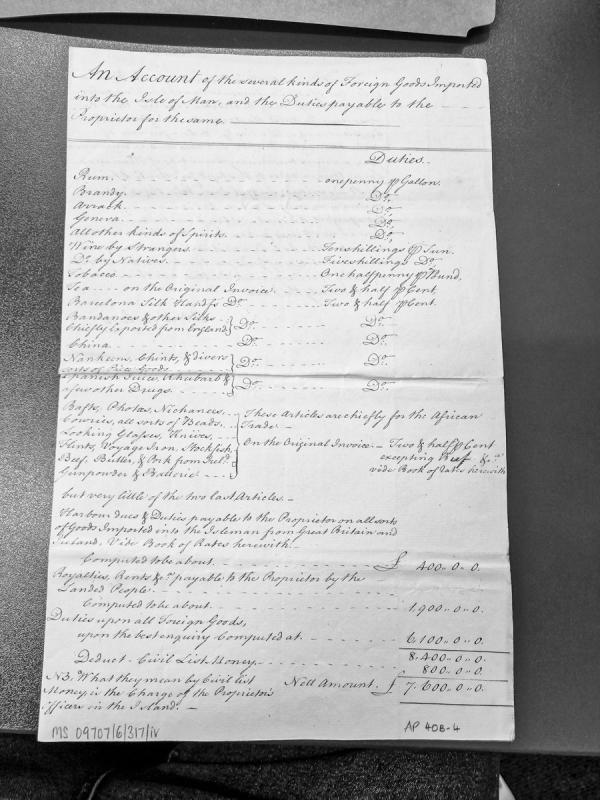
A detailed revenue abstract listing duties on imported foreign goods (spirits, wine, tobacco, tea, silk, china, drugs, and trade goods) and computed revenues including harbour dues, royalties, and rents payable to the Proprietor. Total nett amount computed at £7,600.
A detailed itemized account of commissary expenses incurred by John Younger for victualling His Majesty's troops stationed across the Isle of Man from July to October 1767. The document lists specific costs for flour, bread, coal deliveries, warehouse rents, and carriage between garrison locations (Ramsey, Peel, Douglas, Castletown, and other ports), providing insight into military logistics and the distribution of troops across the island during the post-Revestment period.
A detailed expense account compiled by John Younger, Commissary to His Majesty's Troops in the Isle of Man, covering costs for victualling, transport, and warehousing of provisions (flour, bread, coals) across multiple Manx locations (Ramsey, Peel, Jurby, Castletown, Dawby, Port Iron, Port St. Mary, Douglas) during July–October 1767. Relevant to understanding post-Revestment military logistics and the administrative infrastructure required to support the garrison.
Chapter 4 from Wood's 1811 Account of the Isle of Man, discussing the state of manufacturing and mechanical trades on the island. Covers brewing, malting, textiles (cotton, flax, wool), tanning, and the regulatory constraints imposed by English law on manufacturing for export. Directly relevant to understanding economic conditions and trade restrictions on Man in the post-Revestment period.
Chapter 5 from an 1811 account of the Isle of Man covering medieval merchant regulation, legitimate trade exports (linens, herrings, lead ore), 1790 customs data, currency practices, and the transformation from smuggling (pre-1765) to legal commerce post-Revestment. Includes period quotes on pre-1765 smuggling scale and revenue loss.
A Treasury document comparing the Manx merchant fleet before and after the Crown's purchase of sovereignty in 1765. It provides quantitative data on vessels engaged in foreign trade, legal trade, and smuggling, showing a dramatic post-Revestment decline in commercial shipping. The document is dated 1 September 1766 and submitted by Charles Lutwidge, the Receiver General.
Natural history account of Isle of Man wildlife, focusing on birds (gulls, cormorants, puffins), terrestrial fauna, and vegetation. Includes observations on the Calf of Man, fauna utilisation (feathers, oil, food), and comparative ecological notes. Relevant to understanding pre-Revestment island economy and natural resources.
A detailed naturalistic and economic account of herring biology, migration patterns, and the Isle of Man herring fishery as it operated in the early 19th century. Describes fishing methods, curing processes (red and white herrings), seasonal labour patterns, catch volumes, pricing, and social customs. Highly relevant to understanding the economic foundation of Manx commerce and the trade networks that coexisted with smuggling.
Chapter 8 of a descriptive account of the Isle of Man, detailing the character and customs of inhabitants, their language (Manks/Erse), legal and ecclesiastical institutions, hospitality, and economic attractions. Includes comparative observations on dress, morals, superstitions, and reasons the island attracted English refugees from debt. References historical Bishop Meryk's letter and contemporary pricing data.
An official Treasury account comparing the number and tonnage of vessels belonging to the Isle of Man before and after the Crown's purchase of sovereignty from the Duke of Atholl. The document categorises vessels into foreign trade, legal trade with Britain and Ireland, and smuggling operations, providing concrete evidence of the collapse of smuggling infrastructure following the Revestment. Submitted by Charles Lutwidge, Receiver General.
Charles Lutwidge's detailed letter to the Treasury Commissioners describing the failed prosecution of a tea seizure case in the Isle of Man Court of Exchequer. The letter documents procedural disputes over jury trial rights, the claimant David Angus's appeal to the Privy Council, and Lutwidge's critique of how these proceedings undermined revenue enforcement. Highly relevant to understanding post-Revestment judicial authority and smuggling enforcement challenges.
This is a detailed Treasury account documenting salaries paid to civil and revenue officers in the Isle of Man from 5 July 1767 (when the Revestment Act commenced) to 5 July 1769. It includes quarterly revenue receipts from imports at the four main ports (Douglas, Darby Haven, Peel, Ramsay), arrears of salaries owed to the Governor and civil officers, and specific payments to Charles Lutwidge for his roles as Surveyor General and Water Bailiff. The document provides crucial financial evidence of how the newly acquired island was administered and funded during the immediate post-Revestment period.
Treasury account documenting salaries and incidental expenses paid to revenue and civil officers in the Isle of Man from 5 July 1767 (when the Revestment Act commenced) to 5 July 1769, with arrears due. Includes detailed breakdown of payments to the Governor, Deemsters, Attorney General, revenue officers, constables, and administrative staff, plus receipts from imports at Douglas, Darby Haven, Peele and Ramsay ports.
Official Customhouse record documenting the value of seized goods (primarily tobacco and related products) illegally imported from the Isle of Man into Scotland over a five-year period. The account shows annual seizure values totalling £36,741 and specifies quantities of leaf tobacco, tobacco stems, and snuff destroyed by condemnation. This document provides direct evidence of the smuggling trade's scale immediately before the 1765 Revestment.
Official Customhouse account listing the annual value of seized goods imported illegally from the Isle of Man into Scotland over five years preceding the Revestment (1760–1765). Records £36,741 in total seizures, with detailed breakdown by year and supplementary note on tobacco products destroyed. Directly demonstrates the scale and nature of smuggling trade that prompted Parliamentary interest in acquiring sovereignty.
A detailed first-hand account from a Whitehaven customs officer (Joseph Burrow) reporting on smuggling operations in the Isle of Man. The informant, identified as John Dexter, provides comprehensive intelligence on smuggling routes, merchant networks, vessel operations, cargo handling methods, and distribution channels to Ireland, Scotland, Wales and England. This document reveals the scale and sophistication of the smuggling trade circa early 1765, just months before the Revestment Act.
A detailed contemporary account of smuggling operations from the Isle of Man to Ireland, Scotland, Wales, and England, submitted by Joseph Burrow (Customs House, Whitehaven) to Treasury officials. The document describes the methods used to import prohibited goods (especially tea, spirits, and silk), the ships and crews involved, and smuggling routes and techniques. It includes specific merchant names, cargo details, and operational procedures, providing crucial evidence of the scale and sophistication of the illicit trade that prompted the 1765 Revestment.
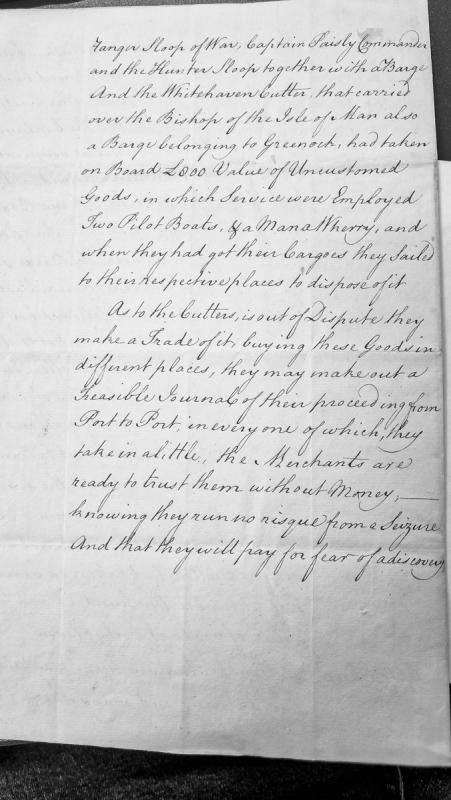
A narrative account describing smuggling activities involving several vessels including the Ranger Sloop of War, Hunter Sloop, Whitehaven Cutter, and various barges. The document details the transport of £800 worth of uncustomed goods and describes the systematic nature of the smuggling trade, noting how merchants trust cutters and maintain port-to-port operations.