This is a detailed financial account submitted by Charles Lutwidge, documenting the subsistence payments (daily allowances) and operational expenses for customs officers and additional staff deployed to the Isle of Man from June 1765 onwards, following the passage of the anti-smuggling Act. The document provides evidence of the immediate administrative implementation of the Revestment and the scale of customs enforcement activity launched to suppress illicit trade.
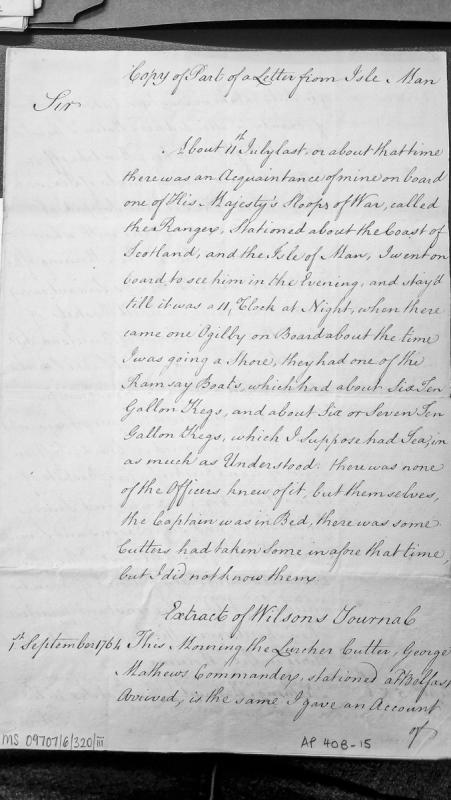
A fragmentary letter describing an incident circa July 1764 involving contraband kegs (suspected tea) brought aboard HMS Ranger by an acquaintance and a man named Ogilby. The letter is followed by an extract from Wilson's Journal dated 1 September 1764 regarding the Lurcher Cutter and its commander George Mathews stationed at Belfast.
Neil Mathieson's scholarly paper examining the life and correspondence of Sir George Moore (1709–1787), a Manx merchant, House of Keys member, and Speaker, and his three sons (Philip, George, James). The document draws on Moore family letter books (1750–1760s) held by the Manx Museum, detailing business ventures, emigration to America during the Revolution, smuggling activities, and the family's complex financial and personal troubles. Directly relevant to understanding Manx merchant life, trade networks, and social context during the Revestment period.
A scholarly article by Neil Mathieson examining the life and correspondence of Sir George Moore (1709–1787), a Manx merchant, landowner, and Speaker of the House of Keys, and his three sons (Philip, George, and James) during 1750–1790. The paper uses Moore family letter books and documents held at the Manx Museum to chronicle their mercantile ventures, involvement in smuggling, American colonial settlement schemes, and personal crises, providing insight into Manx merchant society, trading networks, and family dynamics during the period of the Revestment.
A genealogical and biographical study by Neil Mathieson of the Moore family of Ballamoore, Isle of Man, based on letter books and correspondence held by the Manx Museum. Focuses on Sir George Moore (1709–1787), a Manx merchant and House of Keys Speaker, and his three sons (Philip, George, and James), whose trading ventures in America, France, and India during the American Revolution and post-war period are documented through their correspondence. Directly relevant to understanding Manx merchant networks, smuggling practices, and economic life during the Revestment period.
A scholarly article by Neil Mathieson examining the life and business affairs of Sir George Moore (1709–1787), a prominent Manx merchant, and his three sons (Philip, George, and James) during the late 18th century. Draws on letter books and family correspondence held by the Manx Museum to trace their commercial ventures, family relationships, and involvement in trade (including smuggling), American colonisation schemes, and financial difficulties. Provides valuable detail on how prominent Manx merchant families operated during the Revestment period and beyond.
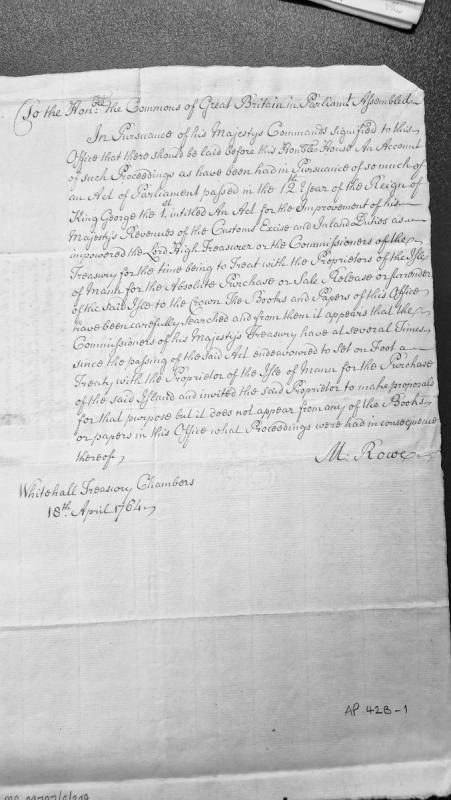
A Treasury Office report to Parliament detailing efforts by the Commissioners of the Treasury to negotiate the purchase of the Isle of Mann from its proprietor under powers granted by an Act of 1714. The document notes that while multiple attempts were made to initiate such a treaty, no records survive detailing the outcomes of these negotiations.
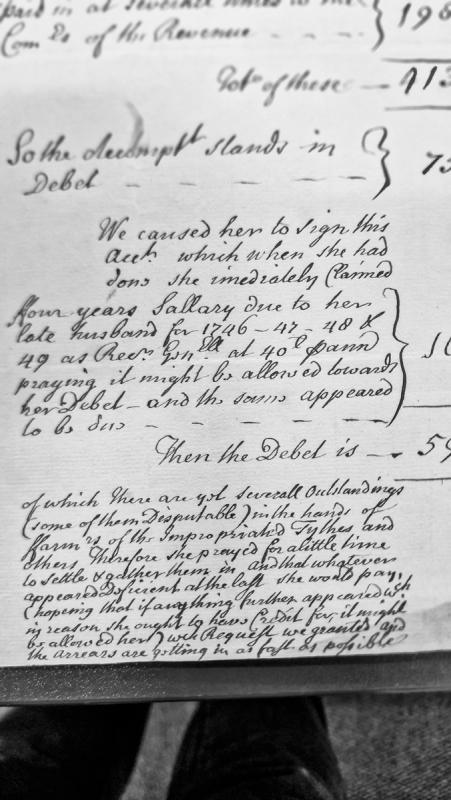
A revenue account document recording the settlement of accounts with a widow, including her claim for four years of salary (1746-1749) owed to her late husband who served as Receiver General at 40 shillings per annum. The document details outstanding debts and arrangements for collection.
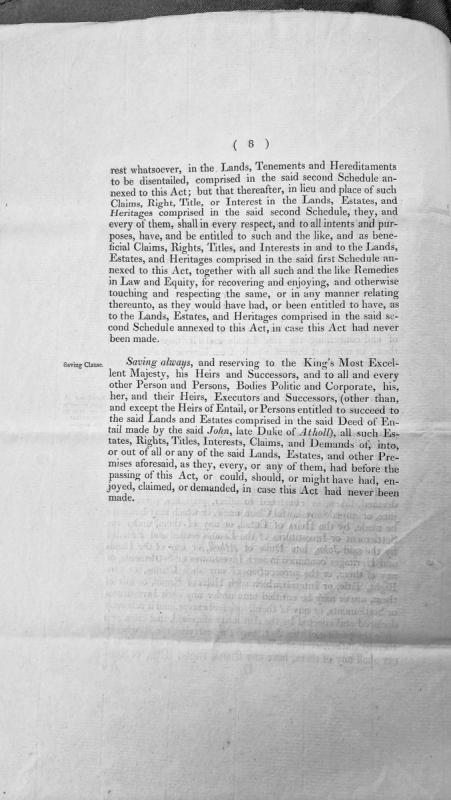
This is page 8 of an Act of Parliament dealing with the disentailment of lands and estates. It establishes that parties relinquishing claims to lands in the second schedule shall receive equivalent claims and remedies regarding lands in the first schedule, with a saving clause preserving the King's and other parties' pre-existing rights and interests.
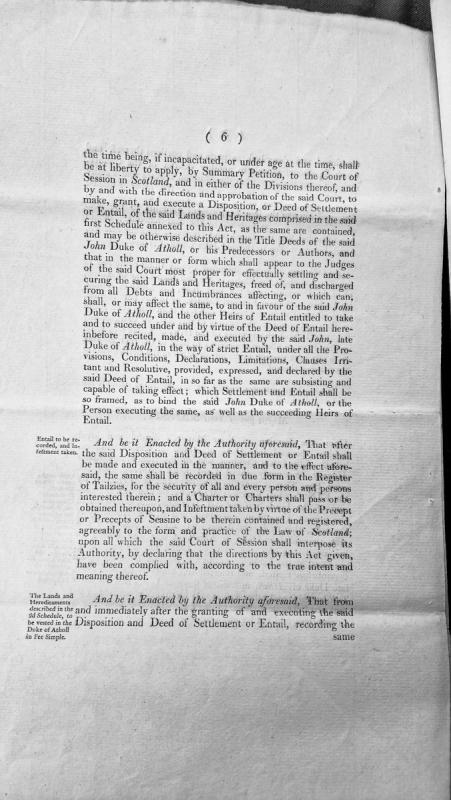
This is an excerpt from an Act of Parliament regulating the settlement and entail of Scottish lands belonging to John, Duke of Atholl. It outlines procedures for executing a Disposition or Deed of Settlement through the Court of Session in Scotland, registration requirements in the Register of Tailzies, and provisions for vesting lands in fee simple.
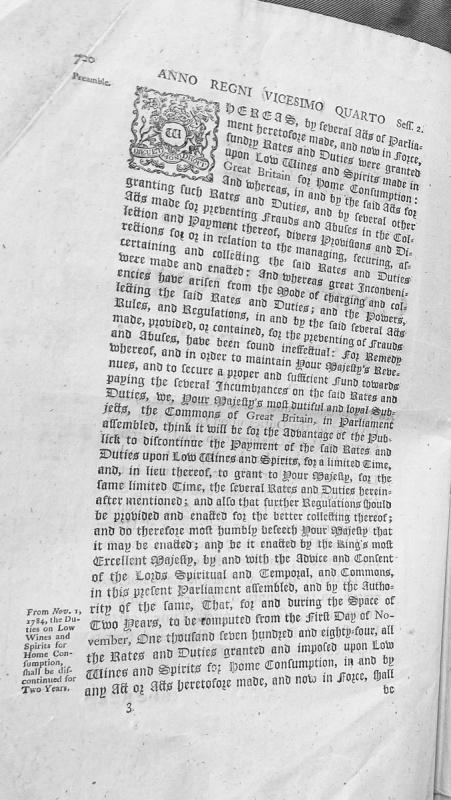
Preamble to a Parliamentary Act (regnal year 24, session 2) proposing to discontinue existing rates and duties on low wines and spirits made in Great Britain for home consumption for a two-year period commencing November 1, 1784, and to enact new regulations to prevent fraud and abuse in collection.
A comprehensive legislative act passed at Tynwald-Court in 1703 by James, Earl of Derby, establishing and confirming the customary tenure system, fines, rents, and services owed by Isle of Man tenants. The act codifies proposals negotiated between the Lord and tenant representatives (including Ewan Christian and John Stephenson) to resolve longstanding disputes over inheritance, alienation, mortgages, and land improvements. Accompanied by explanatory acts on carriages, mortgages, intacks, and quarries. Directly relevant to understanding pre-Revestment Manx constitutional and economic structures.
A comprehensive legislative act passed at Tynwald Court on 4 February 1703 by James, Earl of Derby, establishing customary tenures, inheritance rules, fines, rents, and services for Isle of Man tenants. Ratified by Derby's confirmation in 1704, it also includes supplementary acts addressing carriages, mortgages/alienations, intacks/cottages, and quarry rights. This is foundational documentation for understanding pre-Revestment Manx property law and lord-tenant relations.
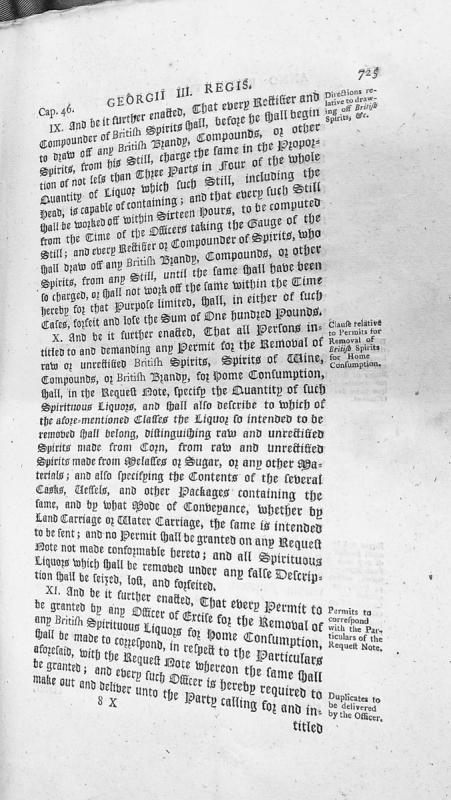
Sections IX-XI of Cap. 46 of an act under King George III regulating the rectification, compounding, and removal of British spirits. The text establishes procedures for charging stills, working them off within time limits, and issuing permits for removal of spirituous liquors for home consumption, with penalties for non-compliance.
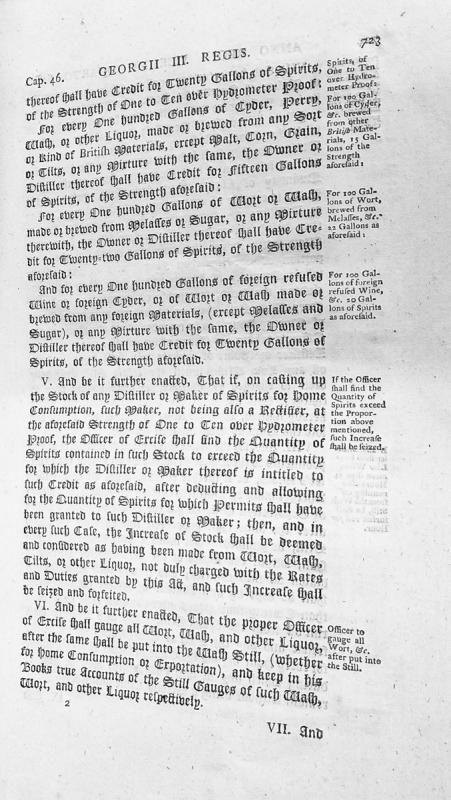
This is an excerpt from a printed Act of Parliament under King George III (Cap. 46) regulating the distillation of spirits and establishing excise duties. It details credit allowances for spirits produced from various materials (malt, cyder, molasses, foreign wine, etc.) and establishes procedures for excise officers to gauge and account for wort, wash, and other liquor in distillation.
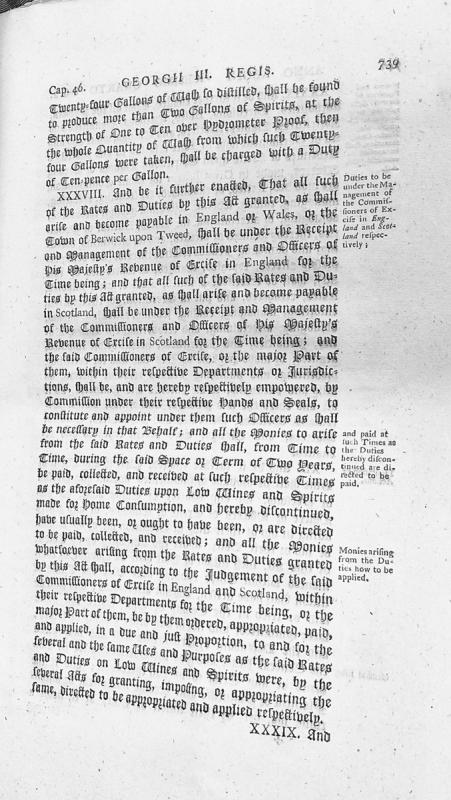
Extract from a printed Act of Parliament under King George III (Cap. 46) detailing excise duty regulations for spirits production and the management of revenue collection. Sections XXXVIII-XXXIX specify duties on wash distillation, administration by Excise Commissioners in England, Wales, Scotland, and Berwick upon Tweed, and application of collected revenues.
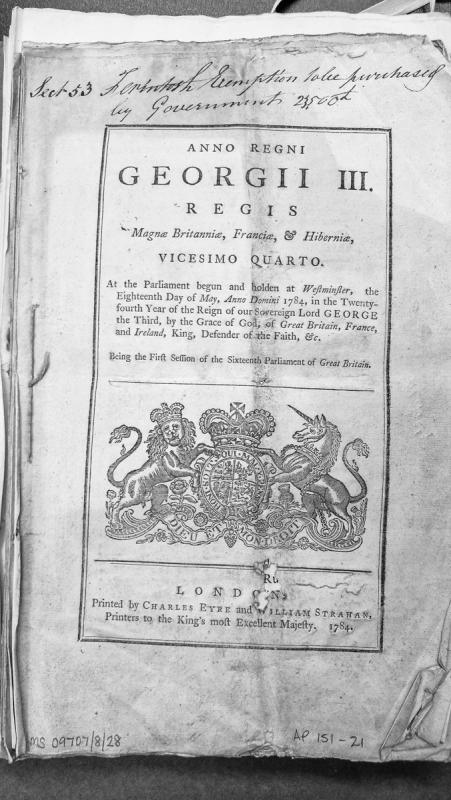
Title page and opening of a printed Act of Parliament from the first session of the sixteenth Parliament of Great Britain, dated May 18, 1784, during the reign of George III. References a section concerning the Lorentosh exemption to be purchased by Government for £23,500.
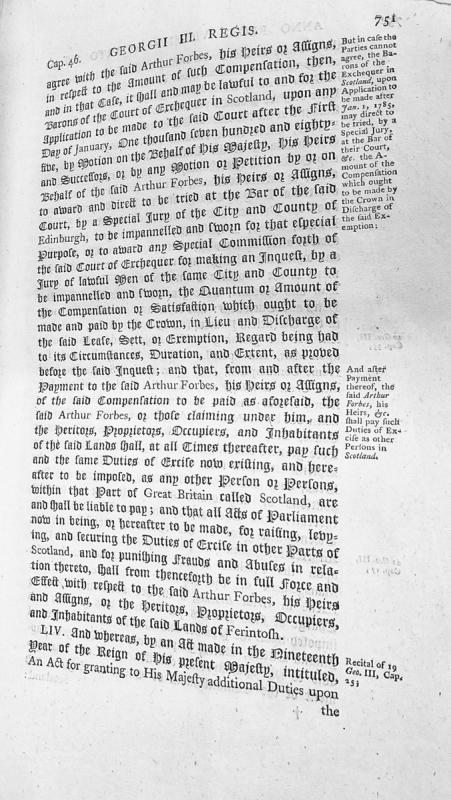
This is an excerpt from a printed Act of Parliament during the reign of George III, specifically Chapter 46. It details legal provisions regarding compensation to be paid to Arthur Forbes (or his heirs/assigns) for the discharge of a lease or exemption on lands of Ferintoſh in Scotland. The document outlines the procedure for determining compensation amount through the Court of Exchequer in Scotland via special jury, and specifies that thereafter the lands shall be subject to excise duties like other parts of Scotland.
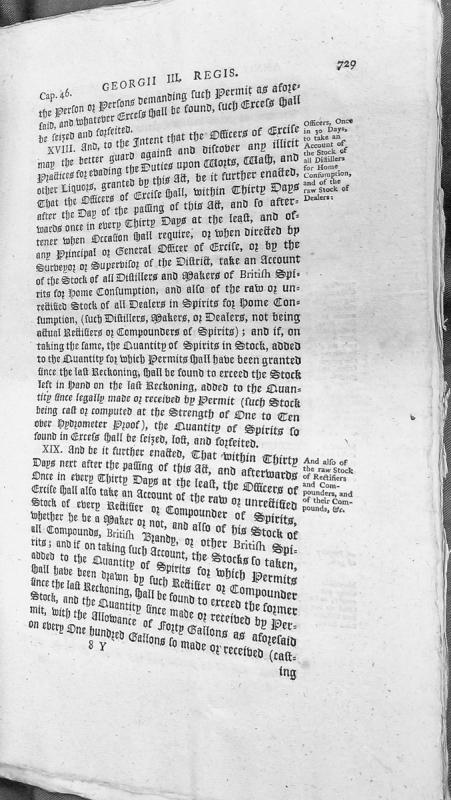
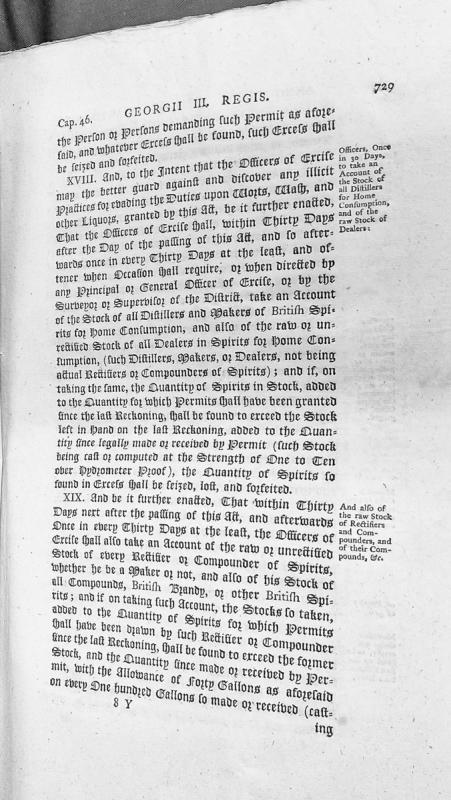
Sections XVIII and XIX of a printed Act of Parliament (George III) establishing excise regulations for distillers and spirits dealers. The sections detail mandatory accounting procedures for excise officers to monitor stock of spirits, enforce duty compliance, and prevent illicit practices. Officers must take stock accounts at least every 30 days.
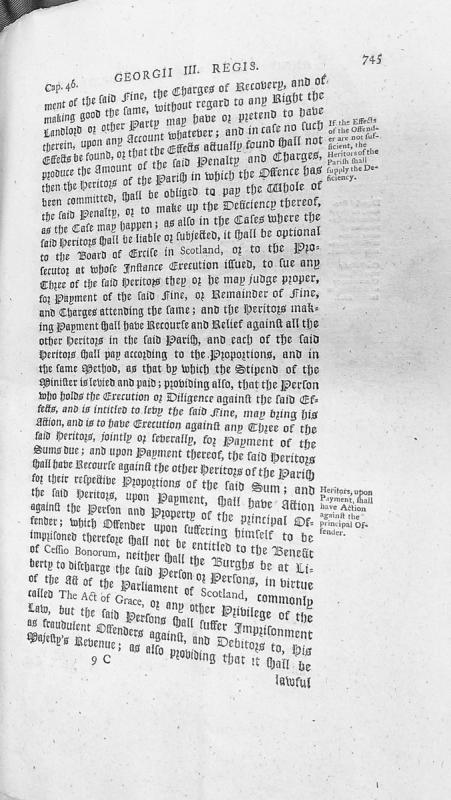
This is an excerpt from a printed Act of Parliament under George III (Cap. 46), page 745. It details provisions regarding the recovery of excise fines and penalties, specifically addressing the liability of parish heritors (landholders) when an offender's effects prove insufficient to cover fines and charges. The text outlines procedures for collection, rights of recourse among heritors, and restrictions on prisoners' legal privileges.
This is a fragment of a printed Act of Parliament under the reign of George III, specifically Chapter 46. It details regulations for excise officers regarding the monitoring of spirits stocks, permits, and forfeiture procedures for excess quantities. The text addresses duties on worts, wash, and other liquors, with provisions for regular stock-taking by excise officers.
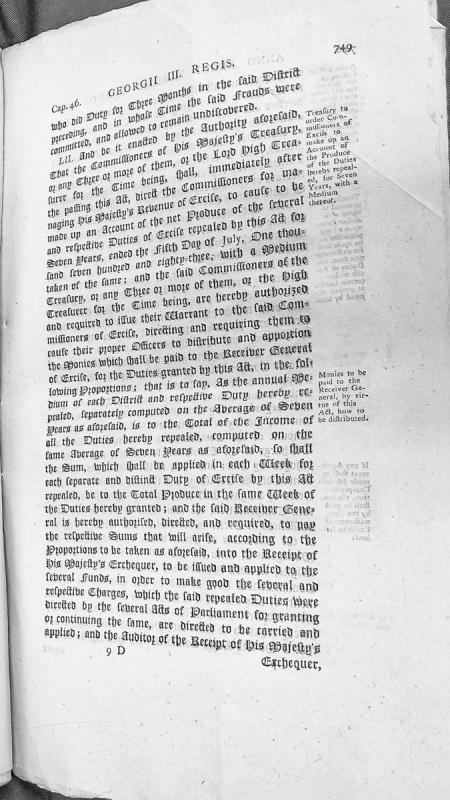
This is an excerpt from an Act of Parliament during the reign of George III, specifically Chapter 46. It deals with Treasury and Excise Commission procedures for accounting for repealed excise duties over a seven-year period (ending July 5, 1783) and establishing proportional distribution formulas for new excise monies to various funds and charges.
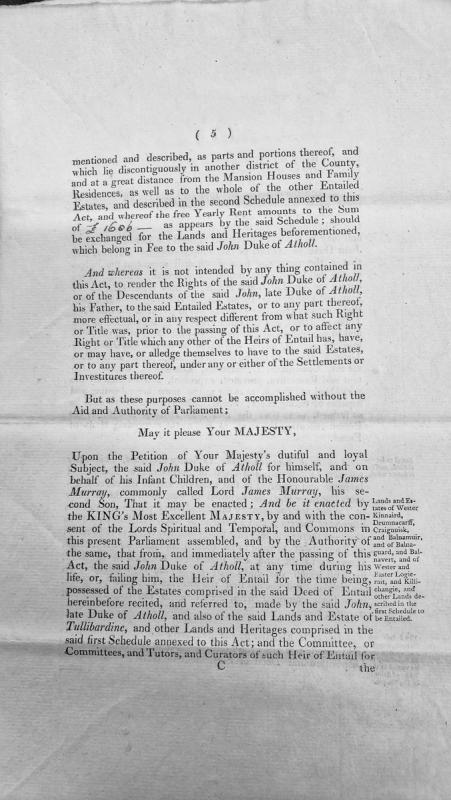
This is an excerpt from a parliamentary act concerning the entailed estates of John, Duke of Atholl. The document outlines provisions for exchanging certain discontiguous entailed lands in Perthshire (including Wester Kinnaird, Drumnacarff, Craignuisk, and other named properties) with lands belonging in fee to the Duke. The act establishes the legal framework and authority for these transactions while protecting the rights of heirs of entail.
A parliamentary act from 1610 (7 James I) confirming William, Earl of Derby's grant and ownership of the Isle of Mann, its castle, lordship, and all associated rights, properties, ecclesiastical patronage, and revenues. The act also settles the succession through James Lord Stanley and Robert Stanley, extinguishes competing claims from the heirs of Ferdinando, Earl of Derby, and includes saving clauses for existing leases and the Archbishop of York's metropolitan jurisdiction.
A 1610 Act of Parliament under James I confirming William, Earl of Derby's hereditary possession of the Isle of Man, its castle, lordship, and all associated rights, franchises, and revenues. The act extinguishes competing claims from the heirs of Ferdinando, late Earl of Derby, and establishes strict entailment to the male line. This document is fundamental to understanding the constitutional and property basis of the Earls of Derby's sovereignty over Man before the 1765 Revestment.