A 1587 obligation/indenture between Hugh Salusbury, George Salisbury, and William Wright (parson of Warton) concerning a lease of tythes and commodities in the Isle of Man, held in trust by William Cotgreve of Chester. The document evidences early modern property arrangements in Man and the Earl of Derby's ownership interests. Relevant to understanding pre-Revestment Manx territorial and ecclesiastical administration.
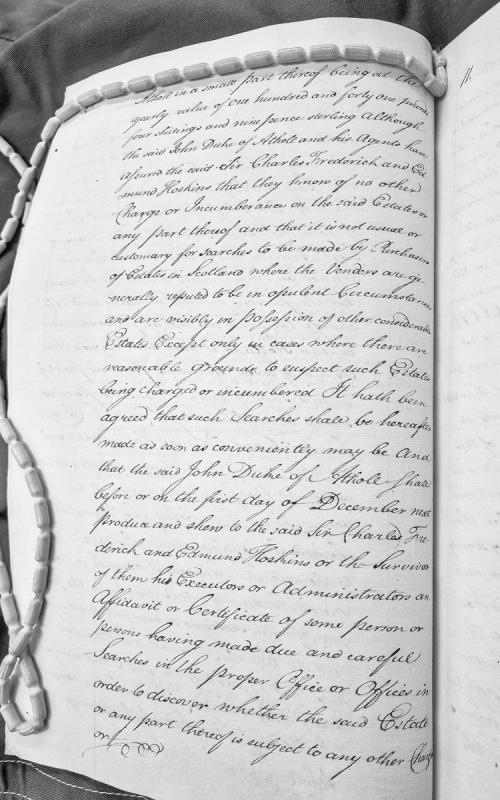
A legal document concerning an agreement between the Duke of Atholl and Sir Charles Frederick and Edmund Hoskins regarding the sale or conveyance of Scottish estates. The document stipulates that searches shall be conducted to verify whether the estates are subject to any charges or encumbrances, with the Duke of Atholl obligated to produce affidavits or certificates by December 1st confirming the results of such searches.
A dual-language (English/Latin) transcription of a 1426 treaty between Norwegian and Scottish kings concerning sovereignty over the Hebrides and Isle of Mann. The document records delegated representatives from Eric of Pomerania (Norway) and James I of Scotland meeting in Bergen to ratify prior agreements between Magnus IV, Halo V, and Alexander III regarding territorial claims.
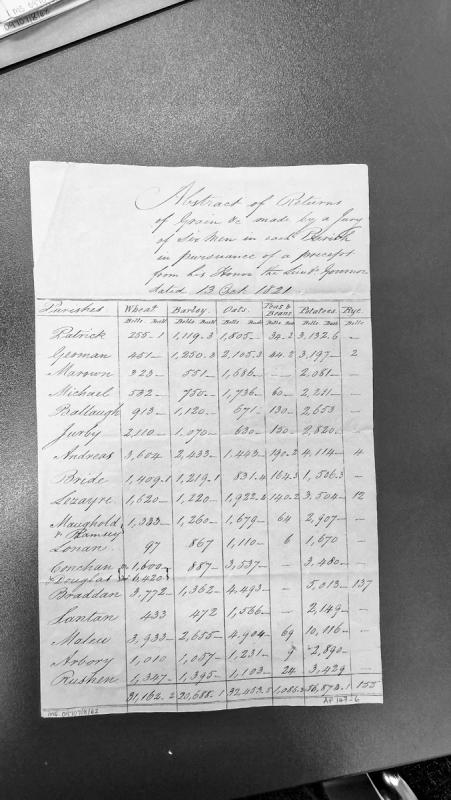
A tabular revenue abstract recording agricultural production by Manx parish, with measurements in bolls and bushels across five columns (likely representing different grain types or years). The data covers all major parishes of the Isle of Man with totals at the bottom, appearing to be an administrative record for taxation or tithes.
Letter from newly arrived Lieutenant Governor Alex Shaw to Lord Grenville (Home Secretary), dated 5 January 1791, reporting his arrival on the Isle of Man and intention to take up office impartially. Shaw succeeded Colonel Dawson and indicates awareness of factional divisions on the Island.
Letter from newly arrived Lieutenant Governor Alex Shaw to Lord Grenville reporting his arrival on the Isle of Man on 30 December 1790 and his imminent swearing-in. Shaw notes the island's factional divisions and pledges impartial governance. This document is relevant to post-Revestment administration and internal island governance.
A comprehensive two-volume history of the Isle of Man from earliest times to the present (1845), covering ancient laws, customs, and superstitions. Written by Joseph Train, F.S.A. Scot., this work draws on the Parr manuscript and other archival sources, including discussion of the Revestment (Act of parliament to purchase sovereignty). Directly relevant to understanding Manx constitutional history, legal traditions, and the political context leading to 1765.
Joseph Train's two-volume historical and statistical account of the Isle of Man, covering from earliest times to 1845. Volume II includes chapters on church history, ecclesiastical antiquities, monuments, manners and customs, superstitions, constitution, tenures, ancient commerce, and modern commerce (including smuggling). Directly relevant to the Revestment project for its extensive treatment of administrative structures, revenue systems, the running trade, and the commercial context.
Joseph Train's comprehensive two-volume historical and statistical account of the Isle of Man, covering ecclesiastical history, antiquities, constitutional development, commerce, customs, and superstitions from earliest times to 1845. Volume II addresses church history, ecclesiastical courts, tenures, ancient and modern commerce (including smuggling), and topography. Directly relevant to understanding the constitutional, economic, and social context preceding the 1765 Revestment.
A lengthy analytical document, purportedly written by a person with 18 years' experience in the Collector's office, addressed to Henry Pelham (Prime Minister 1743–1754). It provides detailed accounts of the smuggling operations centred on the Isle of Man, the role of Governor James Murray in regularising the smuggling trade, revenue figures, smuggling methods and routes, and proposes four schemes to suppress the trade or force the Duke of Atholl to sell the Island to the Crown.
A detailed contemporary analysis of Isle of Man's governance, revenue sources, and smuggling operations, presented to Prime Minister Henry Pelham in the early 1750s. The author, likely Capt. Weber, was a customs official with 18 years' experience in the Island's administration. The document describes the dramatic increase in illicit trade under Duke of Atholl's ownership, detailed smuggling methods targeting Britain and Ireland, and proposes parliamentary remedies including salt trade prohibition and enforcement measures.
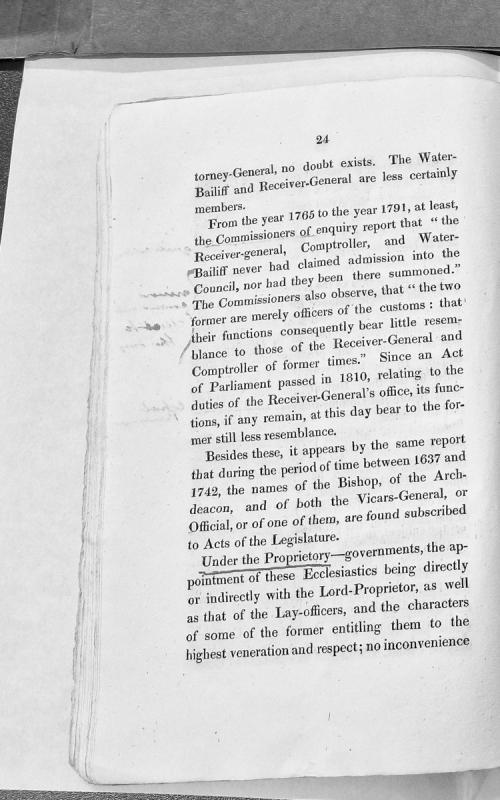
This document discusses the composition and membership of the Isle of Man Council, examining which officers held seats between 1765-1791. It analyzes the roles of the Receiver-General, Comptroller, Water-Bailiff, and ecclesiastical figures (Bishop, Archdeacon, Vicars-General) in legislative acts, noting changes following an 1810 Act of Parliament.
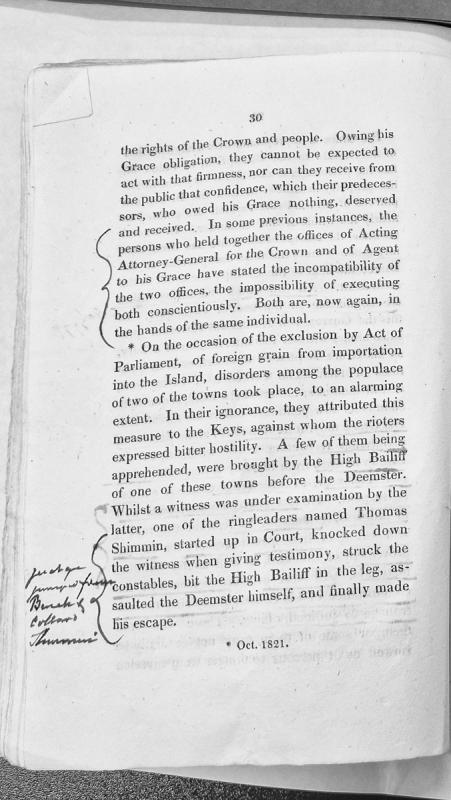
A critical commentary on the incompatibility of holding dual offices (Acting Attorney-General and Agent to the Duke), with particular concern about conflicts of interest. The document includes a detailed account of October 1821 riots over foreign grain exclusion, during which Thomas Shimmin assaulted court officials including the Deemster.
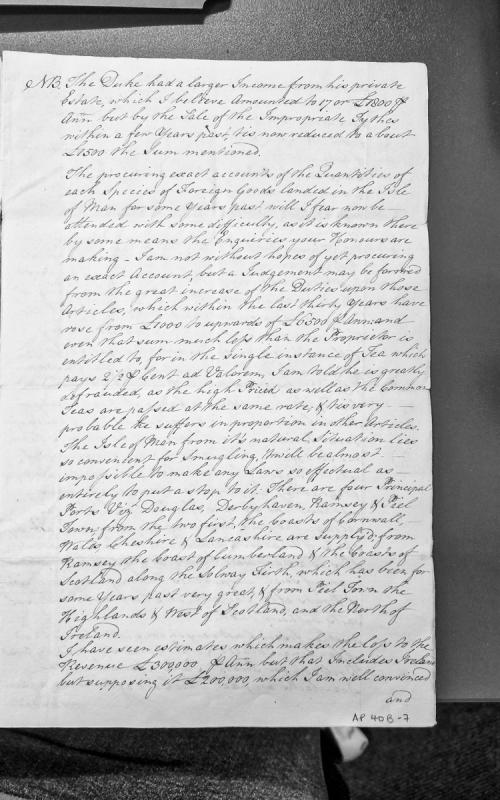
A report analyzing the Duke's private estate income, the quantities and duties on foreign goods landed in the Isle of Man, and the revenue losses from smuggling. The document discusses four principal ports (Douglas, Derbyhaven, Ramsey, and Piel Town) used for smuggling contraband to the British mainland and Ireland, with estimated annual losses to revenue.
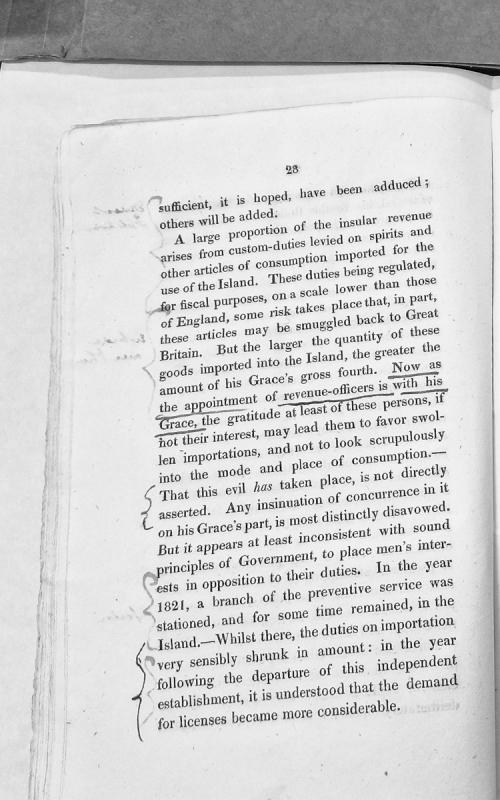
An excerpt from a printed pamphlet discussing customs duties on spirits and imported goods in the Isle of Man, the relationship between revenue officers and fiscal interests, and concerns about smuggling to Great Britain. References the 1821 preventive service and its effects on import duties.
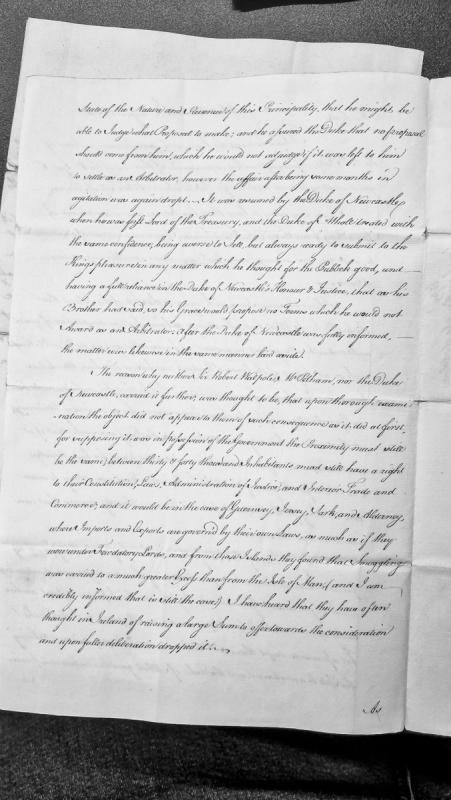
A historical legal or administrative opinion discussing various Crown attempts to acquire governance of the Isle of Man, spanning the administrations of Sir Robert Walpole, Mr Pelham, and the Duke of Newcastle. The document evaluates why these proposals were ultimately abandoned, comparing the Isle of Man's strategic and commercial value with other Channel Islands.
This document discusses historical attempts by British government officials (Walpole, Pelham, Newcastle) to acquire the Isle of Man from the Duke of Atholl. It examines the political and economic reasoning behind these failed negotiations, comparing Man's governance structure to that of the Channel Islands and addressing concerns about smuggling.
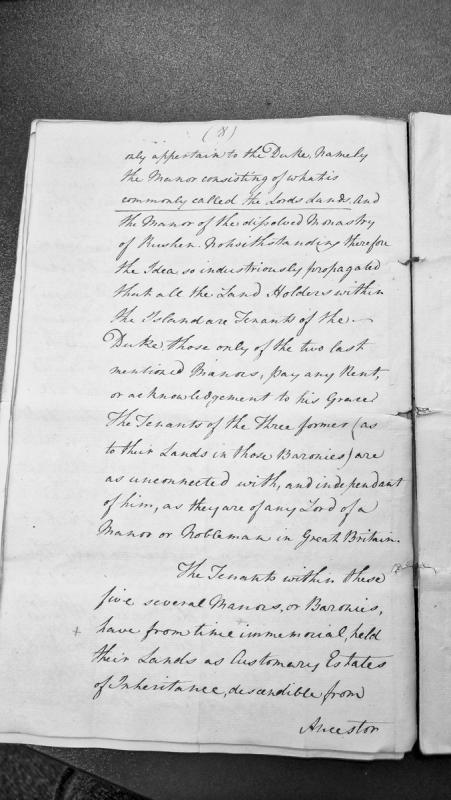
This document discusses the five manors or baronies of the Isle of Man and clarifies that only tenants of the Duke's two manors (the Lords Lands and the dissolved Monastery of Rushen) pay rent. Tenants in the three other baronies hold their lands as customary estates of inheritance independent of ducal authority, contrary to popular misconception.
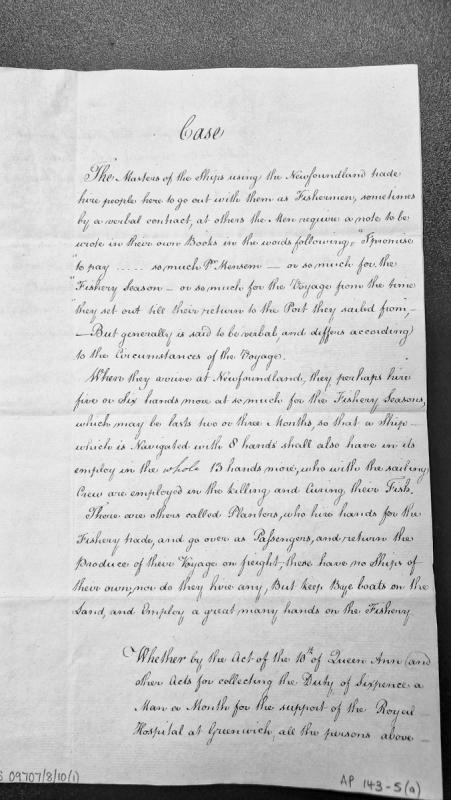
A legal or administrative analysis discussing hiring practices for the Newfoundland fishery trade, including verbal and written contracts for fishermen, wages (per month or per season), and the distinction between ship masters and planters. The document appears to address taxation implications under Queen Anne's legislation regarding duties for the Royal Hospital at Greenwich.
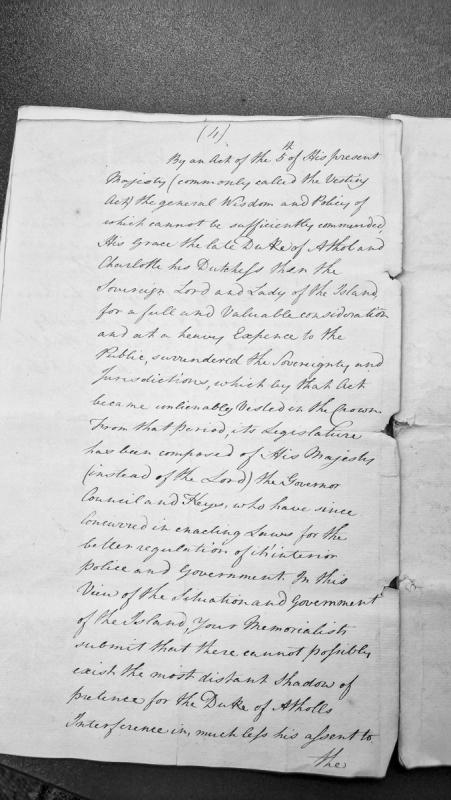
A legal memorandum discussing the 5th Act of the present Majesty (the Vesting Act) which transferred sovereignty of the Isle of Man from the Duke of Athol to the Crown. The document explains how the island's legislature now comprises the King, Governor, Council, and Keys, and argues against any remaining interference by the Duke of Athol in island affairs.
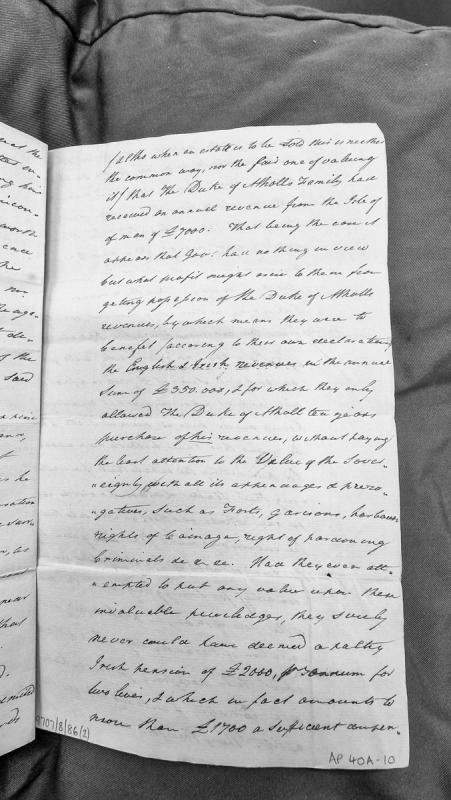
A critical legal or administrative analysis examining the inadequate compensation offered to the Duke of Atholl for the Isle of Man. The document argues that the government's valuation failed to account for sovereignty rights, fortifications, harbours, coinage rights, and pardoning powers, offering only a ten-year purchase of revenues and an Irish pension of £2000 per annum for two lives.
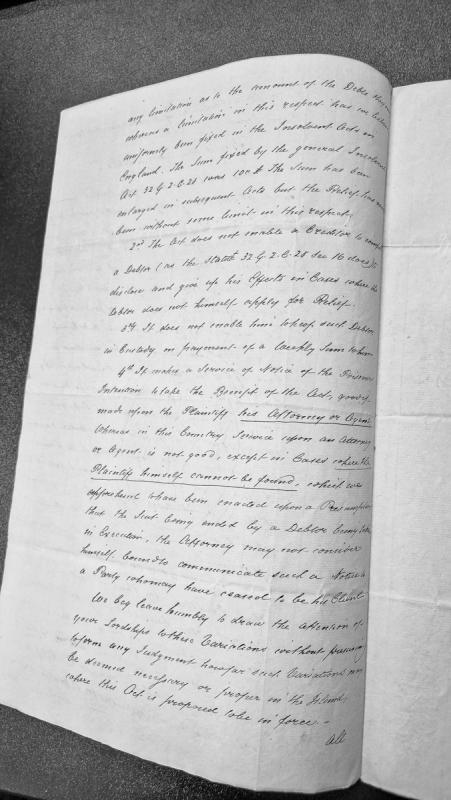
A legal opinion examining key differences between a proposed Insolvent Act for the Isle of Man and English insolvency legislation (32 G. 2. C. 28). The document identifies four major variations concerning debt limits, creditor powers, custody provisions, and service of notice procedures.
Extract from the Anglo-Saxon Chronicle (A.D. 1087) describing William the Conqueror's dominion over England, the land of the Britons, and the Isle of Man. This primary source establishes early Norman control over Man and provides historical context for the island's political status before the later Revestment period.
Extract from the Anglo-Saxon Chronicle (A.D. 1087) describing William the Conqueror's comprehensive survey of England and his dominion over the Isle of Man. This is a foundational historical reference establishing early Norman royal authority over the island.
A royal charter issued by the King of Scotland (superior lord of the Isle of Man) annulling the outlawry of Donekan Mactoryn, who had been declared an outlaw by Walter de Huntercumbe, bailiff of the Island, for offences against the peace. The charter states that upon inspection, a manifest error was found in the original trial and outlawry record, leading to its complete annulment. This document demonstrates early Scottish sovereignty over the Isle of Man and the operation of medieval justice and royal authority over the Island.