A royal charter from the King of Scotland (superior lord of the kingdom of Scotland) dated 28 June 1293, annulling the outlawry of Donekan Mactoryn that had been pronounced by judges in the Isle of Man. The document concerns a judicial error identified in the record of trial before Walter de Huntercumbe, the King's bailiff of the Island. This provides evidence of early medieval Scottish sovereignty over Man and the administrative/judicial structure of the island under Scottish overlordship.
An anonymous letter addressed to the Marquis of Rockingham criticizing Charles Lutwidge, the newly appointed Receiver General and head of the Revenue Department on the Isle of Man following the 1765 Revestment. The letter alleges smuggling, financial impropriety, misuse of authority, and fraudulent documentation. It includes a contemporaneous 1766 petition by Lutwidge against Caesar Parr for defamation, documenting the scandal complaint mentioned in the diatribe.
Two-part document: (1) An anonymous letter to the Marquis of Rockingham criticising Charles Lutwidge, the newly appointed Revenue officer on the Isle of Man post-Revestment, alleging smuggling, corruption, and misuse of authority. (2) Lutwidge's formal petition to Governor Wood against Caesar Parr for slander and menaces (February 1766). The diatribe charges Lutwidge with seizing smuggled goods and selling them privately, corrupt dealings with smugglers, and fabricating military incidents to maintain power. Critical evidence of post-Revestment tensions and allegations of revenue officer misconduct.
Letter from Anthony Bacon, Army contractor, to the Treasury seeking directions on provisioning and forage supply for troops stationed on the Isle of Man following the Revestment. Discusses logistics of importing provisions from Ireland, storage arrangements, and customs difficulties under recent Parliamentary acts. Includes editorial notes on troop deployments and the use of Light Dragoons.
A biographical and genealogical entry from Monumenta de Insula Manniae (Manx Society vol. 7) documenting Anthony Beek's career as Bishop of Durham and his royal gift of the Isle of Man, which he held until his death in 1310. The text is presented in both English and Latin (Monasticon Anglicanum) and provides context on feudal land tenure, royal patronage, and ecclesiastical holdings relevant to pre-Revestment Manx sovereignty.
A bilingual (English/Latin) biographical entry on Anthony Beek, Bishop of Durham (elected 1283, died 1310), from the Manx Society's published collection of Manx historical monuments. Notes that Beek held the Island of Man as a gift from the king until his death, making it directly relevant to pre-Revestment Manx lordship and ecclesiastical governance.
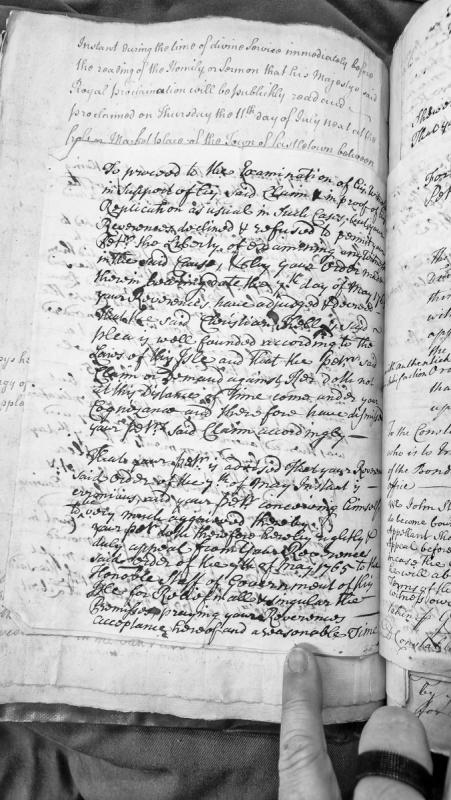
A petition appealing an order dated May 9th 1765 that dismissed the petitioner's claim against Christian Tholl on grounds of distance in time. The petitioner argues the court's decision was erroneous and appeals to the Staff of Government of the Isle of Man for relief.
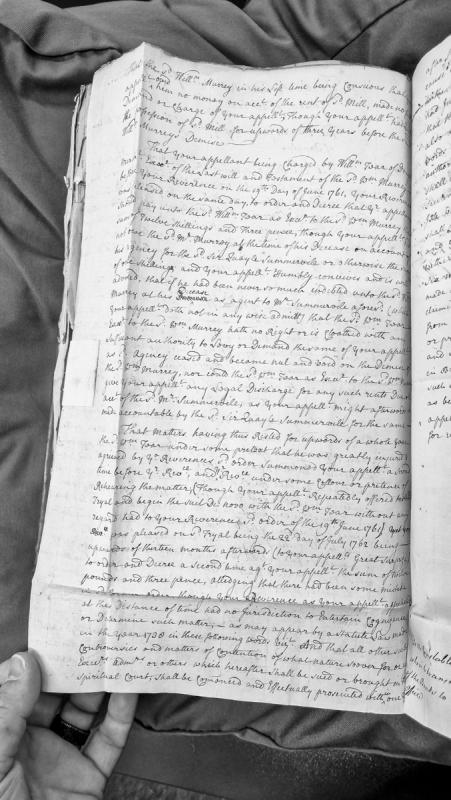
This is an appeal document contesting two orders from an ecclesiastical court (dated June 19, 1761 and July 22, 1762) requiring the appellant to pay sums to William Toar as executor of William Murray's will. The appellant argues he owed nothing as an agent for Sir Quayle Summerville and that the executor lacked authority to collect such debts after Murray's death.
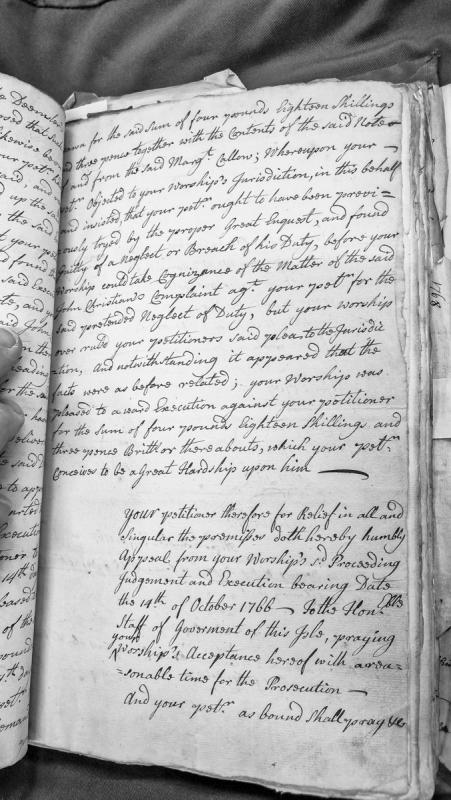
A petition appealing a magistrate's judgment and execution order against the petitioner for a sum of £4 18s 3d. The petitioner contests the magistrate's jurisdiction, arguing that he should have been tried by the Great Inquest before the magistrate could take cognizance of the complaint by John Christian regarding alleged neglect of duty.
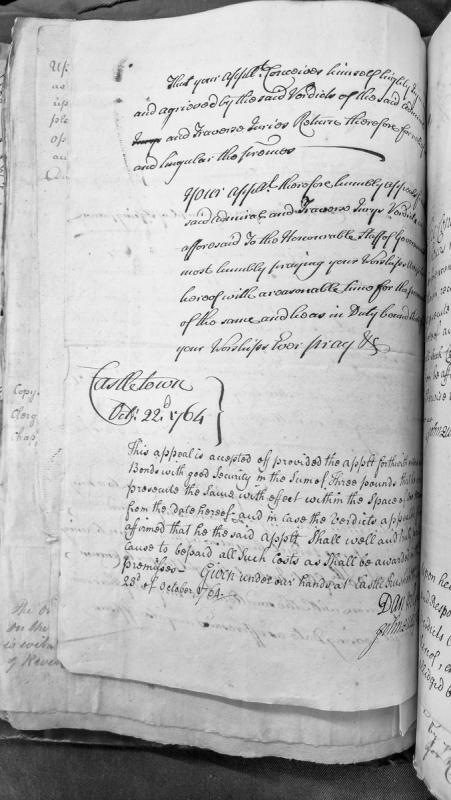
An appeal document dated October 1764 in which the appellant seeks to challenge verdicts rendered by Admirals and Traverse Juries. The appeal is conditionally accepted, requiring the appellant to post a three-pound bond with security and prosecute the appeal within a specified timeframe. If the original verdicts are affirmed, the appellant must pay all awarded costs.
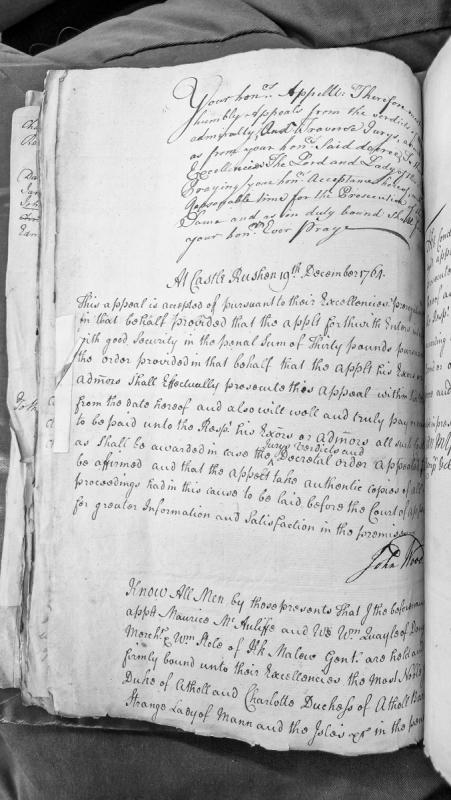
An appeal from a verdict in an admiralty case, filed at Castle Rushen on 19 December 1764. The appellant Maurice McAuliffe is required to enter into a recognisance with sureties in the penal sum of Thirty Pounds to prosecute the appeal within six months and pay costs if the jury's verdict is affirmed.
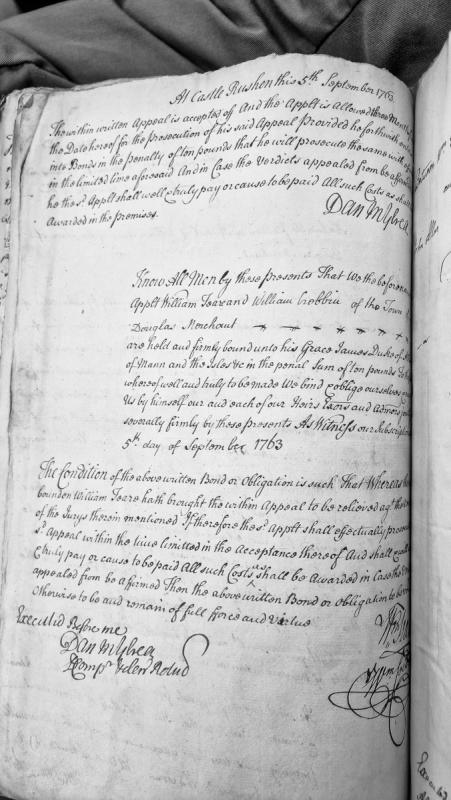
A bond and recognisance document recording acceptance of an appeal at Castle Rushen. William Toare, appellant, is required to enter into a £10 bond with William Crobbin as surety, conditioned upon prosecuting the appeal within three months and paying all awarded costs if the original verdict is affirmed.
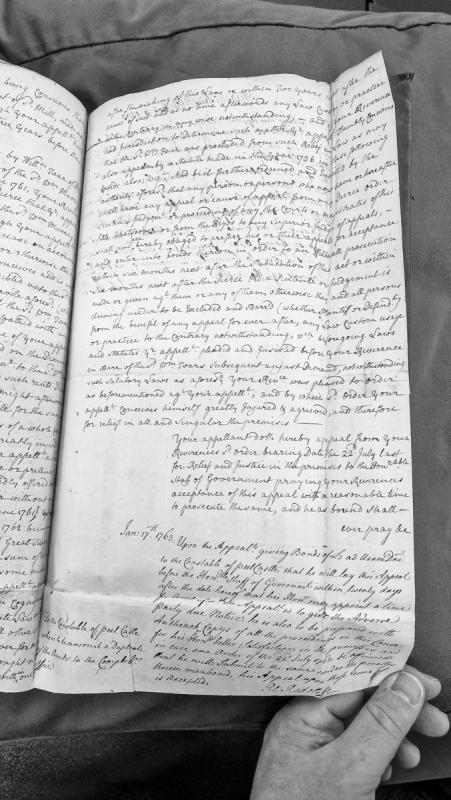
A legal appeal document dated 17 January 1763 in which an appellant seeks relief from a court order dated 22 July (of the previous year), citing statutes from 1736 regarding limitations on appeals. The document sets conditions for the appeal's acceptance, including a bond of £3 and requirements for providing copies of proceedings to the Government.
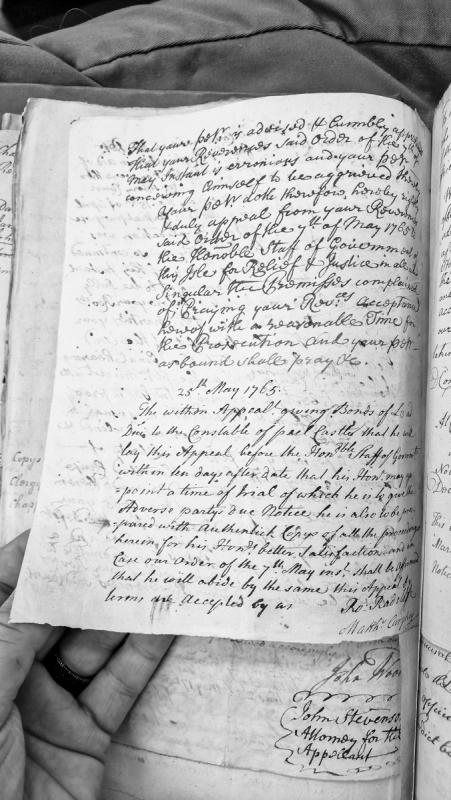
A petition and appeal document whereby the petitioner appeals against an order of the House of Keys dated 7th May 1765, claiming grievance. The document records the acceptance of the appeal on terms, including a bond of £3 to the Constable of Peel Castle and requirements for producing copies of proceedings and giving notice to the adverse party.
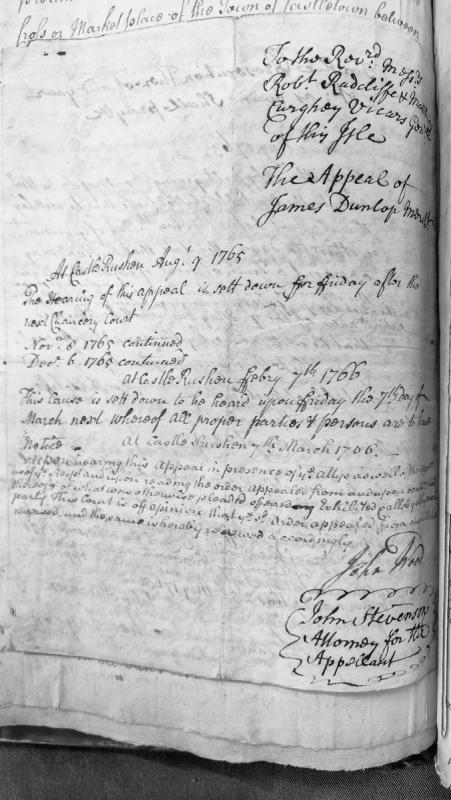
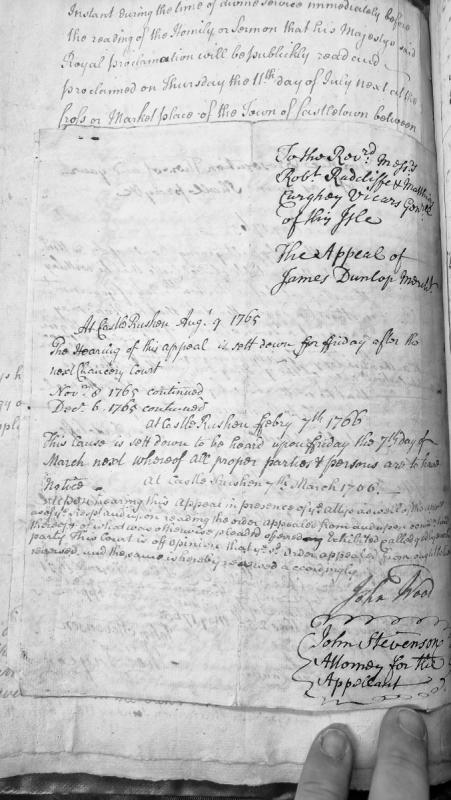
A court judgment reversing an order in an appeal case heard before the Ecclesiastical Court at Castle Rushen. The appeal of James Dunlop was initially scheduled for hearing in August 1765 and was continued several times before being finally heard on March 7th, 1766, resulting in the reversal of the original order.
A judgment document recording the hearing and reversal of an appeal by James Dunlop, a merchant, before the Castle Rushen court. The document traces the appeal's procedural history from August 1765 through March 1766, with multiple continuances, culminating in the court's decision to reverse the original order appealed from.
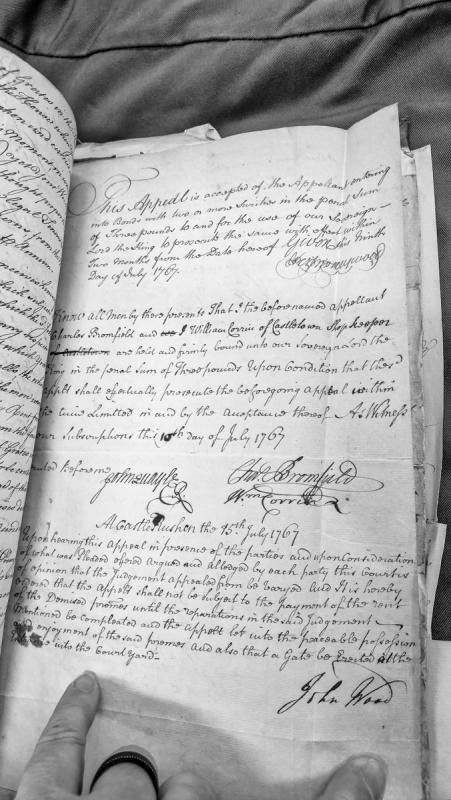
A House of Keys judgment dated 15 July 1767 reversing a previous judgment in an appeal concerning a rental property dispute. The appellant Charles Bromfield is relieved from paying rent until repairs are completed and he gains possession of the premises, with provisions for erecting a gate at the courtyard entrance.
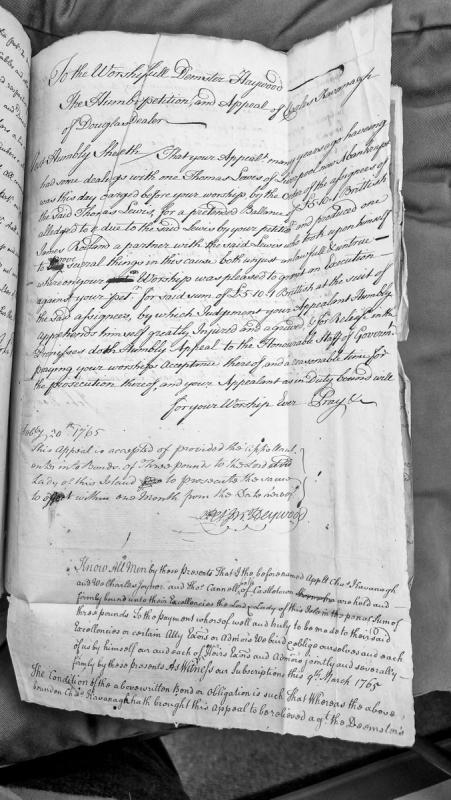
A petition and appeal by Charles Kavanagh of Douglas against an execution for £5.10.1 sterling granted by Demster Haywood at the suit of assignees of Thomas Lewis of Liverpool (bankrupt). The petition challenges the evidence presented by James Rostan as unjust and unlawful. The appeal was accepted on condition of a three-pound bond, which is detailed in the accompanying bond document dated March 9th 1765.
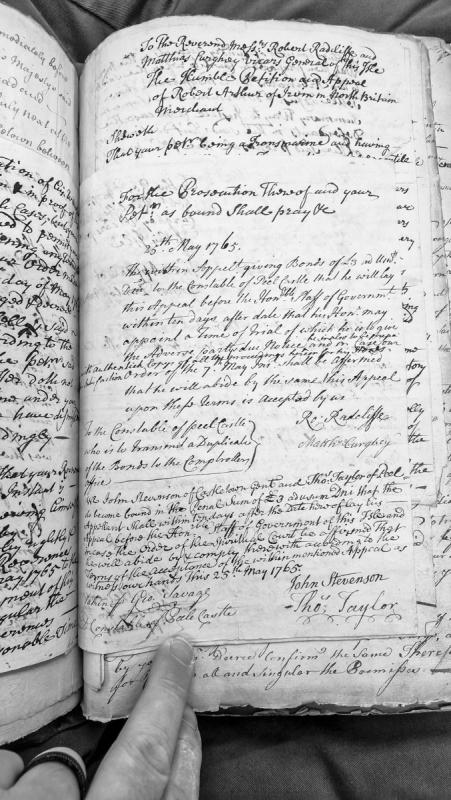
A humble petition and appeal submitted by Robert Arthur, a merchant from Irom in North Britain, to the Vicars General of the Isle of Man. The document records the acceptance of the appeal by Robert Radcliffe and Matthias Curghey, with bonds of £3 posted by John Stevenson and Thomas Taylor to ensure the appellant will present the case before the Government within ten days and comply with the court's decision.
A collection of four historical appendices to a scholarly work on Manx social and economic history. Appendix A presents an eyewitness account (mid-17th century) of formal reception procedures for arriving strangers in Man, describing the bureaucratic surveillance and interrogation apparatus. Appendices B-D document historical records on benevolences (1682), emergency defence procedures (1600), and debt imprisonment law (1418-1846), illustrating administrative structures and legal frameworks under the Lords of Man.
Editorial appendix from Monumenta de Insula Manniae clarifying the identity of an early Manx bishop named Hamond (son of Jole), and explaining how he was historically confused with Wimund, a 12th-century militant Norman monk. This source addresses medieval Manx ecclesiastical history and the reliability of chronicle sources.
A scholarly appendix from the Manx Society publications clarifying historical confusion between two medieval bishops: Hamond (a Manx bishop, son of Jole) and Wimund (a Norman monk and warrior-bishop). The text discusses how later historians erroneously conflated these figures and provides primary source citations from Matthew Paris and other chroniclers. Relevant to understanding medieval Manx ecclesiastical history and the reliability of historical sources used in Revestment-era scholarship.
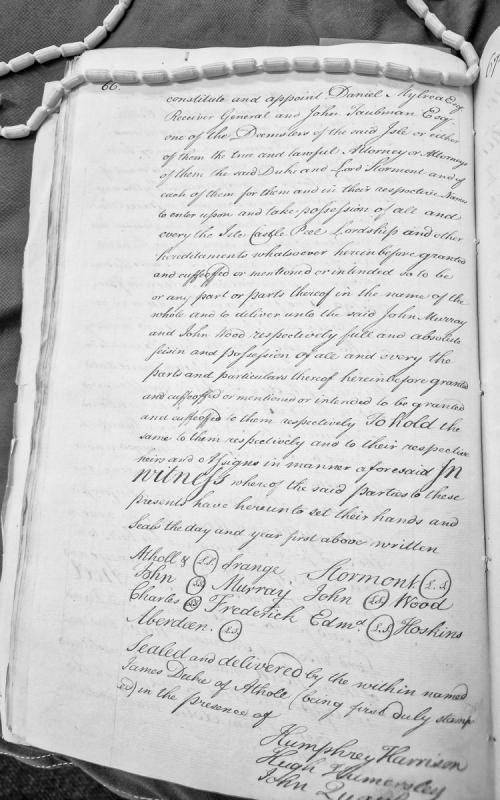
A legal instrument appointing Daniel Mylrea (Receiver General) and John Taubman (Deemster) as attorneys for the Duke of Atholl and Lord Stormont to take possession of Isle Castle, Peel, and other hereditaments, and to deliver seisin to John Murray and John Wood. The document is sealed and witnessed.
A royal patent from King Edward III appointing Edmund Mortayn, escheator of Ireland, and Brother John Tyrel to lead forces to recover the Isle of Man from Scottish invaders under Richard de Maundevill. The document is a Latin record from the Irish Patent and Close Rolls, published in the Manx Society's Monumenta de Insula Manniae series, and provides evidence of medieval Manx sovereignty disputes and military interventions.
Royal patent from Edward III appointing Edmund Mortayn, escheator of Ireland, and Brother John Tyrel to lead forces to recover the Isle of Man from Scottish occupation under Richard de Maundevill. The document reflects medieval military and administrative responses to threats to English sovereignty over the island, providing context for pre-Revestment Manx governance and English Crown interests.