Parliamentary Act of 1784 appropriating monies for naval, military, and civil services, including detailed expenditures for land forces, pensions, American loyalists, and colonial administration. Cap. XLV extends powers for trade with American colonies and British plantations. Relevant to understanding post-Revestment fiscal arrangements and imperial trade regulation affecting Isle of Man.
Parliamentary Act (24 Geo. III) appropriating funds for 1784 naval, military, and civil services, and extending powers for trade with American colonies and British plantations. Contains detailed financial schedules for army, ordnance, pensions, and civil establishments. CAP. XLV extends trade powers with United States and British American colonies. Provides context on post-American Revolution financial priorities and constitutional trade arrangements.
Letter from the Duke of Grafton (Secretary of State) to the Lords Commissioners of the Treasury enclosing approval from the King for barracks construction at Castle Rushen and Castletown, Isle of Man. The letter notes the removal of horse stables from the original plan following the withdrawal of cavalry from the island. This document records post-Revestment military infrastructure decisions and reflects the strategic assessment of Isle of Man's defence needs after 1765.
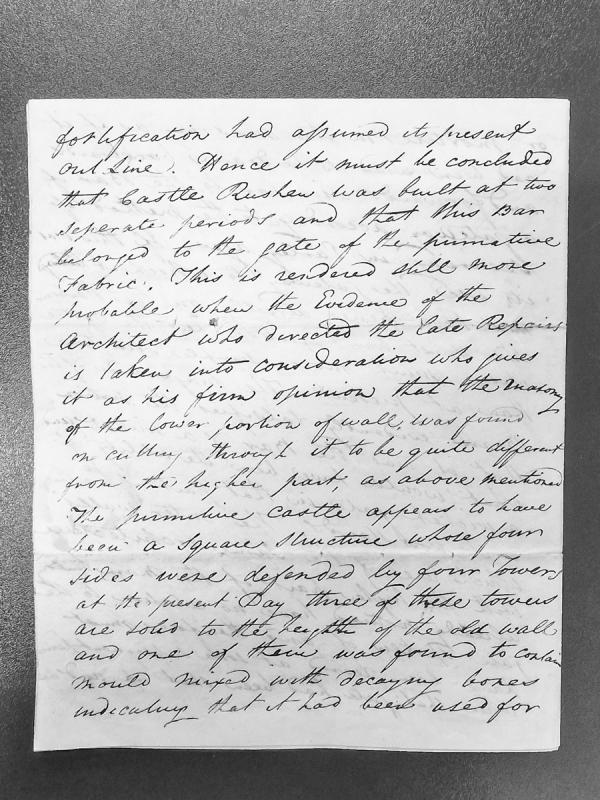
A detailed architectural and historical analysis of Castle Rushen, discussing evidence of two separate construction periods and the structure of the primitive castle. The document references masonry analysis and architectural evidence regarding the castle's original defensive towers.
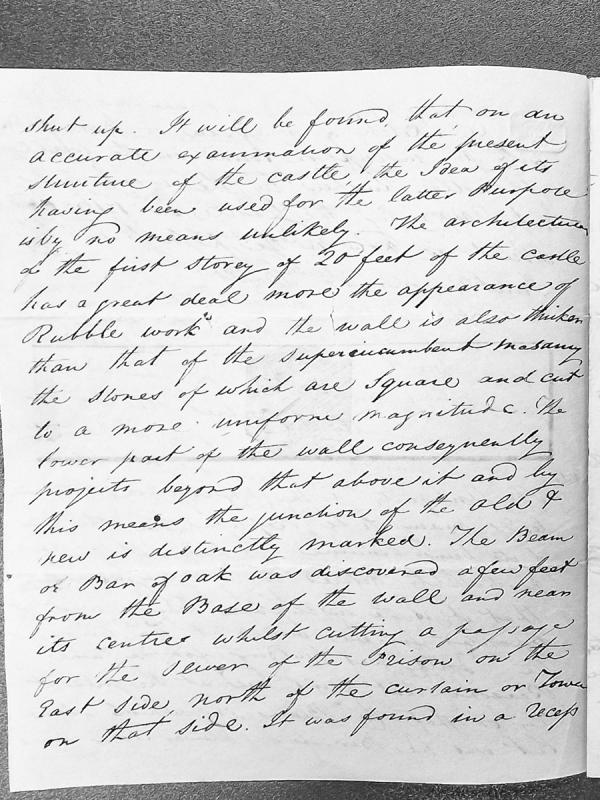
This document appears to be an excerpt from a longer architectural or historical analysis discussing the structure of a castle, particularly examining differences between the lower and upper masonry work. It describes the discovery of an oak beam or bar found during excavation for a prison sewer passage on the east side of the structure.
This appears to be a metadata header or placeholder from the Manx Primary Source Archive transcription system. No actual document content is present in the transcription file.
A brief archival entry or reference document containing only an archive reference number (MS 09707/4/37-38) and what appears to be an internal cataloging code (AP 42C). The document provides insufficient content for detailed analysis.
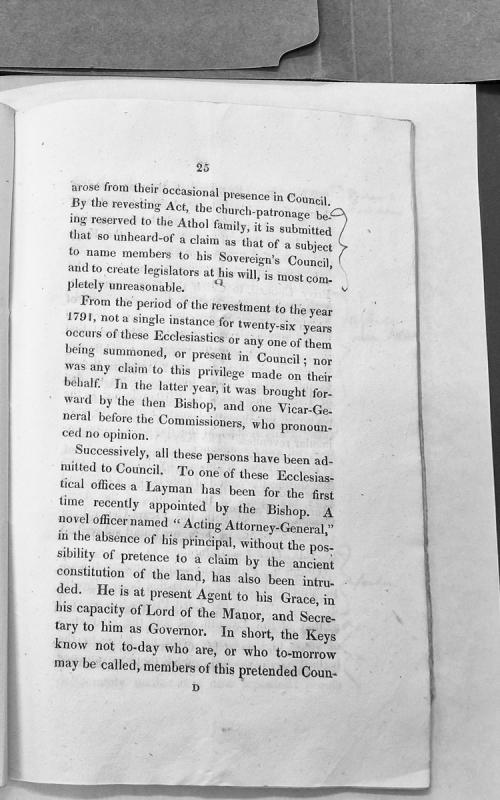
This is page 25 of a legal opinion or petition concerning the rights of ecclesiastical officers to sit in the Manx House of Keys Council. The document argues that since the revestment (returning sovereignty to the Athol family) and church patronage being reserved to them, ecclesiastics have no constitutional basis to claim Council membership. It notes a 26-year gap (1765-1791) without such claims, and criticises recent admissions of clergy and new officers like an 'Acting Attorney-General' as unconstitutional innovations.
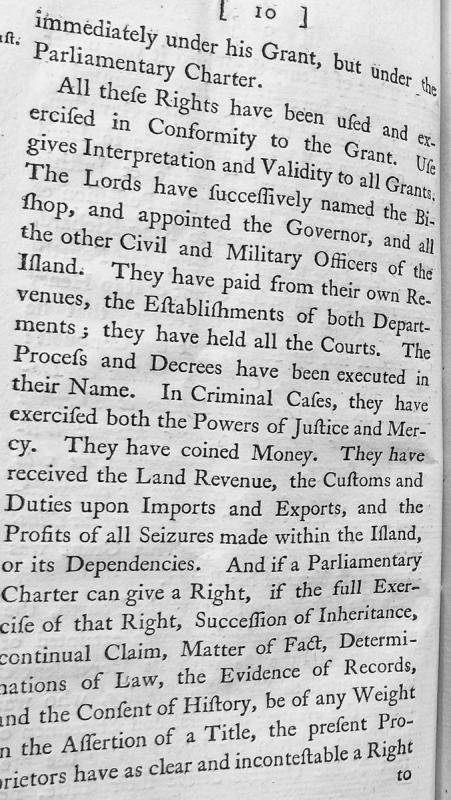
A legal argument asserting the rights and powers of the Lords proprietors of the Isle of Man under a Parliamentary Charter. The document enumerates the successive exercise of sovereign powers including appointment of officials, judiciary, coinage, and revenue collection, claiming these establish an incontestable title through use, inheritance, and historical record.
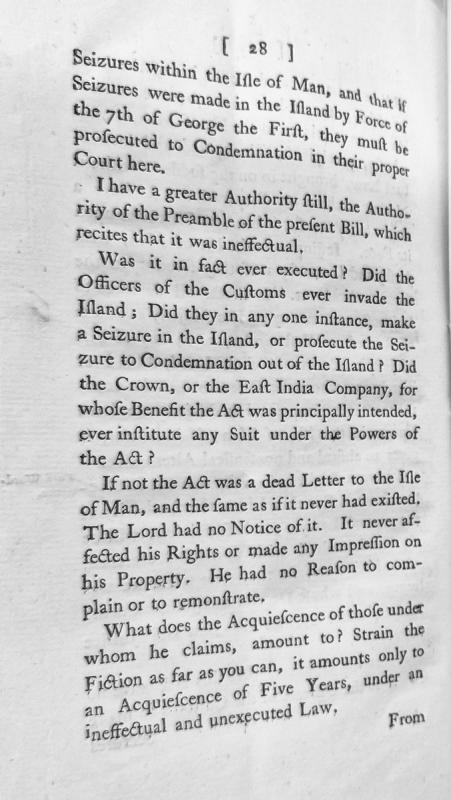
A legal argument discussing whether a statute (7th of George the First) concerning customs seizures was ever actually executed in the Isle of Man. The author argues the Act was ineffectual and never enforced, making it a 'dead Letter' that had no effect on the Lord's rights or property. The fragment discusses acquiescence and statutory authority.
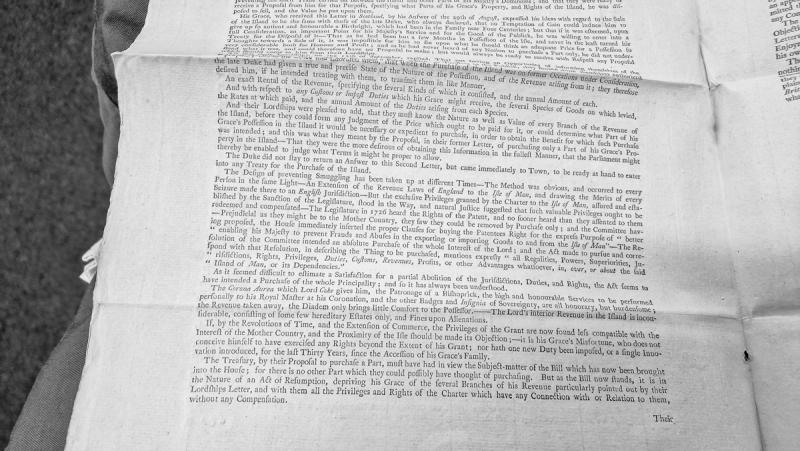
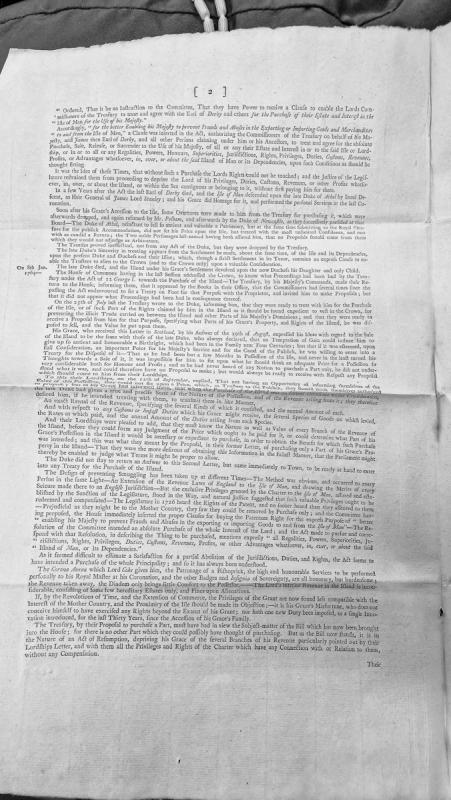
This is a legal memorandum or opinion addressing negotiations between the Duke of Atholl and the British Treasury regarding the potential purchase of the Isle of Man. It discusses the historical context of smuggling prevention efforts, the exclusive privileges granted by charter, and argues that a proposed bill constitutes an act of resumption depriving the Duke of revenue branches without compensation.
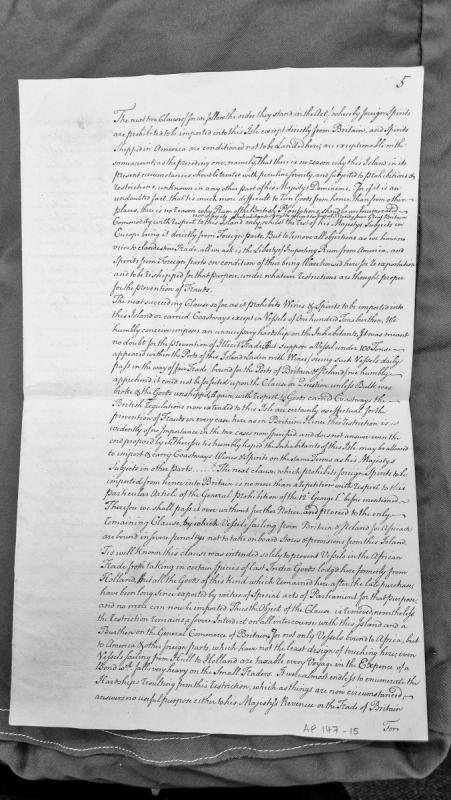
A detailed legal/commercial argument petitioning for relief from trade restrictions imposed on the Isle of Man, including prohibitions on importing foreign spirits, restrictions on vessel size for wine and spirit imports, and penalties on vessels taking provisions for Africa. The document argues these restrictions are unnecessarily severe and serve no useful purpose given changed circumstances.
This document presents arguments concerning the Crown's proposed purchase of the Isle of Man from its proprietor, the Duke of Athol. It outlines the historical legal basis for such a purchase under an Act of George I, chronicles negotiation attempts between the Treasury and the Duke, and argues that proposed legislation amounts to an unlawful act of resumption rather than a fair purchase, depriving the Duke of revenue and privileges without compensation.
Letter from Arthur Onslow, Collector of Customs at Liverpool, responding to official inquiry about the Isle of Man smuggling trade and foreign goods imports. Onslow provides accounts of duties payable to the Proprietor, analysis of the book of rates (dating to 1692), and strategic observations on declining trade and the role of the East India Company and African merchants. Directly relevant to understanding commercial conditions preceding the 1765 Revestment.
A letter from Arthur Onslow, Customs officer at Liverpool, responding to directions regarding the smuggling trade and import duties on the Isle of Man. Onslow provides an account of foreign goods imported to the island, duty rates payable to the Proprietor (Duke of Atholl), and observations on the decline of island trade and the role of the East India Company and African merchants. The letter discusses tea as a new staple commodity and suggests measures to discourage smuggling.
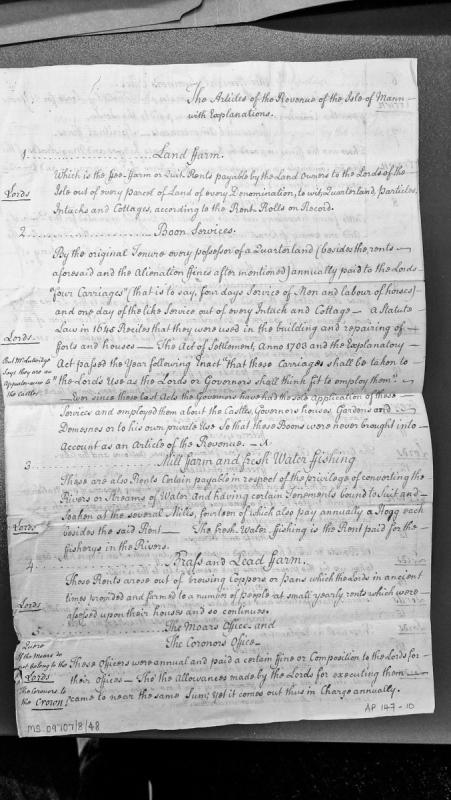
A systematic enumeration and explanation of the principal revenue sources of the Isle of Mann, including land farm (quit-rents), boon services, mill farm and fishing rights, brass and lead farm, and various offices. The document provides historical context for each revenue article, referencing statutory law from 1645, 1703, and subsequent acts.
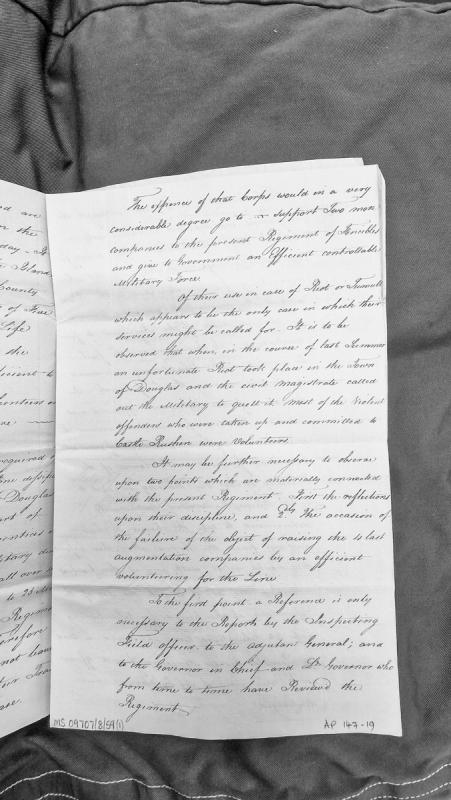
This document discusses the expenses and utility of a military corps in relation to the Regiment of Fencibles, with reference to a riot in Douglas and observations on military discipline and recruitment. It appears to be part of an official report or correspondence regarding military administration on the Isle of Man.
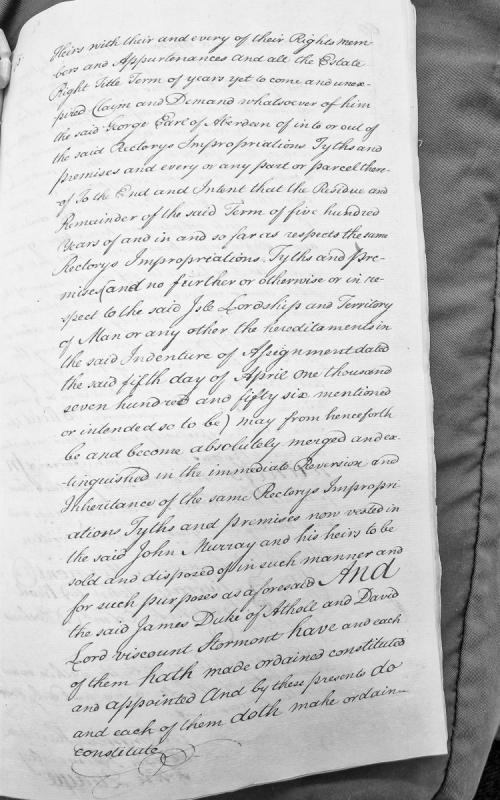
A legal document concerning the assignment and merger of rights to rectorys, impropriationes, tithes and premises. The document references an Indenture of Assignment dated April 5, 1756, and involves the Earl of Aberdeen, John Murray, the Duke of Athole, and Lord Viscount Stormont. The text deals with the extinguishment of a term of five hundred years and the vesting of inheritance rights.
Correspondence between John Murray, 1st Duke of Atholl, and Lord Hawkesbury regarding Atholl's appointment of his brother Lord Henry Murray as Lieutenant Governor of the Isle of Man in August 1804. Hawkesbury firmly rejects the appointment as exceeding Atholl's authority, establishing that only the Crown could confer the Lieutenant Government. The exchange clarifies the constitutional limits of the Duke's powers post-Revestment.
Correspondence between the Duke of Atholl and Lord Hawkesbury (Home Secretary) regarding Atholl's unauthorized appointment of his brother Lord Henry Murray as Lieutenant Governor of the Isle of Man in August 1804. Hawkesbury's stern response clarifies that only the Crown can appoint a Lieutenant Governor, invalidating Atholl's commission. Includes Lord Henry Murray's response acknowledging the invalidity and his limited actions as Commanding Officer.
A collection of letters between the 4th Duke of Atholl and his Isle of Man stewards John Quayle and William Callow (1775–1777), covering post-Revestment manorial administration, revenue collection, mining leases, ecclesiastical affairs, the Governor's House lease negotiations, and interactions with successive governors. Illustrates practical challenges of Ducal sovereignty and relationships with resident authorities.
A curated index and prioritization guide to key documents from the Atholl Papers collection covering the Duke of Atholl's negotiations, valuations, and correspondence regarding the sale of the Isle of Man to the British Crown (1752–1765). Organized by priority level: highest priority documents on the Duke's valuations and decision to sell; second priority on 1764 Treasury and legal correspondence; third priority on smuggling intelligence.
A curated index and finding guide to key Atholl Papers documents covering the Duke of Atholl's negotiations, valuations, and correspondence regarding the sale of the Isle of Man to the British Crown (1752–1765). Organized by priority and topic: highest-priority negotiation documents, 1764 Treasury correspondence, and smuggling evidence. This is a research tool identifying primary sources rather than a primary source itself.
A series of letters exchanged between the 4th Duke of Atholl and his appointed stewards John Quayle and William Callow regarding management of ducal interests on the Isle of Man following the 3rd Duke's death. Topics include revenue collection, mines operations, ecclesiastical matters (Malew Chancel), the Governor's House lease, and administrative concerns. These letters illuminate the transition of Atholl family control post-Revestment and relationships with island officials.
Six letters exchanged between Governors Cochrane and Wood and the Duke of Atholl during Wood's transition to and early tenure as Governor of the Isle of Man (July–December 1761). Letters cover administrative handover, arrival details, revenue remittances (£1500–£2000), appeals procedures, tithes disputes, smuggling activity (spirits and tea imports), and governance procedures. Highly relevant to understanding the administrative structure and revenue dynamics immediately preceding the 1765 Revestment.