A series of six letters from Governor Cochrane and his successor Governor Wood to the Duke of Atholl, covering the handover of the governorship, arrival on the Isle of Man, financial remittances, appeal procedures, revenue collection, and smuggling activity (spirits and tea imports). These letters document the administrative operation of the island under Atholl's sovereignty, shortly before the 1765 Revestment.
Letter from the Duke of Atholl to Lord Hawkesbury (Home Secretary) outlining proposed administrative reforms for the Isle of Man, including Deemster salary parity, a government house for the Lieutenant Governor, judicial authority clarification, and the appointment of a permanent secretary to the Governor. Reflects post-Revestment governance challenges and Atholl's attempts to strengthen executive control over the Keys.
Letter from the Duke of Atholl to Lord Hawkesbury (Home Secretary) outlining administrative proposals for the Isle of Man, including Deemster salaries, Lieutenant Governor housing, judicial procedure, control of the Keys assembly, and creation of a civil secretary post. Reflects tensions between Atholl and the Manx Keys over governance and finances post-1765 Revestment.
Wadsworth Busk, Attorney General, presents evidence to the Commissioners of Inquiry refuting the Duke of Atholl's claims about fair collection of customs revenues prior to 1765. Busk argues that the vast majority of pre-Revestment customs income derived from illicit smuggling in tobacco, East India goods, spirits, and wine—not legitimate trade. He traces the rise of contraband commerce from c.1709, the role of merchant lessees (1720–1727), and subsequent decline due to Parliamentary restrictions and naval enforcement. This document is central to establishing that compensation paid for the Revestment should not have accounted for illegally-obtained revenues.
Letter from Wadsworth Busk, Attorney General, to the Commissioners of Inquiry (1792) presenting evidence that the Isle of Man's customs revenue prior to 1765 was predominantly derived from illicit smuggling—particularly tobacco, spirits, wine, and East India goods—rather than legitimate trade. Busk rebuts the Duke of Atholl's claims that fair revenues were uncollected and could have been increased, arguing that smuggling profits cannot justify compensation and that legitimate customs revenue was minimal (~£100/annum). Critical to understanding the financial justification for the 1765 Revestment.
A legal opinion from William de Grey (Attorney General) dated October 1766, addressing the ownership of fishing rights in Manx waters following the 1765 Revestment Act. The opinion clarifies that sea fisheries (including bay fisheries) belong to the Crown, not to the Duke of Atholl, despite the Duke's reservation of inland waters and fisheries in the Revestment Act. This document is directly relevant to disputes over revenue collection and property rights immediately after the Revestment.
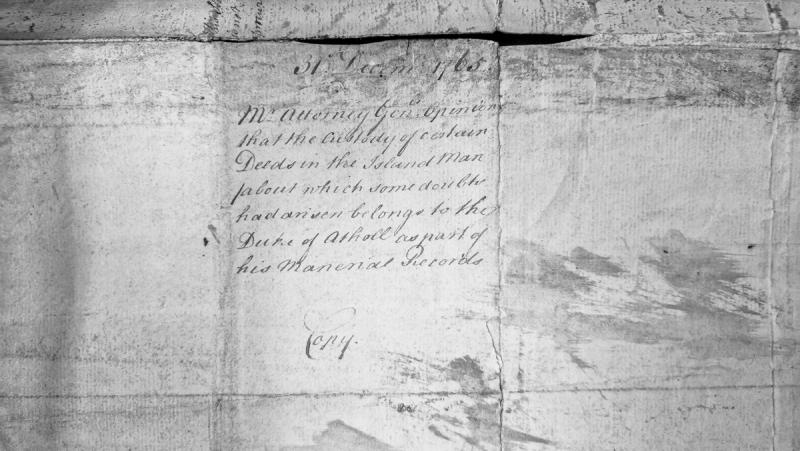
A legal opinion from the Attorney General dated 31 December 1765 addressing questions regarding the custody and ownership of certain deeds held in the Isle of Man. The opinion concludes that these deeds, which had been subject to some dispute, properly belong to the Duke of Atholl as part of his manorial records.
William de Grey (Attorney General) provides a legal opinion on the ownership of Manx fisheries following the 1765 Revestment. The opinion clarifies that while the Duke of Atholl retained certain manorial rights including inland waters and inland fisheries, all sea fisheries (including Bay Fisheries) belong to the Crown. The document addresses a dispute over Lutwidge's possession of Bay Fisheries for the Revenue.
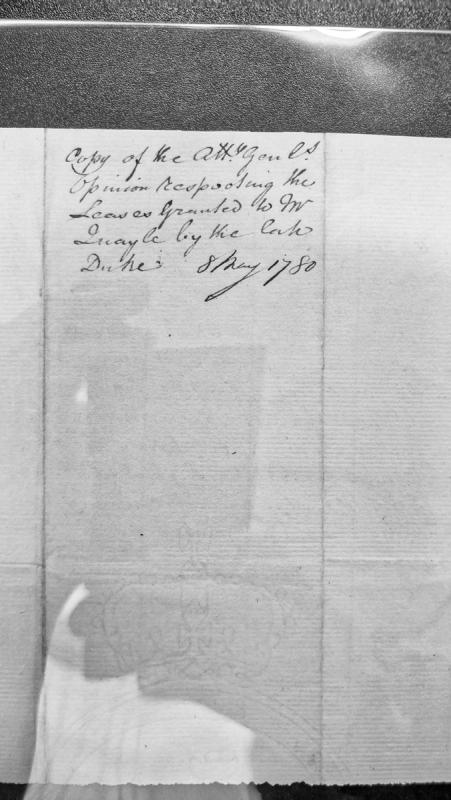
A copy of the Attorney General's legal opinion concerning leases that were granted to Mr Quayle by the late Duke of Atholl. The document provides formal legal advice on the validity and terms of these leases, dated 8 May 1780.
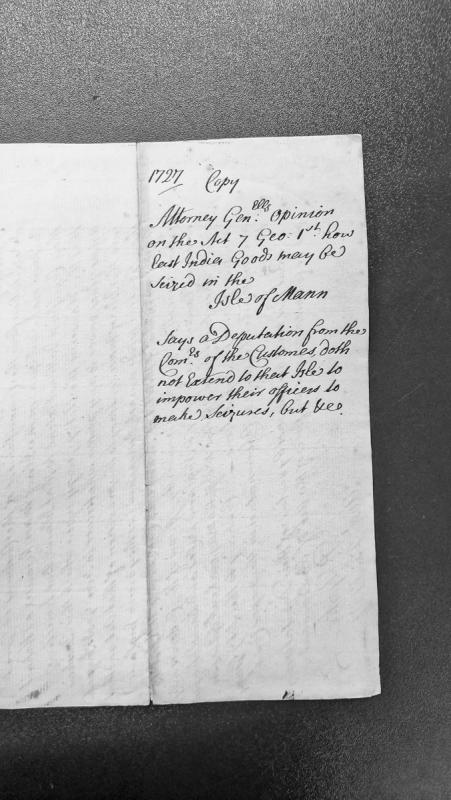
A legal opinion from the Attorney General regarding the application of Act 7 of George I concerning the seizure of East India goods in the Isle of Man. The opinion addresses whether a deputation from the Commissioners of the Customs extends authority to officers in the Isle of Man to make seizures of such goods.
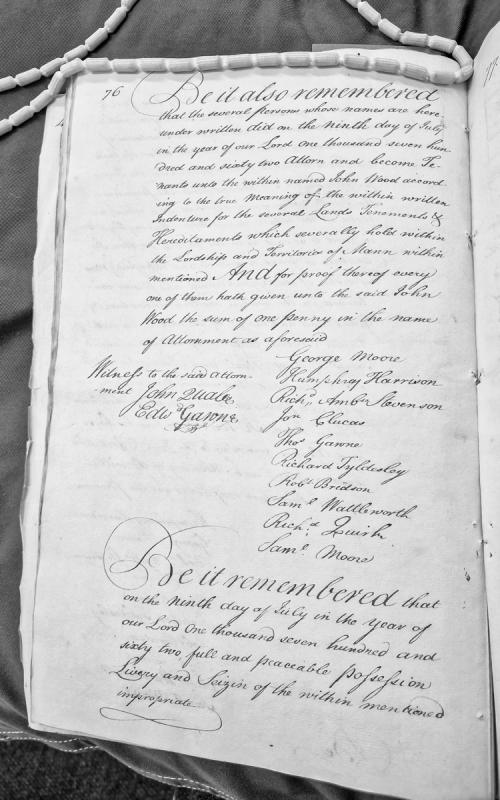
A legal document recording the attornment of multiple tenants to John Wood on behalf of various lands, tenements and hereditaments within the Lordship and Territories of Mann. Each party paid one penny as consideration for the attornment. The document also records the delivery of full possession, livery and seizin of the impropriate lands.
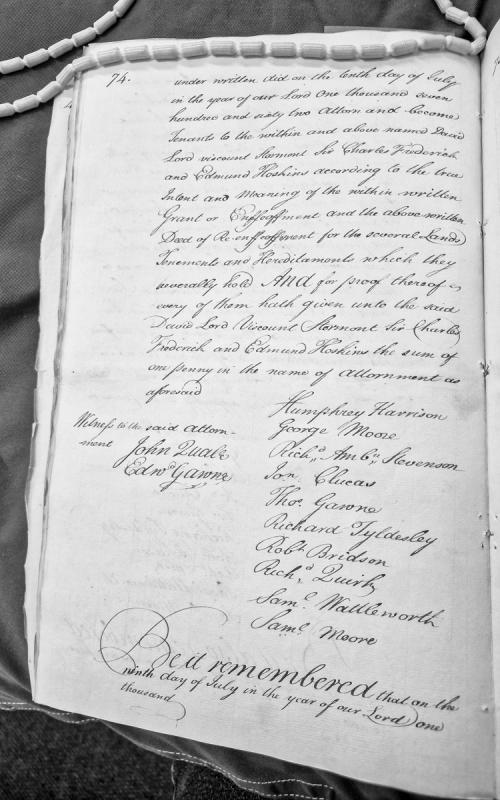
A legal document recording the attornment (transfer of tenancy) of various lands, tenements and hereditaments to David Lord Viscount Stormont, Sir Charles Frederick, and Edmund Hoskins on 10 July 1762. Multiple witnesses attest to the transaction, with symbolic payment of one penny given as proof of attornment.
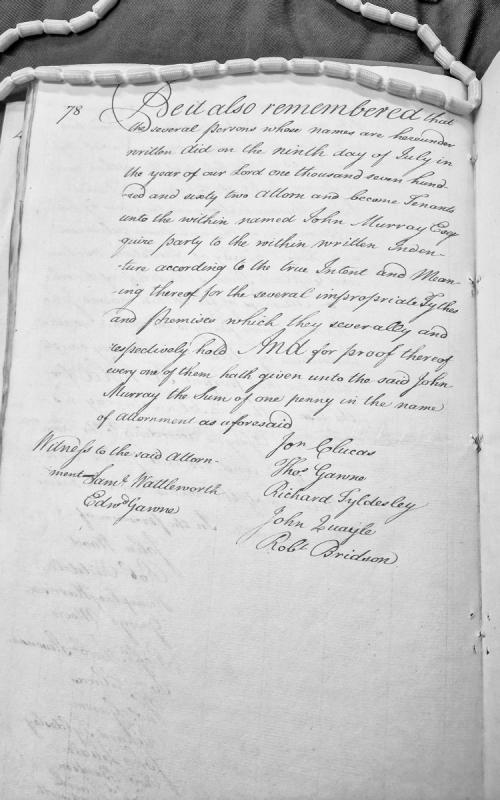
A legal document recording the attornment (transfer of tenancy) of several named persons to John Murray Esquire on 9 July 1762 for impropriate tythes and premises. Each party gave one penny as proof of attornment, witnessed by Samuel Wattleworth and Edward Gawne.
Official correspondence from the Home Office (8 July 1788) clarifying that the Duke of Atholl was NOT to be invested with authority or control over the Isle of Man, despite stronger wording in a Treasury letter. Includes Lord Sydney's formal letter authorizing the Duke's summer visit and George Steuart's survey of Crown properties. Demonstrates tensions between the Duke's claims and actual post-Revestment government policy.
A scholarly subject catalogue entry that synthesizes primary and secondary sources on Isle of Man smuggling (c.1690–mid-19th century). It traces the rise of the running trade, key figures (McGwire, Poole, George Moore, James Murray), legislative responses, and the role of smuggling as a driver of the 1765 Revestment Act. Includes citations to contemporary reports, historical studies, and manuscript sources.
A subject catalogue entry from the Manx Notebook providing a comprehensive historiographical overview of Isle of Man smuggling (c.1690–mid-19th century). It synthesizes secondary and primary sources, discusses the causes and evolution of smuggling under Manx sovereignty, key merchants (George Moore), governors (James Murray), and the role of customs farming. Directly relevant to understanding the economic and legal context driving the 1765 Revestment.
Extract from Bede's Ecclesiastical History (Book II, A.D. 616) describing King Edwin of Northumbria's subjugation of the Mevanian Islands (identified as Anglesey and the Isle of Man) and their extent. Provided with parallel Latin text from the original. Relevant as early historical documentation of the Isle of Man's political status and administrative divisions.
Transcription of passages from Bede's Ecclesiastical History (written c. 731) describing early Anglo-Saxon kings and their dominion over Britain, including the Mevanian Islands (Anglesey and Isle of Man). The text notes that King Edwin of Northumbria subjected these islands to English rule and provides population estimates. Provides historical context for medieval Manx sovereignty and early English claims to the island.
Letter from Benjamin Franklin in London to Isaac Norris in Philadelphia reporting on Parliamentary and Board of Trade proceedings relating to Pennsylvania colonial affairs, including the Indian Trade Act, proprietary disputes, and publication of the Historical Review. Discusses smuggling-adjacent trade regulation issues and constitutional tensions between Assembly and Proprietors.
Letter from Benjamin Franklin in London to Joseph Galloway regarding Pennsylvania Assembly business before the Privy Council, including presentation of colonial laws and financial advice on British stocks. Discusses the Proprietor's opposition to Pennsylvania legislation and investment strategy during wartime.
Letter from Benjamin Franklin, Pennsylvania's agent in London, to Speaker Thomas Leech and the Assembly Committee of Correspondence, detailing legal proceedings before the Attorney and Solicitor General regarding William Smith's petition against the Pennsylvania Assembly, and Board of Trade hearings on Assembly acts. Discusses constitutional issues of parliamentary privilege, the scope of colonial assembly powers, and proprietary interference with provincial governance.
Benjamin Franklin reports to the Pennsylvania Assembly Committee of Correspondence on legal proceedings regarding William Smith's imprisonment by the Assembly, the status of an Attorney General's report, and strategic advice on constitutional issues arising from potential direct Crown governance. Includes discussion of legal opinions on Assembly privileges and a planned propaganda work to improve the colonies' reputation in Britain.
Letter from Benjamin Franklin in Paris to Thomas Walpole in London discussing Franklin's financial interest in the Walpole (Grand Ohio) Company, his request for reimbursement of £200 for two shares, and prospects for the Company's land claims in Virginia. Includes extensive editorial commentary examining the tension between Franklin's role as American diplomat and his private interest in western land speculation.
Letter from Benjamin Franklin in Paris to Thomas Walpole in London concerning Franklin's financial claims and shares in the Walpole (Grand Ohio) Company, written during the American Revolution. Includes extensive editorial commentary on Franklin's involvement with western land speculation, his role as diplomat, and potential conflicts of interest regarding territorial claims. Contextualizes Franklin's business interests against his diplomatic negotiations and Congressional peace commission work.
A substantial letter from Benjamin Franklin to his son William Franklin, written in London on 14 July 1773, discussing the Pratt-Yorke legal opinion on Indian land grants, Franklin's evolving theory of settlers' rights to acquire territory independently of Crown sovereignty, land speculation schemes (particularly the Walpole Company and Retribution Grant), political intrigue with Lord Hillsborough, and personal and family matters. The letter provides critical evidence of Franklin's radical constitutional thinking regarding colonial independence and his involvement in western land speculation.