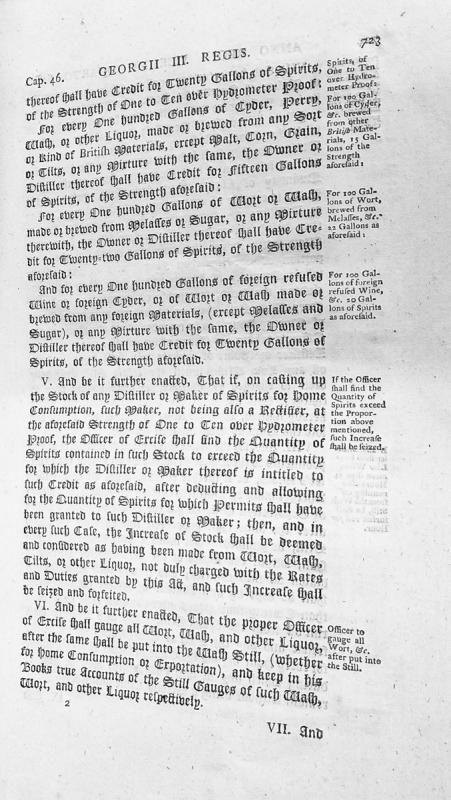
This is an excerpt from a printed Act of Parliament under King George III (Cap. 46) regulating the distillation of spirits and establishing excise duties. It details credit allowances for spirits produced from various materials (malt, cyder, molasses, foreign wine, etc.) and establishes procedures for excise officers to gauge and account for wort, wash, and other liquor in distillation.
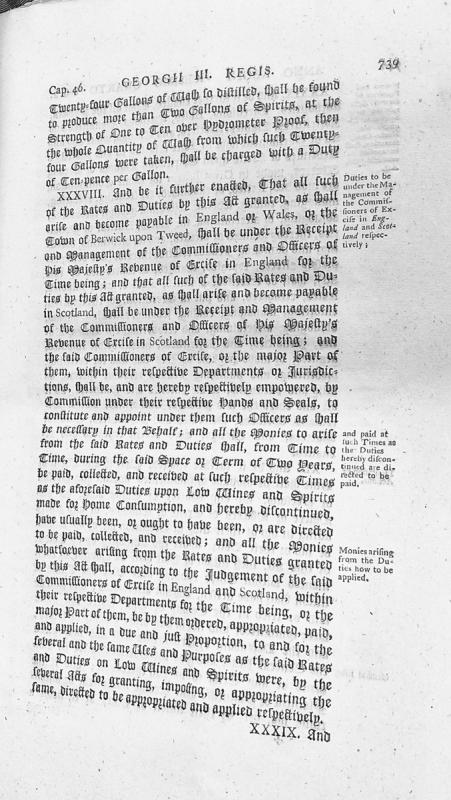
Extract from a printed Act of Parliament under King George III (Cap. 46) detailing excise duty regulations for spirits production and the management of revenue collection. Sections XXXVIII-XXXIX specify duties on wash distillation, administration by Excise Commissioners in England, Wales, Scotland, and Berwick upon Tweed, and application of collected revenues.
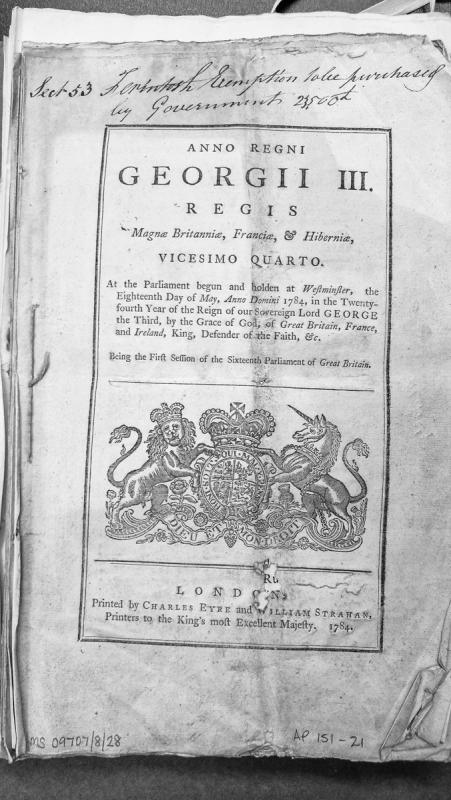
Title page and opening of a printed Act of Parliament from the first session of the sixteenth Parliament of Great Britain, dated May 18, 1784, during the reign of George III. References a section concerning the Lorentosh exemption to be purchased by Government for £23,500.
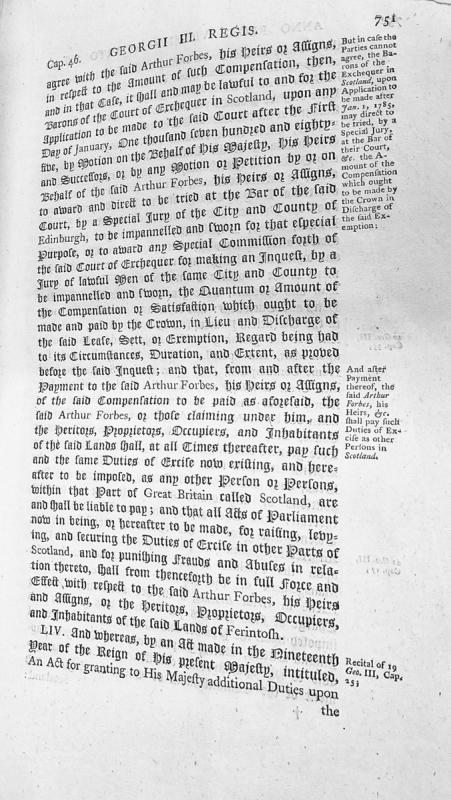
This is an excerpt from a printed Act of Parliament during the reign of George III, specifically Chapter 46. It details legal provisions regarding compensation to be paid to Arthur Forbes (or his heirs/assigns) for the discharge of a lease or exemption on lands of Ferintoſh in Scotland. The document outlines the procedure for determining compensation amount through the Court of Exchequer in Scotland via special jury, and specifies that thereafter the lands shall be subject to excise duties like other parts of Scotland.
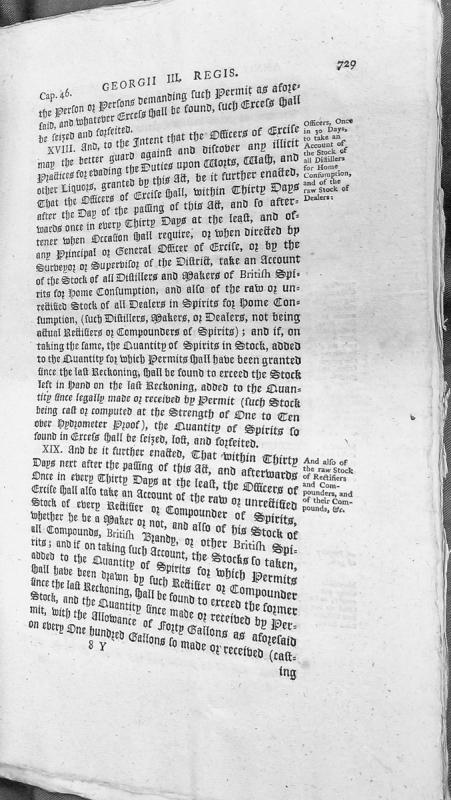
Sections XVIII and XIX of a printed Act of Parliament (George III) establishing excise regulations for distillers and spirits dealers. The sections detail mandatory accounting procedures for excise officers to monitor stock of spirits, enforce duty compliance, and prevent illicit practices. Officers must take stock accounts at least every 30 days.
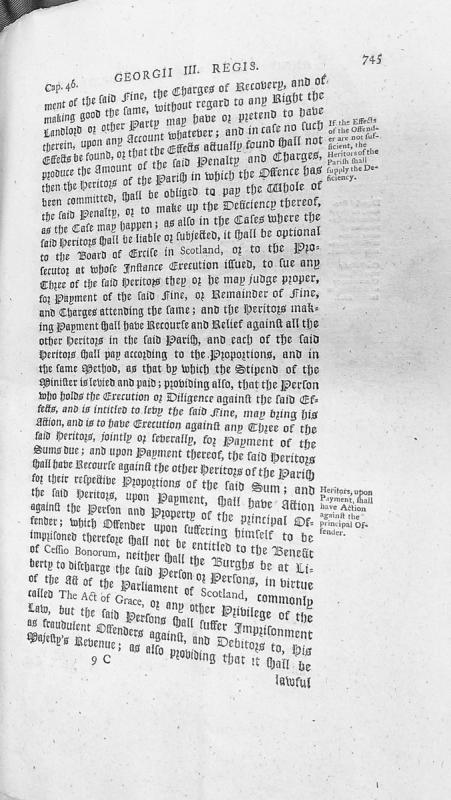
This is an excerpt from a printed Act of Parliament under George III (Cap. 46), page 745. It details provisions regarding the recovery of excise fines and penalties, specifically addressing the liability of parish heritors (landholders) when an offender's effects prove insufficient to cover fines and charges. The text outlines procedures for collection, rights of recourse among heritors, and restrictions on prisoners' legal privileges.
This is a fragment of a printed Act of Parliament under the reign of George III, specifically Chapter 46. It details regulations for excise officers regarding the monitoring of spirits stocks, permits, and forfeiture procedures for excess quantities. The text addresses duties on worts, wash, and other liquors, with provisions for regular stock-taking by excise officers.
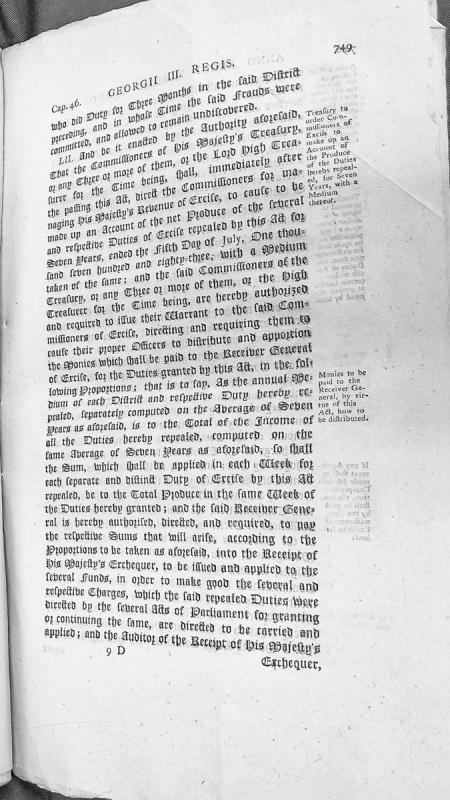
This is an excerpt from an Act of Parliament during the reign of George III, specifically Chapter 46. It deals with Treasury and Excise Commission procedures for accounting for repealed excise duties over a seven-year period (ending July 5, 1783) and establishing proportional distribution formulas for new excise monies to various funds and charges.
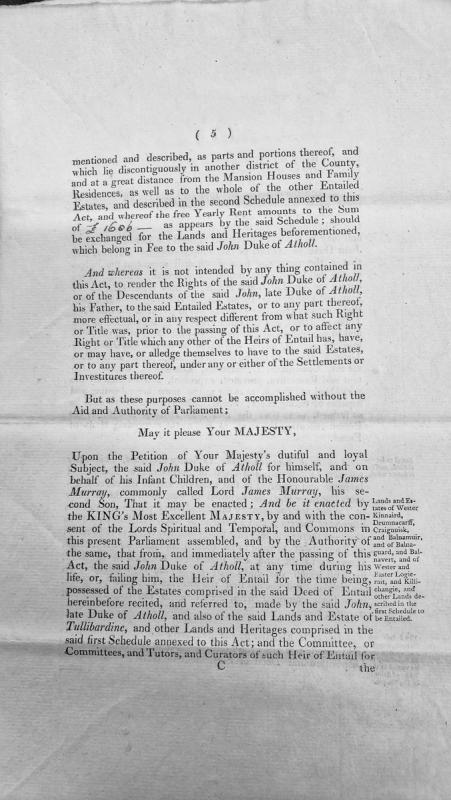
This is an excerpt from a parliamentary act concerning the entailed estates of John, Duke of Atholl. The document outlines provisions for exchanging certain discontiguous entailed lands in Perthshire (including Wester Kinnaird, Drumnacarff, Craignuisk, and other named properties) with lands belonging in fee to the Duke. The act establishes the legal framework and authority for these transactions while protecting the rights of heirs of entail.
A parliamentary act from 1610 (7 James I) confirming William, Earl of Derby's grant and ownership of the Isle of Mann, its castle, lordship, and all associated rights, properties, ecclesiastical patronage, and revenues. The act also settles the succession through James Lord Stanley and Robert Stanley, extinguishes competing claims from the heirs of Ferdinando, Earl of Derby, and includes saving clauses for existing leases and the Archbishop of York's metropolitan jurisdiction.
A 1610 Act of Parliament under James I confirming William, Earl of Derby's hereditary possession of the Isle of Man, its castle, lordship, and all associated rights, franchises, and revenues. The act extinguishes competing claims from the heirs of Ferdinando, late Earl of Derby, and establishes strict entailment to the male line. This document is fundamental to understanding the constitutional and property basis of the Earls of Derby's sovereignty over Man before the 1765 Revestment.
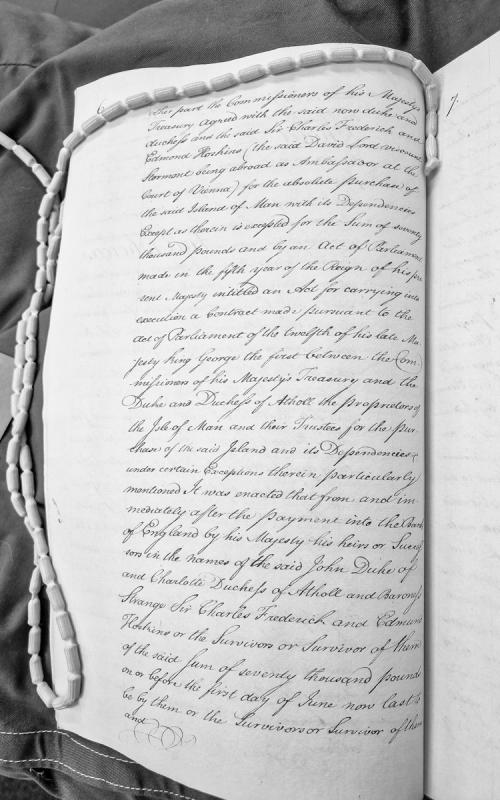
Fragment of legal text describing an Act of Parliament authorizing the purchase of the Isle of Man and its dependencies from the Duke and Duchess of Atholl for seventy thousand pounds. The document details the negotiation between the Commissioners of His Majesty's Treasury and the proprietors, referencing earlier parliamentary acts and naming the parties involved in the transaction.
The Act of Settlement codified the relationship between lord and people, securing Manx land rights and defining the custodianship. It happened because the Lord needed his tenants to invest in land they believed was theirs — the alignment of interest producing constitutional settlement. This was the arrangement Parliament would purchase in 1765 without understanding what it was buying.
The Act of Settlement 1703 is a foundational Manx constitutional and property law document passed by Tynwald Court. It codifies the relationship between the Earl of Derby (Lord of Mann) and his tenants, establishing customary estates of inheritance, standardising fines on descent and alienation, and resolving long-standing disputes over tenancy terms. The act also addresses cottages, intacks, mortgages, and quarries. This document is central to understanding Manx landholding law, feudal relations, and governance structures before the 1765 Revestment.
The 1703 Act of Settlement, passed at Tynwald Court, formally codified and confirmed the estates, tenures, fines, rents, suits, and services owed by tenants to James, Earl of Derby, Lord of the Isle of Man. The Act resolved long-standing disputes between the Lords and tenants, established hereditary customary estates, fixed fine schedules for inheritance and alienation, and set terms for mortgages, cottages, intacks, and quarries. It is fundamental to understanding Manx land law and property rights on the eve of the 18th century.
A brief historical overview of the 1703/4 Act of Settlement (Act of Tynwald), describing how Manx farmers gained rights to possess and alienate land, ending feudal restrictions imposed by the Seventh Earl. The article credits Bishop Wilson as the reform's architect and references A.W. Moore's History of the Isle of Man and Spenser Walpole's Land of Home Rule as key sources.
A web-based historical summary of the 1703/4 Act of Settlement (Act of Tynwald), which granted Manx farmers/tenants the right to possess and alienate their land, ending a century of feudal discontent under the Seventh Earl of Derby. The page contextualises the act as the Manx equivalent of Magna Carta and credits Bishop Wilson as the reform agent.
Act of Tynwald securing the customary tenants of the Isle of Man in estates of inheritance, passed in 1703 and proclaimed on the Tynwald Hill on 6 June 1704.
Its full title is an Act for the perfect settling and confirmation of the estates, tenures, fines, rents, suits and services of the tenants of James, Earl of Derby, within the Isle of Man. It was passed at a Tynwald Court at St John's Chapel on 4 February 1703, by the Earl as Lord of the Isle, Robert Mawdesley as Governor, the Lord's other officers and the twenty-four Keys.
The dispute it settled was over a hundred years old. The tenants claimed an ancient tenure of inheritance which they called the tenure of the straw. The Lord's officers would not allow it, because of the breaks that had been made in that manner of holding by the granting of leases, a change dated by one nineteenth-century editor to 1643 and laid at the door of the seventh Earl. Delegates of the Keys made proposals to the tenth Earl on behalf of themselves and all the tenants, and those proposals, slightly modified, became the Act. Estates were declared good and perfect customary estates of inheritance, descendable from ancestor to heir, in return for fines certain on descent and on alienation and the accustomed rents, boons, suits and services. The Lord expressly reserved his royalties, regalia, prerogatives, homages, fealties, escheats, forfeitures, mines and minerals, quarries, franchises and jurisdictions.
Bishop Wilson's part in the negotiation is recorded in his own diary. On 6 September 1703 he wrote that he had been, he hoped, a happy instrument in bringing the Lord of Man and his people to an agreement, his Lordship having that day condescended to settle them upon a certain tenure, or rather to restore them to their ancient tenure, which had been uncertain for more than a hundred years.
The Act did not lapse at Revestment. One of the earliest statutes passed after the Crown purchased the sovereignty in 1765 was an Act for the more effectual confirmation and establishment of the Act of Settlement and the Act of Tynwald explanatory thereof, which declared both to be the basis of the tenure of lands in the Island. It was promulgated on 9 September 1777, and the royal approbation was signified from St James's on 21 August 1777 in a letter from Suffolk returning the Acts transmitted by Governor Smith. The Act is repeatedly described in the Manx Society volumes as the Magna Charta of the Island as between the Lords and their tenants.
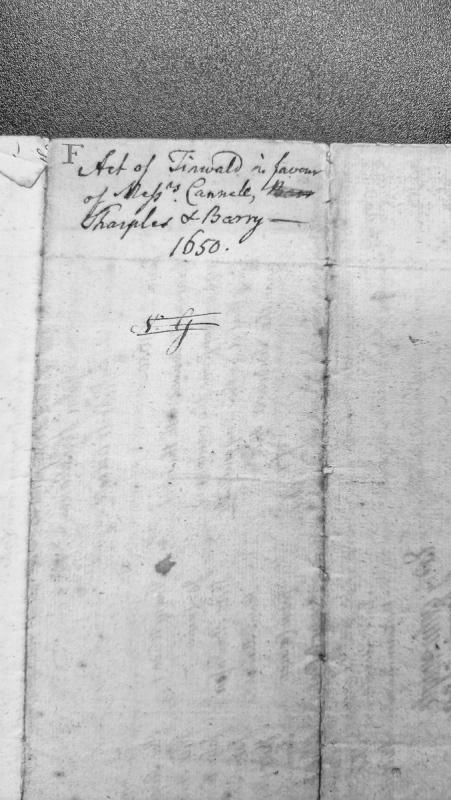
An Act of Tinwald (Manx legislative body) from 1650 granting favour or privileges to three named parties: Cannele, Sharples, and Barry. The document appears to be a legislative record or formal act.
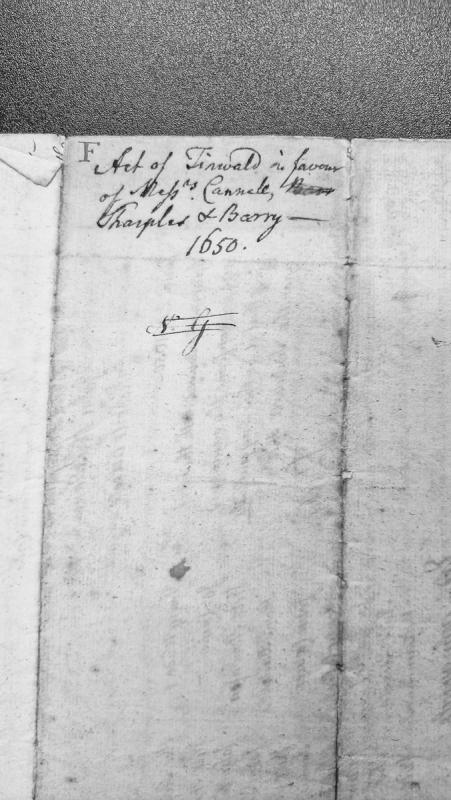
An Act of Tinwald (the Manx legislative body) from 1650 favouring the merchants or parties Cannell, Sharples and Barry. The document appears to be a legislative enactment granting some privilege, right, or favour to these named individuals.
This is an excerpt from a legislative act concerning the settlement and entailment of lands belonging to John, late Duke of Atholl. The document details the vesting of certain lands in fee simple and the conditions under which entail provisions may be altered through authorized exchanges, while preserving the rights of heirs of entail.
This is an excerpt from Chapter 46 of an Act passed during the reign of George III, concerning regulations for distillers and makers of spirits. The preamble outlines problems with distillers withdrawing their still-house entries while leaving equipment in place, suspected illicit night-time distilling, and the inadequacy of penalties preventing excise officers' access to premises. The legislation aims to strengthen revenue security and fraud prevention.
This is an excerpt from a printed parliamentary act (14 Geo. III, Cap. 73) extending regulations for distillers of Low Wines and Spirits, particularly concerning furnace doors, stills, and locks under excise control. It addresses fraud prevention in wash still charges and clarifies that distillers cannot claim allowances for increased wash due to water or other fluids.
This is an excerpt from a statute during the reign of George III (Cap. 46), focusing on excise regulations for spirit distillers. It prescribes standards for wash still piping to prevent fraud, sets penalties for violations, and grants excise officers powers to sample liquors during fermentation and conveyance.
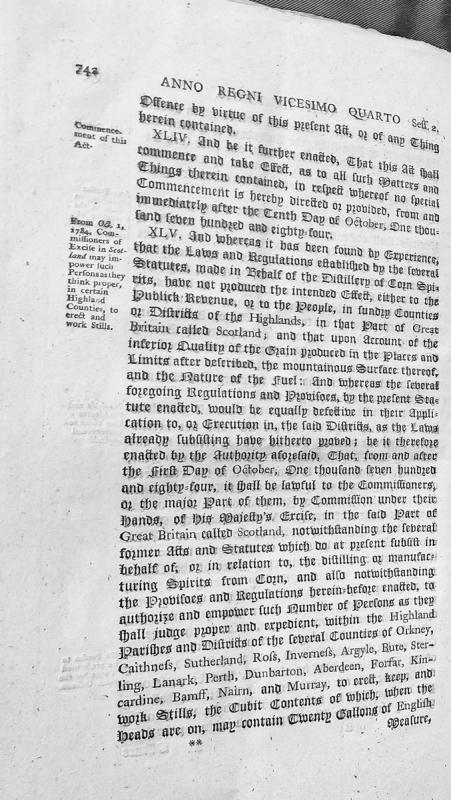
This is an excerpt from a statute (anno regni vicesimo quarto, session 2) establishing regulations for the distillery of corn spirits in Scotland. Section XLV authorizes the Commissioners of Excise in Scotland to empower persons to erect and operate stills in specified Highland parishes and counties, effective from October 1st, 1784, due to previous legislation's ineffectiveness in Highland regions.