Official report from Charles Lutwidge to the Treasury (dated 15 June 1765, three days before the Revestment became effective) detailing his arrival at the Island with His Majesty's Cutter Cholmondeley and deployment of officers and boats to four ports. Lutwidge reports on fraudulent licensing of rum and brandy shipments claimed for African trade but actually intended for smuggling, and recommends stricter controls on future export licences. Highly significant as evidence of immediate post-Revestment revenue enforcement and the smuggling problem the Crown inherited.
Official letter from Charles Lutwidge to the Treasury reporting his arrival at the Isle of Man with revenue officers and enforcement vessels, and noting fraudulent licensing practices for rum and brandy exports. Dated 15 June 1765, just days before the formal Revestment. Lutwidge recommends tightening export license conditions to prevent smuggling.
A detailed administrative report from Charles Lutwidge (Receiver General for the Isle of Man) to the Lords of the Treasury, responding to an order of 18 May 1764 to investigate smuggling between the Isle of Man and Great Britain. The report catalogues goods smuggled (tea, brandy, wine, tobacco, silks), quantifies the Duke of Atholl's revenue (£7,500 p.a., with £6,500 from smuggling duties), identifies four major smuggling ports, estimates national revenue loss at £200,000 p.a., and describes smuggling techniques including fraudulent coastal clearances and drawback abuse.
Official report by Charles Lutwidge (Whitehaven) to the Duke of Atholl's officials on the extent and nature of smuggling from the Isle of Man to Great Britain, detailing imported goods (tea, brandy, wine, tobacco, silk), smuggling routes, estimated annual revenue losses (£200,000–£300,000), and the Duke of Atholl's annual income (£7,500). Includes methodological analysis of smuggling evasion tactics and comparison to Irish legislative approaches.
Official report from Charles Lutwidge to unnamed Parliamentary honours (likely Treasury or Customs commissioners) detailing the scale and methods of smuggling operations from the Isle of Man, the goods involved, duty rates under the Duke of Atholl's proprietorship, and estimated revenue losses to the Crown. Lutwidge estimates the Duke's annual revenue at £7,500, with £6,500 derived from duties on foreign goods smuggled via the island. The report identifies specific smuggling routes, ports, commodities (particularly tea, brandy, tobacco, and East India goods), and fraudulent practices including false coast-clearances and drawback frauds.
Detailed report from Charles Lutwidge, revenue official at Whitehaven, responding to an order from the Atholl Papers archive (dated 18 May 1764) to assess smuggling between Isle of Man and Great Britain. Provides comprehensive account of foreign goods imported to the Island, duties payable to the Duke of Atholl, estimated annual revenue (£7,500), and analysis of smuggling routes, methods, and estimated losses to the Crown (£200,000 annually). Documents the Island's four principal ports and supplies key evidence for understanding the economic incentives behind the 1765 Revestment.
Memorial from Charles Searle, Attorney General of the Isle of Man, to the Lords Commissioners of the Treasury requesting an increase to his £100 annual salary. Searle details inadequate compensation, office expenses, and compulsory unpaid legal work on revenue matters and orphan/widow cases. The document provides insight into the administrative structure and financial arrangements of the Isle of Man post-1768 and the impact of declining trade on legal practice.
A memorial petition from Charles Searle, Attorney General of the Isle of Man, to the Treasury Lords requesting an increase to his £100 annual salary, citing inadequate compensation for his duties and the declining profitability of legal practice on the island. Undated but contextually placed c.1768–1774, the document illuminates post-Revestment administrative challenges, revenue matters, harbour jurisdiction, and the Crown's assumption of powers previously held by the Duke of Atholl.
Eighth Earl of Derby and Lord of Mann, under whom William Christian was tried and shot.
His mandate, dated at Lathom in September 1662, directed that Christian be proceeded against for all his illegal acts at, before or after 1651. In the December of that year, at Castle Rushen, seven of the twenty-four Keys were removed from the House by his order, and a modern historian reads that removal as securing a unanimous decision in the Lord's favour in the case then before them. Christian was shot at Hango Hill on 2 January 1662-3.
The Earl's business with the Christians did not end there. Writing from Derby House on 22 June 1663 to Sir Henry Bennet, Principal Secretary of State, he asked for the King's commands concerning George Christian, and for the dismission of certain persons then in town, whose absence from the Island he thought would secure its peace and its allegiance to the King.
Charles Yorke, the Home Office official through whom the Isle of Man's correspondence passed.
He served in the Northern Department of the Home Office under Lord Hawkesbury in the early 1800s, and it was to him that the various reports and letters from the Manx Governors were directed. The Island's business reached the Secretary of State through that department, so the Lieutenant-Governor's despatches, the Duke of Atholl's complaints and the appointments to the Manx bench all crossed his desk in those years.
That is the whole of him in the Manx record: one editorial note identifying the channel. The office matters more than the man, and it is given here because the channel itself is worth knowing.
Single storey, double-fronted thatched cottage, originally constructed before 1868 (present on Ordnance Survey 1:2500 1st edition map of that date).
Acquired by the Manx Museum and National Trust in 1950.
The structure is maintained as a ruin.
Extract from Draper's 1864 'House of Stanley' covering Charlotte de la Tremouille, Countess of Derby, her imprisonment during the Civil War, her post-Restoration vindication including the trial and execution of Captain William Christian in 1662-3, and her genealogical descendants. Includes detailed discussion of Tynwald Court procedures and Isle of Man law, with references to Sir Walter Scott's Peveril of the Peak.
Heiress through whom the Stanley title to the Lordship of Man passed into the Atholl family and one of the parties to the 1765 Revestment.
Charlotte was the only surviving daughter of James Murray, second Duke of Atholl, and inherited through her mother, Amelia Stanley, the Stanley claim to Mann. The succession placed her in the line descending from the Earls of Derby who had held the Island for generations.
She married her cousin John Murray, third Duke of Atholl, in 1753. Later Manx accounts identify Charlotte as Duchess of Atholl and Baroness Strange and describe the Lordship of Man as passing to her through the female Stanley line.
In 1765 she and her husband negotiated with the British government over the surrender of the sovereign rights attached to the Lordship. The resulting agreement was confirmed by Act of Parliament. The Crown paid £70,000 for the rights transferred under the purchase.
The transfer did not remove every Atholl interest in Mann. Later documents distinguish between the sovereign rights surrendered in 1765 and other proprietary, ecclesiastical and landed interests retained by the family.
Contemporary Manx liturgical material still reflected Charlotte’s position immediately before Revestment. The Manx Prayer Book included prayers for “the Lord and Lady, and Rulers of this Isle”, preserving the proprietary household within the Island’s public worship.
The Revestment could not happen without Charlotte Murray’s written consent. She held the lordship through the Barony of Strange — a title that passed through heirs general (male or female), not heirs male only. Her husband the Duke held the title through her. Without her signature, the entire transaction was void.
What was the Barony of Strange? What did consent mean when a wife could not legally act independently of her husband? Was her consent real or ceremonial? If Charlotte had refused, could the Revestment have happened at all?
Research her life, her family’s connection to the lordship, and the legal mechanics.
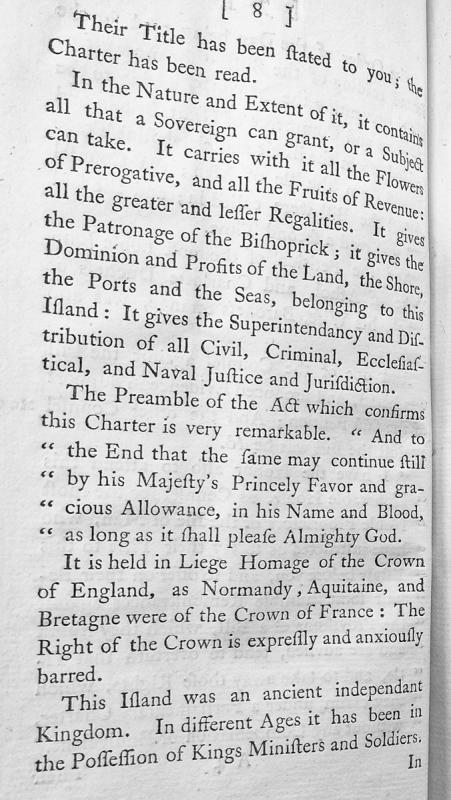
A legal discourse explaining the nature and extent of the charter governing the Isle of Man, detailing the sovereign powers, prerogatives, and jurisdiction it grants. The document discusses the charter's confirmation by Act, its historical context as an ancient independent kingdom, and its current relationship to the English Crown held in Liege Homage.
A 1305 charter in which Aufrica de Connaught, heiress of the Isle of Man, grants all her hereditary rights and title in Man to Simon de Montacute, a knight. The document includes both English and Latin versions and demonstrates the feudal transfer of Manx sovereignty in the medieval period, providing important context for understanding the island's constitutional status before the later Atholl and Revestment periods.
A charter issued by Aufrica de Connaught, heiress of the Isle of Man, in 1305, formally transferring her rights and inheritance in Man to Simon de Montacute, a knight. The document commands the people of Man to receive Montacute as their lord and render him the same obedience and service they would have rendered to Aufrica. This represents a key moment in medieval Manx succession and feudal authority.
A royal charter dated 1 May 1308 in which King Edward II grants sovereignty and administration of the Isle of Man to Henry de Bello Monte for his lifetime. The grant includes all lordships, royal justice, knight's fees, church advowsons, liberties, customs, and escheats. This document is foundational to understanding pre-Revestment feudal tenure of Man and the trajectory of Manx lordship before the 1765 purchase.
A royal charter from Edward II (dated 1 May 1308) granting the Isle of Man to Henry de Bello Monte for his lifetime, including all lordships, royal justice, knight's fees, church advowsons, liberties, customs, escheats, and other privileges previously held by the lords of Man under the Kings of Scotland. The document includes both English and Latin versions and derives from the Manx Society's Monumenta de Insula Manniae collection.
A charter issued by Godred (Godred Crovan), King of the Islands, granting the Church of Holy Mary of Furness full liberty to elect a chief bishop of the Isles. This primary source demonstrates early medieval Manx governance, ecclesiastical authority, and the Crown's relationship with the Church, and provides context for understanding the island's constitutional and spiritual history prior to the 1765 Revestment.
A 12th-century charter issued by Godred (Godfred), King of the Islands (Man and the Hebrides), granting the Church of the Holy Mary of Furness full liberty to elect a chief bishop of the Isles. The charter references his father Olave's earlier grant and reinforces ecclesiastical authority. This document is foundational to understanding pre-Norman Manx sovereignty and Church relations.
A royal charter by Harald, King of Mann and the Islands, granting protection and safe passage to vessels, persons, and goods of the Abbot and monks of Furness Abbey. The document demonstrates medieval Manx royal authority and the island's relationship with religious institutions and trade. It provides context for understanding pre-Revestment governance structures and the kingdom's institutional framework.
A charter issued by King Harald of Mann (c. 1245) granting royal protection to the Abbot of Furnes Abbey and his monks, their vessels, and their goods. The document demonstrates the ecclesiastical-royal relationship and Harald's authority over Mann. Originally held in the Cottonian MSS, this is an HTML transcription from the Manx Society publication series.
A 13th-century royal charter issued by Magnus, King of Mann and the Islands, granting the Prior and Convent of Coningshead exemption from all tolls (Thol) and customs duties throughout Manx territories. The document reveals the early medieval administrative structure of Mann, royal revenue mechanisms, and ecclesiastical privileges. Relevant to understanding pre-Revestment Manx governance and the historical foundations of the island's constitutional position.
A royal charter granted by Magnus, King of Mann and the Islands, to Richard, Bishop of Mann and the Isles, confirming ecclesiastical liberties, territorial grants (including the Island of St. Patrick and the village of Kellerast), fishing and commercial rights, and mineral rights. This document is a web transcription from Manx Society publications and provides context for medieval Manx governance and church-state relations prior to the 1765 Revestment.