The findspot of an early prehistoric flint scatter, including rude flint flakes and chips were found by C.H. Cowley on a small patch of ground a few metres square at an altitude of 487 metres above sea level.
The site of a mound of unknown significance, recorded by William Cubbon and re-examined by Dr Larch S. Garrad. It was found that there were two sub-circular platforms at track level, with two more on the upper level. They measure circa 12-15 metres in diameter, with some stone apparent at the latter site.
Undated midden.
A midden of animal bones, of possibly Iron Age date, was uncovered in the course of extracting sand within the curtilage of a house being built in 1923. The sand deposit was found at a depth of 3.3m below ground level and appeared to be associated with a raised beach of not later than Neolithic date.
Within the deposit were three layers of fine red gravel and small flinty stones containing remains of ox, pig, sheep and red deer, the last included a rib with signs of human working. The origin of the material was uncertain as it may be redeposited or insitu.
L.S. Garrad compared the site with Perwick Cave (PRN 0055) and suggested that it might be of similar, that is, Iron Age date.
Colonel Robert Duckenfield (c.1619-1689) was the Parliamentary commander who received the surrender of the Isle of Man in 1651. After William Christian (Illiam Dhone) led the Manx people in rising against the Stanley garrison, Duckenfield crossed from Lancashire to take possession of the Island. Charlotte de la Trémouille held out briefly in Castle Rushen and Peel Castle before negotiating terms. Duckenfield's arrival marked the end of direct Stanley rule and the beginning of the Interregnum on the Island.
The Countess tried to trade the Island for her husband's life. The Earl had written to her from prison advising her to comply, and on receiving the letter she thought it prudent to do so, sending her servant Broyden with letters to Duckenfield, the Commander in Chief appointed for the expedition against the Island, treating about its rendition on condition that the Earl might be released. It was too late. The Earl had been beheaded some days before the letter reached her.
His chaplain was used on the Earl as well. Mr Slater, Duckenfield's chaplain, came to him from the Governor to persuade him that his life was in no danger, and the Earl heard the discourse patiently but did not believe a word of it, being resolved not to be deceived.
He reported to London on the spoils. John Bradshaw wrote to him in 1651 acknowledging his letter of 3 December with papers enclosed concerning the goods in the Isle of Man likely to be prize, and noting that this and his other letters since the taking of the place had been referred on.
Governor-in-Chief of the Isle of Man in the later 1770s and early 1780s.
Smith succeeded John Wood as Governor-in-Chief while Richard Dawson continued to act as Lieutenant-Governor. The surviving correspondence shows that Smith spent significant periods away from the Island, with day-to-day administration often left to Dawson.
His letters nevertheless dealt directly with Manx government. In July 1777 he wrote to the Earl of Suffolk about the customs establishment and proposed changes to its organisation. Other correspondence records his involvement in transmitting Manx legislation and in discussions over the relationship between the Governor, Council, Deemsters and Keys.
Smith also intervened in questions of coinage. In January 1779 he wrote concerning the need for new copper coin for the Island. He explained that Manx governors had previously arranged coinage by contract and asked that the Treasury determine how the new issue should be handled.
The 1792 inquiry later examined Smith’s period in office critically. One account stated that he had arrived as a stranger to Manx manners, laws and customs and had possessed the government only a few weeks when disputes arose over constitutional practice.
Smith’s own 1783 correspondence shows him preparing to return to Mann and asking whether governors were normally favoured with the King’s portrait to carry to their government.
Colonel Mark Wilks (1759-1831) was born at Kirk Michael Vicarage, the son of the Reverend James Wilks. He served in the Madras army and was Political Resident at the Court of Mysore before being appointed Governor of St Helena by the East India Company in 1813. He was governor when Napoleon arrived in exile in 1815, and the two men developed a mutual respect. Napoleon later lamented his replacement by the rough and tactless Sir Hudson Lowe. Wilks was also a member of the House of Keys and Speaker, and a distinguished oriental scholar and historian.
He came home to the Island and took up its business. He lived at Kirby near Douglas. On 16 October 1817, when the House of Keys inspected its own building and found it not only unfit but imminently unsafe, the members resolved that Mark Wilks and John Christian should form the deputation to wait on the Lieutenant-Governor and impress on him the urgent necessity of soliciting the Secretary of State for an immediate order to rebuild it. He was still in public life in December 1826, when he appears in the list of magistrates for Braddan.
He wrote on Manx history too, and the Manx did not thank him for it. He is taken to be the author of the anonymous tract on the characters in Peveril of the Peak, privately printed and very sparingly circulated, and afterwards reprinted in an appendix to the introduction of the last edition of that novel and in Forsyth's Antiquary's Portfolio of 1825, along with the Lament for Illiam Dhone and the Privy Council's order of 5 August 1663. One editor remarks that Sir Walter Scott took all its statements upon trust and entirely mistook some of the principal characters. The Manx Society's editors were sharper: Colonel Wilks, they wrote, was neither a stranger nor unacquainted with the laws and customs of his native country, and so could not have been induced from any motive to pen the erroneous statements the pamphlet contains.
The family produced other men of note. His sister Margaret married the Rev. Thomas Cubbon, and their seventh child was Sir Mark Cubbon, born at the vicarage of Maughold on 23 August 1775, who served sixty years in India. Sir Mark Wilks Collet, Governor of the Bank of England, was a Manxman by descent connected with this family and, it was believed, with the Corletts of Loughan-y-yei in Lezayre.
Colonel William Christian (1743-1786) was a frontier soldier and politician in colonial Virginia, descended from the Christian family of the Isle of Man. He married Anne Henry, sister of the revolutionary patriot Patrick Henry, and served as a colonel in the American War of Independence, leading campaigns against the Cherokee. He was killed by Native Americans in 1786.
Monograph examining the economic history of Boston, New York, and Philadelphia as nodal centers in Atlantic and global trade networks. Argues that colonial merchants' trans-imperial commerce and resistance to British mercantilist constraints formed the economic roots of American independence. Relevant for understanding how trade networks and smuggling created political tensions preceding the Revolution.
Modern watermill. The Ordnance Survey 1:2500 First Edition mapping of 1867-8 depicts a watermill at this location, annotated 'T. Mill'. The building has been demolished.
Modern watermill.
The Ordnance Survey 1:2500 First Edition mapping of 1867-8 depicts a watermill at this location, annotated 'T. Mill'.
This farm threshing mill has been demolished and the land returned to agriculture.
Modern millpond.
The Ordnance Survey 1:2500 First Edition mapping of 1867-8 depicts a watermill at this location, annotated 'T. Mill'.
The millpond was located just to the NW of the building, contained behind a dam on its SE side. The pond was fed by field drains running from the NW, extending c500m upslope to a spring.
The pond has been infilled, the field drain re-routed along the edge of the field, and the land returned to agriculture.
Columba (c. 521-597), also known as Colm Cille, was an Irish monk who founded the monastery of Iona and is credited with spreading Christianity across Scotland and the wider Irish Sea region. In Manx tradition, his mission is associated with the early Christianisation of the Island, and several keeills (early chapel sites) bear associations with the Columban tradition.
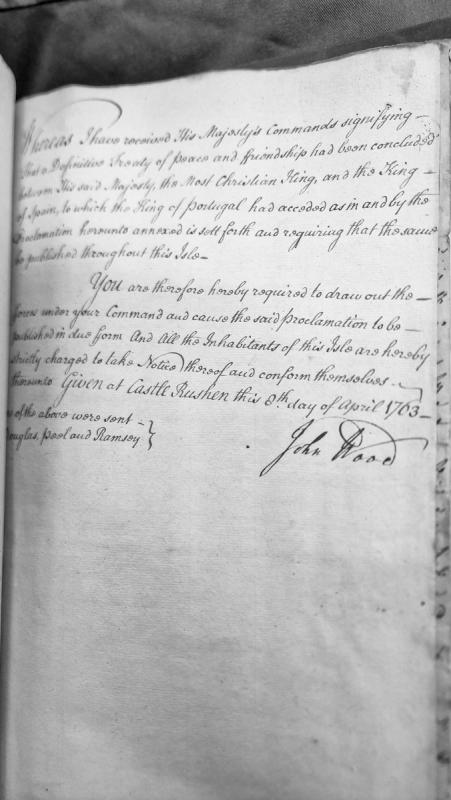
An administrative directive issued at Castle Rushen commanding the publication of a Proclamation announcing the conclusion of a Definitive Treaty of Peace and Friendship between Great Britain, France, Spain, and Portugal. Copies were to be distributed to Douglas, Peel, and Ramsey on the Isle of Man.
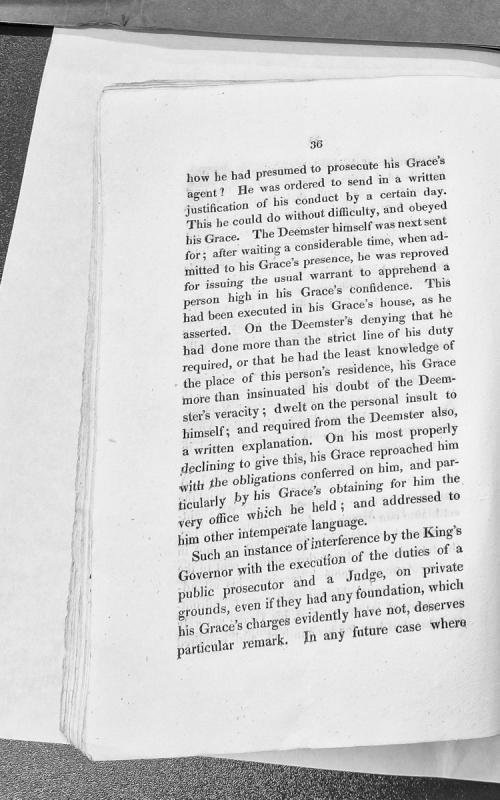
A critical account of a Governor's improper intervention in the execution of judicial duties, specifically regarding the prosecution of the Governor's agent and the issuance of an arrest warrant. The text discusses how the Governor summoned both a prosecutor and a Deemster (judge) to remonstrate with them, demanding written justifications and employing intemperate language, which is presented as an abuse of executive power over the judiciary.
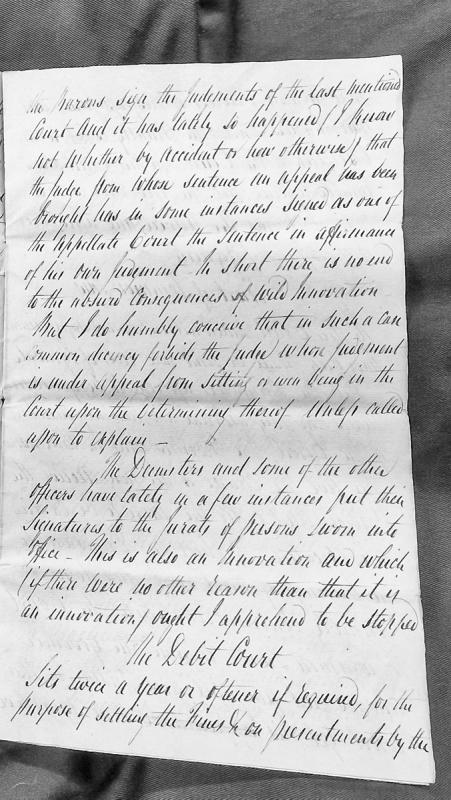
A legal opinion or memorandum discussing procedural irregularities in Manx courts, including instances where judges have signed judgments on appeal cases involving their own prior decisions, and innovations regarding officer signatures on oaths of office. The author argues against these practices as departures from established procedure.
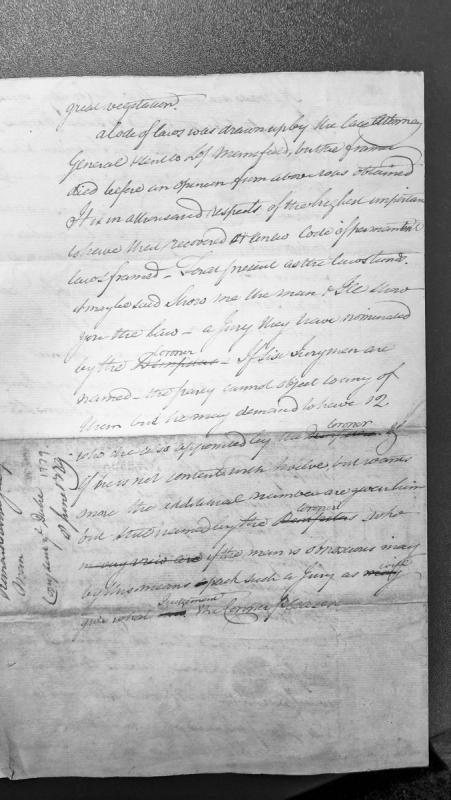
A critical analysis of the deficiencies in Manx law, noting that a code drawn up by the late Attorney General Heintom of Mansfield was never completed. The document discusses the problematic nature of jury selection procedures, where the Coroner has excessive power to nominate and pack juries, potentially compromising judicial impartiality.
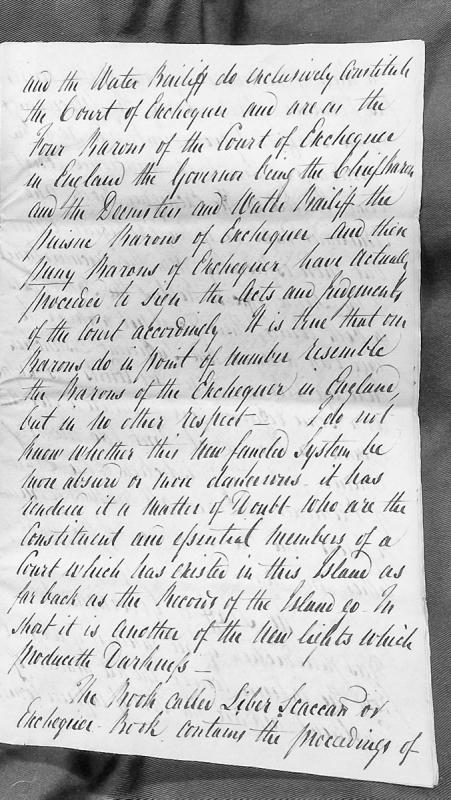
A legal opinion or argumentative text discussing the composition and structure of the Court of Exchequer in the Isle of Man, comparing it to the English Court of Exchequer. The author critiques a 'new fangled System' that has created confusion about which members constitute the court, and references the Liber Scaccari (Exchequer Book).
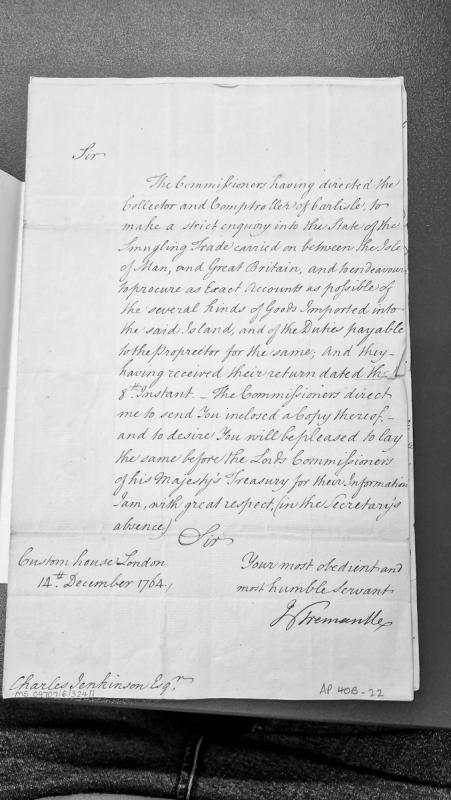
Official correspondence from the Custom House in London transmitting a report from the Collectors and Comptrollers of Carlisle regarding smuggling activities and goods imports to the Isle of Man. The Commissioners direct that this report be forwarded to the Lords Commissioners of the Treasury for their information.
A series of administrative documents from the Commissioners of the Customhouse London concerning Charles Lutwidge's memorial for a reward for services in forming improvement plans for Isle of Man customs duties and expenses incurred during the passage of the Revestment Act. Includes financial accounts of receipts and charges from May 1765 to July 1767, salary arrears, and incidental expenses. Shows the Commissioners' initial resistance to authorizing payment from customs revenue, followed by compliance after Treasury direction.
Part II of an official 1792 report by Commissioners of Inquiry examining Isle of Man revenue systems post-Revestment. Covers receipt and expenditure, customs establishments, duty systems, illicit practices, and proposals for trade relief. Includes detailed financial accounts, port structures, officer establishments, and recommendations for reform of revenue collection and harbour management.
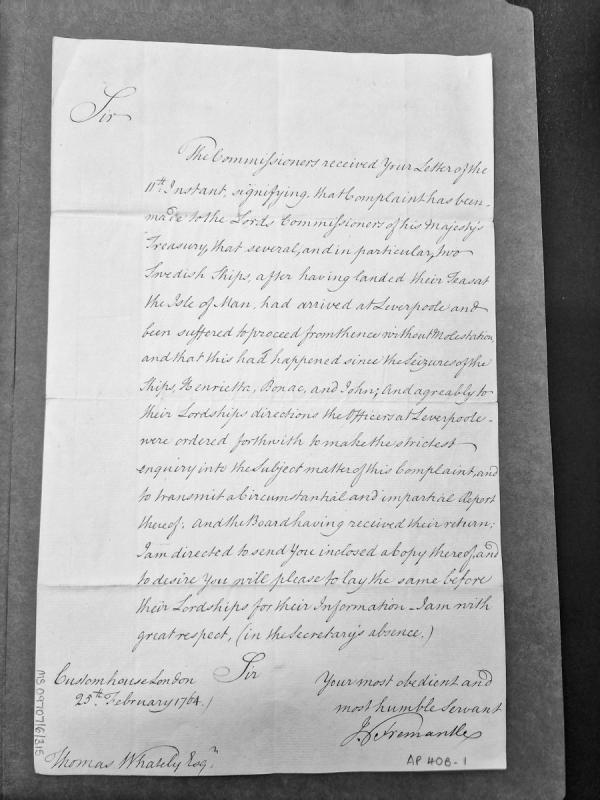
Letter from H Fremantle at the Custom House London to Thomas Whately reporting on complaints made to the Lords Commissioners of the Treasury regarding Swedish ships that landed tea at the Isle of Man and subsequently proceeded from Liverpool without molestation. The letter transmits an enclosed report from officers at Liverpool following their inquiry.