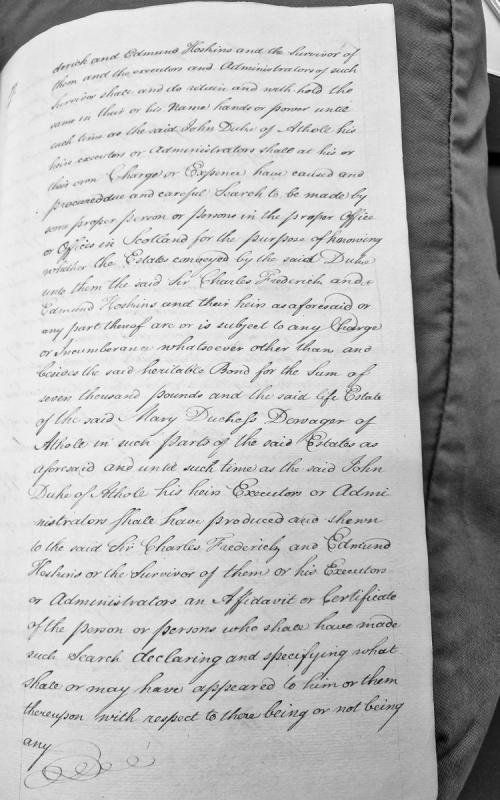
Fragment of a legal document concerning the conveyance of Scottish estates by John Duke of Athole to Sir Charles Frederick and Edmund Hoskins. The text outlines conditions requiring due search to be made in Scottish offices to verify the estates are free of charges or encumbrances beyond a heritable bond of £7,000 and the life estate of Mary, Duchess Dowager of Athole.
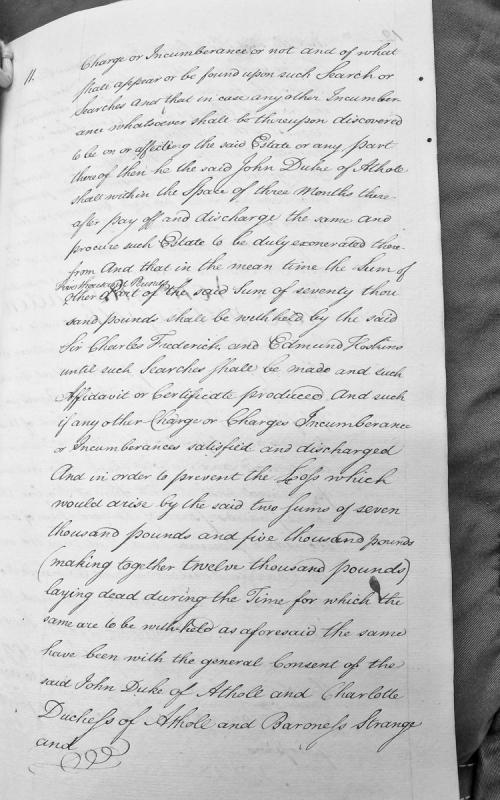
This is a fragment of a legal bond or recognisance documenting conditions for an estate transaction involving John Duke of Athol and Charlotte Duchess of Athol. It specifies procedures for searching the estate for charges or encumbrances, requirements for discharging any found, and arrangements for withholding sums (£5,000 and £7,000) pending completion of searches and production of affidavits/certificates.
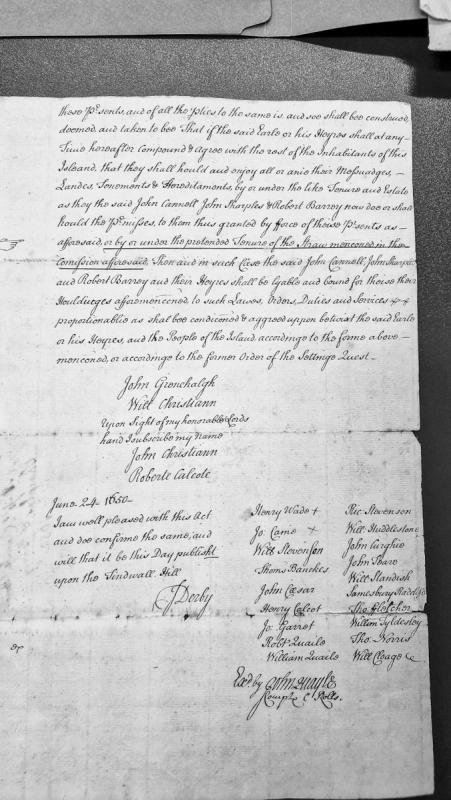
A formal administrative document confirming terms of land tenure and settlement on the Isle of Man. It addresses conditions under which inhabitants may hold properties and establishes obligations toward the Earl and the people of the island, with formal confirmation by J Derby and attestation by multiple witnesses.
Prehistoric flint scatter.
A small quantity of worked prehistoric flint was recovered from Congary by CH Cowley, from 'In Hedge By Railway Gate'.
The description appears to refer to a gate which formerly prevented access on to the railway line at the grid reference provided.
The antiquary Charles Harry Cowley was an avid collector of worked flint and coarse stone artefacts revealed by agricultural activity, mainly on farms located around Peel, and occasionally from further afield. He was active from 1900 until 1943. His entire collection of artefacts, together with a daybook cataloguing his discoveries, was later donated to Manx National Heritage.
A small quantity of worked prehistoric flint was recovered from Congary by C.H. Cowley, from the 'Congary Brooghs'. It included an axehead, an arrowhead, a knife, a polishing stone, a spearhead and a worked flint. No further details concerning the circumstances of the discovery were recorded and the grid reference relates to the site for indicative purposes only.
The antiquary Charles Harry Cowley was an avid collector of worked flint and coarse stone artefacts revealed by agricultural activity, mainly on farms located around Peel, and occasionally from further afield. He was active from 1900 until 1943. His entire collection of artefacts, together with a daybook cataloguing his discoveries, was later donated to Manx National Heritage.
A single worked prehistoric flint was recovered from Congary by C.H. Cowley, from 'Klondyke Hedge'. No further details concerning the circumstances of the discovery were recorded and the grid reference relates to the site for indicative purposes only.
The antiquary Charles Harry Cowley was an avid collector of worked flint and coarse stone artefacts revealed by agricultural activity, mainly on farms located around Peel, and occasionally from further afield. He was active from 1900 until 1943. His entire collection of artefacts, together with a daybook cataloguing his discoveries, was later donated to Manx National Heritage.
A single worked prehistoric flint was recovered from Congary by C.H. Cowley, from 'near Railway'. No further details concerning the circumstances of the discovery were recorded and the grid reference relates to the site for indicative purposes only.
The antiquary Charles Harry Cowley was an avid collector of worked flint and coarse stone artefacts revealed by agricultural activity, mainly on farms located around Peel, and occasionally from further afield. He was active from 1900 until 1943. His entire collection of artefacts, together with a daybook cataloguing his discoveries, was later donated to Manx National Heritage.
A small quantity of worked prehistoric flint was recovered from 'Congary' by C.H. Cowley. The collection includes an arrowhead, an axehead, a knife, a scraper and a flint. No further details concerning the circumstances of the discovery were recorded and the grid reference relates to the farmstead for indicative purposes only.
The antiquary Charles Harry Cowley was an avid collector of worked flint and coarse stone artefacts revealed by agricultural activity, mainly on farms located around Peel, and occasionally from further afield. He was active from 1900 until 1943. His entire collection of artefacts, together with a daybook cataloguing his discoveries, was later donated to Manx National Heritage.
A single worked prehistoric flint was recovered from Congary by C.H. Cowley, from the 'Battle Field'. No further details concerning the circumstances of the discovery were recorded and the grid reference relates to the site for indicative purposes only.
The antiquary Charles Harry Cowley was an avid collector of worked flint and coarse stone artefacts revealed by agricultural activity, mainly on farms located around Peel, and occasionally from further afield. He was active from 1900 until 1943. His entire collection of artefacts, together with a daybook cataloguing his discoveries, was later donated to Manx National Heritage.
A single worked prehistoric arrowhead was recovered from Congary by CH Cowley, from the 'Battle Field'. No further details concerning the circumstances of the discovery were recorded and the grid reference relates to the site for indicative purposes only.
The antiquary Charles Harry Cowley was an avid collector of worked flint and coarse stone artefacts revealed by agricultural activity, mainly on farms located around Peel, and occasionally from further afield. He was active from 1900 until 1943. His entire collection of artefacts, together with a daybook cataloguing his discoveries, was later donated to Manx National Heritage.
The site of a Mesolithic flint scatter which included both heavy blade and microlithic type material. This includes scattered microlithic flints, possibly related to the Fenella Hotel site, and some Mesolithic 'Bann' material, found at 'The Congary'. The finds were made over a period of years by local Peel antiquary Charles 'Harry' Cowley.
The precise findspot of Cowley's material is unknown, but is unlikely to have been on the golfcourse, which was founded in 1895. This is reflected in the location of the grid reference for indicative purposes on neighbouring farmland overlooking the River Neb.
The site of a possible fort dating to the 11th century AD. The enclosure measured over 25 metres in diameter and was still visible in 1927 according to C.H. Cowley. It was situated on the most prominent part of Congary Brooghs, overlooking the river to the south, where the Peel Golf Links are now located. The earthwork was said to have been built at the time of the Battle of Santwat in 1098.
Conquet is a port town on the western tip of Brittany, France. Its inclusion in a Manx heritage context relates to the maritime connections between the Isle of Man and the French Atlantic coast, particularly during the period of conflict and trade in the eighteenth century.
William Bolts's polemical treatise on East India Company governance in Bengal, examining monopolies, administrative corruption, revenue extraction, and the Company's transformation from merchant to sovereign. Bolts advocates for Parliamentary intervention to establish justice, free trade, and proper administration. Appendix includes Attorney-General opinions (1757) on Company war powers and plunder rights. Directly relevant to understanding the constitutional and commercial issues that informed the 1765 Isle of Man Revestment and broader debates on chartered company sovereignty.
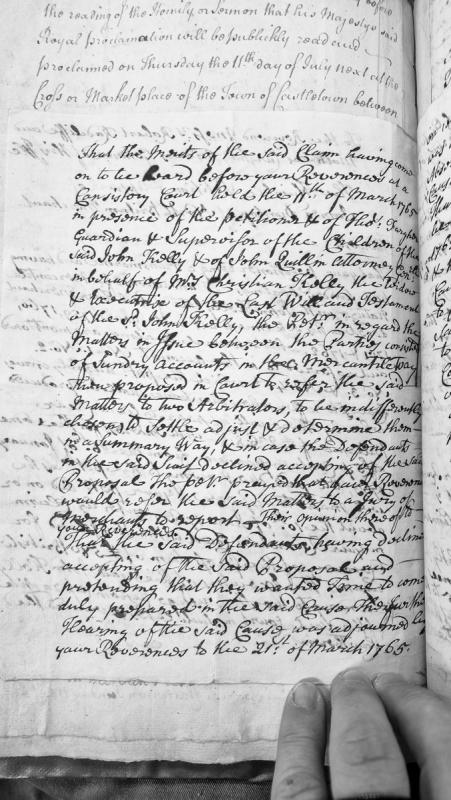
A court presentment documenting proceedings before a Consistory Court on 11 March 1765 concerning disputed mercantile accounts between parties regarding the estate of John Killey. The petitioner proposed arbitration or merchant jury review; defendants declined and sought adjournment to 21 March 1765.
Constance Radcliffe (1921 - 6 January 2004) was a Ramsey-born historian, educated at Ramsey Grammar School and the University of Liverpool, who taught Latin and history before returning to teach at the Buchan School and Ramsey Grammar School. Working with her husband Bill Radcliffe, she wrote what are considered the definitive local histories of her home town, Ramsey 1600-1800 (1986) and Shining by the Sea: A History of Ramsey 1800-1914 (1989), and helped preserve the Anglo-Manx dialect through cassette recordings of Manx poets and writers. She received the Reih Bleeaney Vanannan award in 1989 and was appointed MBE in 1996 for her contribution to Manx culture.
The slow rebuilding. The House of Keys Election Act of 1866 gave Manx people the right to elect their own representatives for the first time. Women's suffrage followed in 1881 — decades before Westminster. Yn Cheshaght Ghailckagh was founded in 1899 to preserve the Manx language. A.W. Moore documented the folklore, the music, the history before it was lost. But the language was dying. Ned Maddrell, the last native speaker, died in 1974. Crown dependence remained the living condition.
A formal address from the Continental Congress to the people of Canada, urging them to join the American colonies in resisting what they characterize as tyrannical British Parliamentary measures. The document articulates grievances about loss of liberty, arbitrary government, and religious persecution under the Quebec Act, and invites Canadian participation in the defense of 'common liberty.' While primarily an American Revolutionary document, it provides comparative context for understanding constitutional and liberty arguments of the period relevant to the Revestment era's debates about Parliamentary sovereignty and colonial governance.
Prehistoric flint scatter.
A single worked prehistoric flint was recovered from Contrary Head by CH Cowley.
No further details concerning the circumstances of the discovery were recorded and the grid reference relates to the headland for indicative purposes only.
The antiquary Charles Harry Cowley was an avid collector of worked flint and coarse stone artefacts revealed by agricultural activity, mainly on farms located around Peel, and occasionally from further afield. He was active from 1900 until 1943. His entire collection of artefacts, together with a daybook cataloguing his discoveries, was later donated to Manx National Heritage.
The findspot of a single Mesolithic 'Bann' flake found 60 centimetres below ground on Contrary Head. It is now in the Cowley Collection and the Manx Museum.
A record for an unspecified crop mark at the site of a 19th century quarry on Contrary Head, shown as a working quarry on the 1869 1:2500 scale Ordnance Survey map.
A bilingual (English/Anglo-Norman French) indenture from 1357 establishing truces between the King of England and the King of Scotland, explicitly naming the Isle of Man as a territory included in the agreement. The document outlines conditions for affirming and holding the truce, including oaths and letters, and names key allies including Edward de Balliol and John of the Isles. This early medieval source demonstrates the Isle of Man's strategic importance in Anglo-Scottish relations centuries before the 1765 Revestment.
A formal indenture from October 1357 recording a convention between the King of England and King of Scotland, affirming truces and their terms of payment. The document explicitly mentions the Isle of Man as part of the territorial scope of the agreement, indicating early medieval English claims to Manx sovereignty. This is relevant to understanding the constitutional and political status of Mann before the Revestment.
A bilingual (Anglo-Norman French and English) record of treaty conventions from 1355 concerning truces between the King of England and Scottish forces, explicitly naming the Isle of Man as a party to the agreement. The document references Edward III and establishes peace terms between English and Scottish parties including allies and adherents, with specific mention of the Isle of Man's inclusion in the truce provisions.
A bilingual (English and Anglo-Norman French) record of conventions establishing truces between the King of England and David de Bruys of Scotland, explicitly including the Isle of Man within the scope of the agreement. This document demonstrates the Isle of Man's status as a distinct territorial entity under English royal protection in the 14th century, relevant to understanding pre-Revestment sovereignty claims.