A group of shieling settlements found along the Cornaa Valley, Maughold. At least thirty-two shieling mounds are situated in the valley, which probably should be considered to belong to a single shieling.
A group of shieling settlements found along the Cornaa Valley, Maughold. At least thirty-two shieling mounds are situated in the valley, which probably should be considered to belong to a single shieling.
This example is a mound built up to create a platform. Its diameter is 11.0 metres and height about 1.5 metres. There is no trace of stones. It is heavily overgrown with grass and fern and difficult to assess but is possibly a hut site.
A group of shieling settlements found along the Cornaa Valley, Maughold. At least thirty-two shieling mounds are situated in the valley, which probably should be considered to belong to a single shieling.
This feature at SC 43158939 is similar to the hut or shieling mounds at Block Eary.
A group of shieling settlements found along the Cornaa Valley, Maughold. At least thirty-two shieling mounds are situated in the valley, which probably should be considered to belong to a single shieling.
This example is a circular mound built up on the south side by 1.6 metres to form a level top with a diameter of 5.5 metres. The top is surrounded by a circular bank average. 0.1 metres high with an apparent entrance in the north west. A stream coming from the north west passes the mound on its north eastern side. The mound is grass covered but largely composed of stone and is apparently a hut circle. It is set on land falling to the south.
A group of shieling settlements found along the Cornaa Valley, Maughold. At least thirty-two shieling mounds are situated in the valley, which probably should be considered to belong to a single shieling.
This example is a semi-circular bank of earth and stones on a hillside sloping to the south which has apparently been built up to form a level platform. The height in the south is 0.7 metres. One stone which is partially exposed has sides of 0.7 x 0.4 x 0.4 metres. By its form it is a probable hut mound.
A group of shieling settlements found along the Cornaa Valley, Maughold. At least thirty-two shieling mounds are situated in the valley, which probably should be considered to belong to a single shieling.
This example is in an area where the ground is heavily overgrown with fern and no trace of antiquity could be found but in view of the proximity of others it has been thought to be a possible hut site.
A group of shieling settlements found along the Cornaa Valley, Maughold. At least thirty-two shieling mounds are situated in the valley, which probably should be considered to belong to a single shieling.
This example is heavily overgrown with ferns. It consists of a slightly curved sloping wall built on the side of a hill which falls to the south and appears to be the retaining wall of a mound built up to a level platform about 5.0 metres across. It is possibly rectilinear and perhaps a hut site. This group of features appear to be similar to the hut or shieling mounds at Block Eary.
A group of shieling settlements found along the Cornaa Valley, Maughold. At least thirty-two shieling mounds are situated in the valley, which probably should be considered to belong to a single shieling.
This feature at SC 43198937 is similar to the hut or shieling mounds at Block Eary.
This now lost stone is described in some detail by Miss A.M. Crellin in Volume 2 of Yn Lioar Manninagh,
"There was a somewhat curious large rough stone, about three feet every way, weighing several hundredweight, in a field on the Michael Glebe, between the Vicarage. and the sea, known as "Corneil-y-Keillagh." The old people called this black fixture a "font," and it was one of their favourite walks on Sunday afternoons to go and see this "font," which, for many years, was partly built up into the hedge of the field. When the late Rev. W. Hawley was vicar, he gave some members of this Society permission to take it out for the purpose of examination, but although there was a small groove in it at one end, evidently water worn, it presented no appearance whatever of "font," and certainly could hardly have been used for that purpose. It is curious what gave rise to the name "font," but the field in which it was, being called "Corniel-y-Keillagh" (corner of the chapel), is not without significance. The stone, after lying some time in the field, and being, probably, in the way of the plough, was, by Mr. Hawley’s orders, split up into flakes, and these are now thrust back into the gap in the hedge whence it came."
This site reportedly consisted of a circular bank within which a burial cist was identified. It is shown on the 1869 1:2500 scale Ordnance Survey map, which shows the ring and describes it as a "Burial Ground". A "Cist" is shown set into southwestern section of the bank defining the ring.
A modern description of the site found it to be a depression with a diameter of 25 metres but no enclosing bank and no evidence of a cist. The site had been rooted by pigs and badly damaged.
A "ring" with a diameter of about 36 metres does appear to be visible on the 2006 Google Earth Aerial Photograph. The true character of the site is not known.
A slate bearing "cup-marks" has been described as being found against the south wall of the field numbered 3590 on the 1869 1:2500 Ordnance Survey map. It has also been described as "situated in the base of the East fence in the road to the farmhouse at Eairy ny Sooie". The stone measured 1.52 metres by 0.76 metres and was 0.45 metres high, with one face having three holes or "cup-marks" bored into it.
Cornelly House, just to the south of Townsend's Mine, was the Mine Captain's House, complete with a boardroom. When recorded it was relatively unchanged externally. It is not open to the public.
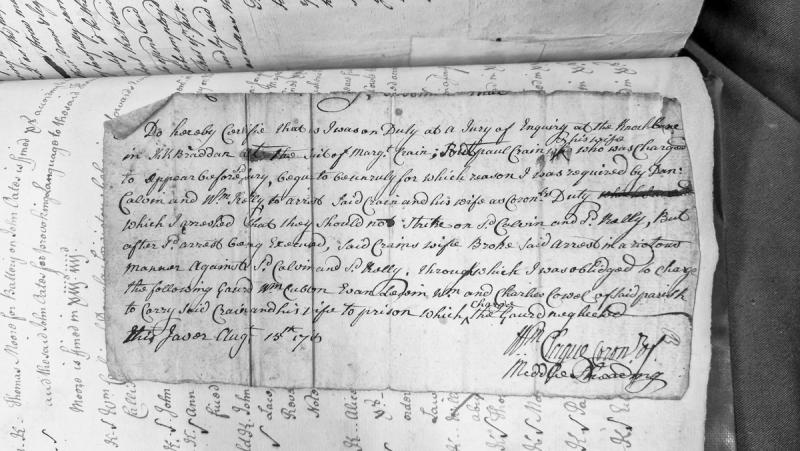
A coroner's certificate documenting events at a jury of inquiry held at Knoll Lane in Kirk Braddan. William Crigue certifies that Paul Crain and his wife were arrested for disorderly conduct before jurors Dan Calvin and William Kelly, but the wife subsequently broke arrest in a riotous manner. Crigue charged a guard to convey them to prison, which the guard allegedly neglected.
A collection of 30+ letters (MS 01798C–01828C from Manx Museum archives) between Isle of Man Governor Edward Smith, Lieutenant Governor Richard Dawson, and Westminster agent George Aust, covering the period 1783–1787. The letters document administrative issues, revenue disputes, copper coinage proposals, customs administration, harbour management, and constitutional matters following Charles Lutwidge's death in 1784. Key topics include copper coinage procurement, salary disputes, Water Bailiff appointments, and the Duke of Atholl's bills of 1780–1781.
A letter dated 30 July 1595 from Geo. Nicholson and John Cunningham to Mr Bowes, concerning warnings issued to the Isle of Man and defensive preparations. The document reflects 16th-century governance and security concerns regarding the island, predating the 1765 Revestment by 170 years but relevant to understanding long-term English authority and administration of Man.
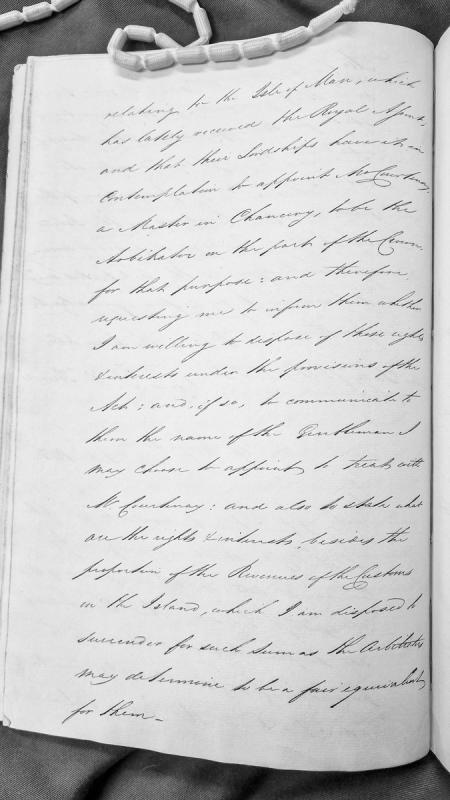
A fragment of administrative correspondence concerning the disposition of rights and interests relating to the Isle of Man under provisions of a recently enacted Act. The letter discusses the Crown's intention to appoint Mr Courtenay, a Master in Chancery, as arbitrator and requests confirmation of willingness to dispose of certain rights and interests, including customs revenue proportions.
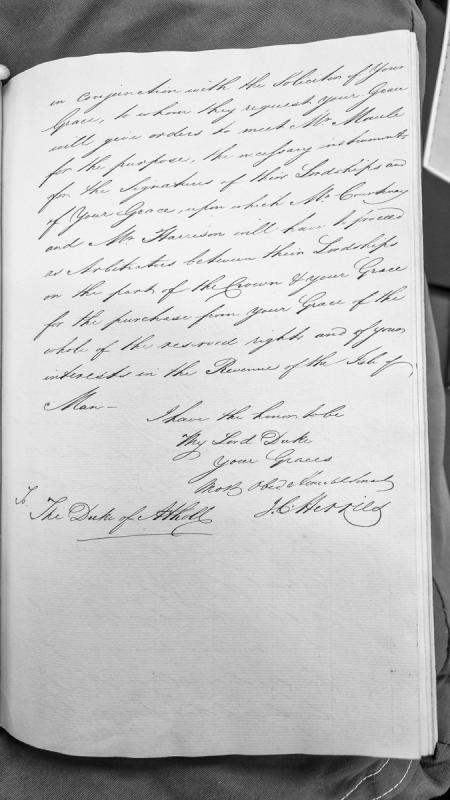
A letter fragment concerning negotiations between the Crown and the Duke of Atholl over the purchase of reserved rights and revenue interests in the Isle of Man. The correspondence references arbitrators (Messrs Courtney and Harrison) and instructs the Solicitor to prepare necessary instruments for signatures.
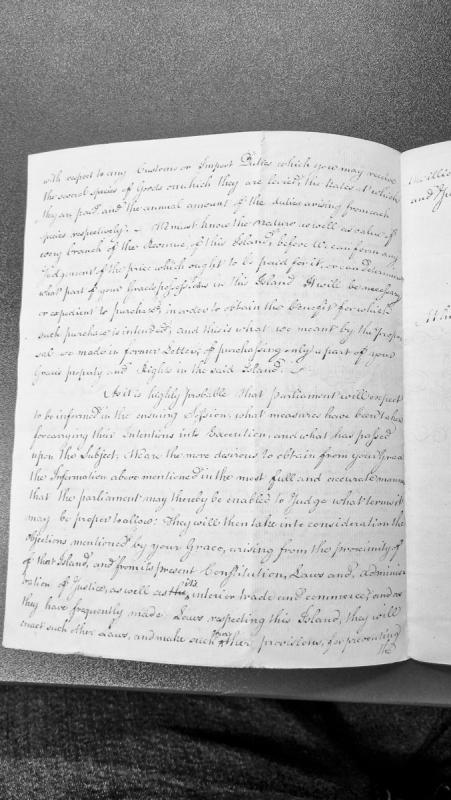
Administrative correspondence discussing the nature and value of revenue branches on the Isle of Man, including customs and impost duties on goods. The writer seeks detailed information about duty rates and annual amounts to inform parliamentary consideration of property and rights acquisition, referencing previous correspondence and anticipated parliamentary session discussions.
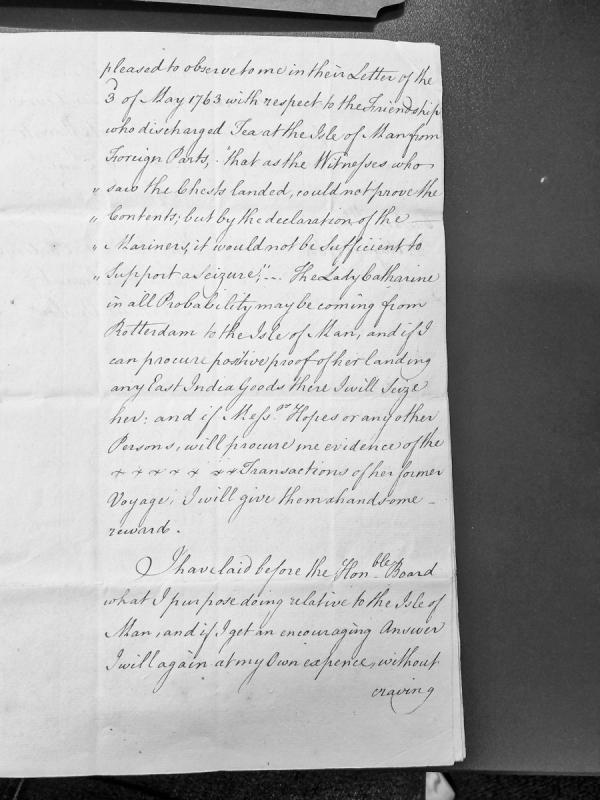
Administrative letter discussing the seizure of tea cargo from the vessel 'Friendship' discharged at the Isle of Man from foreign ports. References evidentiary standards for seizure, mentions the vessel 'Lady Catharine' from Rotterdam, and discusses potential rewards for evidence of smuggling. Written in context of revenue enforcement.
A post-medieval fishnet factory in Peel, begun by Robert Corrin and later run by his sons John and Thomas as Corrin Bros.
The oldest part of the factory gave its name to Factory Lane, and is located on the Ordnance Survey 1:2500 large scale mapping of 1868 at the grid reference provided, together with the annotation 'Net Factory'. The factory was later extended to the rear. T
The business is mentioned in Porter's Directory of 1889.
The site was redeveloped for housing in the 1990s.
The possible site of a Bronze Age cairn or barrow which is said to have been removed in the 19th century when Corrin's Tower was built on Corrin's Hill. A description dating to 1878 refers to the removal of the barrow, but the burial cist apparently survived. Flint flakes have also been found in the area of the base of Corrin's Tower.
Corrin's Tower stands on Corrin's Hill above Patrick, on the west side of the Island overlooking Peel. It was built in 1806 by Thomas Corrin, a local landowner remembered as an eccentric figure, who raised the pillar, tower and mount as a memorial to his wife Alice Corrin and their two children, whose remains were laid beneath it. A later inscription on the pillar, dated 1850, records that it was erected "six feet distant from the base of this mount," so that the family's remains would rest undisturbed "until reanimated by the power of God." The tower is one of several early nineteenth-century hilltop memorials on the Island and remains a distinctive landmark visible from Peel and the surrounding coast.