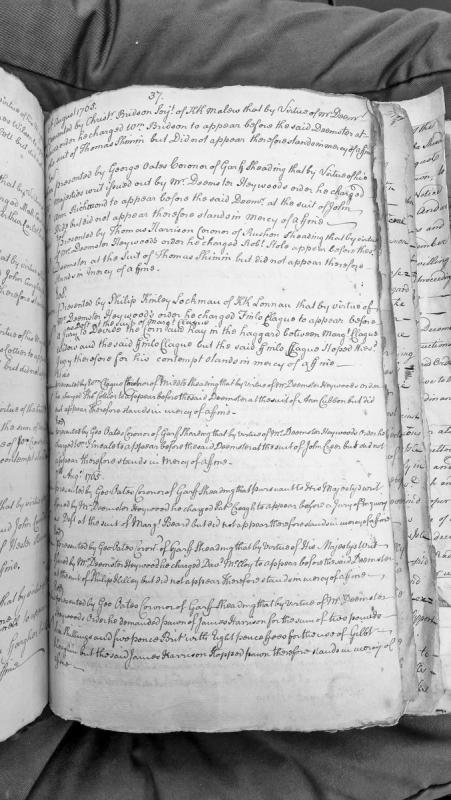
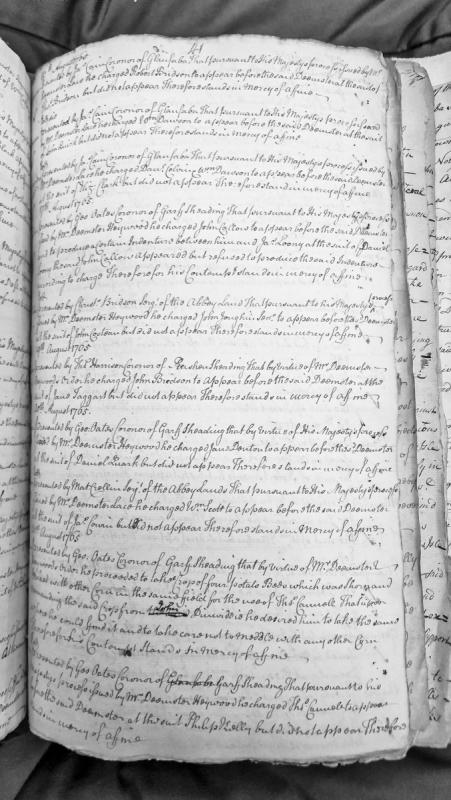
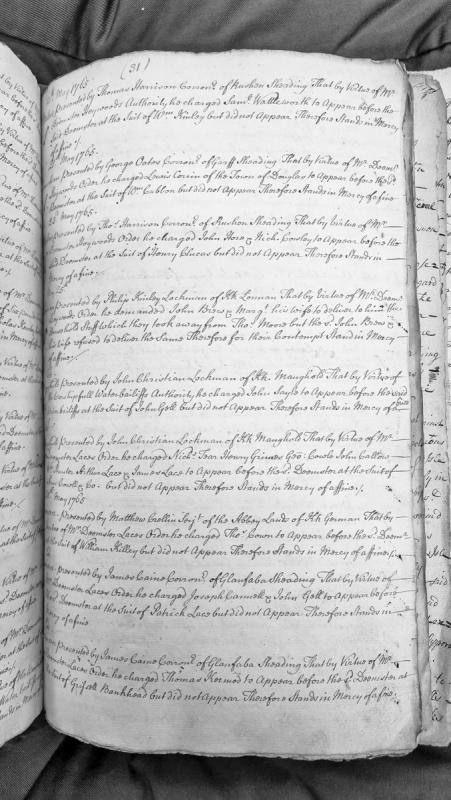
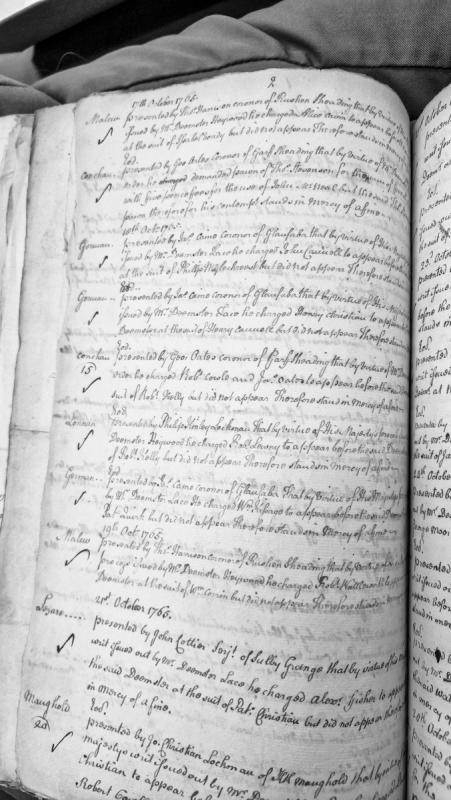
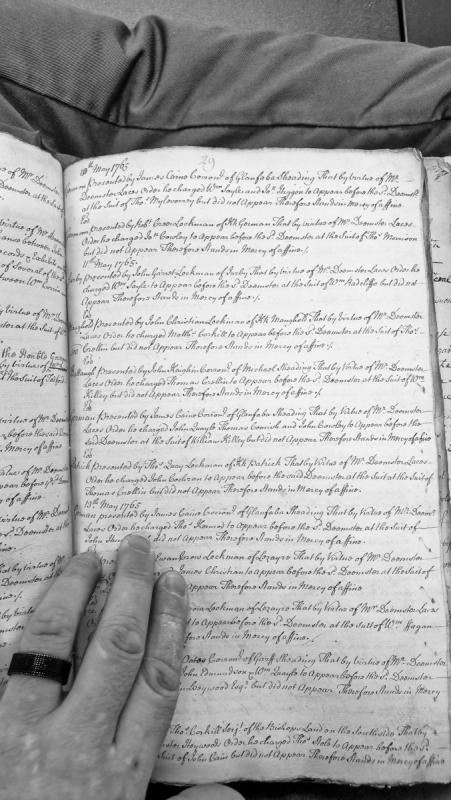
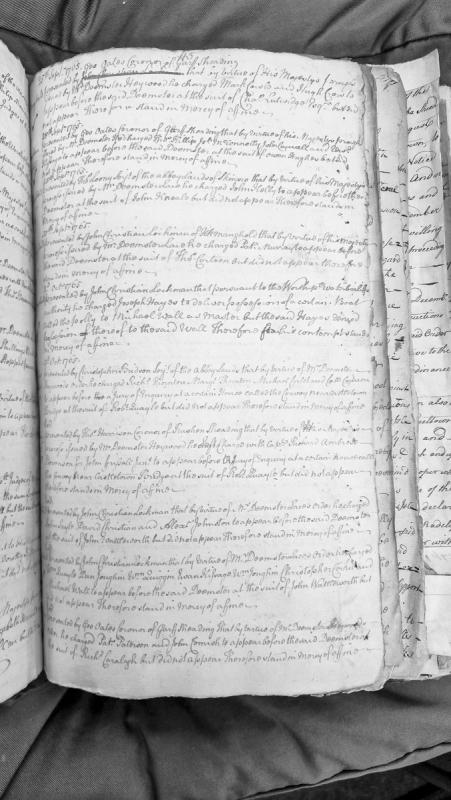
A series of court presentments documenting failures to appear before the Deemster in various civil and administrative proceedings, recorded by coronors from different Sheadings (Malow, Garff, Rushen, Middle, and Lonnan). The document records multiple cases where defendants failed to appear at the suit of various plaintiffs, and one case of contempt of court by Finlo Clague for stopping a jury.
A series of court presentments by various coronors and sergeants documenting individuals charged to appear before Deemsters (judges) but who failed to appear or refused to comply with court orders. The presentments detail multiple cases across different sheadings of the Isle of Man, with defendants standing in mercy of fines for non-compliance.
A series of court presentments documenting individuals who failed to appear before Deemsters Heywood and Lace when summoned, or who showed contempt of court. Each presentment records the charging officer, the defendant(s), the suit plaintiff, and notes the defendant(s) stand in mercy of a fine for non-compliance.
A series of court presentments from various Manx sheadings documenting cases where defendants failed to appear before the Deemsters despite being charged. The presentments were made by coronors and lockmen, with defendants standing in mercy of fines for contempt.
A series of presentments by various Lockmen and Coroners of the Isle of Man reporting that individuals charged by order of Deemster Lace failed to appear before him at the suit of various parties. Each presentment concludes that the accused stands in mercy of a fine for non-appearance.
A series of court presentments recording individuals charged by coronors and officers to appear before the Deemster or jury of enquiry but failed to do so, dating from September to October 1765. Each presentment details the arresting officer, the charged parties, the suit or order originating from a Deemster, and notes that the defendants stand in mercy of a fine for their non-appearance or contempt.
A formal marriage covenant dated 25 July 1281 between King Eric II of Norway and Margaret, daughter of King Alexander III of Scotland, wherein the Isle of Man is assigned to the King of Norway as security/compensation in the event of breach of contract. The document demonstrates medieval diplomatic practice and includes detailed provisions regarding the transfer of the Isle of Man, highlighting claims and counterclaims to Manx sovereignty by Scotland and Norway in the late 13th century.
A bilateral marriage covenant (cyrograph) from 1281 between King Alexander III of Scotland and representatives of King Eric II of Norway concerning the betrothal of Princess Margaret. The document contains conditional provisions assigning the Isle of Man to Norway as security/compensation under specific circumstances related to the marriage contract and financial obligations. Critical for understanding medieval Scottish-Norwegian relations and early claims to Man.
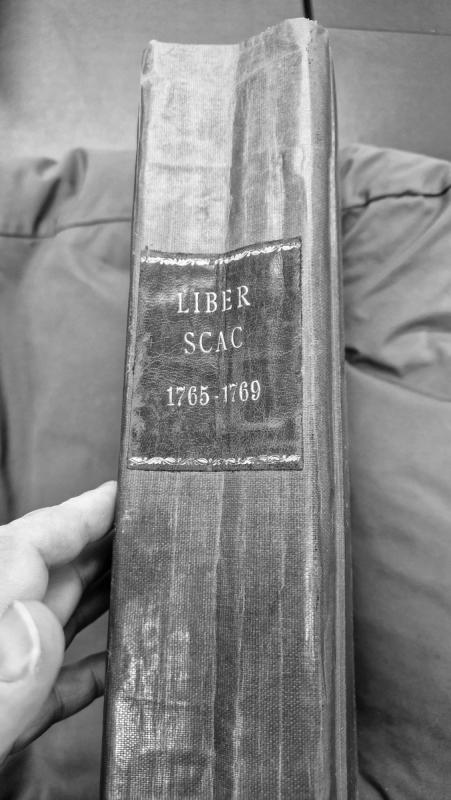
This appears to be a cover page or title page for a bound volume designated 'Liber SCAC' covering the period 1765-1769. SCAC likely refers to a court or administrative body (possibly Snaefell Court or similar Manx institution). The document establishes the scope and chronological range of the manuscript collection.
The first book printed in Manx, published by Bishop Wilson in 1707. Wilson began with the catechism and kept going, book by book, because a people who spoke Manx deserved to pray in Manx. The title means further advice or counsel. Wilson's Manx publications created the literary infrastructure that would survive the Revestment and eventually provide the foundation for the language revival two centuries later.
A stone circle is marked here on the 1870 1:2500 scale Ordnance Survey map. There are five irregular quartz blocks still in place, forming a circle with an outer diameter of 12.0 metres and situated on top of a small hillock. It is now thought that the stones represent the circle of a ruined cairn or barrow, rather than a stone circle.
The dimensions of the five stones are; 1.7 metres long, 0.9 metres wide, 0.8 metres high; 2.1 metres long, 0.8 metres wide, 0.7 metres high; 1.8 metres long, 1.3 metres wide, 0.5 metres high (possibly fallen over); 1.3 metres long, 0.4 metres wide, 0.4 metres high (possibly fallen over). The fifth stone is largely covered by brambles but its size compares with the others.
At SC 32399332 are two quartz blocks forming gate posts on either side of the lane. The west one is faced to give a rectangular section and resembles a bigger than normal gate post, but the east one is similar in size and form to those of the circle.
Philip Kneen told the Ordnance Survey in 1866 that he remembered more blocks being in the circle and that urns had been found.
The findspot of a Mesolithic flint scatter. Kermode recorded flints from this area as early as 1914. Early descriptions describe them as 'Great accumulations of cores, chips and worked flints of very primitive type.' OS Field No. 2090.
The site of a post-medieval horsewalk at Crammag. The circular horsewalk appears on the 1870 1:10560 scale Ordnance Survey map at the southwest corner of the farmstead complex. The circular earthwork of the horsewalk is still visible on early 21st century aerial photographs, having survived due to the abandonment of the farmstead during the 20th century.
Cranstal Cottage, on the coast road between Bride and the Point of Ayre, is a thatched traditional Manx cottage that was among the very first buildings placed on the Isle of Man's protected buildings register, in May 1983. It stands close to a matching thatched neighbour, Bridge Cottage, and the pair are among the best-known surviving examples of the island's vernacular thatched cottages in this exposed northern corner of the island.