The Albert Tower commemorates an unplanned royal visit: in 1847 Queen Victoria and Prince Albert, cruising the Irish Sea aboard the royal yacht, anchored in Ramsey Bay, and Prince Albert came ashore to walk up the hill above the town to admire the view, causing a scramble among local officials to receive him. The hill was renamed Albert Mount in his honour, and the tower's foundation stone was laid on Easter Monday 1848 by Mrs Eden, wife of the then Bishop of Sodor and Man. Paid for by public subscription and designed by engineer C.W. Buck, the 45-foot slate-and-granite tower stands on Lhergy Frissel in the parish of Maughold, just over the Ramsey boundary, overlooking the town. It served as a lookout post during the Second World War and has been closed to the public since.
Albion Terrace, a row of nine houses (numbers 2 to 18) in Ramsey, was registered as a group of protected buildings in August 1994. Beyond this official listing, no further published history of the terrace's construction or residents has been found.
This is a typical promontory site but there are no obvious signs of a ditch or bank indicative of a fort having been built here. An Iron Age or Early Medieval date is assumed.
There is shore access with a cleared channel.
Letter from newly arrived Lieutenant Governor Alex Shaw to Lord Grenville (Home Secretary), dated 5 January 1791, reporting his arrival on the Isle of Man and intention to take up office impartially. Shaw succeeded Colonel Dawson and indicates awareness of factional divisions on the Island.
Letter from newly arrived Lieutenant Governor Alex Shaw to Lord Grenville reporting his arrival on the Isle of Man on 30 December 1790 and his imminent swearing-in. Shaw notes the island's factional divisions and pledges impartial governance. This document is relevant to post-Revestment administration and internal island governance.
The Ordnance Survey 1:2500 First Edition mapping of 1867 marks a rope works at this location together with the annotation 'Rope Works'. The grid reference relates to the covered office / premises at the southern end of the walk.
The rope walk is shown extending in a north-northeast direction for a distance of 100 metres, with an extension indicated to a total of 185 metres. The rope walk eventually reached as far as the Meadow Mill complex, for a total of 260 metres.
The Qualtrough family, whose timber yard has stood on the site for many years, record that the walk went under Alexandra Road by way of a tunnel.
A Mesolithic occupation floor was identified beneath a later burial cairn (0097.00) during the construction of Alfred Pier in the late 19th century. Alfred Pier, Port St Mary's outer harbour breakwater, was built in 1882. No further published detail on the excavation or finds from the occupation floor itself has been located.
The stained glass window is at the rear of All Saints Church and is in seven columns. The window represents as its central figure that of St Paul preaching. At the head of the design are the figures of St George of England and St Louis of France, with the British Coat of Arms between. In the framework of the design are six angels bearing the armour of God. At the base are two angels holding a shield. Column 2: An engraved figure of a sailor fills the entire window frame, below the figure is etched "To all Seafarers lost at sea in Peace & War." Column 4: A celtic sword is shown with "1914 1918" either side of the handle. Below the handle is a green roundlet of leaves over the blade and beneath this and either side of the blade is "1939 1945". Below the sword tip is "LAND. AIR. SEA." At the base of this column hangs a Royal Air Force ensign. Column 6: Engraved figure of an airman in his flying suit. Etched above his head are the words "We will remember them". Below the figure is the following inscription: "In proud & thankful memory / of those of this Island, who died / whilst serving in the Royal / Air Force, & members of the / Royal Air Force Association, / Isle of Man Branch, who died / in the Winter Hill air disaster / 27th February 1958 a.d."
The memorial window was unveiled on Sunday 10 February 1918 by the Lord Bishop. The window was designed and made by Messrs. J. Powell and Sons, of the Whitefriars Glass Works, London and was installed by Mr Royston, sculptor, of Douglas. The total cost of the window was £71 4s.
Information provided by the Isle of Man Government Preservation of War Memorials Committee. Image courtesy of Chris Blyth, Isle of Man Photographic Society.
Below is leaf decoration, with further inscription underneath: "Erected by loving friends." White and grey marble plaque with black, red and gold lettering. Boer War.
Unveilled by the Speaker of the House of Keys, Mr A. W. Moore, on Sunday 3 November 1901. The Vicar, the Rev. John Quine took the service, assisted by the Rev. Canon Moore, Vicar of Braddan (formerly of Lonan). (Isle of Man Times, 9 Nov 1901, p.17).
All Saints' Church on Alexander Drive first opened in July 1898 as a chapel of ease to St George's, built to serve the growing population of the newly developed upper part of Douglas following a diocesan conference decision in 1897. Its corrugated-iron exterior earned it the local nickname the "Tin Tabernacle," but this cladding did not withstand the Manx climate well, and the church was entirely rebuilt in concrete and angular modernist lines, reopening on 20 April 1967 as one of the few major modernist buildings on the Island and the last new Anglican church built on the Isle of Man for over fifty years. Structural problems later emerged that were estimated to cost around £400,000 to repair, leading the church to close permanently on 1 May 2017 and subsequently be sold.
Brass altar cross. Inscription has faded through polishing.
Laurence Hall Walker was the son of Mrs M.H. Walker of 1 Chester Gate, Regents Park, London and the late Thomas Walker (Barrister-at-Law). Born at Altringham. Source: Commonwealth War Graves Commission.
Amsterdam is the capital of the Netherlands. Manx trading vessels engaged in the eighteenth-century smuggling trade maintained commercial links with Dutch ports, and the Netherlands featured in the broader network of European trade that connected the Isle of Man with Continental markets.
A comprehensive two-volume history of the Isle of Man from earliest times to the present (1845), covering ancient laws, customs, and superstitions. Written by Joseph Train, F.S.A. Scot., this work draws on the Parr manuscript and other archival sources, including discussion of the Revestment (Act of parliament to purchase sovereignty). Directly relevant to understanding Manx constitutional history, legal traditions, and the political context leading to 1765.
Joseph Train's two-volume historical and statistical account of the Isle of Man, covering from earliest times to 1845. Volume II includes chapters on church history, ecclesiastical antiquities, monuments, manners and customs, superstitions, constitution, tenures, ancient commerce, and modern commerce (including smuggling). Directly relevant to the Revestment project for its extensive treatment of administrative structures, revenue systems, the running trade, and the commercial context.
Joseph Train's comprehensive two-volume historical and statistical account of the Isle of Man, covering ecclesiastical history, antiquities, constitutional development, commerce, customs, and superstitions from earliest times to 1845. Volume II addresses church history, ecclesiastical courts, tenures, ancient and modern commerce (including smuggling), and topography. Directly relevant to understanding the constitutional, economic, and social context preceding the 1765 Revestment.
A lengthy analytical document, purportedly written by a person with 18 years' experience in the Collector's office, addressed to Henry Pelham (Prime Minister 1743–1754). It provides detailed accounts of the smuggling operations centred on the Isle of Man, the role of Governor James Murray in regularising the smuggling trade, revenue figures, smuggling methods and routes, and proposes four schemes to suppress the trade or force the Duke of Atholl to sell the Island to the Crown.
A detailed contemporary analysis of Isle of Man's governance, revenue sources, and smuggling operations, presented to Prime Minister Henry Pelham in the early 1750s. The author, likely Capt. Weber, was a customs official with 18 years' experience in the Island's administration. The document describes the dramatic increase in illicit trade under Duke of Atholl's ownership, detailed smuggling methods targeting Britain and Ireland, and proposes parliamentary remedies including salt trade prohibition and enforcement measures.
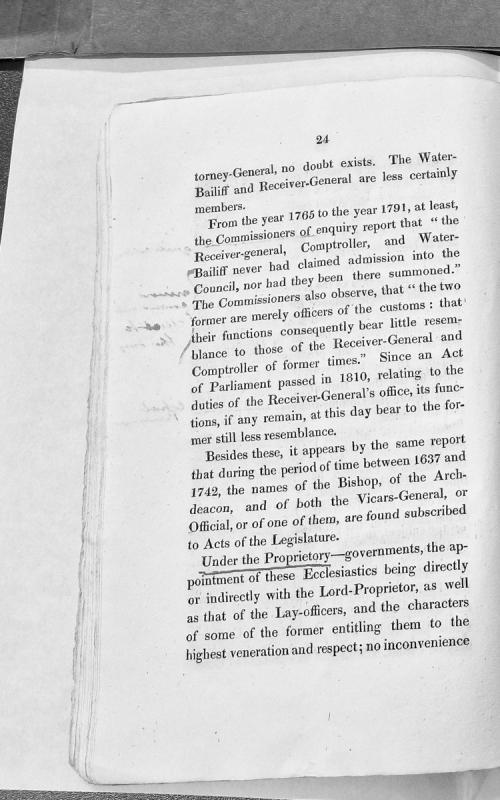
This document discusses the composition and membership of the Isle of Man Council, examining which officers held seats between 1765-1791. It analyzes the roles of the Receiver-General, Comptroller, Water-Bailiff, and ecclesiastical figures (Bishop, Archdeacon, Vicars-General) in legislative acts, noting changes following an 1810 Act of Parliament.
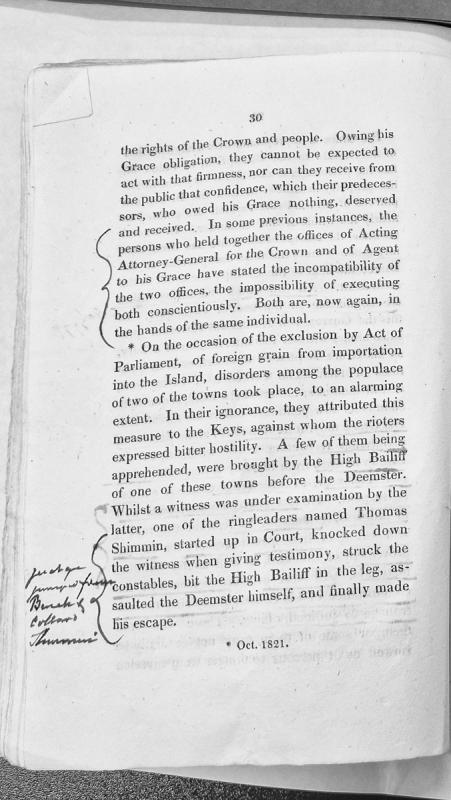
A critical commentary on the incompatibility of holding dual offices (Acting Attorney-General and Agent to the Duke), with particular concern about conflicts of interest. The document includes a detailed account of October 1821 riots over foreign grain exclusion, during which Thomas Shimmin assaulted court officials including the Deemster.
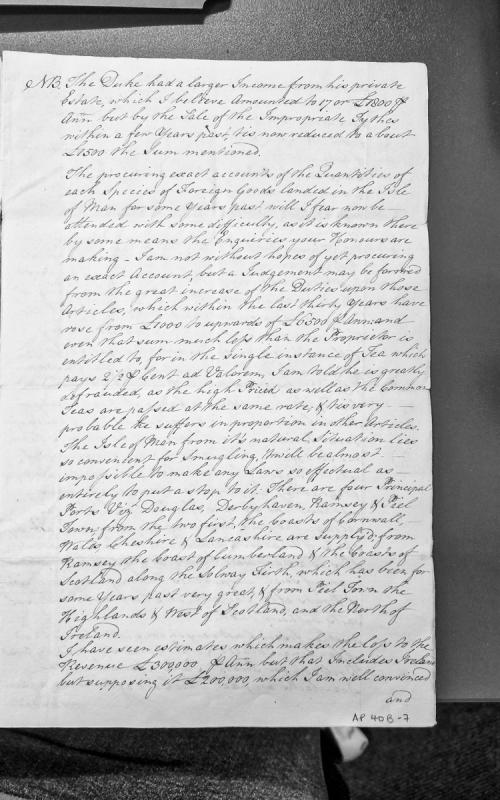
A report analyzing the Duke's private estate income, the quantities and duties on foreign goods landed in the Isle of Man, and the revenue losses from smuggling. The document discusses four principal ports (Douglas, Derbyhaven, Ramsey, and Piel Town) used for smuggling contraband to the British mainland and Ireland, with estimated annual losses to revenue.
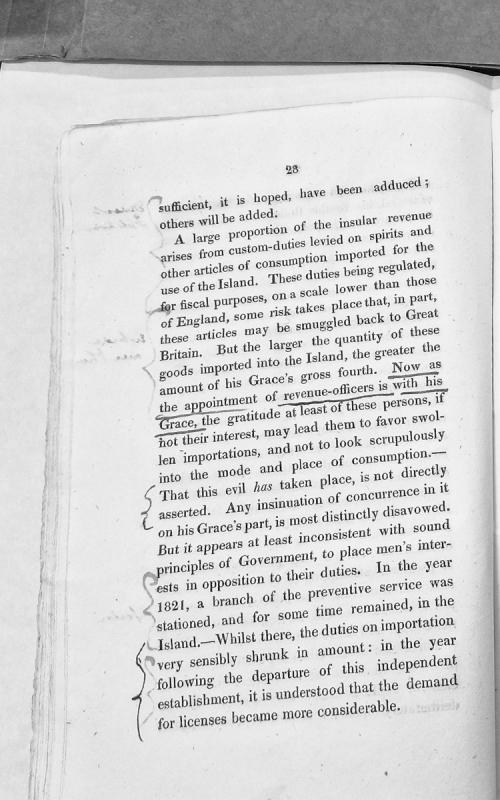
An excerpt from a printed pamphlet discussing customs duties on spirits and imported goods in the Isle of Man, the relationship between revenue officers and fiscal interests, and concerns about smuggling to Great Britain. References the 1821 preventive service and its effects on import duties.
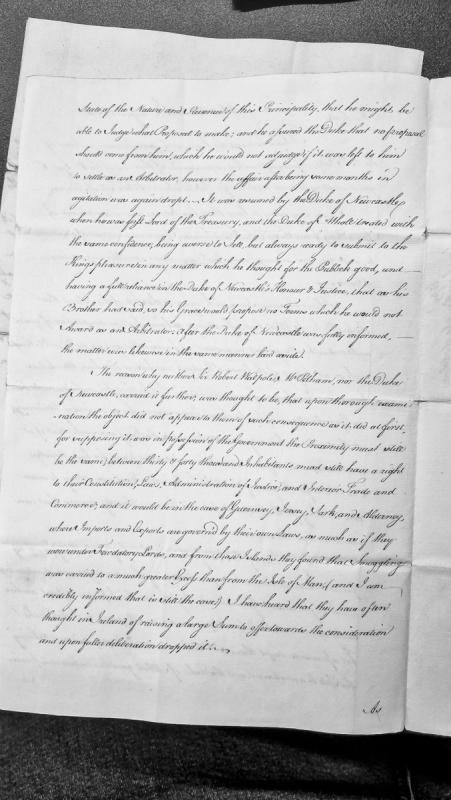
A historical legal or administrative opinion discussing various Crown attempts to acquire governance of the Isle of Man, spanning the administrations of Sir Robert Walpole, Mr Pelham, and the Duke of Newcastle. The document evaluates why these proposals were ultimately abandoned, comparing the Isle of Man's strategic and commercial value with other Channel Islands.