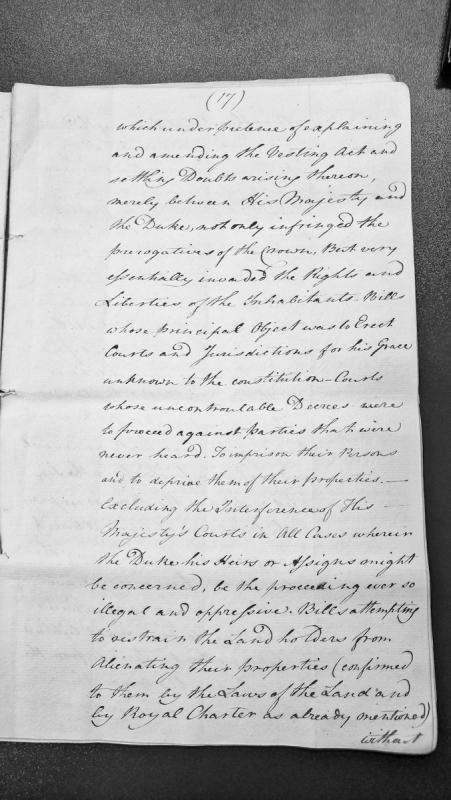
A fragment of a legal document critiquing proposed legislation that would establish courts under the Duke's authority, restricting Crown jurisdiction and inhabitants' property rights. The text argues these bills violate constitutional principles and the rights of landholders confirmed by law and royal charter.
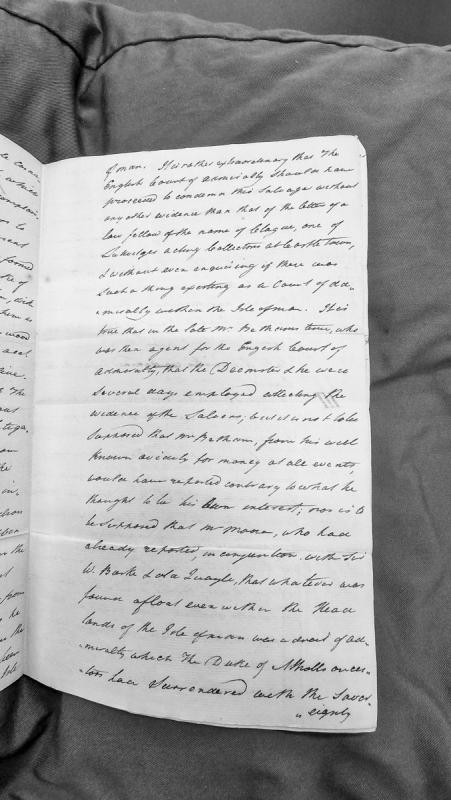
A legal document criticizing the English Court of Admiralty's condemnation of salvage based on limited evidence from a collector named Clague. The document questions the legitimacy of admiralty proceedings within the Isle of Man and references historical agents Betham and Moore, discussing disputes over droits of admiralty and the Duke of Atholl's sovereignty.
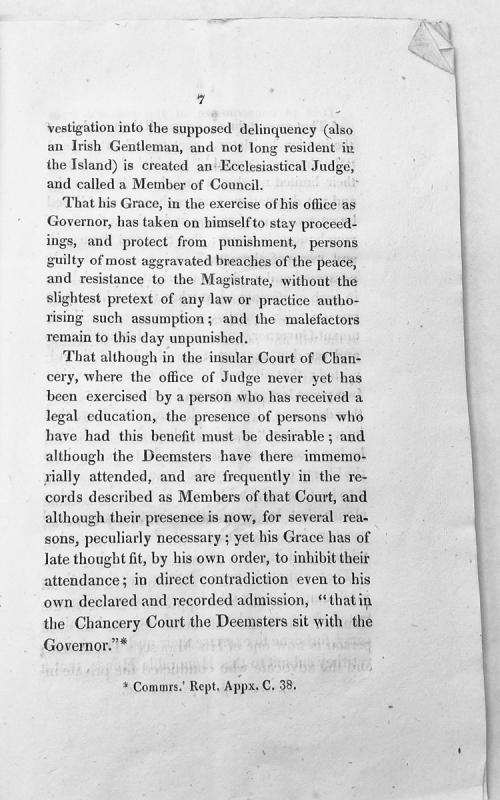
A legal document critiquing the Governor's actions, including the appointment of an Irish gentleman as an Ecclesiastical Judge without proper authority, the protection of persons guilty of breaches of peace, and the inhibition of Deemsters' attendance at the Court of Chancery contrary to established practice and the Governor's own admissions.
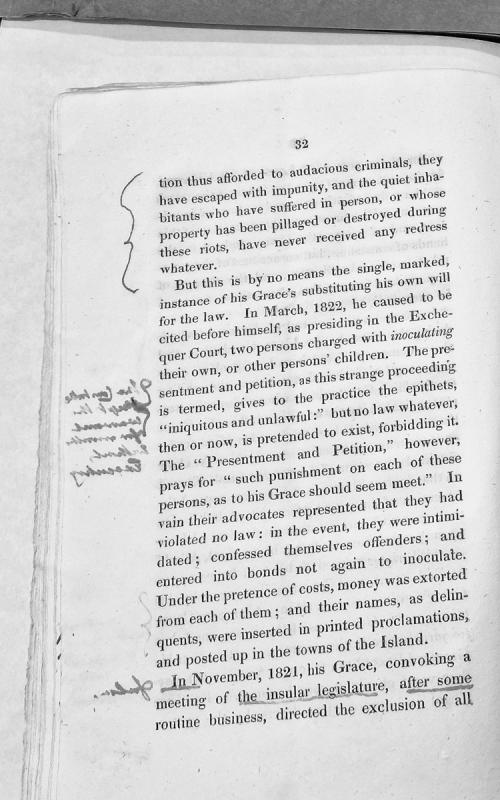
This is page 32 of a printed pamphlet criticizing the Governor's ('his Grace's') exercise of arbitrary power. It details two specific instances: his failure to prosecute rioters who destroyed property with impunity, and his 1822 prosecution of individuals for inoculating children despite no law forbidding the practice. The text argues the Governor substituted his will for the law.
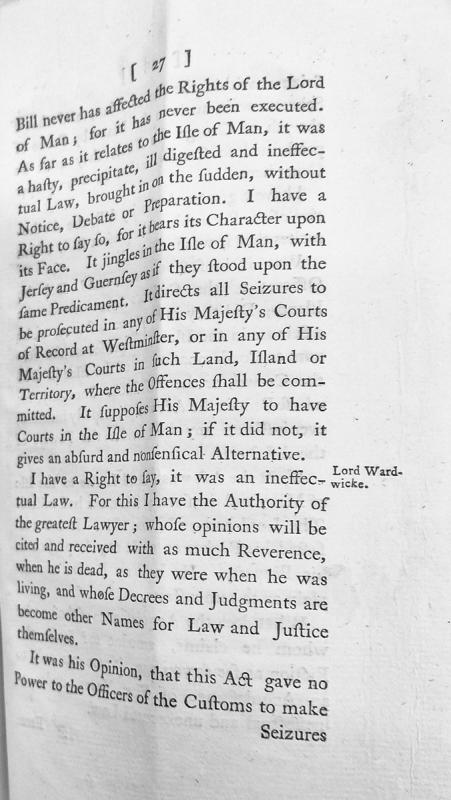
A legal argument criticizing an Act of Parliament regarding customs enforcement in the Isle of Man, Jersey, and Guernsey. The author argues the law was hastily passed, poorly drafted, and ineffectual, citing the authority of a great lawyer (likely Lord Hardwicke, mentioned in margin) regarding the Act's failure to grant seizure powers to customs officers.
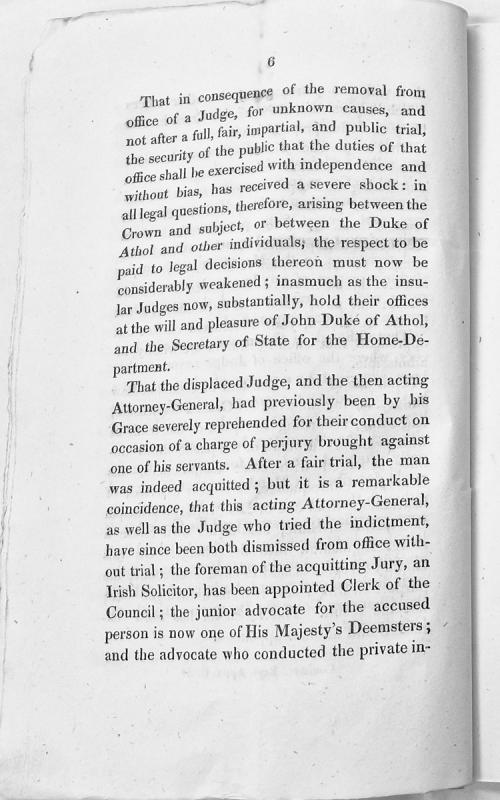
A legal opinion criticizing the removal of a judicial officer without proper trial, arguing that this undermines public confidence in the independence of the judiciary. The document references concerns about judicial appointments in the Isle of Man and their dependence on the will of the Duke of Athol and the Home Secretary, with detailed observations about related dismissals and appointments following a perjury case.
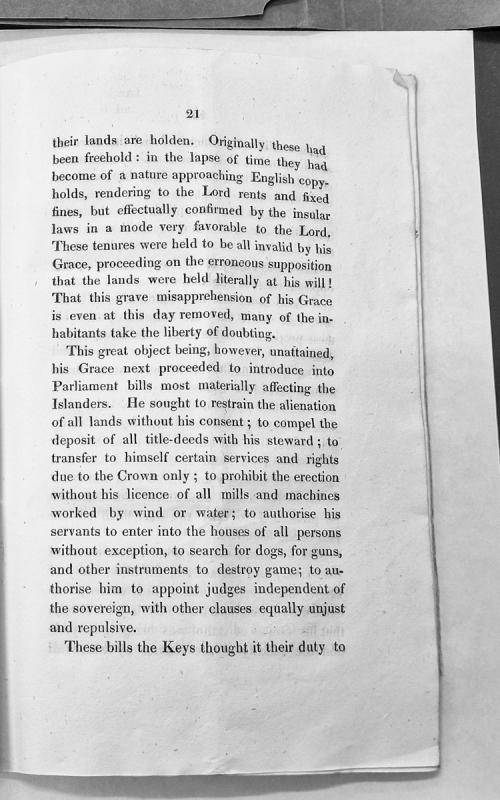
This document discusses historical land tenure systems in the Isle of Man, particularly the erroneous claims made by the Duke regarding freehold and copyhold lands. It details the Duke's attempts to introduce restrictive parliamentary bills affecting islanders' rights, including restrictions on land alienation, title deed deposits, mill licensing, and search authority.
Crofton, on The Crofts, was built between 1851 and 1861 for John Moore Jeffcott, an advocate who sat as member of the House of Keys for Castletown from 1855 to 1882. Following Jeffcott's financial difficulties the house was sold at auction in 1886 to Doctor John Clague, who is believed to have practised medicine from the property and to have added the rear extension providing a waiting room and surgery. Built of local limestone, the house is notable for its unusual dormers extending below the eaves and its recessed, pilastered entrance porch, and together with neighbouring Elderbank and Westwood it forms part of a recognised architectural group on The Crofts within the Castletown Conservation Area.
The conjectured and unproven site of a Bronze Age stone circle. Savage noted four stones here, some 4.8 metres apart. No further evidence is recorded of such a monument.
Crogga Mill stands within the historic Crogga estate on the Old Castletown Road, an estate long associated with the Quayle family of Mann, who acquired land here from the 1830s onward. One estate history describes the mill site as centuries old, retaining an ancient mill wheel, and the Isle of Man Steam Railway, opened in 1874, runs directly through the grounds of the estate. Beyond this, detailed documentary history specific to the mill building itself is limited in the sources available.
Flakes, blades, core and a nodule of Mesolithic heavy-blade type, and a Bronze Age sherd, were recovered by fieldwalking from Ordnance Survey Field no. 1464, Croit, Arbory.
The flints and potsherd were found separately, but no further details are available. The grid reference refers to the centre of the field.
Flakes, blades, core and a nodule of Mesolithic heavy-blade type, were recovered by fieldwalking from Ordnance Survey Field no. 1464, Croit, Arbory.
The flints and potsherd were found separately, but no further details are available. The grid reference refers to the centre of the field.
The flints are in the Manx National Heritage collections, accession no. 1984-0252/2.
A Bronze Age sherd was recovered by fieldwalking from Ordnance Survey Field no. 1464, Croit, Arbory.
The flints and potsherd were found separately, but no further details are available. The grid reference refers to the centre of the field.
The sherd is in the Manx National Heritage collections, accession no. 1984-0252/1.
Modern corn drying kiln.
A corn-drying kiln was discovered during ploughing on Croit e Caley farm, Colby in 1968. An emergency excavation revealed a substantial though much ruined structure. Clear traces of burning, with large quantities of charcoal, were found, together with a well-preserved 'drying-pot' built of cobbles, and a millstone. Paving and a possible flue were also identified.
No dating evidence was found, but its excavator AM Cubbon and BRS Megaw (1969) consider a 17th-18th century date is likely.
This rough slab was found built into a corn-drying kiln at Croit e Caley (IOMHER 0187.00) in 1968. On one face it bears a roughly pecked cross, with equal upper and side arms, and a longer lower arm. No further published detail on the discovery or subsequent study of this slab has been located.
Worked flints, comprising four blades were found at Croit e Caley, Rushen.
The precise findspot is not known, and the grid reference relates to the old farmstead.
The objects are in the Manx National Heritage collections, accession no. 1971-0096.
There are three columns containing 50 names, listed alphabetically except for the last five names. Four names are encircled in black, indicating that these men died during the war.
First World War Framed Roll of Honour.
Following the closure of the Croit e Caley Chapel, in 2016 MNH was advised by the Reverend Richard Hall that "the roll of honour is now in the District office (Trinity Methodist Church, Bucks Rd, Douglas) along with some other materials from Croit e Caley."
Modern chapel.
The Primitive Methodist chapel at Croit e Caley replaced an earlier chapel at Kentraugh in 1881.
The chapel was later extended by the addition of a Sunday school attached to the south gable.
It is now a private dwelling.
Modern chapel.
The Primitive Methodist chapel at Croit e Caley replaced an earlier chapel at Kentraugh in 1881. A roll of honour commemorates 50 men from Colby and the surrounding district who fell in the First World War.
It closed in 2014 and was subsequently sold. It is now a private dwelling.
Modern chapel.
The Primitive Methodist chapel at Croit e Caley replaced an earlier chapel at Kentraugh in 1881.
The Sunday school was later added by extending from the southerly gable.
It is now a private dwelling.