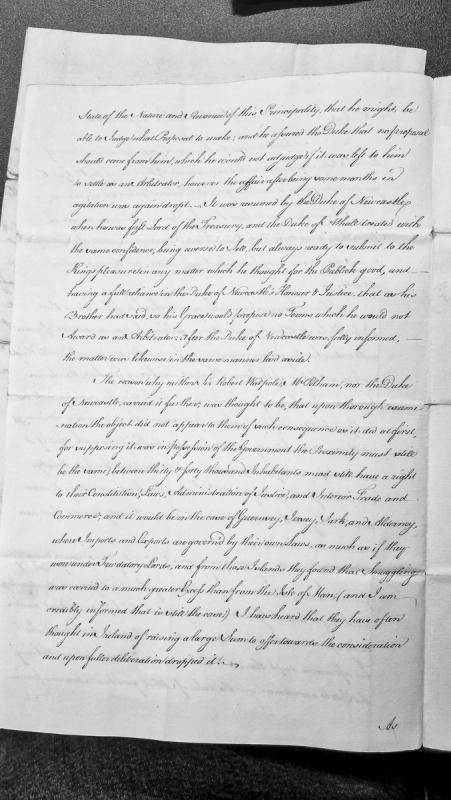
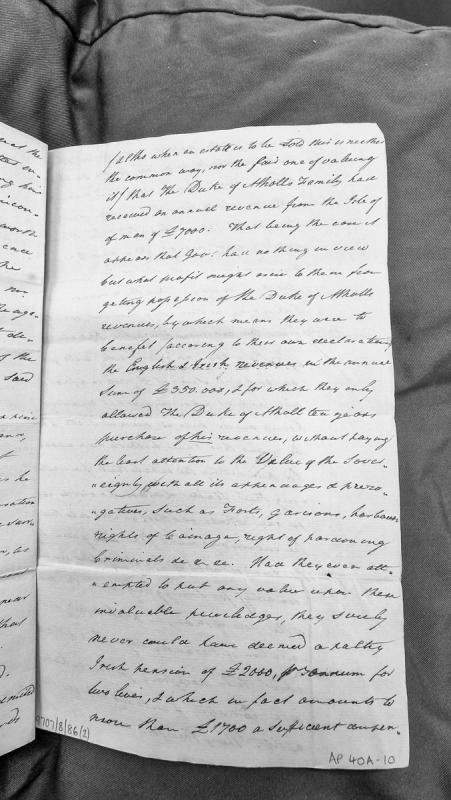
This document discusses historical attempts by British government officials (Walpole, Pelham, Newcastle) to acquire the Isle of Man from the Duke of Atholl. It examines the political and economic reasoning behind these failed negotiations, comparing Man's governance structure to that of the Channel Islands and addressing concerns about smuggling.
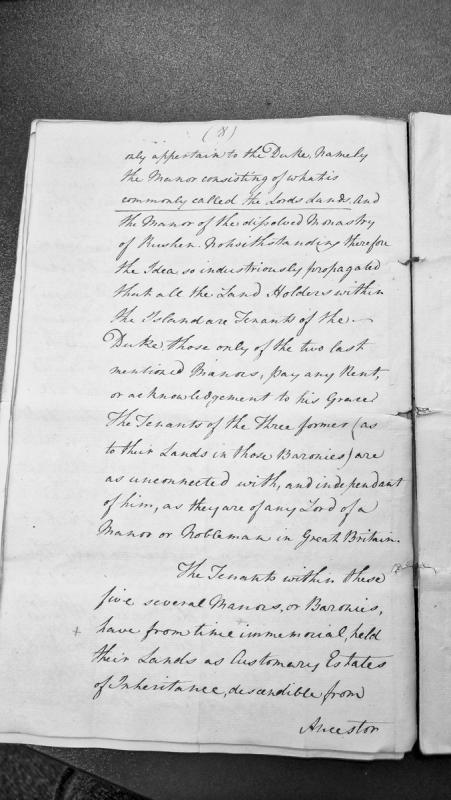
This document discusses the five manors or baronies of the Isle of Man and clarifies that only tenants of the Duke's two manors (the Lords Lands and the dissolved Monastery of Rushen) pay rent. Tenants in the three other baronies hold their lands as customary estates of inheritance independent of ducal authority, contrary to popular misconception.
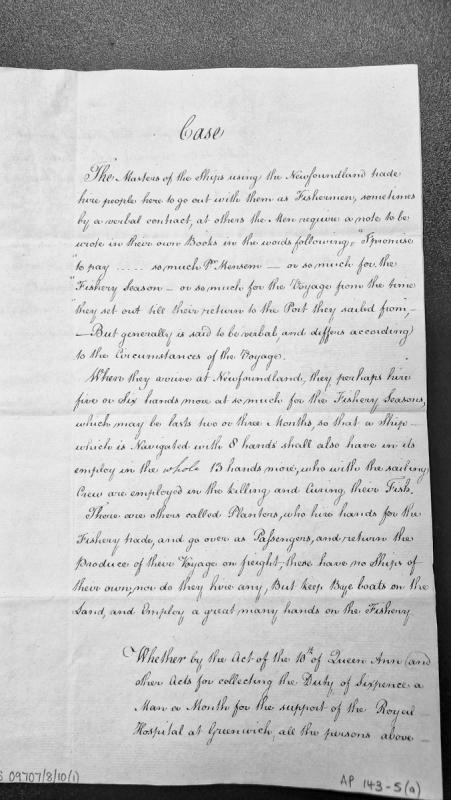
A legal or administrative analysis discussing hiring practices for the Newfoundland fishery trade, including verbal and written contracts for fishermen, wages (per month or per season), and the distinction between ship masters and planters. The document appears to address taxation implications under Queen Anne's legislation regarding duties for the Royal Hospital at Greenwich.
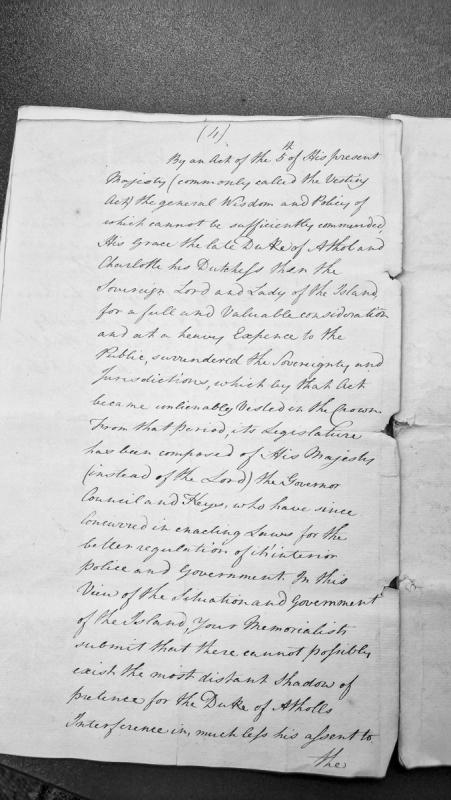
A legal memorandum discussing the 5th Act of the present Majesty (the Vesting Act) which transferred sovereignty of the Isle of Man from the Duke of Athol to the Crown. The document explains how the island's legislature now comprises the King, Governor, Council, and Keys, and argues against any remaining interference by the Duke of Athol in island affairs.
A critical legal or administrative analysis examining the inadequate compensation offered to the Duke of Atholl for the Isle of Man. The document argues that the government's valuation failed to account for sovereignty rights, fortifications, harbours, coinage rights, and pardoning powers, offering only a ten-year purchase of revenues and an Irish pension of £2000 per annum for two lives.
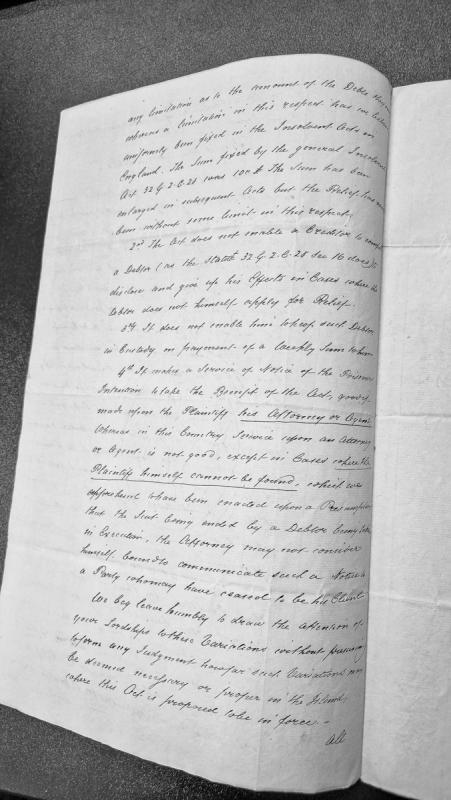
A legal opinion examining key differences between a proposed Insolvent Act for the Isle of Man and English insolvency legislation (32 G. 2. C. 28). The document identifies four major variations concerning debt limits, creditor powers, custody provisions, and service of notice procedures.
The site of Andreas Airfield. It was established as RAF Andreas, which was operational between 1941 and 1946. It has been used by a gliding club in recent times.
A small broken slab with cross inscribed on both faces and traces of ring-chain and plait on one. There is a runic inscription on the edge of the stone. It was found in 1886 being used as a window lintel at the rectory. The stone measures 86.5 centimetres by 17.8 centimetres by 7.5 centimetres.
A fragment of the lower end of a cross shaft. It is carved on two faces of the stone slab, one with ring-chain design, other with plait. It was found in 1885 in the rectory garden and measures 70 centimetres by 22.8 centimetres by 11.4 centimetres.
A fragment of a inscribed stone carved on both faces, one with tendril pattern and key-fret, other with a plait and a Bind-rune inscription. It was found in 1886 and measures 56 centimetres by 26 centimetres by 7 centimetres.
An early medieval cross slab from Andreas parish church. St Andrew's Church, Andreas, houses a collection of eleven medieval Manx carved cross slabs. The best known of these, Thorwald's Cross, is dated to around 940 CE and combines a Christian cross with Norse imagery: a bearded human figure (interpreted as the god Odin) with a foot in a wolf's mouth and a bird at his shoulder, evoking the Ragnarok legend, alongside a runic inscription reading 'Thorvaldr raised (this) cross'.
A Norse-type cross-slab with carved shaft and volutes. It was found being used as headstone near the churchyard gate in 1939. It measures 91.5 centimetres by 20.3 centimetres and is kept in Andreas church.
An early medieval churchyard cross from Andreas parish church. It is a stone with plain Latin cross pecked out on each face. It measures 51 centimetres by 14 centimetres by 7.5 centimetres. A cast copy is kept at the Manx Museum.
This fragment, of the head of a broken cruciform slab, appears to have been found in the churchyard. Each face bears the remains of a cross of compressed 'Celtic' form. A small circle is carved at the centre, and the whole of the cross is bordered with a boldly cut line.
This fragment was found in 1885 in a rockery at the rectory. Both faces show the lower end of the shaft of a cross. On one face a ring-chain terminates in irregular loops and the space to the right is decorated with key-fret. The other face shows a cross shaft filled with a plait-of-three, and the panel to the left with a form of link-twist.
This fragment of a slab was found in 1886 in the churchyard. One side shows the remains of tendril-pattern on the shaft and bold key-fret in the panel to the right. The other side is decorated with twist-and-ring on the shaft, and a linked-twist to the right. To the left is an incomplete runic inscription. The letters are 'bind-runes', a codified form of writing where each character represents several others. It has resisted all attempts to decipher it.
This small slab was found in use as a lintel over a door in an outbuilding belonging to the rectory in 1886. It is broken along its length but is otherwise almost complete. Both faces show a long-shafted cross without circle. On one face only the outline of a cross can be traced; this is shorter than on the other side, and terminates in a stepped pedestal. The other face shows more of the outline of a cross, bearing the ghost of an interlace pattern, almost certainly ring-chain, on the shaft and traces of a plait in the panel to the right. The surviving part of one edge bears an incomplete runic inscription which translates as, '...erected this cross in memory of...'.
This fragment of a large slab was found in the churchyard in 1939. It is heavily weathered and bears the remains of a cross shaft terminating in spirals or 'volutes'. The lower half of the slab is undecorated, but forms a long mortice which would once have fitted into a socket stone.
This water-smoothed boulder was found in the churchyard just before WW1. Both broad faces bear a simple pecked cross in outline with an extended lower limb forming a pronounced cross shaft.
This large and weathered slab stood on the small green outside the church where the war memorial is now located until the 1880s when it was brought inside the church. It had been used for tethering horses and as a billboard for posters. Its carvings are heavily worn, but each broad face bears a cross surrounded by a ring, both filled with plaited and interlaced carvings. The shaft on both faces is decorated with plait-of-five; one face bears twist and ring to the left and key-fret to the right, the other a plain twist and form of linked twist.
The design follows the Scandinavian Borre style and dates to AD950-1000. The runic inscription along the edge is now unclear, but with the help of an earlier drawing the inscription has been deciphered to read, 'this in memory of Ofeig his father, but Gaut made it, son of Biarn from Kuli'. The first part of the inscription is lost but probably recorded the name of the person who raised the stone. Gaut is also recorded on one of the stones at Kirk Michael (Manx Cross 101).
A number of stylistic similarities which appear on these and several other crosses from the Island suggest that they may have been carved by the same person, or at least come from the same workshop, and Gaut's intricate work has thus become some of the most iconic from the Island. The runic inscription implies something of the ancestry of Gaut: he was the 'son of Bjorn from kuli'. It has been suggested that 'kuli' refers to the island of Coll in the Hebrides.