A two storey, double-fronted, semi-detached house with single storey extensions to its rear and east gable. The house was originally a single-storey structure with a thatched roof, until an additional, slate-roofed storey was added in the 1930s.
Old photographs suggest that Cummel Beg is older than its neighbour Creg y Shee (0046.04). Prior to the addition of the extra storey and rendering, a straight joint and trapped quoinstones on the west gable of Cummel Beg were apparent. It would also appear that only the left hand, or westerly, of the rooms in the original cottage had a hearth.
The property was acquired by the Manx Museum and National Trust in 1973.
Two storey, double-fronted, semi-detached house with single storey extensions to rear and east gable. Originally constructed before 1868 (present on Ordnance Survey 1:2500 1st edition map of that date).
The house was originally a single-storey structure with a thatched roof, until an additional, slate-roofed storey was added in the 1930s.
Old photographs suggest that Cummel Beg is older than its neighbour Creg y Shee: prior to the addition of the extra storey and rendering, a straight joint and trapped quoinstones on the west gable of Cummel Beg were apparent. It would also appear that only the left hand, or westerly, of the rooms in the original cottage had a hearth.
The property was acquired by the Manx Museum and National Trust in 1973.
Medieval carved stone.
This pillar-shaped stone (Manx Cross 3) was noted at least as early as 1885 built into the south wall of the friary church, where it had probably been re-used as a lintel. It bears an incomplete ogham inscription running up one edge, which reads, 'Cunamagli maq...', translated as '(the stone) of Cunamaglus, son of...'.
It is now displayed in the Manx Museum.
The findspot of an early prehistoric flint scatter which consisted of circa 30 pieces including a blade, blade core, thumbnail scraper, waste flakes and cores and a "fragment of slate pencil."
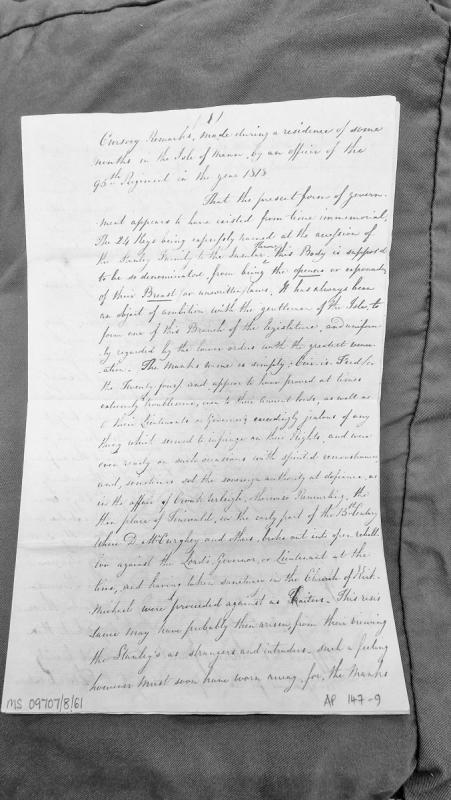
An officer of the 95th Regiment provides observations on Manx governance during a residence of several months in 1813. The document discusses the form of government, the House of Keys (24 Keys), their role as expounders of law, their influence and occasional conflicts with Lords and Lieutenants, and historical incidents including the McInghey rebellion of the 15th century.
The cushag (common ragwort) is regarded as the unofficial national flower of the Isle of Man, its status reputedly bestowed in jest by Lord Raglan, Governor from 1902 to 1918, when asked to name a national flower for the island as was then fashionable elsewhere; according to Manx Museum botanist Larch Garrad, he suggested it partly as a wry comment on how much of it grew in Manx fields. The flower was later celebrated by poet and folklorist Josephine Kermode, who wrote under the pen name 'Cushag'.
The Custom House on Crown Street, Peel, was registered as a protected building on 7 July 2021. No further verifiable history of its construction or use as a civic building was found.
A formal report from Custom House officers (Pelham, Mead, Musgrave, Hooper) to the Treasury recommending full annexation of the Isle of Man to the Kingdom as part of Cumberland, rather than adopting separate regulatory proposals. The report argues that annexation would be the most effective way to prevent smuggling revival and secure revenue, and situates this within the context of the 1764 purchase of sovereignty.
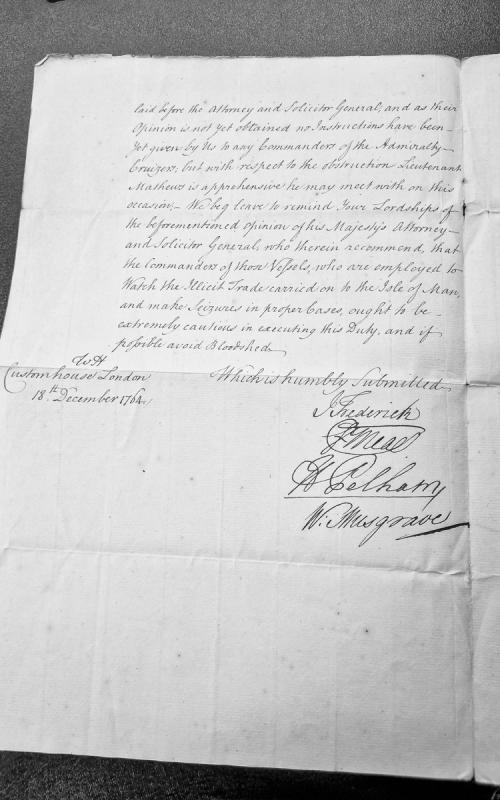
A letter from the Custom House in London dated 18 December 1764 addressing instructions to naval commanders regarding the enforcement of customs law and seizures related to illicit trade at the Isle of Man. The document references a legal opinion from the Attorney and Solicitor General recommending cautious execution of duties with avoidance of bloodshed.
A reference table comparing customs duty rates on imports and exports across four periods (1577, 1677, 1692) for the Isle of Man, distinguishing between duties charged to natives and strangers. Covers commodities including grain, livestock, textiles, and colonial goods (sugar, tobacco). Relevant for understanding the Revestment period's fiscal context and trade regulation.
A formal report from the Customhouse (signed by H. Pelham, J. Mead, W. Musgrave, and Edwd Hooper) to the Treasury Lords responding to proposals for improving Isle of Man revenue. The officers recommend full annexation to Great Britain (specifically to Cumberland) rather than implementing separate trade regulations, arguing this would prevent smuggling and integrate the island's customs administration with English ports. This represents the official revenue perspective on constitutional settlement two years after the 1765 Revestment.
Reply from the Secretaries of Customs (Frederick, Mead, Pelham, Musgrave) to the Treasury regarding instructions for naval officers seizing smuggled goods in Isle of Man ports. References an opinion from the Attorney and Solicitor General on the legal powers of customs officers to conduct seizures in Manx waters, and discusses caution required to avoid bloodshed during enforcement operations.
Reply from the Secretaries of Customs (Frederick, Mead, Pelham, Musgrave) to the Treasury regarding instructions for revenue officers and Admiralty cruizers operating in Isle of Man ports. Addresses concerns raised by Lieutenant Mathews of the Lurcher Cutter regarding seizure of tea smuggling and legal authority to conduct seizures. References Attorney and Solicitor General opinions and cautious enforcement procedures.
29 names are listed, two of which are believed to be Manx, in two columns. Second World War. Framed parchment. Originally displayed at Daily Mail main office in Manchester prior to demolition; now on display at the Peveril Hotel, Peel.
Prehistoric flint scatter.
A small quantity of worked prehistoric flint was recovered from Dalby by CH Cowley.
No further details concerning the circumstances of the discovery were recorded and the grid reference relates to the centre of the village for indicative purposes only.
The antiquary Charles Harry Cowley was an avid collector of worked flint and coarse stone artefacts revealed by agricultural activity, mainly on farms located around Peel, and occasionally from further afield. He was active from 1900 until 1943. His entire collection of artefacts, together with a daybook cataloguing his discoveries, was later donated to Manx National Heritage.
Prehistoric flint scatter.
A single worked prehistoric flint was recovered from Dalby by CH Cowley, from 'Corris The Clieau's House'.
No further details concerning the discovery were recorded and the grid reference relates to the farmstead for indicative purposes.
The antiquary Charles Harry Cowley was an avid collector of worked flint and coarse stone artefacts revealed by agricultural activity, mainly on farms located around Peel, and occasionally from further afield. He was active from 1900 until 1943. His entire collection of artefacts, together with a daybook cataloguing his discoveries, was later donated to Manx National Heritage.
Prehistoric flint scatter.
A single worked prehistoric flint was recovered from Dalby Mountain by CH Cowley.
No further details concerning the circumstances of the discovery were recorded and the grid reference relates to the summit for indicative purposes only.
The antiquary Charles Harry Cowley was an avid collector of worked flint and coarse stone artefacts revealed by agricultural activity, mainly on farms located around Peel, and occasionally from further afield. He was active from 1900 until 1943. His entire collection of artefacts, together with a daybook cataloguing his discoveries, was later donated to Manx National Heritage.