Prehistoric flint scatter.
A single worked prehistoric flint was recovered from Dalby Mountain by CH Cowley, from 'above Head of Glen Rushen'.
No further details concerning the circumstances of the discovery were recorded and the grid reference relates to the summit for indicative purposes only.
The antiquary Charles Harry Cowley was an avid collector of worked flint and coarse stone artefacts revealed by agricultural activity, mainly on farms located around Peel, and occasionally from further afield. He was active from 1900 until 1943. His entire collection of artefacts, together with a daybook cataloguing his discoveries, was later donated to Manx National Heritage.
Prehistoric flint scatter.
A single worked prehistoric flint was recovered from Dalby Mountain by CH Cowley, from 'Between Corris and Road to Eary Cushlin'.
The description suggests the area centred around the grid reference provided.
The antiquary Charles Harry Cowley was an avid collector of worked flint and coarse stone artefacts revealed by agricultural activity, mainly on farms located around Peel, and occasionally from further afield. He was active from 1900 until 1943. His entire collection of artefacts, together with a daybook cataloguing his discoveries, was later donated to Manx National Heritage.
Prehistoric flint scatter.
A small quantity of worked prehistoric flint was recovered from Dalby Mountain by CH Cowley, from 'Between Doolish Cashen and Glen Rushen Mines'.
The description suggests the more northerly end of the summit of Dalby Mountain, centred around the grid reference provided.
The antiquary Charles Harry Cowley was an avid collector of worked flint and coarse stone artefacts revealed by agricultural activity, mainly on farms located around Peel, and occasionally from further afield. He was active from 1900 until 1943. His entire collection of artefacts, together with a daybook cataloguing his discoveries, was later donated to Manx National Heritage.
Prehistoric flint scatter.
A small quantity of worked prehistoric flint was recovered from Dalby Mountain by CH Cowley, from 'near Mountain Gate'.
The mountain gate is shown on the OS 1:2500 First Edition mapping of 1868 at the grid reference provided.
The antiquary Charles Harry Cowley was an avid collector of worked flint and coarse stone artefacts revealed by agricultural activity, mainly on farms located around Peel, and occasionally from further afield. He was active from 1900 until 1943. His entire collection of artefacts, together with a daybook cataloguing his discoveries, was later donated to Manx National Heritage.
Prehistoric flint scatter.
A single worked prehistoric flint was recovered from Dalby Mountain by CH Cowley, from 'on Road Between Farms'.
No further details concerning the discovery were recorded and the grid reference relates to the summit for indicative purposes only.
The antiquary Charles Harry Cowley was an avid collector of worked flint and coarse stone artefacts revealed by agricultural activity, mainly on farms located around Peel, and occasionally from further afield. He was active from 1900 until 1943. His entire collection of artefacts, together with a daybook cataloguing his discoveries, was later donated to Manx National Heritage.
Prehistoric flint scatter.
A small quantity of worked prehistoric flint was recovered from Dalby Mountain by CH Cowley, from 'Opposite Glen Rushen Mines'.
The description would appear to relate to a broad area on the east facing slopes below the summit ridge, which is centred at the grid reference provided.
The antiquary Charles Harry Cowley was an avid collector of worked flint and coarse stone artefacts revealed by agricultural activity, mainly on farms located around Peel, and occasionally from further afield. He was active from 1900 until 1943. His entire collection of artefacts, together with a daybook cataloguing his discoveries, was later donated to Manx National Heritage.
E.B. Savage recorded a cairn 'opposite Beckwith's mine', 'on the slope of Dalby Mountain'. Beckwith's Mine, worked by the Isle of Man Mining Company on the northern slopes of South Barrule in Glen Rushen between about 1830 and 1879, was one of the Island's major lead producers, so the cairn can be located with reference to that well-documented mine site.
A mound with a diameter of 7.0 metres and a height of 0.3 metres. Several stones are exposed in the surface of the mound, which is heather-covered and appears to be intact. No further sourced detail could be verified.
The site of a partly ploughed-out burial mound. Professor Rhynn found cremated bone here in 1980 as well as sherds of cinerary and cordoned vessels and an incised stone, Heavy-blade Mesolithic flint was found in excavation.
A flat-topped cairn, which is heather-covered but has small stones exposed on its surface. It has a diameter of 12.0 metres and a maximum height of 1.0 metre. A shallow ditch, average 3.0 metres wide and 0.2 metres deep surrounds the cairn.
A grass covered bowl barrow, which measures 13.0 metres west to east, by 15.0 metres north to south, and is up to 1.1 metre high on its west side. There is a slight disturbance to the centre of the mound and it has been ploughed over, but it is relatively intact.
A collection of microlithic and Mesolithic 'Bann' flints found were found by Cowley on Dalby Mountain at a site described as 'J Radcliffe's farm, Glen Rushen.' The flints included nine arrowheads (numbered by Cowley as 'arrowheads 468, 469, 470, 471, 472, 473, 474, 475, 476') as well as two scrapers (numbered by Cowley as 'scrapers 282, 283).
2 names listed; Second World War. Wooden plaque. Headed with a crest of the Royal Air Force with wings either side; the upper left of the plaque has the crest of the Post Office Engineers whilst on the upper right of the plaque are the initials 'G.R.'
The memorial was sponsored by corporate donation by the Post Office Engineering Union.
Fragments of a Bronze Age cordoned cinerary urn were found in 1913-14 inverted over burnt bones and charcoal. The discovery was made near the site of an excavation for a manhole. Further fragments were recovered by a separate finder, and all were donated to the Manx Museum.
The site is now built over.
Daniel Laimster petitioned against William Cashin for assault on 27 May 1765, just ten days after the Revestment Act took effect. The petition's timing reflects the social disruption that accompanied the Crown's takeover of the Island.
The Rev. Daniel Mylrea, Archdeacon of the Isle of Man, who acted for the poor clergy in the settlement with the Duke of Atholl.
He was a son of the Rev. William Mylrea, vicar of Kirk Andreas, who died in 1787, and it was he who did the duty of that parish for Lord George Murray after his father's death.
As Archdeacon he was one of the parties to the long negotiation over the tithes and the clergy's incomes. He joined Claudius, Lord Bishop of Sodor and Man, in filing a bill on behalf of the poor clergy, the ministers of the Gospel resident and exercising their ministerial functions within the Island, and on behalf of the master of the Free School. He was named in the Articles of Agreement of 26 June 1811 between the Duke of Atholl, the Earl of Derby, Bishop Claudius, Lord Stanley, Mylrea himself, William Scott the Receiver-General and John Cosnahan, made on behalf of themselves and the clergy of the Island, and printed by the King's printers. The arrangement provided for raising sixteen thousand pounds of lawful money of Great Britain, with interest from the date of the Articles, to be paid to the Duke, the Bishop, Mylrea, Scott and Cosnahan and their successors, and applied as the agreement directed. The parties said their object was to prevent any litigation that might thereafter arise.
David Murray, 2nd Viscount Stormont (1727-1796), later 7th Earl of Mansfield, was a British diplomat and politician connected to the Murray family's interests in the Isle of Man. As a relative of the Dukes of Atholl, he was involved in the political affairs surrounding the lordship of Mann during the Revestment era.
David Reid, one of His Majesty's Commissioners of Inquiry into the state of the Isle of Man in 1791 and 1792.
The commission came out of a letter from the Secretary of State at Whitehall dated 8 September 1791, directing the commissioners to proceed to the Island for the purpose of obtaining the most accurate information upon various points respecting it. Reid sat with John Spranger, William Osgoode and William Roe, and on some of the business with William Grant as well. The Keys received them at their house in Castletown on 19 October 1791.
His name is at the foot of the record. The examinations that make up the fullest surviving account of how the old Manx constitution worked are each attested by the commissioners, Reid signing last: John Quayle the Clerk of the Rolls on the Great Inquest and on the records of the courts, John Taubman the Speaker on the House of Keys and the promulgation of Acts, Thomas Moore on imprisonment for debt and the sixpence a day a creditor must allow, and George Savage the Water Bailiff on his juries. The memorials came to the four of them by name: the Bishop and the Vicar-General on the ecclesiastical seats in Council, the merchants and shopkeepers of Castletown on the prohibition of foreign brandy and geneva, and the Duke of Atholl's own letters answering the charges against him.
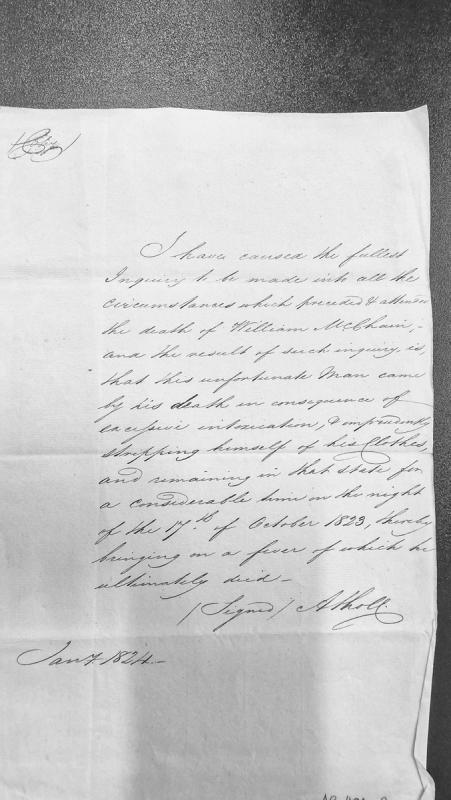
A formal legal opinion documenting the results of an inquiry into the death of William McChain. The document concludes that McChain died from fever brought on by excessive intoxication and exposure (stripping of clothes) on the night of 17 October 1823. Signed by Atholl in January 1824.
Extract from Manx Society volume 4 ('Monumenta de Insula Manniae - Vol 1'), presenting a translation/transcription of the account of King Magnus's death in Ireland from the Icelandic Sagas. The document describes the ambush and battle at Magh Coba near Downpatrick where Magnus was killed after his raid on Wales and Ireland. Relevant to understanding the medieval history and Norse sovereignty of the Isle of Man.
Appendix D from Manx Society vol. IV transcription of Monumenta de Insula Manniae, providing a detailed narrative account of King Magnus's death in Ireland derived from Icelandic Sagas. Relevant to Manx medieval history and Isle of Man's historical context under Norse rule prior to the 1765 Revestment.
Ned Maddrell, the last native speaker of Manx Gaelic, died at Cregneash. His death was reported internationally as the death of a language. But by then, Brian Stowell and Douglas Faragher and others had already begun the revival work that would prove the reports premature. The language was not dead. It was waiting.