After the finish line, the deceleration lane runs into a hairpin turn-around loop in Nobles Park, leading riders back to the winners' enclosure and parc ferme within the paddock complex used by all race finishers.
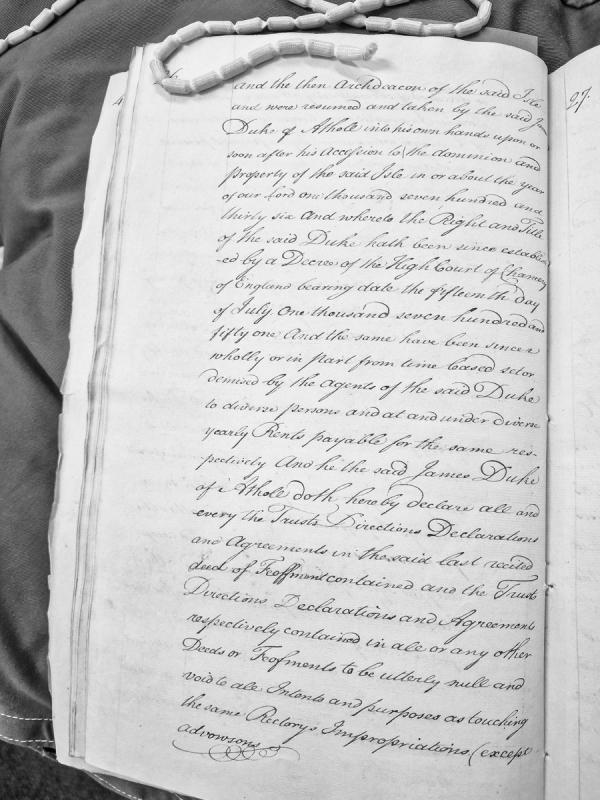
A legal document in which James Duke of Athole declares null and void various trust deeds and feoffments related to rectory impropriations on the Isle of Man. The document references his acquisition of dominion over the Isle around 1736 and a confirming Chancery decree of 1751, establishing his authority to manage and lease these ecclesiastical properties.
A formal declaration by the Bishop of Sodor, Abbot of Russyn, and Manx clergy denying that they ever acknowledged Sir Stephen Lestrop as heir to William Lestrop or delivered him the lordship of Man. The document was issued in open court at Tynwald Hill and sealed by multiple ecclesiastical and lay officials. It provides crucial evidence of disputed succession and the role of Tynwald in affirming sovereignty claims during the early 15th century.
A formal declaration by the Bishop of Sodor, Abbot of Russyn, and senior clergy of the Isle of Man, issued at Tynwald Hill, denying that they acknowledged Sir Stephen Lestrop as heir to William Lestrop's lordship of Mann or transferred any lands, offices, or franchises to him. The document establishes ecclesiastical and civil witness to succession disputes on the island in the early 15th century.
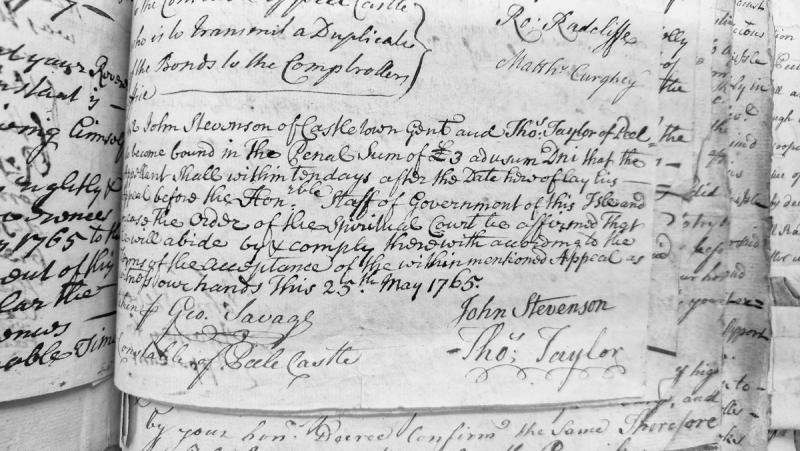
Fragment of a legal document confirming a decree by the House of Keys. The text indicates a formal judicial confirmation of a previous decision or ruling.
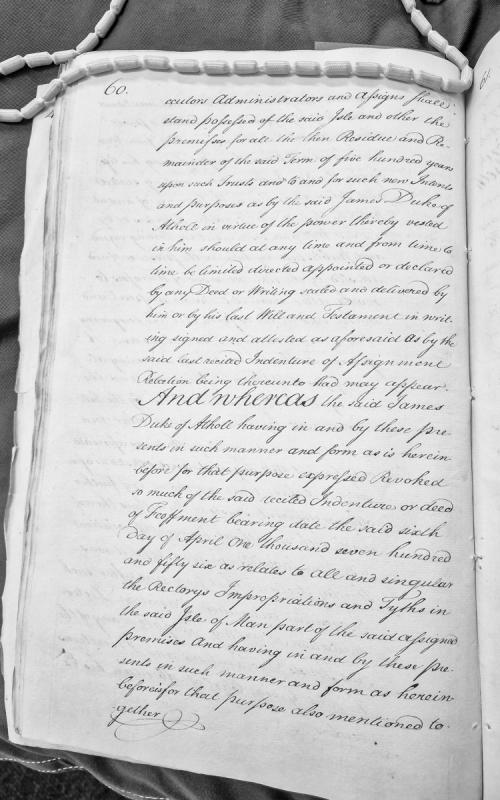
A legal document detailing the revocation by James Duke of Atholl of portions of a 1756 Deed of Feoffment relating to rectories, impropriations, and tithes in the Isle of Man. The document discusses trust arrangements and powers vested in the Duke regarding property on the Isle of Man.
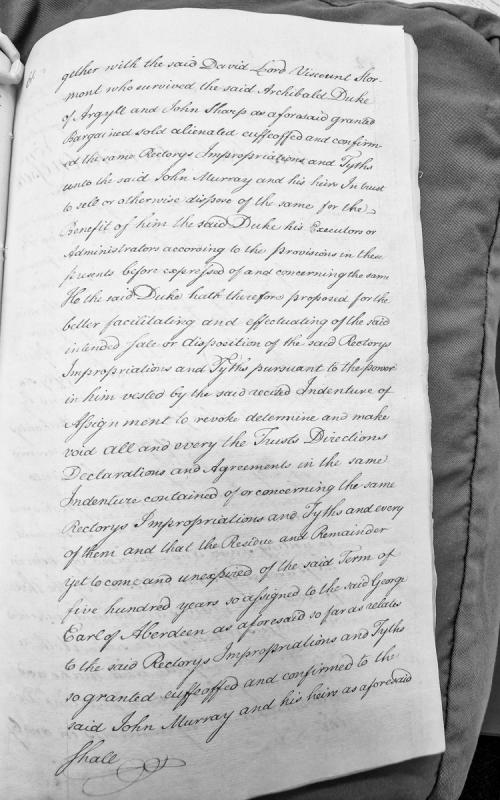
Fragment of a legal document dealing with the revocation of trusts, directions and agreements contained in an indenture of assignment concerning Scottish rectories, impropriatios and tithes. The document involves multiple parties including the Duke of Argyll, David Lord Viscount Stormont, John Murray, and George Earl of Aberdeen, and relates to powers vested in the Duke to revoke and make void certain trust arrangements.
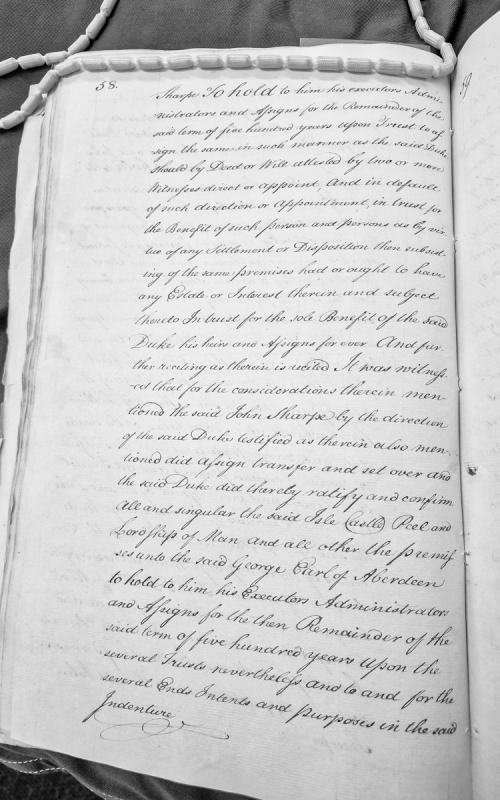
This is an excerpt from a legal deed documenting the transfer and assignment of the Isle of Man, Castle Peel, and associated lordship and premises from John Sharpe to George, Earl of Aberdeen. The document outlines trust arrangements for a five-hundred-year term, with provisions for direction by deed or will and ultimate benefit to the Duke.
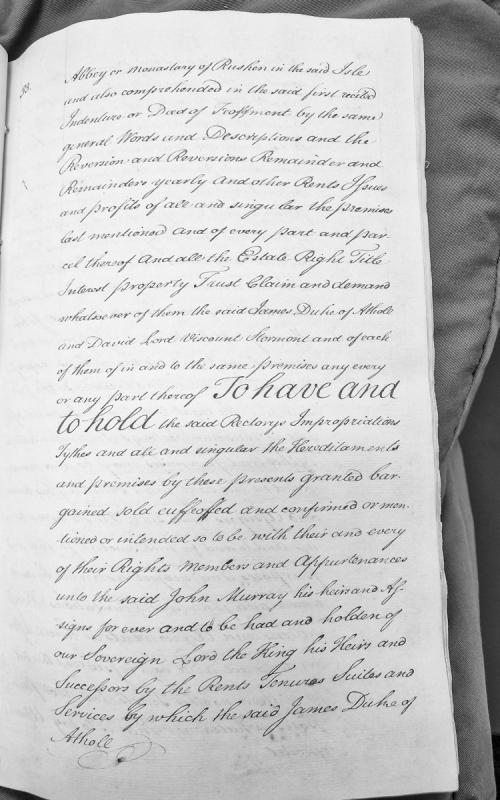
A legal document detailing the transfer of rectories, impropriations, tithes and other profits from Rushen Abbey on the Isle of Man from James Duke of Atholl and David Lord Viscount Stormont to John Murray. The document uses formal feoffment language establishing rights, reversions and remainders with full inheritance provisions.
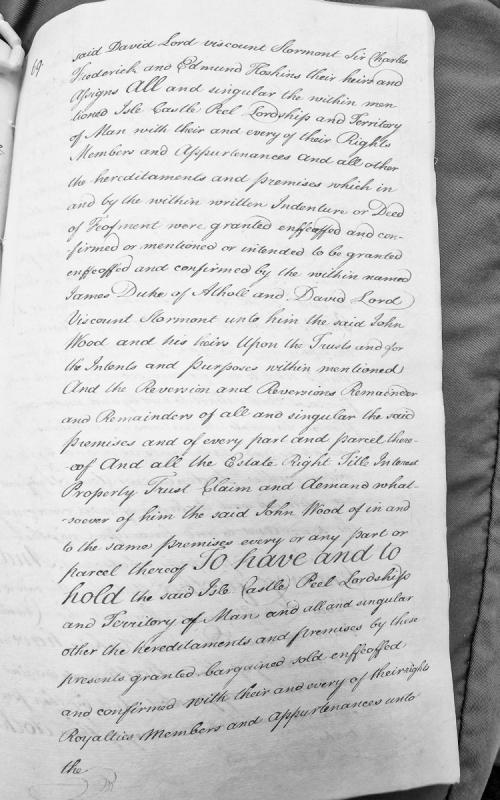
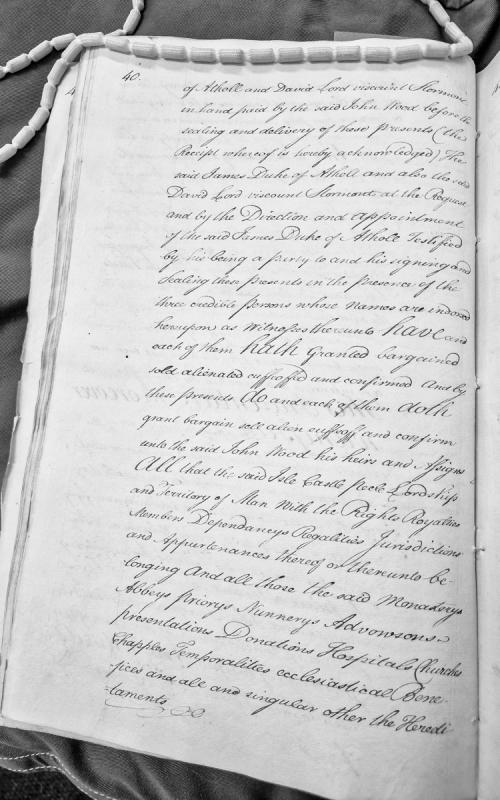
A legal deed transferring the Isle of Man, Castle Peel, lordship and territory from James Duke of Atholl and David Lord Viscount Stormont to John Wood and his heirs. The document outlines the rights, members, appurtenances and hereditaments being conveyed, with provisions for reversion and remainders of the premises.
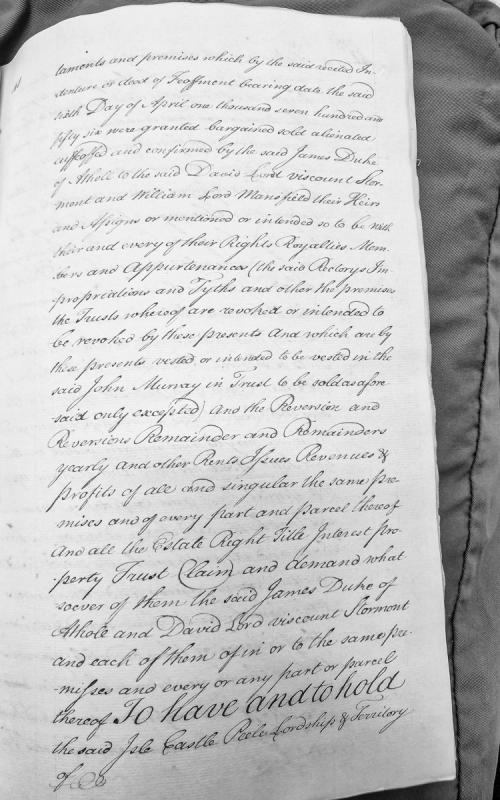
A legal deed of feoffment dated 6 April 1756 transferring the Isle of Man, castle, pele, lordship and territory from James Duke of Athole to David Lord Viscount Stormont and William Lord Mansfield, with various rights, royalties, rents and appurtenances. The document includes trust provisions and references to ecclesiastical properties.
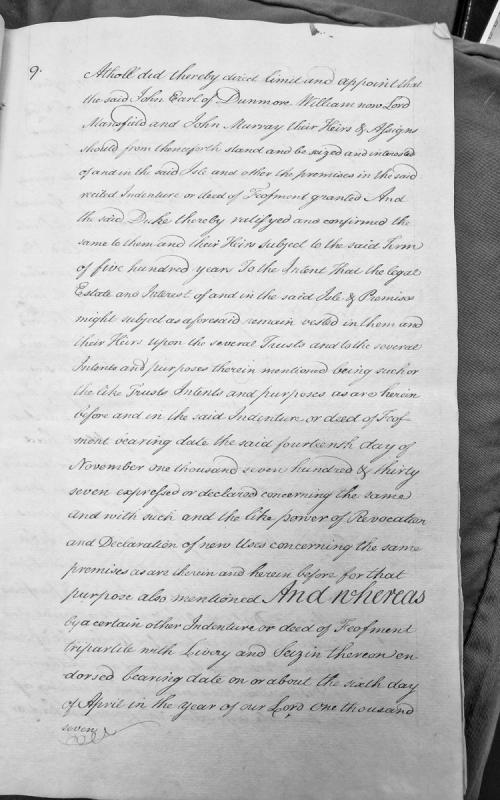
A legal document concerning the transfer and feoffment of the Isle of Man and related premises. The Duke of Atholl directs that John, Earl of Dunmore, William (now Lord Mansfield), and John Murray, as heirs and assigns, shall be seized of the Isle subject to a term of five hundred years. The document ratifies and confirms earlier feoffment terms dated 14 November 1737 and references another tripartite indenture from approximately 6 April 1700.
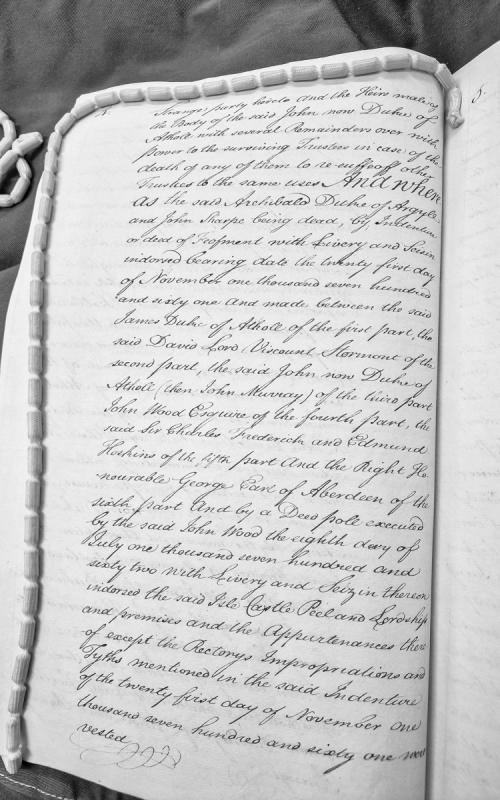
A legal document detailing the transfer of Isle of Man property (Castle Peel and Lordship) through indentures and deeds of feofment dated November 21, 1761 and July 8, 1762. The document concerns the vesting of property with various trustees and remainders to the heirs male of the Duke of Atholl.
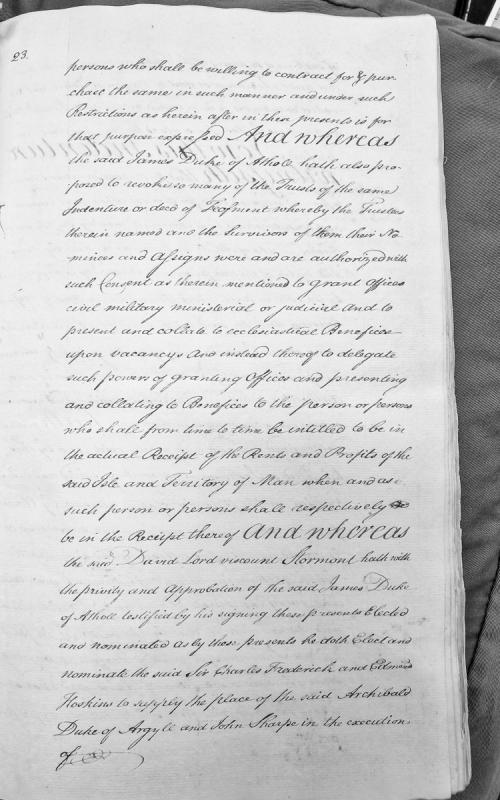
This is an excerpt from a legal document concerning the Isle of Man, specifically addressing the revocation of certain trusts established in a prior Indenture or deed of Feofment. The document details the delegation of powers to grant civil, military, ministerial, and judicial offices, and to present and collate to ecclesiastical benefices. It records the nomination of Sir Charles Frederick and Edmund Hoskins to replace the Duke of Argyll and John Sharpe.
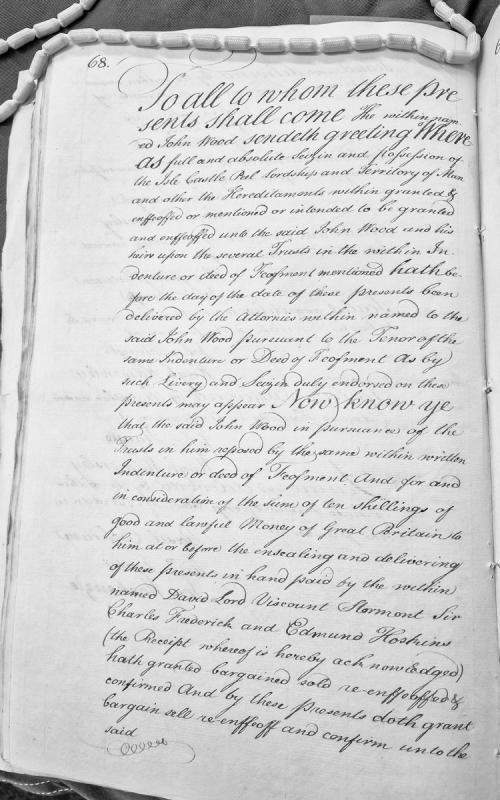
A formal deed of re-enfeoffment transferring seisin and possession of the Isle of Man, Castle Peel, lordships and territory to David Lord Viscount Stormont, Sir Charles Frederick and Edmund Hoskins. The document records John Wood's delivery of property held in trust and subsequent re-enfeoffment to the named parties for consideration of ten shillings.
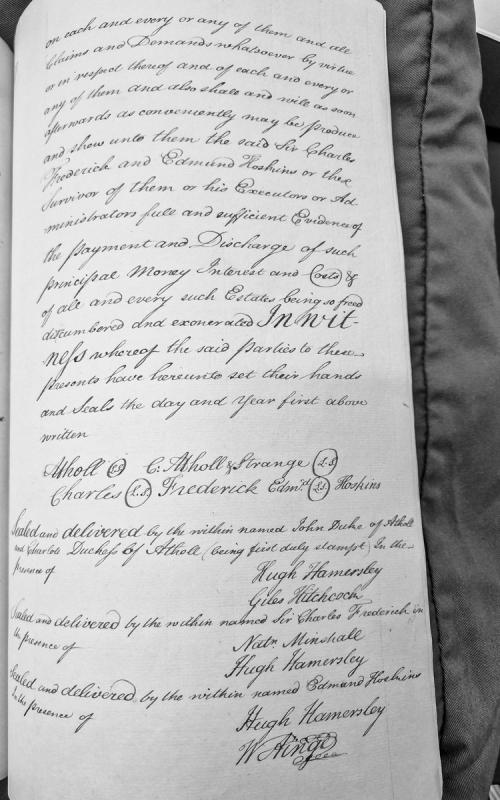
This is the closing portion of a formal legal deed or bond in which the Duke and Duchess of Atholl release claims and discharge principal money, interest, and costs owed to Sir Charles Frederick and Edmund Hoskins. The parties covenant to produce evidence of payment and discharge of estates. The document is sealed and witnessed.
This is a formal deed of conveyance wherein James Duke of Atholl and David Lord Viscount Stormont transfer the Isle of Man, Castle Peel, and associated lordships, rights, royalties, and ecclesiastical benefices to John Wood and his heirs. The document records payment received and involves multiple witnesses.
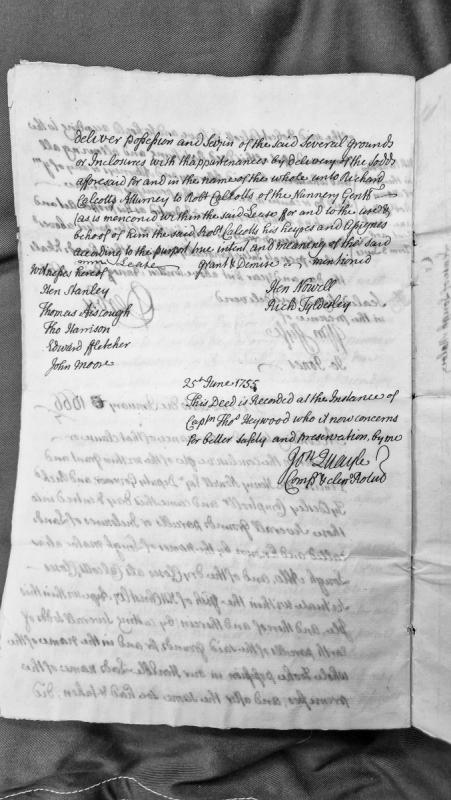
A deed recording delivery of possession and seizin of several grounds or inclosures at the Nunnery to Robert Calcotts (Gentleman) through his attorney Richard Calcotts. The document was recorded by the Comptroller and Clerk Rotulorum on 25 June 1755 at the instance of Captain Thomas Heywood for preservation purposes.
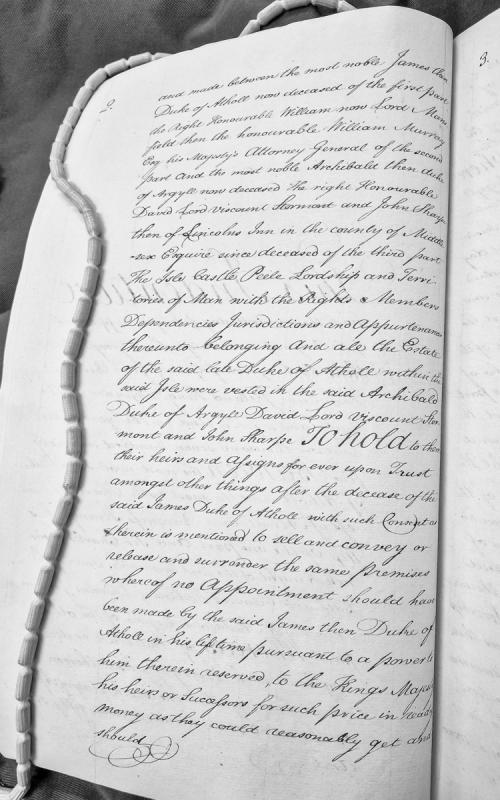
A legal document describing a trust arrangement concerning the Isle of Man, Castle Peel, and associated lordships and territories. The document establishes that these properties were vested in Archibald Duke of Argyle, David Lord Viscount Stormont, and John Sharpe as trustees, with powers to sell or convey the premises to the Crown following the death of James Duke of Atholl.
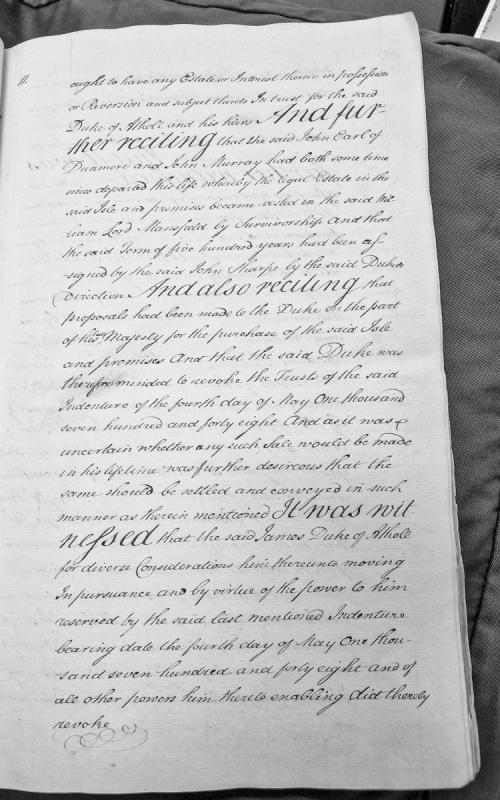
A legal document concerning the revocation of trusts established in an indenture dated May 4, 1748, relating to the Isle of Man. The document recites the deaths of John Earl of Dunmore and John Murray, the vesting of the legal estate in William Lord Mansfield by survivorship, and proposals from His Majesty for the purchase of the Isle. The Duke of Athole seeks to revoke the previous trusts and settle the premises in a specified manner.
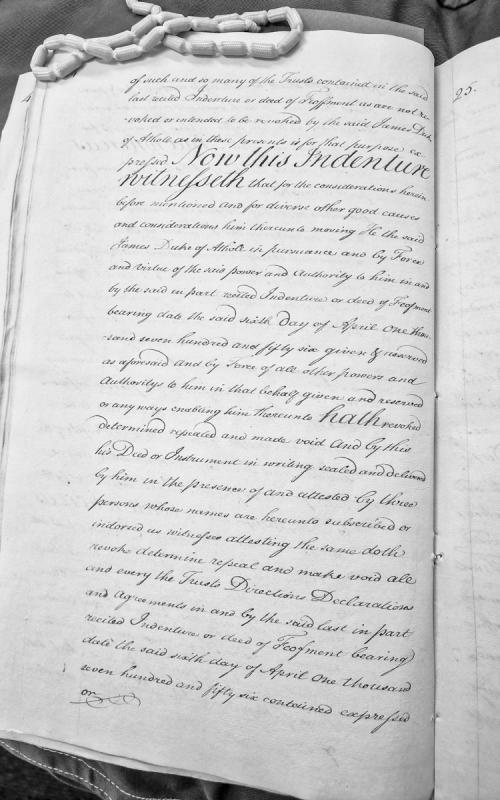
This is a formal legal indenture in which James, Duke of Athole, exercises his power of revocation to void certain trusts, directions, declarations and agreements contained in a prior deed of feoffment dated 6 April 1756. The document is executed under seal and witnessed by three persons.
Edward Christian (1628-1693), Deemster of the Isle of Man, son of Deemster John Christian of Milntown and nephew of Illiam Dhone.
He is remembered for a court he refused to sit in. At the trial of William Christian in December 1662 he was acting as his father's deputy and assistant. When the Deputy-Governor sent a guard of soldiers to require the prisoner to come to the bar, and Christian refused to plead anything but the King's Act of Indemnity, the Deputy-Governor demanded the law of the Deemsters. The record notes that Deemster John Christian had not appeared, and that Mr Edward Christian his son and assistant had also forborne to sit in that court. Deemster Norris was left alone on the bench, craved the advice and assistance of the twenty-four Keys, and sentence of death was pronounced on 31 December 1662. Father and son had by then sailed for England to lay the case before the King.
The bench was made fit for the purpose before they went. Deemster Christian was removed and replaced by the Attorney-General, Hugh Cannell. Seven of the Keys were displaced by Lord Derby's own order and seven other persons appointed in their room.
His own affairs came apart after his death. He married Dorothy Wilson, and by his will of 1693 he desired that, subject to his widow's consent, their second son Edward Christian of Staple Inn should have Mullenlowne. His widow evidently did not approve, and after her death in 1695 Mullenlowne became the subject of a dispute between that son and his sister Margaret Christian, who was executrix to their mother's will.
John Lace, Deemster for the southern district of the Isle of Man and afterwards First Deemster.
He came to the bench from the House of Keys. He was a member of the House in 1791, and it was he who certified the true copies taken from its journals for the Commissioners of Inquiry on 28 September that year, including the resolution of March 1765 by which the Keys had appointed commissioners at the Revestment. In July 1793 he was one of the witnesses to Bishop Claudius's instrument executed at St John's Chapel, with Edward Christian, John Crebbin and Henry Corlett.
By the end of the century he was Deemster for the south and living at Castletown, while John Frissell Crellin held the northern district from Orrisdale. Feltham, who set the two down side by side in his tour, remarked that he had not had the honour of knowing the former, though he was warm about the Crellins' hospitality.
His most public moment came in 1809 and it began in a theatre. Major-General William Stapleton, in what was described as a mere frolic, pushed a person at the theatre in Douglas, and an affray followed. Stapleton afterwards preferred charges against his Honour John Lace, by then His Majesty's First Deemster, and the Home Secretary ordered an investigation. Stapleton's case was printed, dated 21 October 1809, and runs to thirty pages.
Thomas Norris, Deemster of the Isle of Man, who pronounced sentence of death on Illiam Dhone and was imprisoned for it.
He gave the law before he gave the sentence. On 26 November 1662 the question was put to him in writing, over Richard Stevenson's signature: to declare under their hands what the law deemed against any person indicted for any manner of crime, of whatever nature, who refused or denied to come to the bar to receive his trial or abide the law of the Island. Norris answered that the law in such a case deemed such a person to be in the mercy of the Lord for life and goods, as they found by ancient records, and he signed it as Deemster. Robert Quayle, John Garrett, Thomas Fletcher, William Quayle, Robert Calcott, John Standish and Thomas Ratcliffe signed with him.
The trial followed on that opinion. When William Christian refused to plead anything but the King's Act of Indemnity, Deemster John Christian did not appear and his son Edward, acting as his assistant, forbore to sit, which left Norris alone on the bench. He craved the advice and assistance of the twenty-four Keys, and sentence of death was pronounced on 31 December 1662.
London reversed it and came after the judges. Ewan Christian, son of William, petitioned, and on the hearing of the case on 5 August 1663 full restitution of the estates was ordered to be made to the heir. The two Deemsters who had decreed Christian's death, Thomas Norris and Hugh Cannell, were ordered to be committed and to remain prisoners in the King's Bench, and to be proceeded against in the ordinary course of justice. The other parties who had been summoned were discharged.
He kept his place in ordinary business afterwards. He is one of the attesting witnesses, with Richard Stephenson, to the grant of Ballagilley and Hango Hill in Malew to trustees for the fund out of which King William's College grew.