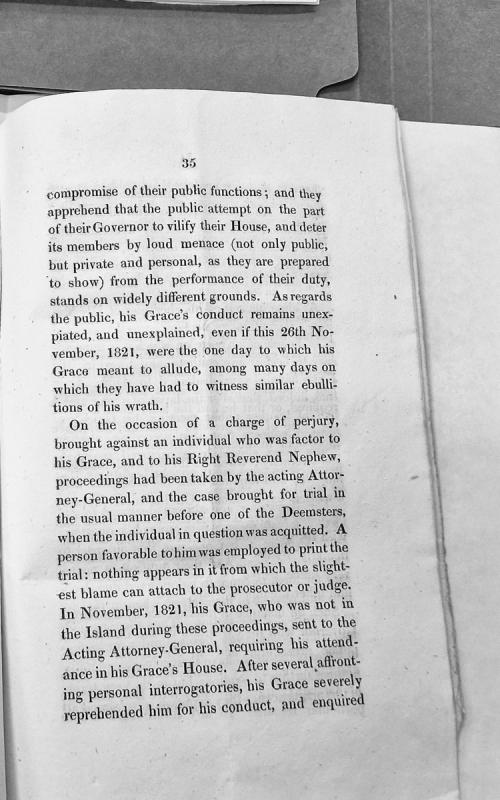
A legal or parliamentary defence document from the House of Keys responding to allegations made by the Governor (referred to as 'his Grace') regarding their members' conduct and performance of duties. The document addresses specific incidents including a perjury case and the Governor's treatment of the Acting Attorney-General in November 1821.
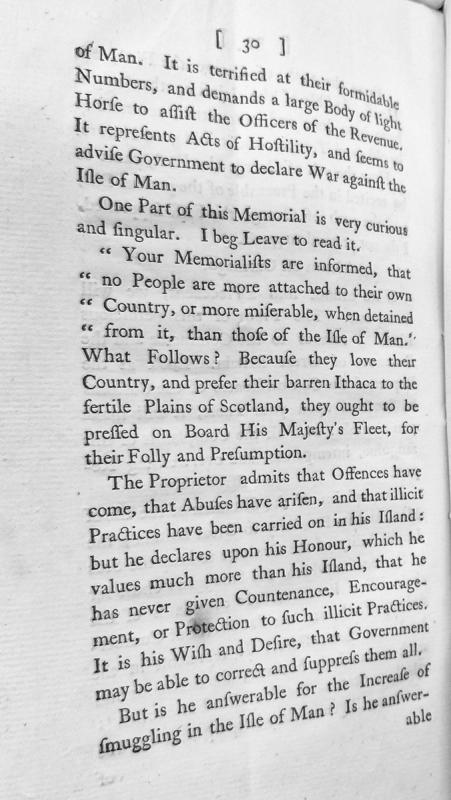
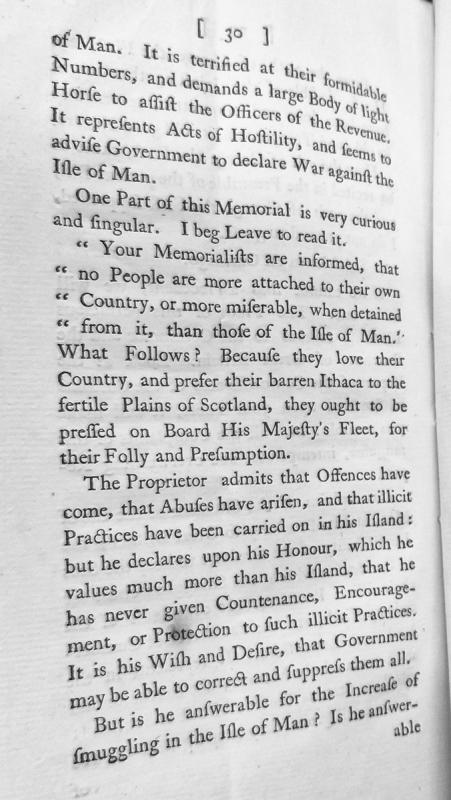
A legal or political defence document addressing a memorial that criticizes the Isle of Man and its proprietor for smuggling activities. The author defends the proprietor's honour, acknowledges some abuses exist, but denies he has encouraged illicit practices. The document critiques the memorial's logic regarding Manx attachment to their homeland and military conscription.
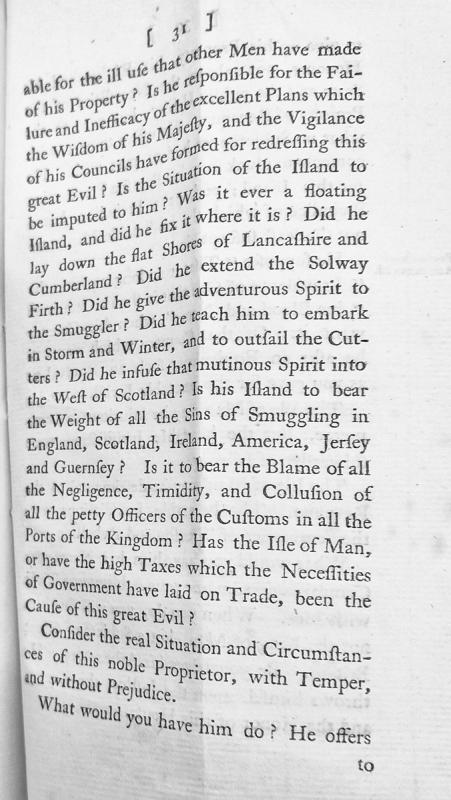
A rhetorical legal or political argument defending the proprietor of the Isle of Man against accusations of responsibility for widespread smuggling in the Irish Sea region. The document uses a series of pointed questions to argue that natural geography, government policy, and the actions of smugglers and customs officers—not the proprietor—are responsible for smuggling activities.
A rhetorical legal argument defending the proprietor of the Isle of Man against charges of responsibility for smuggling and contraband trade. The text uses a series of questions to argue that the proprietor cannot be held accountable for geographical circumstances, the actions of smugglers, or the negligence of customs officers across multiple kingdoms.
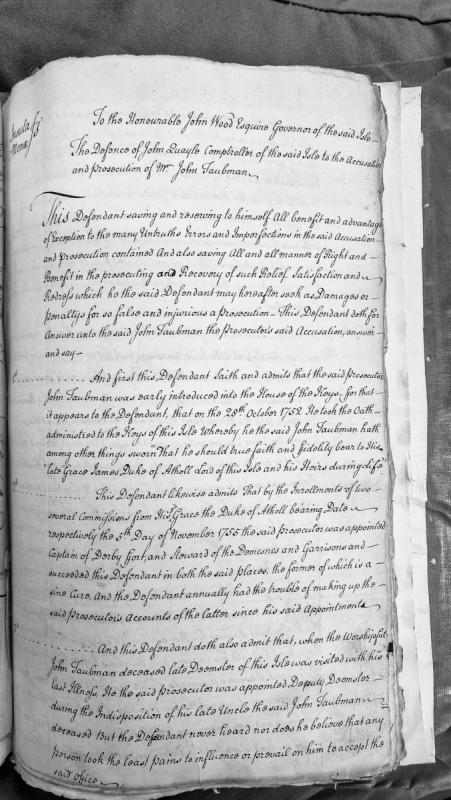
A legal defence document submitted by John Quayle, Comptroller of the Isle of Man, responding to accusations and prosecution brought by John Taubman. The defence addresses Taubman's oath to the House of Keys (28 October 1752), his appointments as Captain of Derby Fort and Steward of the Demesnes and Garrisons (5 November 1755), and his appointment as Deputy Deemster during his uncle's illness.
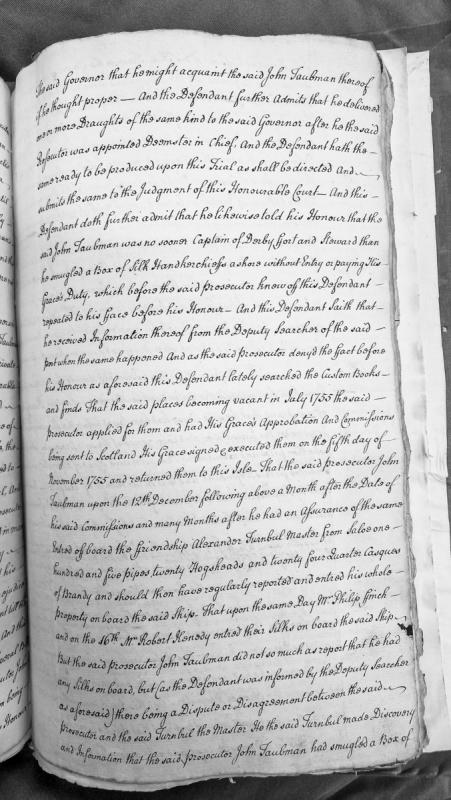
A legal document containing a defendant's admissions and evidence regarding allegations of smuggling and misconduct by John Taubman, who held the position of Captain of Derby fort and Howard. The document discusses draughts (drafts) presented to the Governor, smuggling of silk handkerchiefs, and customs records from 1755 involving brandy importation aboard the Friendship.
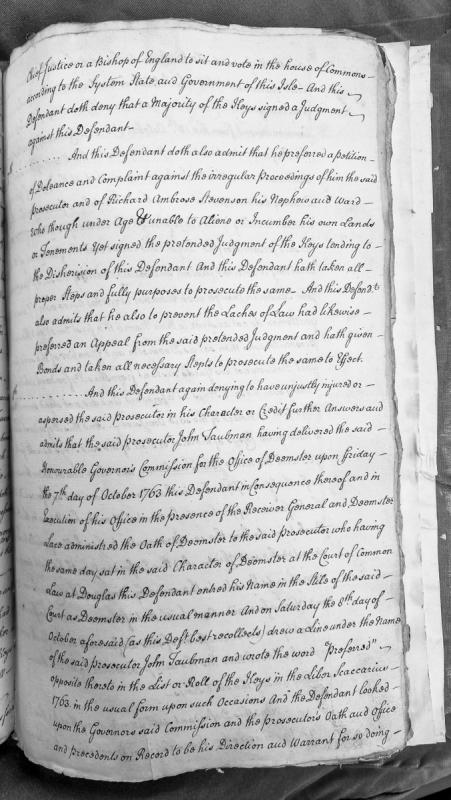
A defendant's legal response denying accusations of injuring the prosecutor's character and providing details of administrative procedures related to John Taubman's appointment as Deemster in October 1763. The document addresses disputes over a House of Keys judgment, an appeal, and the proper execution of the appointment process.
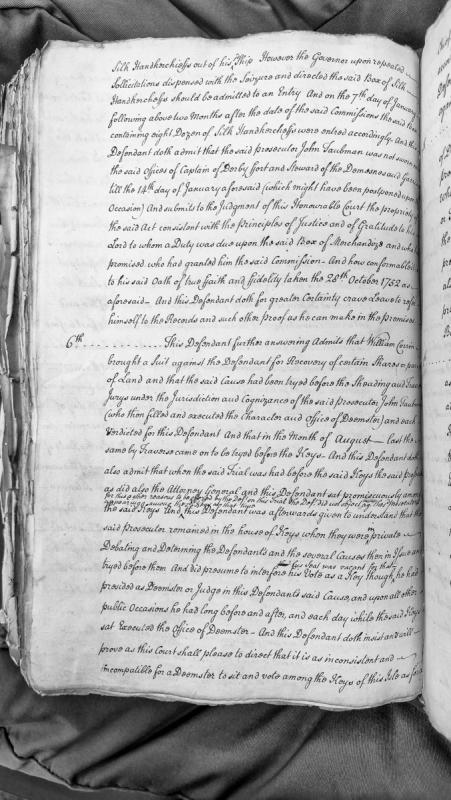
A legal answer/defence document in which the defendant responds to charges related to the seizure of silk handkerchiefs from a ship and challenges the propriety of John Taubman's conduct in voting as a Key while serving as Deemster in a related land dispute case. The document raises questions about conflict of interest and adherence to judicial oaths.
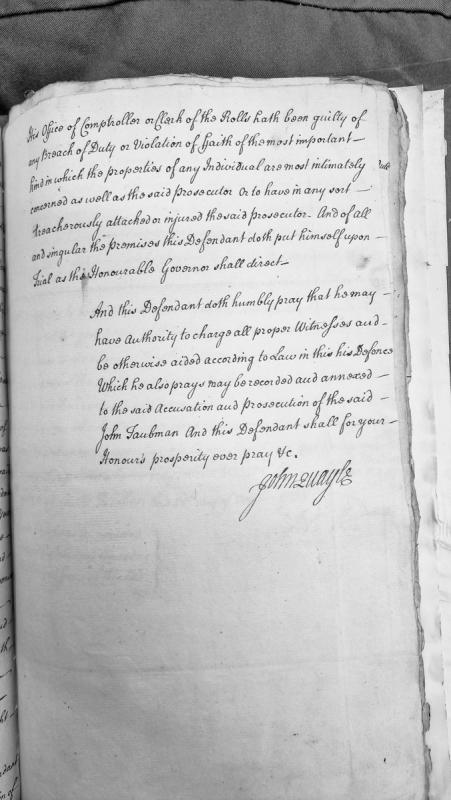
A formal legal defense document wherein the defendant (John Quayle) denies charges of breach of duty or violation of faith in his office, specifically regarding the Comptroller or Clerk of the Rolls position. The defendant requests authority to call witnesses and prays that this defense be recorded and annexed to the accusation brought by John Taubman.
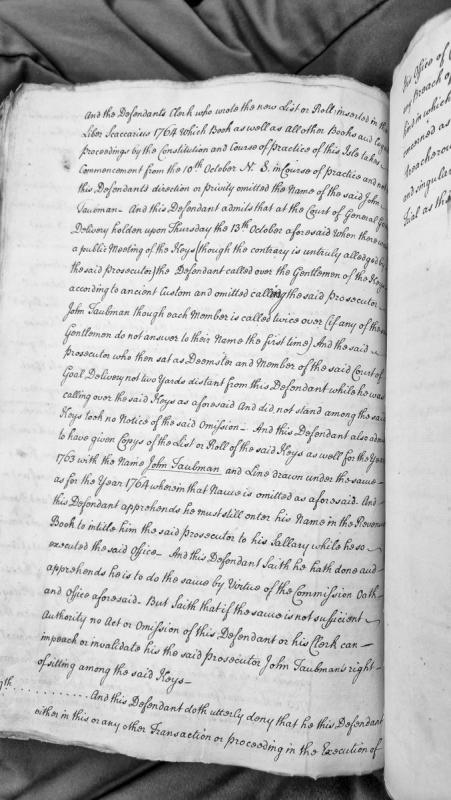
A legal defense document in which the defendant responds to allegations regarding the omission of John Taubman's name from the official list (Liber Scaccarius) of the House of Keys for 1764. The defendant argues that the omission was procedural and made by a clerk without his direction, and that Taubman's rights as a member remain unimpaired.
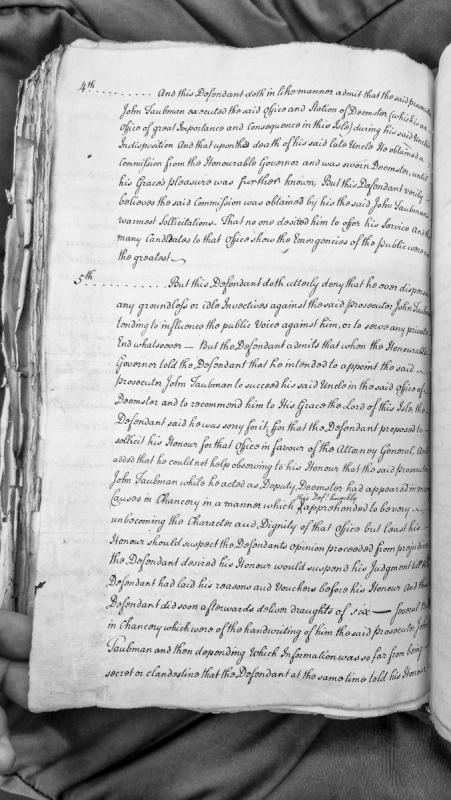
A defendant's legal response addressing allegations about interference in John Taubman's appointment to the office of Deemster on the Isle of Man. The defendant admits Taubman served as Deputy Deemster during his uncle's illness and obtained a commission from the Governor, but denies spreading malicious invectives. The defendant claims to have merely expressed concerns about Taubman's conduct in Chancery cases to the Governor.
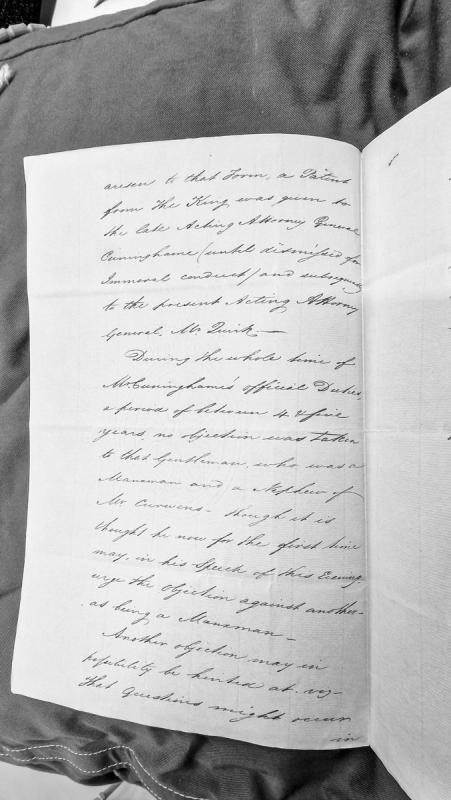
A fragment of a legal or administrative document defending the appointment of an Acting Attorney General against potential objections based on Manx origin. The text references the previous Acting Attorney General Cunninghame (dismissed for immoral conduct) and the current Acting Attorney General Quirk, arguing that similar objections were not raised during Cunninghame's tenure despite his being a Manxman.
A legal defense or opinion addressing a memorial accusing the Isle of Man of smuggling and illicit practices. The document defends the Proprietor against charges, distinguishes between his responsibility and the actions of inhabitants, and critiques the memorial's logic regarding Manx attachment to their homeland. The text appears part of a larger argument questioning whether the Proprietor bears accountability for increased smuggling.
Delapré Abbey is a neo-classical mansion in Northampton, England, incorporating the remains of a Cluniac nunnery founded around 1145. Its grounds saw the Battle of Northampton in 1460 during the Wars of the Roses, and the body of Eleanor of Castile rested here in December 1290 on its journey from Lincoln to Westminster. The abbey surrendered to the Crown at the Dissolution in 1538. (Added as a stand-in to test the proximity feature while off-island; safe to delete afterwards.)
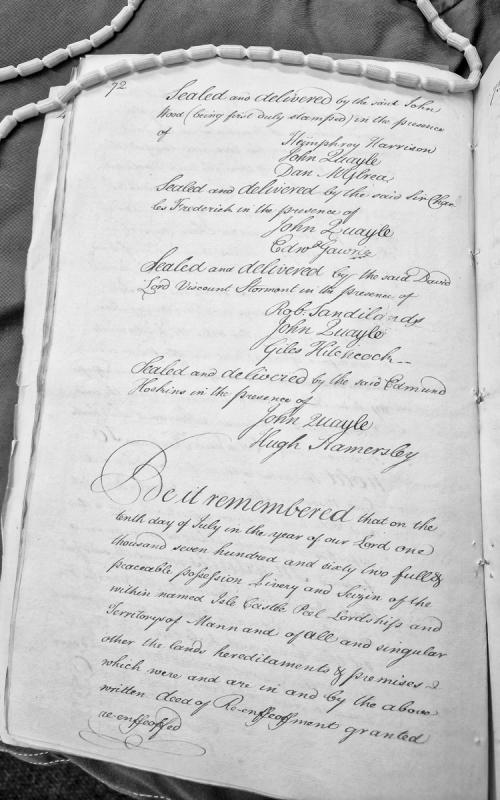
A legal document recording the sealed delivery of a deed of re-enfeoffment relating to Isle Castle, Peel, and the Lordships and Territories of Mann. Multiple parties sealed and delivered the document in the presence of witnesses on July 10, 1762, transferring full possession, livery and seizin of lands and hereditaments.
A sworn deposition from 1633 in which John Casen, servant to Lord Strange, testifies about delivering correspondence to Edward Christian, captain of the Isle of Man, and Christian's serious illness. The document provides insight into early 17th-century Isle of Man governance and the health crisis affecting the military command. It is part of the Manx Society's published collection of Monumenta de Insula Manniae.
A sworn deposition by John Casen, servant to Lord Strange, testifying to the poor health of Captain Edward Christian, governor of the Isle of Mann, as of March 1633. Casen delivered letters from Lord Strange to Christian in late January and observed him bedridden throughout his stay. The document attests to Christian's incapacity to travel by horseback due to a lingering sickness that began in September 1632.
Record of depositions taken by a jury of indictment in Rushen Sheading concerning the discovery and counterfeiting of copper pence on the Isle of Man. The case involves George Wilks (accused of manufacturing counterfeit coins) and his son John Wilks. Includes witness testimonies, evidence of casting equipment and counterfeit coins, and subsequent court proceedings including a controversial acquittal by the Grand Jury and a petition challenging the jury's fine.
Legal depositions and inquest proceedings from Rushen Sheading concerning the discovery and investigation of counterfeited Manx copper pence. George Wilks and his son John Wilks were suspected of counterfeiting; evidence includes sworn testimonies from witnesses, soldiers, and the coroner, recovered counterfeit coins, and molds. The grand jury indicted George Wilks but he was later acquitted by the 24 Keys, who found the grand jury's proceedings illegal under the 1709 counterfeiting act. Includes subsequent petitions and fines.
Small fortification in the Isle of Man associated with the pre-Revestment garrison establishment.
The office of Commander of Derby Fort appears in the evidence of John Quayle to the Commissioners of Inquiry in 1791. Quayle stated that for several months in 1755 he simultaneously held the offices of Attorney-General, Steward of the Garrisons and Demesnes, Commander of Derby Fort and one of the three officials executing the office of Collector.
The command itself involved very little work. Quayle told the Commissioners that the command of Derby Fort was “almost a sinecure” and carried a salary of £8 Manx currency.
Responsibility for the fort sat within the wider office of Steward of the Garrisons. The Steward directed repairs to the Lord’s houses, forts and castles, provided entertainment at the castle on particular days, supplied ammunition to the garrisons and forts, and supervised carriage services. He received a salary of £8 Manx, while the overseer assisting him received forty shillings.
The offices of Commander of Derby Fort and Steward of the Garrisons ceased at Revestment in 1765. Quayle explained that afterwards a Store Keeper and Overseer of Works was appointed by the Board of Ordnance.
Derby House faces Parliament Square in the heart of old Castletown. Local tradition (recorded on tourism and hospitality sites) links the name to accommodation built on the site for the Lords of Mann, the Earls of Derby, in the 16th century. Manx historian William Henry Cooper's account of the building on this site describes a mid-19th century structure built by tobacco and spirits merchants Robert and John Duff, which later traded as a draper's shop run by Richard Watterson, then became a restaurant and boarding house under John Cannell, and served for a time as Castletown's Post Office before conversion to offices by 1999. The building has more recently been restored as a boutique hotel trading under the Derby House name.
Post medieval house.
Domestic quarters within Castle Rushen were modernised in the later 16th century by creation of what is now Derby House. The building was extensively remodelled during the Civil War period by the 7th Earl of Derby during his time on the Island (1643-51), and further more minor changes were brought about by his successors.
The role of Derby House was redefined after the Revestment in 1765, whence it served as the governor's residence and then as Rolls Office and provided accommodation for the courthouse based in the Gatehouse. Latterly it served as the custodian's lodging and as a registry office.