Dhoon Glen is the deepest of the Isle of Man's National Glens, a steep, wooded ravine running about a mile from the hills down to a secluded pebble beach five miles south of Ramsey. Partway down, the stream drops over the 'Inneen Vooar' ('Big Girl'), one of the island's highest waterfalls, cascading more than 40 metres in two stages into a plunge pool reached by a steep path. In the 1880s and 1890s the paddle steamer Manx Fairy called at Dhoon Bay to land day-trippers who spent the day on the beach or exploring the glen; today it can still be reached on foot from a stop on the Manx Electric Railway.
A granite quarry on the coast north of Laxey. The Manx Electric Railway's own Dhoon West Quarry was worked from around 1900 into the 1930s, while an adjacent Isle of Man Highway Board quarry at the same site continued operating until 1972, both producing hard-wearing granite setts for road paving. Stone was carried out by a 225-metre aerial ropeway to a loading platform on a siding of the Manx Electric Railway, whose Dhoon Quarry Halt request stop still serves the site today as a permanent-way maintenance depot.
Historic ecclesiastical jurisdiction centred on the Isle of Man and descended from the medieval bishopric associated with Mann and the western islands.
The surviving Manx material preserves a long and complicated history for the see. Medieval sources refer to bishops of Sodor, while later Manx records use the combined title Sodor and Man.
Bishop Simon is one of the best-documented early figures. The Manx Society bibliography noted the survival of synodal statutes and constitutions attributed to him in 1229. These were printed from medieval records and later reissued in the Society’s editions of Manx historical material.
The medieval diocese operated within the political world of Mann and the Isles. Its bishops appear in the Chronicle of Mann and related documents, while the monks of Furness Abbey were involved at different periods in episcopal elections. One Manx Society note records an election made by the monks of St Mary of Furness, to whom the right of election was said to belong.
The political separation of Mann from the Hebrides eventually produced a corresponding ecclesiastical division. Nineteenth-century Manx writers placed this process around the later fourteenth century, after Mann and the western islands had come under different political rulers.
In the sixteenth century the diocese was formally attached to the Province of York. The Manx Society bibliography specifically identified the Act of 33 Henry VIII, cap. 31, as the measure by which the Diocese of Sodor and Man was annexed to York.
The diocese continued as a distinct Manx ecclesiastical institution thereafter, with its own Bishop, Archdeacon, Vicars-General and church courts. These officers also played a part in the Island’s wider constitutional structure, with senior ecclesiastical office-holders historically sitting in the Governor’s Council.
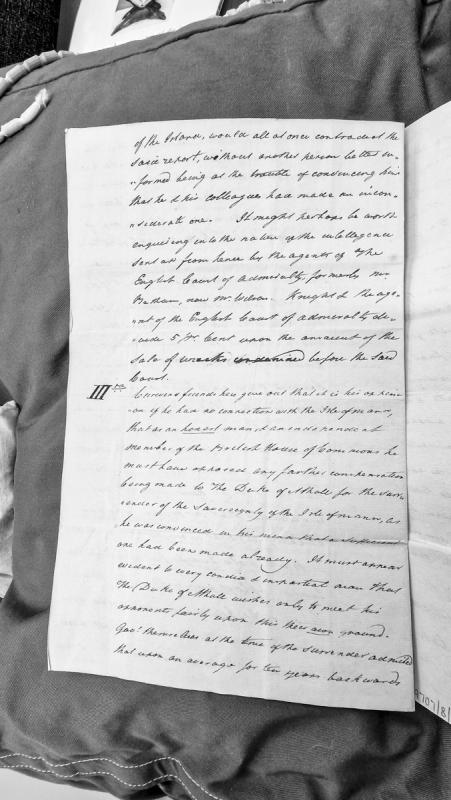
Fragment of a longer administrative or political correspondence discussing intelligence reports from admiralty agents, fee structures for wreck sales, and debate over compensation paid to the Duke of Atholl for surrendering sovereignty of the Isle of Man. References to Member of Parliament Curwen and his position on these matters.
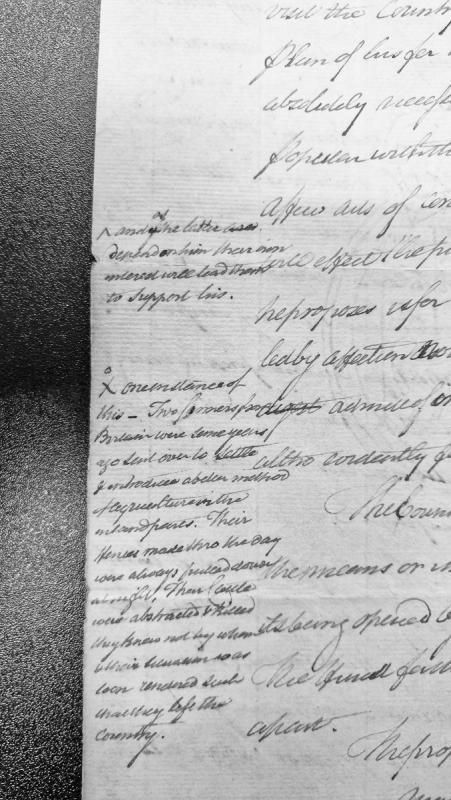
A fragmentary document containing two overlapping handwritten texts discussing agricultural reform in the Isle of Man. The left-hand text describes an instance where two British farmers were sent to introduce improved farming methods but faced local opposition including destruction of fences and theft of cattle, forcing them to leave. The right-hand text is largely obscured but appears to discuss proposals and popular support for improvements.
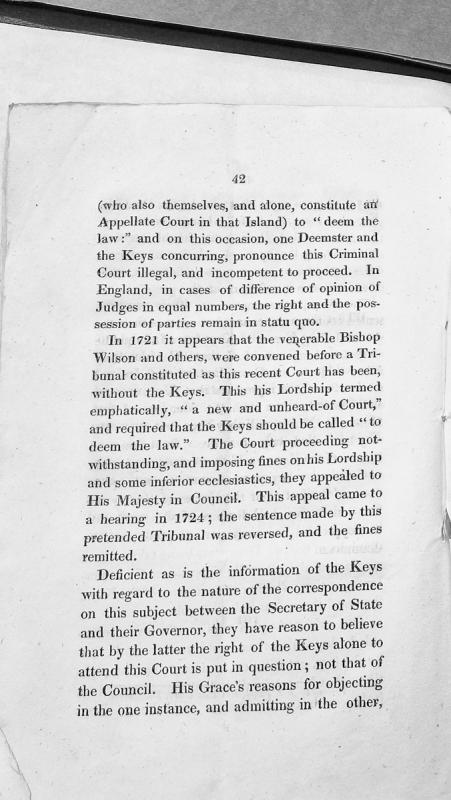
A legal document discussing the constitutional composition and authority of criminal courts on the Isle of Man, referencing historical precedent from 1721 when Bishop Wilson challenged a court convened without the Keys. The document compares Manx court procedures to English practice and addresses disputes over whether the Keys (House of Keys) should participate in such tribunals.
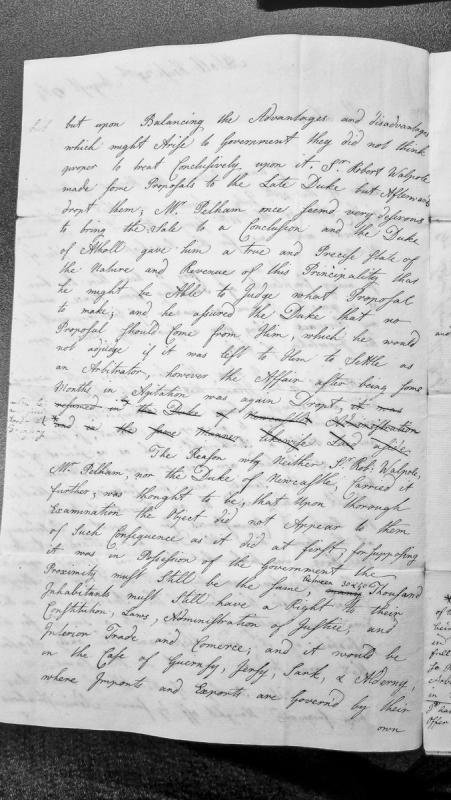
This document discusses historical attempts by various British government officials (Sir Robert Walpole, Mr. Pelham, Duke of Newcastle) to negotiate the purchase or acquisition of the Isle of Man from the Duke of Atholl. It explains why these proposals ultimately failed, noting that examination revealed the island's limited strategic value given that its population would retain constitutional rights regardless of ownership.
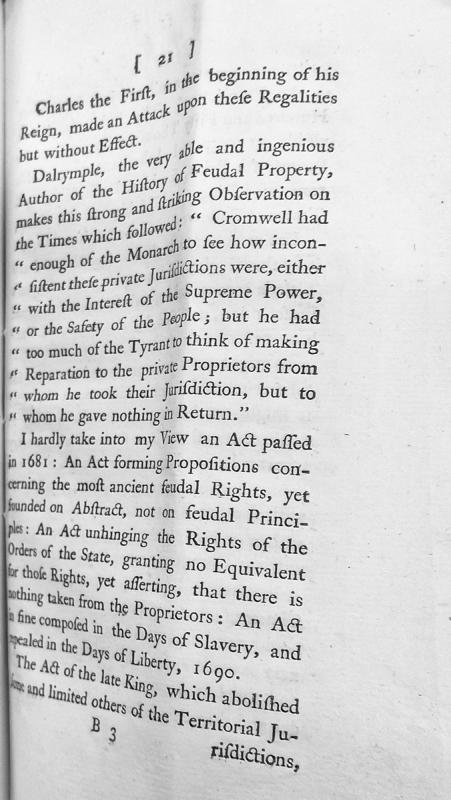
An excerpt from a printed pamphlet discussing historical attacks on private regalities and jurisdictions, particularly referencing Dalrymple's History of Feudal Property and Acts of 1681 and 1690 concerning feudal rights. The author critiques the abstract principles underlying these acts and their impact on proprietors' jurisdictions.
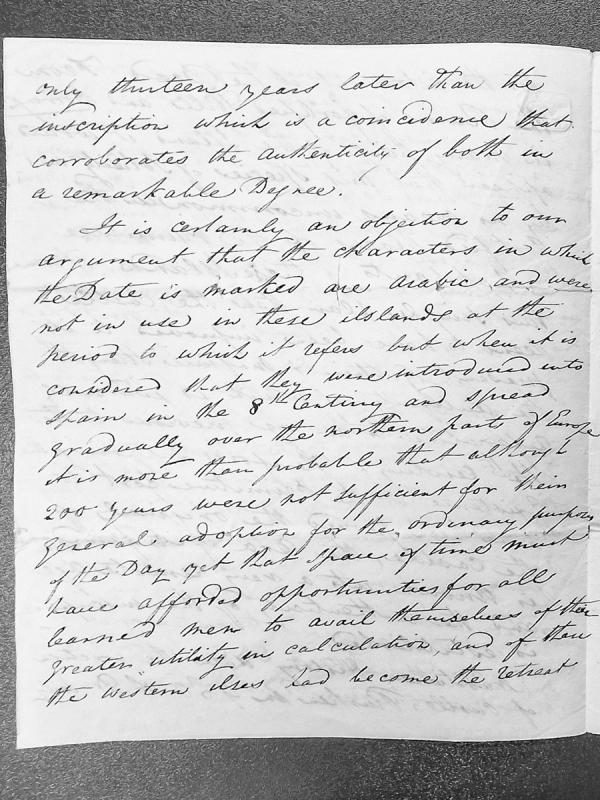
Fragment discussing the authentication of historical inscriptions through chronological coincidence and examining the adoption of Arabic numerals in the northern European regions, particularly the Western Isles. The text addresses objections to dating arguments based on character usage.
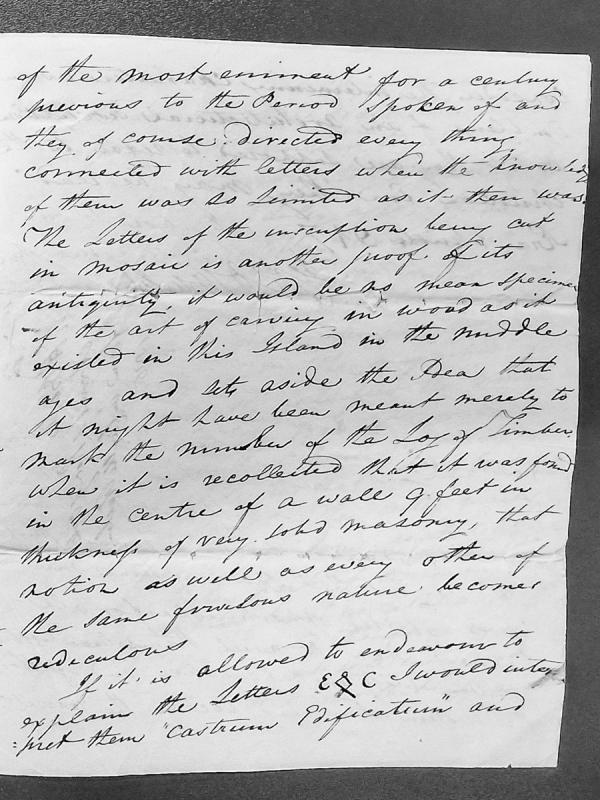
This is an excerpt from a scholarly discussion analyzing ancient letters (E & C) found carved in mosaic within thick medieval masonry on the Isle of Man. The author argues for the antiquity of the inscription based on the mosaic cutting technique and its placement within substantial stonework, rejecting frivolous interpretations. The text proposes a Latin interpretation of the letters as 'Castrum Edificatum' (Fortress Built).
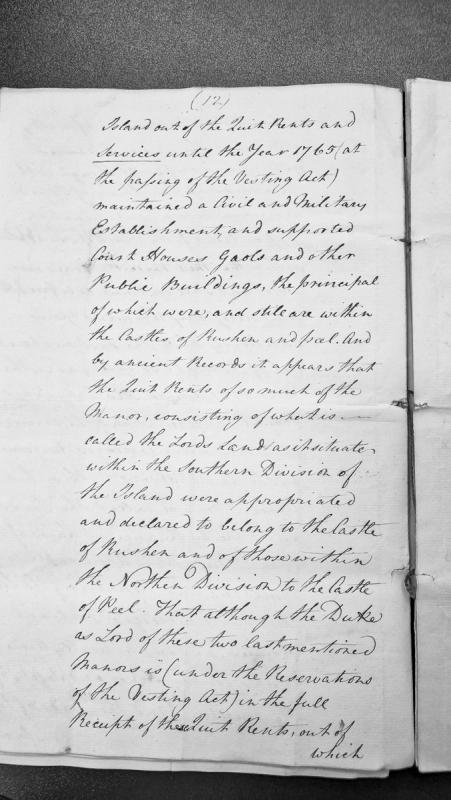
A legal document discussing the historical appropriation of Quit Rents from the Manor of the Isle of Man to support the civil and military establishment, court houses, gaols, and public buildings, particularly those within Rushen and Peel Castles. The document references the Vesting Act of 1765 and the division of Quit Rents between the Northern and Southern divisions of the island.
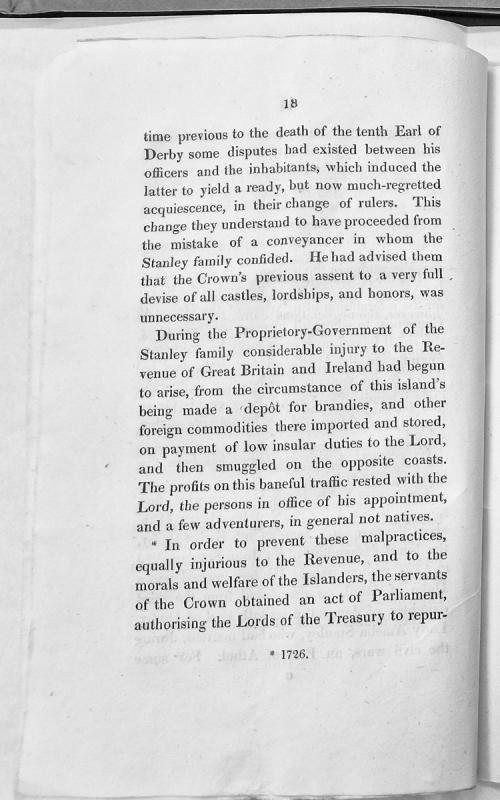
This document discusses the transition of Isle of Man governance from the Stanley family to Crown rule, allegedly prompted by a conveyancer's legal error. It details how the island was used as a depot for smuggled goods under Stanley proprietorship, causing revenue losses to Great Britain and Ireland, and mentions parliamentary action by the Treasury to address these malpractices.
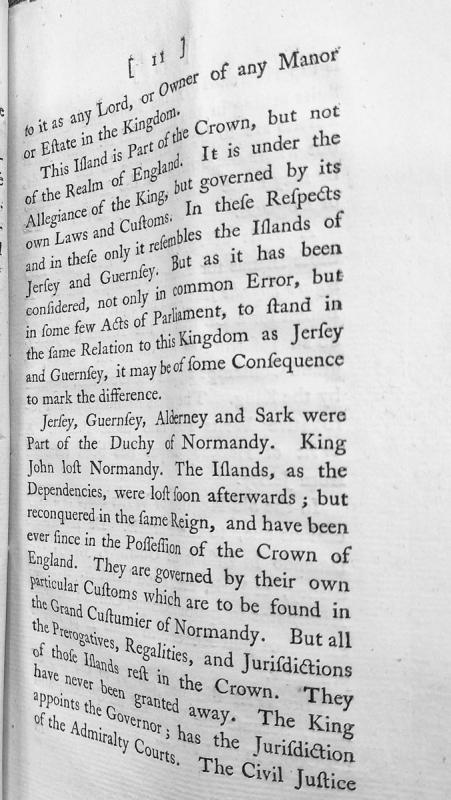
A legal treatise explaining the Isle of Man's unique constitutional position as part of the Crown but not the Realm of England, governed by its own laws and customs. The document clarifies distinctions between Man and Jersey/Guernsey regarding their historical origins and relationship to Crown jurisdiction, discussing prerogatives, regalities, and jurisdictions.
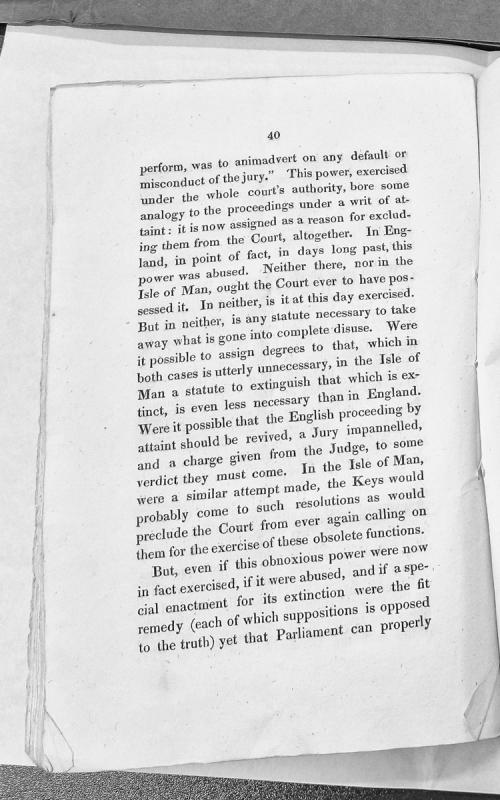
A legal opinion or treatise discussing the historical powers of courts over juries, comparing English and Manx legal procedures. The text examines whether statutory intervention is necessary to extinguish obsolete judicial powers regarding jury oversight, and argues that such powers are already in disuse in both England and the Isle of Man.
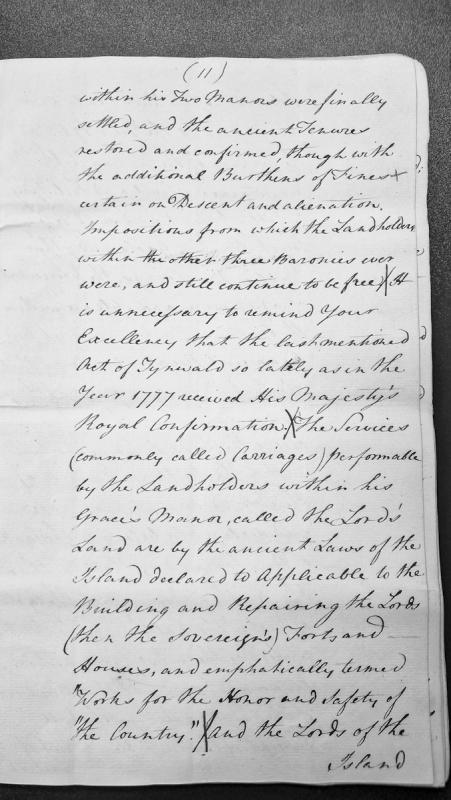
A fragment of a legal document discussing the settlement of tenures within manors on the Isle of Man, the restoration of ancient tenures with additional fines on descent and alienation, and the distinction between burdens imposed on the Lord's Manor versus other baronies. References a 1777 Act of Tynwald confirmed by His Majesty and describes services (carriages) performable by landholders.
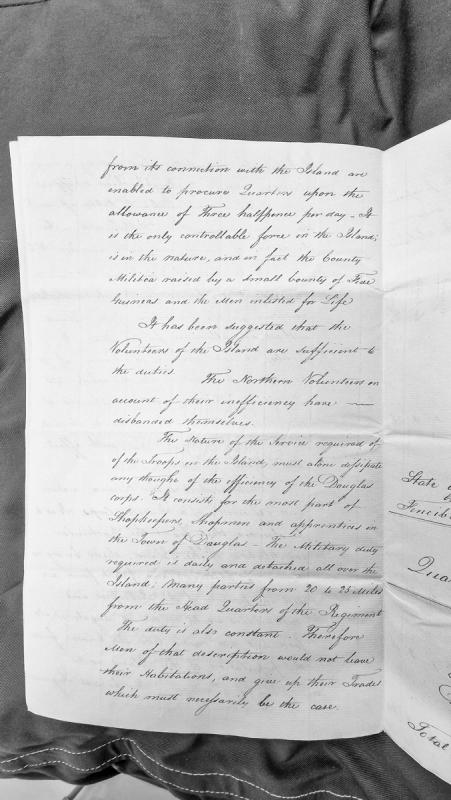
A fragment of administrative correspondence discussing the nature and efficiency of military forces on the Isle of Man, including commentary on militia, volunteers, and the composition of the Douglas corps. The document addresses the impracticality of using local shopkeepers and tradesmen for military duties requiring travel across the island.
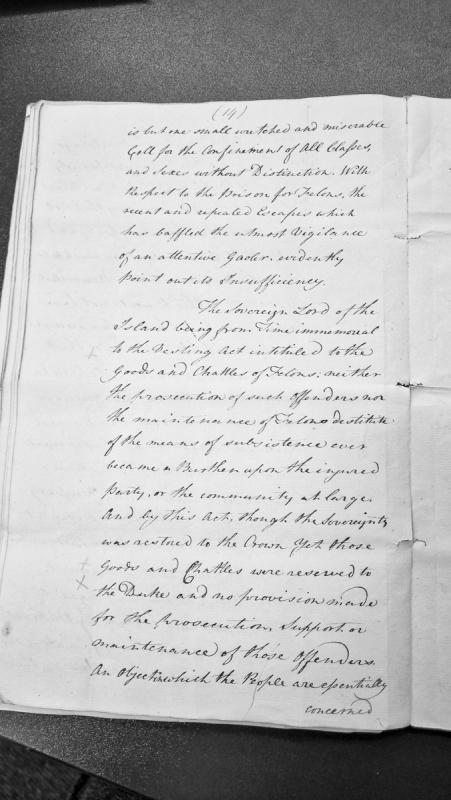
This document discusses the inadequate state of prison facilities on the Isle of Man, particularly regarding confinement of felons and the problems of escapes. It examines the legal and financial implications of the Vesting Act regarding the Crown's sovereignty, the Duke's retained rights to felons' goods, and the unresolved question of who bears responsibility for prosecuting and maintaining offenders.
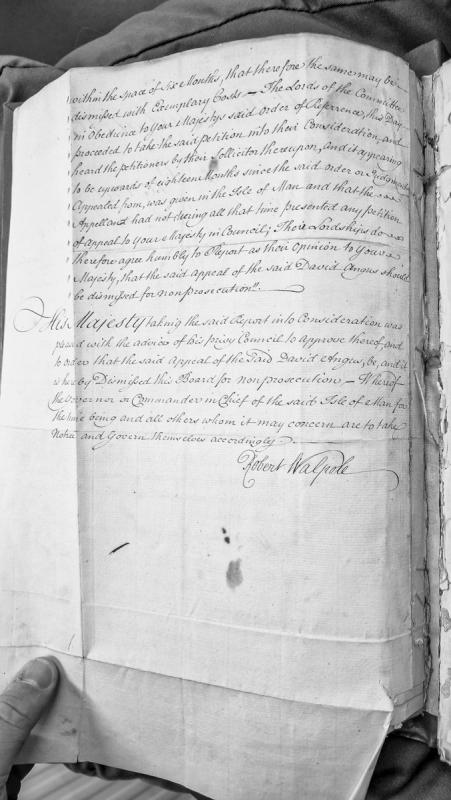
A Privy Council order dismissing the appeal of David Angus for lack of prosecution. The document reports that over eighteen months had elapsed since the original judgment in the Isle of Man without the appellant presenting a petition of appeal, leading the Lords of the Committee to recommend dismissal with exemplary costs, which His Majesty approved.
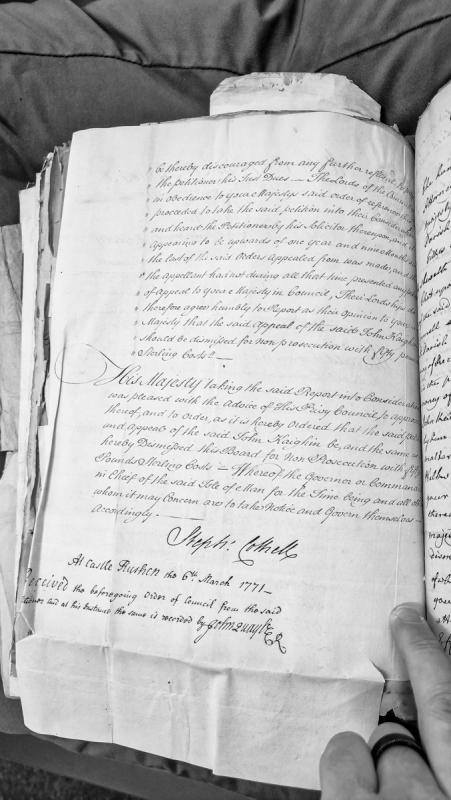
A formal order from His Majesty's Privy Council dismissing the appeal of John Kaighin for non-prosecution. The Lords of the Committee reviewed the petition and found that over a year and nine months had elapsed since the original orders without the appellant presenting an appeal to the Majesty in Council, leading to dismissal with fifty pounds Sterling costs imposed.
A parliamentary decree (5 Ed. II) from 1312 ordering the removal of Sir Henry de Beaumont from the King's Council and the forfeiture of lands including the Kingdom of Man, due to his procurement of grants contrary to royal ordinance and bad counsel to the King. The document is presented in both English translation and original Anglo-Norman French from the Rotuli Parliamentorum.
A parliamentary decree (Rotuli Parliamentorum, 5 Ed. II) ordering the removal of Sir Henry de Beaumont from the King's Council and the forfeiture of the Kingdom of Man and other lands due to his taking of the island contrary to royal ordinance and giving bad counsel to the King. The decree also addresses the role of Lady de Vescy in procuring these grants and orders forfeiture of Bamburgh Castle. The text is presented in both English and Anglo-Norman French, providing insight into early 14th-century constitutional constraints on feudal grants.
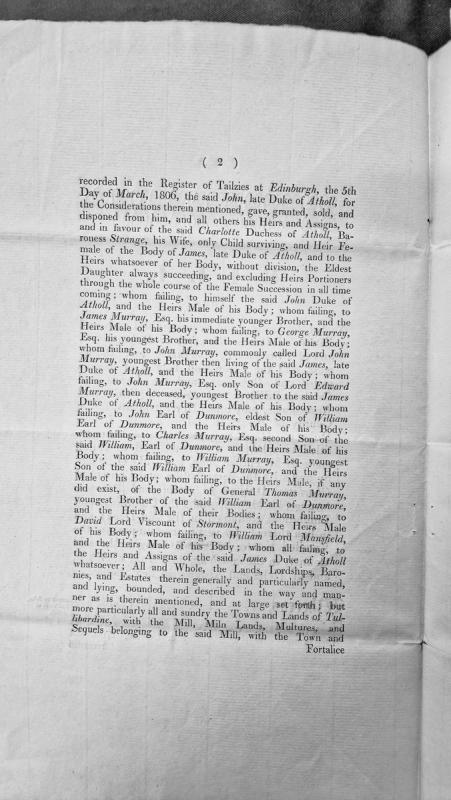
This is a legal document recording a disposition (transfer) of Scottish lands and estates registered on 5th March 1806. The Duke of Atholl transferred extensive properties to his wife Charlotte with detailed succession provisions favoring female heirs followed by male line succession through various branches of the Murray family.
A medieval narrative account, dated to the era of Edward I (c.1272), describing a legendary dispute between the Irish and Scottish kings over sovereignty of the Isle of Man. The story recounts how a wise man proposed that the island's freedom from venomous reptiles should determine its rightful overlord, resulting in the island being adjudged to Scotland. The text includes allegorical Christian interpretation relating the dispute to the contest between Christ and the devil for the human soul.
A medieval narrative account (c.1272, from MS in Edward I's era) describing a legendary dispute over sovereignty of the Isle of Mann between the kings of Ireland and Scotland, resolved through a wisdom-based test involving the presence or absence of venomous reptiles. The document includes allegorical Christian interpretation and demonstrates medieval Manx historiographical traditions.