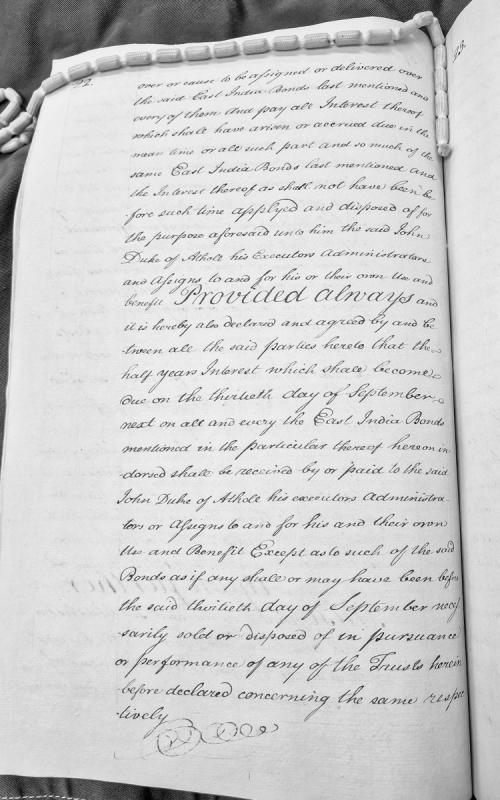
A legal document concerning the assignment and delivery of East India Bonds and accrued interest to John Duke of Athole, with provisions for interest payment due on 30 September and conditions regarding prior disposition of bonds.
British chartered trading company which entered Manx parliamentary discussion through proposals for recruiting troops for service in India.
During debate on an East India recruiting bill, Parliament considered where recruits might be assembled before embarkation. Islands including Jersey, Guernsey and the Isle of Man were specifically discussed and rejected as possible depots.
The objections were practical. The islands were said to be unable to supply the necessary provisions, to lie outside the normal track of East India ships and therefore to risk delaying voyages out of the Channel, and to create other logistical difficulties.
The proposal formed part of a wider debate over how the Company should recruit European soldiers for Bengal. Evidence before the Commons described the poor quality of many existing recruits, mortality during crowded passages and the need for a more regulated system.
The Isle of Man therefore appears here not because the East India Company maintained a Manx establishment, but because Mann was considered — and rejected — as a possible place for assembling recruits before departure for India.
The present evidence pack contains a large quantity of general East India Company parliamentary material, but this recruiting debate is the clearest direct connection with the Island.
Quantitative analysis of the East India Company's parliamentary lobby during 1763–1813, based on a database of 838 MPs. Examines lobby composition (directors, military/civil servants, stockholders), structural evolution, and voting behaviour across major parliamentary issues including the Regulating Act (1773), Fox and Pitt India Bills (1783–84), and the East India Company Act (1813). Concludes the EIC lobby lacked sufficient unity to prevent restrictive legislation despite significant parliamentary presence.
Quantitative analysis of the East India Company's parliamentary lobby during 1763–1813, examining 838 MPs across four lobby groups by level of involvement (directors, military/civil servants, stockholders, former stockholders). Uses voting records and statistical methods to assess the lobby's composition, evolution, and political influence on key Parliamentary issues including the Regulating Act (1773) and Pitt's India Bill (1784).
The second edition of the East India Company's official register and directory, containing comprehensive listings of Company servants (civil and military) at all presidencies (Bengal, Madras, Bombay), establishments in China, St. Helena, and other locations. Includes administrative structures, regulations on retirement and furlough, casualty records (births, marriages, deaths), and merchant vessel information. Compiled from official returns received at East India House and authorized by the Company.
The site of a post-medieval horse engine. It appears on the 1870 1:2500 scale Ordnance Survey map to the north of an outbuilding at the northern edge of the farmyard.
The findspot of a Mesolithic flint scatter including Heavy-blade type pieces with some sign of retouch, an unfinished arrowhead, a round-ended blade and a core.
An early prehistoric flint scatter which included fine Neolithic blades, flakes and a pressure-flaked arrowhead. An ovoid granite stone, possibly used as a slingstone, was also found.
A post-medieval corn mill was located in the southernmost part of an outbuilding in the farmstead, the wheel being located on the gable as shown on the Ordnance Survey 1:2500 large-scale mapping published in 1870. There is no annotation to indicate the mill within the building, which then, as now, was presumably for the most part used for animals and feed storage.
The same mapping depicts the millpond (parcel 1082, lying in Field No 1112) to the south-east of the farm, with a leat connecting the pond and the mill; two sluices, an overflow and the tail-race are also shown.
The mill was presumably used for processing produce from the farm and animal feed.
The book of remembrance is hand-painted in watercolour by Archibald Knox. The book contains 75 pages which list, in his own script, the names of the old scholars of the Eastern District Secondary School who served in the Great War. Knox painted birds with closed beaks and therefore silent, next to the names of those who lost their life in the conflict. The book is an original and the only one of its kind.
Title page reads as follows: "Douglas / Secondary / School / The roll of / the names / of the old / boys who / served in / the Navy / the Army / the Airforce / and Mercantile Marine / in the time / of the / Great War / 1914-1919." 478 (approx.) names listed alphabetically; First World War. On last page are the words: "and for / remembrance / of whom this / roll is made."
The roll of honour was installed in Douglas Boy's High School in 1931. It is displayed under glass in a wooden mahogany pedestal, commissioned by the firm of J.D. Kelly, Kirk Michael. The box was made by J. Stanley Keig, who had just completed his apprenticeship with J.D. Kelly. There is gilded carving around the box incorporating the words 'Live To Learn To Live'. The book was bound at the Oxford University Binding House.
Information provided by the Isle of Man Government Preservation of War Memorials Committee. Image courtesy of Chris Blyth, Isle of Man Photographic Society.
66 names listed, by alphabetical order within three columns; Second World War. Wooden lectern. Three columns of names under the title. Between column 1 & 2, and 2 & 3, the names are seperated by a carved diamond shape.
Information provided by the Isle of Man Government Preservation of War Memorials Committee. Image courtesy of Chris Blyth, Isle of Man Photographic Society.
First World War. Mahogany tablet. Interlaced decorative Celtic style script listing the names of scholars within 4 columns, with incised letters and pattern gilded. Standing out upon the panels of the tablet are two carved figures representing a monk scholar and a Crusader, executed by Mr H. Hemms of Exeter. The memorial was unveiled on 09 October 1924 by Mr George Green, a former master in the school, three of whose five sons were commemorated on the tablet. It was designed by Archibald Knox and the carving was executed by Mr Kelly of Kirk Michael. The gilding was done by Mr Frank Nicholson.
Information provided by the Isle of Man Government Preservation of War Memorials Committee. Image courtesy of Chris Blyth, Isle of Man Photographic Society.
Medieval burial ground. The site was investigated by the Manx Archaeological Survey (1915). Traces of early burials were recorded, and two fragments of carved stone crosses were also recovered.
Medieval carved stone cross.
The site was investigated by the Manx Archaeological Survey in 1915, in the course of which Manx Cross 21 was recovered outside of the doorway in the west wall.