Medieval carved stone cross.
The site was investigated by the Manx Archaeological Survey in 1915, in the course of which Manx Cross 21a, a fragment bearing a spiral motif, was found inside the chapel near the east gable. The stone is now lost.
A small slab with a linear cross found at East Keeill, now kept in Maughold Cross House (Manx Cross No 21). The cross is inscribed within a rectangle. It measures 38.5 centimetres high x 22.5 centimetres maximum width and 4 centimetres thick.
A slab fragment from Maughold which was inscribed with a C-spiral design. It is now lost. It measures 23 centimetres x 12.5 centimetres x 2.5 centimetres thick.
Medieval chapel and burial ground. The site was investigated by the Manx Archaeological Survey (1915). The structure is orientated ESE-WNW, and measures 6.4 by 3.4m internally, with a doorway in the 'west' gable; the walls are 0.4m high and 0.7m thick. The chapel has been obscured by a later structure and a well, the latter of which was sunk through the south-east corner and appears to have destroyed any trace of an altar. Traces of early burials have been recorded, and two fragments of carved stone crosses were recovered by the Survey.
Medieval chapel. The site was investigated by the Manx Archaeological Survey (1915). The structure is orientated ESE-WNW, and measures 6.4 by 3.4m internally, with a doorway in the 'west' gable; the walls are 0.4m high and 0.7m thick. The chapel has been obscured by a later structure and a well, the latter of which was sunk through the south-east corner and appears to have destroyed any trace of an altar.
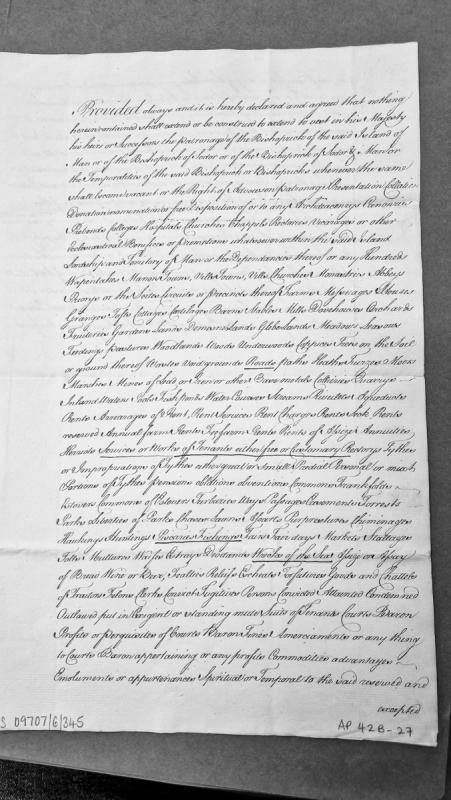
This is a legal proviso declaring that certain ecclesiastical and temporal rights and properties within the Isle of Man shall not vest in the Crown, specifically excluding royal patronage of bishoprics and various ecclesiastical benefices. The document provides an exhaustive enumeration of properties, revenues, rights, and appurtenances (both spiritual and temporal) that are expressly reserved and excepted from the Crown's authority.
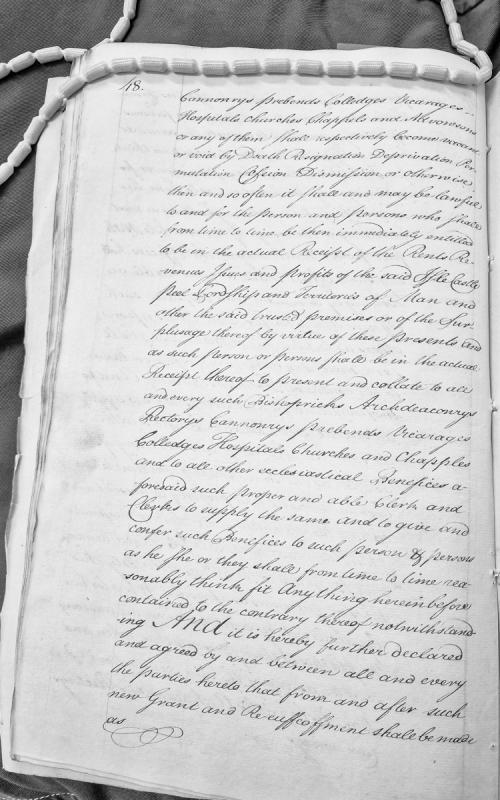
A legal document concerning the rights to present and collate clergy to vacant ecclesiastical benefices (bishoprics, archdeaconries, rectories, canonries, prebends, vicarages, colleges, hospitals, churches and chapels) in the Isle of Man. The document outlines the conditions under which such presentations may be made and the qualifications required of candidates.
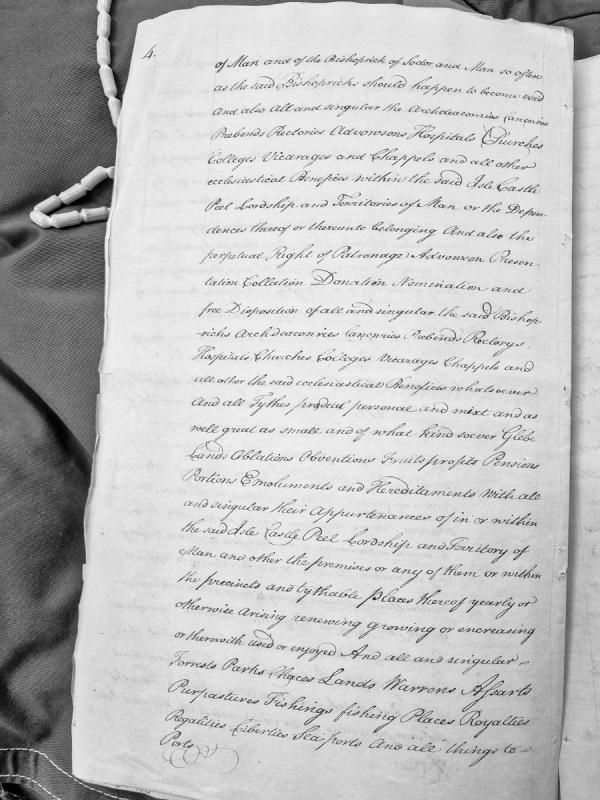
This document appears to be a legal instrument describing the rights, patronage, and ecclesiastical benefices within the Isle of Man, including bishoprics, archdeaconries, canonries, prebends, rectories, churches, and associated tithes and lands. The detailed enumeration of ecclesiastical properties and rights suggests this is part of a larger legal or administrative document, possibly a charter or grant.
Edge's Corner was the final named bend on the Willaston Circuit before the route rejoined the Snaefell Mountain Course at Cronk-ny-Mona, sitting between Cronk-y-Berry and that junction. No dedicated historical page, old map annotation, or race report naming an exact location for 'Edge's Corner' could be found; it does not appear on Wikipedia, Manx Notebook, or the old-OS-map indexes searched, and searches for the name elsewhere on the Isle of Man returned only unrelated results (e.g. an Edge's Corner in Dublin). It is likely a locally-known/club name for a bend on the lane approaching Cronk-ny-Mona (itself fixed at 54.18333N, -4.47583W) rather than a name that ever appeared on an Ordnance Survey map, which would explain the absence of an independent source.
Scottish capital with publishing and scholarly connections to nineteenth-century Manx historical study.
Edinburgh appears in the Manx Society's bibliographical record as one of the centres through which material relating to the Island was printed and circulated. William Harrison's revised Bibliographical Account of Works Relating to the Isle of Man, issued by the Manx Society in 1876, was printed by R. & R. Clark of Edinburgh.
The bibliography itself gathered printed references to Mann ranging from medieval chronicles and antiquarian works to Manx-language publications and government pamphlets. Its preface explained that the Society intended it as a guide for students of Manx history to the available sources.
Edinburgh printing also linked Manx scholarship with the much wider Scottish antiquarian publishing world. The Manx Society volumes frequently drew on Scottish chronicles, Scandinavian material preserved or edited through Scottish scholarship, and comparisons with the Hebrides and western Scotland.
The current evidence pack contains many references to Edinburgh which are merely publication places or unrelated parliamentary material. Only the directly Manx bibliographical connection is therefore used here.
Edmund Hoskins of Lincoln's Inn, one of the two trustees in whose names the Isle of Man was bought for the Crown.
He came into the business as a replacement. Archibald, Duke of Argyll, and John Sharpe had both been trustees of the Atholl settlement and both had died, and Viscount Stormont, with the privity and approbation of James, Duke of Atholl, nominated Sir Charles Frederick and Hoskins to supply their places in the execution of the trusts. The deeds name him as Edmund Hoskins of Lincoln's Inn in the county of Middlesex, Esquire, party of the fifth part with Frederick, in an instrument to which Duke James, Viscount Stormont, the new Duke John, John Wood as Governor and Commander in Chief of the Isle, and George, Earl of Aberdeen, were the other parties.
The mechanics of the transfer ran through his name. Duke James and Viscount Stormont granted the territory of Man to John Wood, the Governor, his heirs and assigns, to the intent that he should re-enfeoff it to Stormont, Frederick and Hoskins as the new trustees, and by a deed poll of 8 July 1762 Wood did so. Duke James reserved a power of revocation.
Then came the sale. The contract of 7 March 1765 was made between four of the Commissioners of His Majesty's Treasury on the one part and the Duke and Duchess of Atholl with Sir Charles Frederick and Edmund Hoskins, their trustees, on the other, for the absolute purchase of the Island with its dependencies. It provided that upon payment by the King into the Bank of England of seventy thousand pounds, in the names of the Duke and Duchess, Frederick and Hoskins, or the survivors or survivor of them, free and clear of all taxes, impositions, fees and other deductions, on or before 1 June 1765, the Isle of Man should vest unalienably in the Crown, and that the cashier's receipt should be a sufficient discharge to His Majesty.
Edward Callister, known as Edward Callister of Kenaa, was a Manx person identified by their connection to the farm or locality of Kenaa on the Isle of Man. No further sourced biographical detail could be verified for this specific individual; records found for other people named Edward Callister on the Isle of Man (including a member of the Legislative Council who died in 1931, and an Edward Callister associated with the Cleveland Medal in 1922) could not be confirmed as the same person without a documented connection to Kenaa, so are not included here to avoid misattribution.
Manx soldier and officer of the Stanleys in the second quarter of the seventeenth century.
James, Lord Strange, first visited the Island in 1628 and took the direction of affairs into his own hands, and in that year appointed Edward Christian his lieutenant and captain. Writing afterwards to his son, he explained how the appointment came about. He had become acquainted with one Captain Christian, whom he observed had abilities to serve him, a Manxman born who had made himself a good fortune. The same letter gives a character sketch: excellent good company, as rude as a sea captain should be, but refined as one who had civilised himself half a year at Court, where he had served the Duke of Buckingham. For some few years, the Earl wrote, he pleased me very well, having the quality of the best servant, that what he was directed to do, if it succeeded ill he would take upon himself, and what happened well he would give his master the glory of.
Chaloner places him earlier and higher, describing Captain Edward Christian of Maughold as appointed governor in August 1627 and serving for nearly seven years. Chaloner also records him experimenting with the ore of lead at the sea crag called Mine-hough, or Bradda Head in Rushen, which was reputed to hold much silver.
He did not keep the Earl's favour. A modern Manx historian describes the able but restless Edward Christian of Maughold as having been relieved of the deputyship not long before the trial at which Ewan Christian, Deemster since 1605, was sitting as Deputy in his place.
Edward Christian of Bemahague, of the Conchan branch of the Christians.
Bemahague is an estate on the rising ground above Douglas in the parish of Conchan, in the treen of Tremsare, where Edmund McGawne was the tenant in 1511. It is now Government House. A guidebook of the early nineteenth century called it a very delightful summer residence with a commanding view of land and sea, and allowed that the building had no architectural beauties, having been reared without a plan and enlarged at different times to gratify a whim or to suit convenience.
The Conchan burial registers place an Edward Christian of Bemaughag there in the eighteenth century. He died on 1 March 1790, aged fifty-six. The same list records others of the connection: an Edward Christian, husband of Margaret Christian alias Gell, who died on 6 January 1778 aged sixty-seven, and a Matthias Christian who died on 1 January 1772 aged forty.
The house did not stay with the family. By the early nineteenth century Bemahague belonged to the Heywoods, and John Joseph Heywood, born in 1789 and died in 1855, was its proprietor and one of Her Majesty's Deemsters. Joseph Jefferson of Bemahague was treasurer of the Manx Society in the 1860s.
Bemahague keeps a place in Manx folklore as well. The tale of the Mooayer ny Booiagh, the begrudged consent, is told of a servant girl there who was sent to Glen Crutchery Well for a can of water before daylight, and met the old man of Glen Crutchery on the way.
The Conchan (Onchan) parish burial registers record an Edward Christian of Bemahague there, who died 1 March 1790 aged fifty-six. The coordinate given is that of the present St Peter's Church, Onchan (Registered Building 119); this is the parish church, not a confirmed specific grave location.
Edward Forbes (12 February 1815 - 18 November 1854) was a naturalist born in Douglas, the son of a banker, who became one of the leading marine biologists and paleontologists of his generation. His 1838 Malacologia Monensis catalogued Manx molluscs, and he went on to become curator at the Geological Society of London, professor of botany at King's College London, and finally Professor of Natural History at Edinburgh University shortly before his early death. His 1846 theory on the ice-age redistribution of montane species anticipated ideas later credited to Charles Darwin, who acknowledged Forbes's priority.
Edward I (1239-1307), King of England, in whose reign the English claim to the Isle of Man was pressed and the Scottish possession of it contested.
The claim of the heirs of the Manx kings came before him and got nowhere. Mary, of the line that married into the Waldeboef family, had sought the Island and been told that she must lay her claim before the King of Scots, who then had possession of it. Her grandson John Waldebeof prosecuted his grandmother's claim in the parliament of the thirty-third year of Edward I, urging it before the King of England as lord paramount over the King of Scotland. The record gives him no more than leave to try elsewhere: that he might prosecute his title before the justices of the King's Bench, and let it be heard and justice done.
He reached into the Island's church as well. Bishop Mauritius was carried off to prison by Edward I, and Allen, or Onanus, was put in his place, to be followed by a succession of Scots in the see.
The chronologies of the Island mark his reign as the turn. One nineteenth-century account, explaining why the Isle of Man was included in a survey of Scotland, says that it had formed part of the territories belonging to Scotland in 1266, was taken under the protection of Edward I in 1290, and in 1307 was assumed by him as his own.
Royal writ from Edward II to Henry de Bello Monte (or his lieutenant) commanding the resumption of the Isle of Man into the king's hands. The revocation follows ordinances made by prelates, earls and barons chosen on 16 March 1310 to regulate the royal household and kingdom, which invalidated all grants of castles, lands, and other properties made since that date. The Isle is to be delivered to Gilbert Makaskel and Robert de Leiburn, constable of Cokermouth Castle. This document illustrates medieval royal sovereignty over Man and the reversibility of feudal grants.
A royal letter from Edward II to Henry de Bello Monte (or his lieutenant) commanding the resumption of the Isle of Man into the king's hands. The letter revokes grants made since 16 March 1310 following ordinances issued by prelates, earls, and barons chosen to regulate the royal household and kingdom. It orders delivery of Man to Gilbert Makaskel and Robert de Leiburn, constable of Cokermouth Castle.
Edward III (1312-1377), King of England, who granted the lordship of Mann to William Montacute.
The grant is dated in the seventh year of his reign, 1333, and opens in the usual form: the King, to all to whom these presents may come, greeting, know ye that by the consent of the prelates, lords and barons. Manx writers translate it from Cumming's notes to Sacheverell and from Oliver's Monumenta.
They also give it a colour beyond the legal one. One account has it that where Edward I had broken King John's papal yoke of tribute from England's neck, it was his grandson Edward III who enabled his friend William Montacute, first Earl of Salisbury, as the heir of Reginald, to set the golden crown of Man upon his own head. The same writer notes that the Montacutes were no friends of Rome and belonged to the party of John of Gaunt, the protector of Wycliffe, so that the change of lordship carried a religious direction as well as a dynastic one.
The recovery of the Island was Montacute's own work and the King's approbation followed it. The Wiltshire account is that the earl drove the Scots out, recovered the seigniory and crown from Edward III, and by his approbation was called King of Man.
Edward III formally recognised Mann as an independent kingdom under William de Montacute, renouncing direct English claims. The Latin text confirmed Mann's separate status — not a territory of the English Crown but a kingdom held under it. This distinction would matter enormously four centuries later when Parliament assumed it could purchase the lordship as though purchasing a piece of England.
Edward Moore Gawne (1802-1871) of Kentraugh, Speaker of the House of Keys from 1854 until the dissolution of the non-elected House in 1867.
He appears in the record chiefly in that character. When the committee for rebuilding St John's Chapel drew up its memorial and resolutions, it resolved that a copy be presented to the House of Keys through the Speaker, Edward Moore Gawne. When the subscription list for the new chapel was opened he headed the members of the Keys with twenty-five pounds, well ahead of any other member. James Kelly had already dedicated a volume printed at Douglas in 1844 to Edward Moore Gawne, Esquire, of Kentraugh.
The Kentraugh seat came into the family in his lifetime. A vacancy in the Keys occurred on the death of Mr Gawne of Kentraugh on 4 October 1837, and among those canvassed to fill it was Edward Gawne of Ballacurry, nephew to the deceased member, of whom a contemporary ballad noted that he was not attached to the Radical party.
He was offered a knighthood in recognition of his services and declined it. He was an enthusiastic agriculturist, and did much to improve the breed of livestock on the Island.
A biographical entry from Draper's 1864 'House of Stanley' covering Edward Smith-Stanley, 13th Earl of Derby (1775–1851). The text details his parliamentary career (Preston MP 1796–1812, Lancashire knight of the shire 1812–1834), family connections, marriage, children, peerage creation (1832), and major interests in natural history and ecclesiastical patronage. Relevant to understanding the Derby family's position during the Revestment era and the 13th Earl's contemporaneous role in public affairs.