Edward VII (1841-1910), King of the United Kingdom from 1901 to 1910 and Lord of Mann.
He came to the Island in August 1902, the year of his coronation, and the visit is remembered at Peel. On 25 August he and Queen Alexandra, with Princess Victoria, were shown over Peel Castle by William Cashen, its custodian, whose collection of Manx folklore was published after his death. Cashen described the castle in his own conversational way rather than by any set piece, and the King was much taken with it. The party signed their names on a stone in the castle, and at the end of it the King shook Cashen's hand. Cashen afterwards paid out of his own pocket for a brass plate recording the visit, set into the wall at the entrance, and that plate was the only public memorial in Peel of the occasion.
Tynwald marked the coronation in its own way. A joint committee reported on 11 April 1902 on the question of celebrating the coronation of the King and Queen Alexandra, and its report was printed at Douglas.
Edward VIII (1894-1972), King of the United Kingdom and Lord of Mann for less than a year in 1936 before his abdication. He visited the Isle of Man during his brief reign.
The abdication gave sudden importance to a piece of constitutional machinery that had been settled five years earlier. The preamble to the Statute of Westminster of 1931 had laid down that any alteration in the law touching the succession to the throne or the royal style and titles required the assent of the parliaments of the Dominions as well as of the United Kingdom, and the events of December 1936 were the first occasion on which those rules had to be worked. The abdication was given effect by the Declaration of Abdication Act.
A biographical account of Edward Smith Stanley, 12th Earl of Derby (1752–1834), extracted from Draper's 'The House of Stanley' (1864). Covers his political career, sporting interests (horse-racing, cock-fighting), patronage of charities, marriages, children, and role as lord-lieutenant of Lancashire. Provides context on the Stanley family's prominence and social standing in late-18th and early-19th-century England, relevant to understanding the political background of the 1765 Revestment negotiations.
Edwin of Northumbria (c. 586-633), King of Northumbria, who took the Isle of Man from the Scots.
The Manx antiquaries date the conquest to 625 and cite Bede for it. Following up his successes against Cadwallon, King of Gwynedd, Edwin wrested the Island from the Scots, who were then in possession of it.
His hold on it did not outlast him. He was killed at the battle of Heathfield in 633, and on his death Cadwallon not only regained his own territories but gained the Isle of Man with them.
Elderbank, on The Crofts, began as a small house built on land bought in 1855 by Flaxney Stowell, whose family lived here for close to a hundred years before selling in 1949. A piece of inscribed timber found in the house records that it was built in 1839 and extended in 1909, when it gained a second floor and its address changed from Arbory Street to The Crofts. Its most striking surviving features are the entrance hall, staircase and landing, with carved hardwood newels, handrails and panelling that a conservation survey judged the finest part of the property. Together with its neighbours Westwood and Crofton, Elderbank forms a group of houses considered to give this stretch of The Crofts its distinctive character within the Castletown Conservation Area.
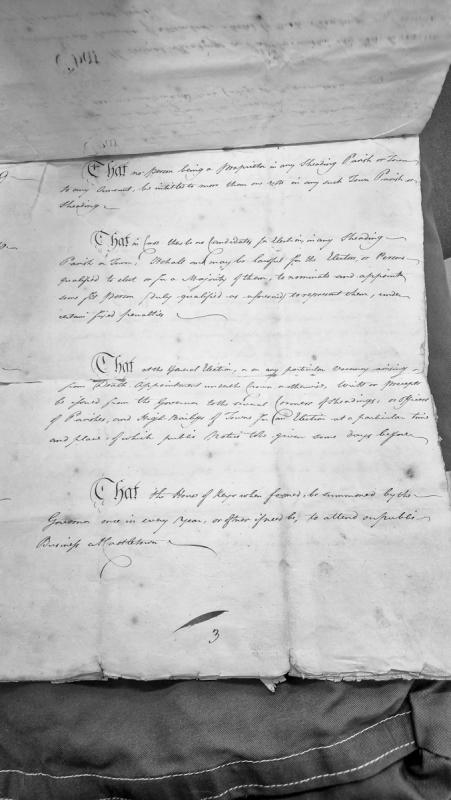
Fragment of electoral regulations establishing voting rights and procedures for House of Keys elections. Stipulates single votes per property owner, nomination procedures for vacancies, issuance of writs for elections, and annual summoning of the House of Keys. Appears to be part of broader electoral or constitutional reform document.
Daughter of the first English Collector of Customs in the Isle of Man, and wife of Captain William Bligh.
Her father was Richard Betham, LL.D. On the completion of the sale of the Island, the government agreed at the Duke of Atholl's request to retain every officer of his appointment except the Collector of the Customs, and that office was conferred on Betham. He held it until his death in 1789. A contemporary called him a gentleman whose erudition was truly respectable, and to whose politeness and friendship he was highly indebted.
Her mother Mary died in 1766, aged forty-two, and is buried at Onchan. Mary's father was Neil Campbell, Principal of Glasgow College from 1728 to 1761, which is how the family came to be connected with the Campbells of the West India trade. A Margaret Betham buried at Onchan in 1783 may have been Richard's sister, come over to keep house for him, since he was left with two young daughters, Elizabeth and Anne.
Elizabeth married William Bligh at Kirk Onchan on 4 February 1781. Some accounts of the marriage give her name as Betty. A daughter of the marriage was baptised at Douglas in 1784.
Elizabeth Christian, recorded in Charles City County, Virginia, in 1662, of the Manx Christian connection in the colony.
The family had been there since the middle 1650s. In 1655 two brothers, William and Jonathan Christian of Maughold, went out to Virginia, and a family of Cottiers from Lezayre went with them, the two families intermarrying afterwards. The Christians acquired considerable tracts of land in the colony and their descendants came to be possessed of an ample fortune.
Elizabeth Holloway Marston (born Sarah Elizabeth Holloway, 20 February 1893 - 27 March 1993) was born in Sulby, the daughter of an American bank clerk father and English mother, before the family relocated to the United States while she was a small child and she was raised in Boston. A lawyer and psychologist, she is credited as an uncredited co-creator, with her husband William Moulton Marston, of the comic-book character Wonder Woman, and her work on blood-pressure research also contributed to the development of the polygraph lie-detector test.
Elizabeth II (1926-2022), Queen of the United Kingdom and Lord of Mann from 1952 until her death. She visited the Isle of Man on several occasions and took a personal interest in Manx affairs. The title Lord of Mann, and not Lady, was used at her express wish, keeping the historic form.
Her title was also the point on which a modern constitutional argument turned. Writing in 2003 on how far Manx emancipation from English tutelage falls short of independence, Augur Pearce set out the case that the Island's claims to constitutional continuity cannot be made out in law. On that reading the Queen held the Island not by any descent from the Norse kings but as heiress of Henry IV of England, whose conquest ended the independence enjoyed under the House of Godred and began the present era of Manx government, and the subordinate lordship of the Percys, the Stanleys and the Murrays is beside the point.
A single worked prehistoric flint found in the garden of No. 8, Elizabeth Rise, Castletown.
The artefact is a missile head of late Mesolithic (heavy bladed) character, and measures 68mm overall. The artefact is in the Manx National Heritage collections, accession no. 1969-0041.
The grid reference is centred on the garden.
The site of a 19th century lead mine shaft. The 1870 1:2500 scale Ordnance Survey maps shows a wheelpit stood at SC44968972 which was connected to the shaft by pumping rods supported on piers. The wheel was powered by a leat which ran through the field numbered as Plot 1584 on the 1870 map. Associated levels are also shown at SC44788969 and SC44808967. Almost no surface remains now survive.
Ellan Vannin is a Registered Building on The Quay, entered on the Protected Buildings Register in 1984, standing in the row of harbourside houses beside the former (Baillie Scott-designed) police station and directly across from Castle Rushen. Local history of Castletown's inns records that a house on the Quay once traded as the Ellan Vannin Arms, in the row flanked by the police station and the old Steam Packet Company office, though it is not certain this is the same building as the present-day dwelling of that name.
A post-medieval house in Castletown.
The dwelling is shown set within substantial grounds on the Ordnance Survey 1:2500 mapping of 1867. The gardens have since been developed for residential use.
Ellerslie Farm's outbuildings stand at Ellerslie, in the parish of Marown near Crosby. The locality is historically associated with lead mining: in the nineteenth century, the entrepreneur George Dumbell operated the Mona Mine at Ellerslie, Crosby, placing the mine engineer Richard Rowe in charge of the works. Available sources do not establish whether the surviving farm outbuildings are connected to this mining operation, and no further verified detail about the buildings themselves was found online.
The site of a steam-powered mill at Ellerslie which was probably the only one on the island in the early 19th century. The disused mill is shown on the 1958 1:10560 Ordnance Survey map.
The Manx people left. Ohio, Cleveland, Virginia — they carried their language, their constitutional instinct, their identity. A tradition connects the Virginia Christians to the same family as Illiam Dhone, and the Fincastle Resolutions of 1775 — drafted by Virginians named Christian — preceded the Declaration of Independence. Whether those Virginians came from the Isle of Man, as A.W. Moore believed, is a question the primary sources have not yet answered. What is documented is the Ohio emigration: John Sayle wrote home from Ohio in Manx Gaelic. The language lived longer in Ohio than it did on the Island. Parish registers and ship manifests trace the Ohio Manx by name, by parish, by ship. The Virginia tradition has no such paper trail.
This transcription file appears to be empty or contains only metadata headers with no actual document content. No substantive text, dates, or identifying information could be extracted.
This transcription file contains no extractable document content. It appears to be either a corrupted file, a blank page, or a transcription error with only metadata headers present.
This transcription appears to contain only metadata headers and formatting but no substantive document content. Unable to extract meaningful information about the source document from the provided text.
This transcription file contains no document content, only metadata headers indicating it was processed through the Manx Museum's automated transcription system. The actual document text is absent.