This is a metadata-only transcription record with no actual document content. The source image reference is provided but the transcription itself contains no text or structured information from a historical manuscript.
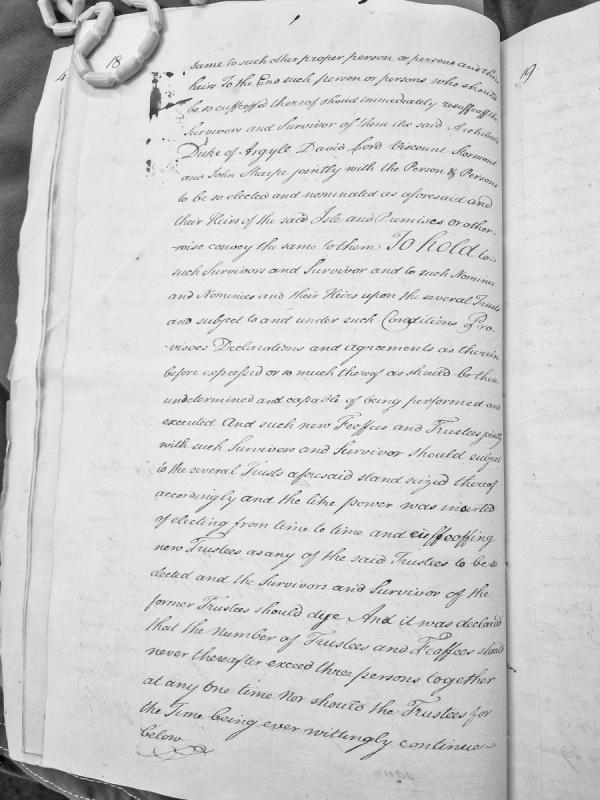
A legal document excerpt detailing provisions for enfeoffment and succession of trustees for Isle of Man property. The text outlines procedures for re-enfeoffment by survivors, nomination of new trustees, and constraints on the number of trustees (not to exceed three at any time).
The Engine Shed at Banks Circus comprises two rubble-stone locomotive buildings dating from the 1890s, still in working use as the Isle of Man Railway's main workshop. Between them, the shed and its single-road workshop can house up to seventeen steam locomotives at once, and the building retains overhead lifting gear, beam engines and wheel lathes from its working life, with a blacksmith's shop added as recently as 2001. It remains a genuine working railway shed rather than a museum piece, central to keeping the island's steam fleet running.
England is the largest constituent country of the United Kingdom and the suzerain power that exercised overlordship of the Isle of Man. The relationship between the English Crown and the Island shaped Manx history profoundly, from the medieval transfer of the Lordship to the English Stanleys in 1405, through the Revestment of 1765, to the continuing constitutional relationship as a Crown Dependency.
The terms of the holding were feudal and were recited for centuries. The Island was granted with the patronage of the bishopric and all its ecclesiastical benefices, as fully as any former lord or king of Man had held them, to be holden by homage and by the service of rendering to the King and his successors at their coronations two falcons.
The English claim was asserted step by step. King John took Reginald, King of Mann, under his protection in 1205 and took his homage for the Island and the out Isles. Edwin of Northumbria had wrested it from the Scots as early as 625. Edward I heard the Waldeboef claim as lord paramount over the King of Scotland, and the Manx chronologies say he took the Island under his protection in 1290 and assumed it as his own in 1307. Henry IV granted it to Sir John Stanley and his heirs after Scrope's attainder.
The Manx never accepted that the relation was simple. The Island's writers insist that when it passed to the kings of England no rights of Holy Mother Church went with it, and yet the Crown afterwards presumed to give or sell the patronage of the bishopric, and Henry VIII and Elizabeth seized the lands and revenues of Rushen Abbey. Sir James Gell as Attorney-General had to answer an opinion of the English Law Officers that the Insular Legislature could not legislate on a matter affecting Crown rights without an Act of the Imperial Parliament, and he answered it with the precedents.
A comprehensive doctoral thesis examining smuggling as commercial activity, social crime, and policing problem in eighteenth-century England. Covers regional variations (East Anglia, Kent, Sussex, Cornwall), the role of violence, involvement of revenue and military forces, and extends analysis to comparative contexts including the Isle of Man, Channel Islands, France, and Scandinavia. Highly relevant to understanding the smuggling trade that prompted the 1765 Revestment.
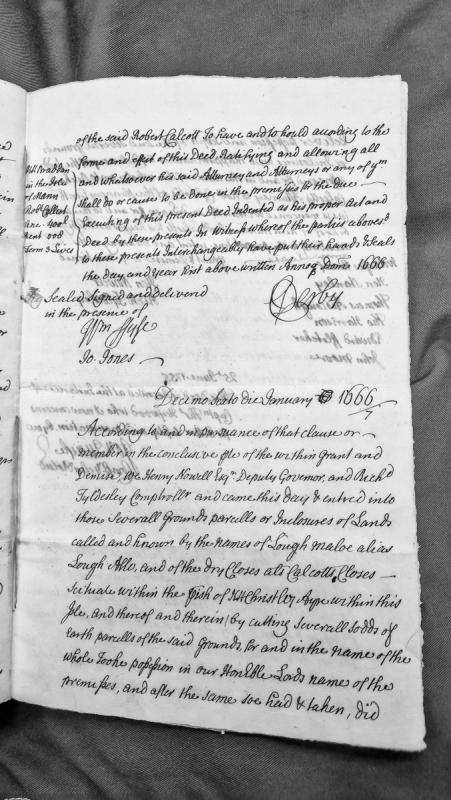
An official record of Henry Nowell (Deputy Governor) and Richard Tyldesley (Comptroller) taking possession of several parcels of land called Lough Maloe, Lough Allo, and the dry Closes/Calcotts Closes in the parish of Christ Ley Ayre. The action was performed by cutting sods of earth as a symbolic act of taking possession on behalf of their Honourable Lord.
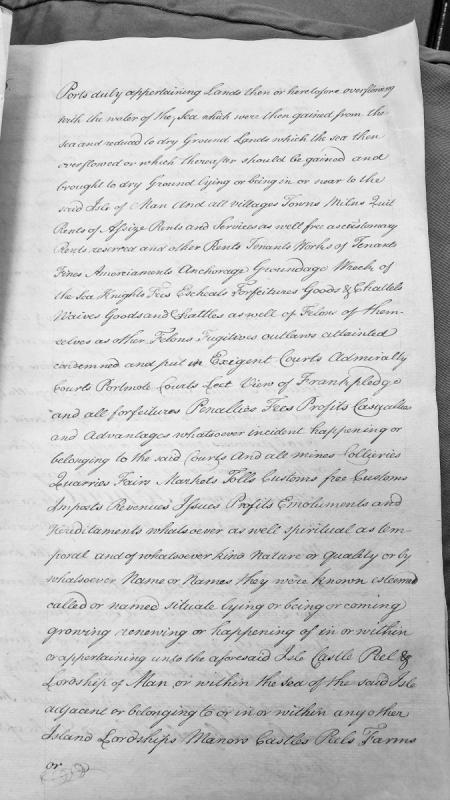
A legal document detailing the comprehensive list of rights, revenues, lands, and jurisdictional powers appertaining to the Isle of Man, including ports, lands reclaimed from the sea, rents, court jurisdictions, and various feudal rights and revenues. The document appears to be part of a larger legal instrument defining the extent of lordship powers and property rights.
An order issued by the Bishop of Man (Derby) in 1691 regarding the administration of funds (£43 19s 10d) deposited for repairs to Peel Cathedral. The order clarifies that no interest is due from the Lord Bishop while funds remain undeployed, and authorizes the Bishop and Governor jointly to invest the money if a secure opportunity arises. Relevant to understanding ecclesiastical governance and financial administration on the Isle of Man in the late 17th century, contextualizing pre-Revestment institutional structures.
Erin Brae on Queens Promenade began as a private residence before later becoming a guest house; it operates today as Kings' House, a historic guest house on the promenade. Specific construction-date and architectural detail could not be independently confirmed from a reliable source, so this entry is kept brief.
The conjectured site of a Bronze Age barrow, proposed by William Cubbon. The site was later discounted and thought to be a natural hillock. No surface evidence of a barrow has been noted here.
Letter from Charles Lutwidge to Grey Cooper at the Treasury (15 June 1770) transmitting an estimate of £155 8s for repairs to Douglas Pier following storm damage in March 1770. Lutwidge requests Treasury approval and proposes a tonnage tax on ships using the harbour to fund repairs. The estimate details costs for mason work, materials, and reconstruction of the lighthouse.
Letter from Charles Lutwidge to Grey Cooper at the Treasury, enclosing an estimate of £155:8:0 for repairs to Douglas Pier damaged by storms in March 1770. Lutwidge requests Treasury approval and proposes a tonnage tax on vessels using the harbour to fund repairs. The document includes itemised repair costs and notes on subsequent harbour damage in 1786.
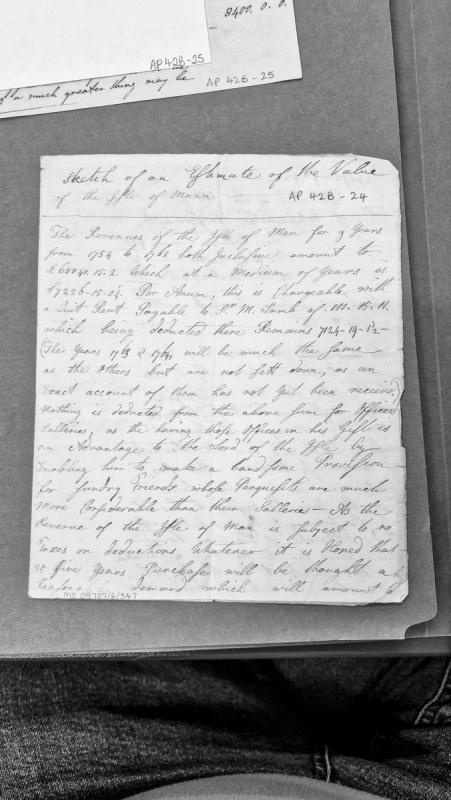
A financial estimate calculating the annual average revenue of the Isle of Man from 1754 to 1762, deducting quit rent payable to Sir M. Lamb, and proposing a valuation based on five years' purchase. The document notes that no deductions are made for officers' salaries as these positions are perquisites of the Lord of the Isle.
Ewan Callister, assistant to the revenue officer at Douglas before the Revestment.
He was paid three pounds Manx a year, the same as Paul Bridson whom he assisted, and more than the assistant at Castletown, who had one pound. The whole of the Duke of Atholl's revenue establishment for the Island cost forty-nine pounds thirteen shillings and fourpence Manx, against collections running at between five and six thousand pounds a year over a ten-year average, and a Receiver General at forty pounds stood outside that figure. Douglas, where Callister served, was the first port of the Island, and the two men there were paid the same.
The Duke printed those figures for a reason. He was answering the suggestion that his officers had done well out of the trade, and he set the salaries against the reputation: when he heard of people on such pay as this living splendidly, bringing up numerous families or dying opulent, he left his readers to draw the conclusion.
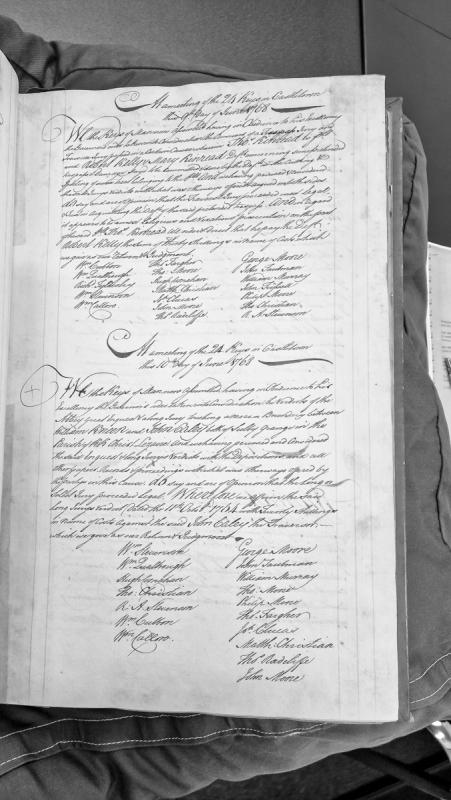
Member of the House of Keys and one of the three who settled the terms of the Act of Settlement with the tenth Earl of Derby.
The Christians of Lewaigue in Maughold descend from Robert, second son of the William Christian who was Deemster alongside his father and succeeded to the Ronaldsway estate in 1535. They are therefore a branch distinct from the Christians of Milntown, and that distinction matters for reading the record, because the two houses used the same forenames.
His known part in Manx affairs is the settlement of the tenures. The ninth Earl had tried and failed to come to terms with the tenants over their holdings. Nothing was done until 1704, when a bargain made between James, the tenth Earl, and Bishop Wilson, with three members of the Keys, was agreed to by the Tynwald Court. The three were Ewan Christian of Milntown, Ewan Christian of Lewaigue, and John Stevenson of Balladoole. The Act which confirmed that agreement is the Act of Settlement, and it secured the tenants in their farms in perpetuity on fixed terms.
A tradition collected in the twentieth century attaches to the name rather than to a dated event. An extremely violent and obstinate spirit at Dreem-y-Jeeskaig had defeated everyone who tried to lay it, until Ewan Christian, known simply as Christian Lewaigue, was called in. The first time he addressed it, it told him to come again on a certain night, alone. He went the second time as asked, and it was not seen afterwards.
Testimony by John Quayle, Clerk of the Rolls for the Isle of Man, given before commissioners of inquiry in September 1791. Quayle describes the pre-1765 customs administration, the role of Paul Bridson as Deputy Searcher, the Duke of Atholl's denial in 1764 that he would sell the island, and the procedures for collecting duties on tea, tobacco, brandy, and other commodities. His account provides detailed insight into revenue collection, smuggling activity, and the administrative transition at the 1765 Revestment.
Sworn examination of John Quayle, Clerk of the Rolls in the Isle of Man, taken before a Commissioners of Inquiry in September 1791. Quayle provides detailed testimony on pre-1765 customs administration, the role of Paul Bridson as Deputy Searcher, revenue collection procedures, duties on tea and tobacco, smuggling seizures, and the transition of authority following the 1765 Revestment Act. This document is part of a post-Revestment inquiry into the island's governance and revenue management.
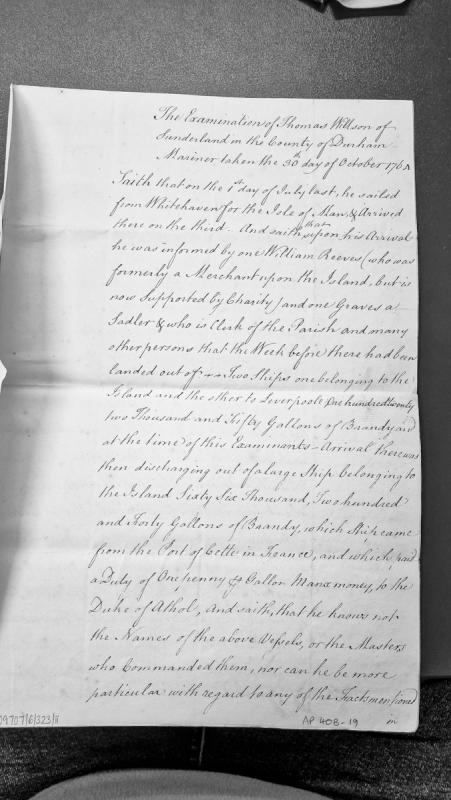
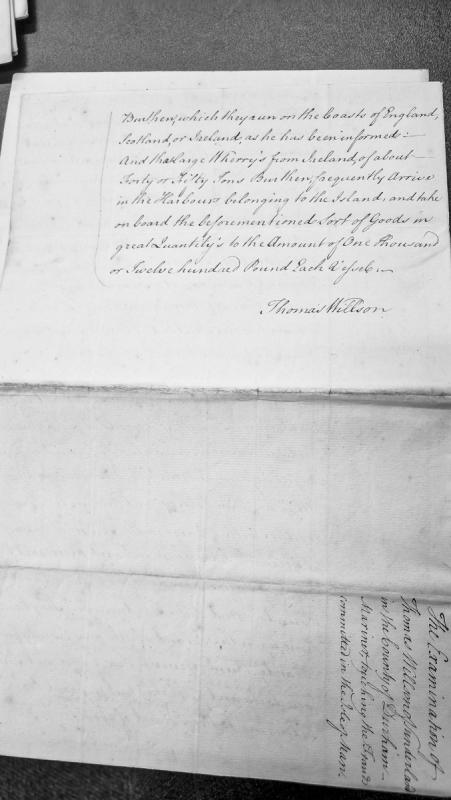
Examination of Thomas Willson, a mariner from Sunderland, concerning the landing of large quantities of brandy on the Isle of Man in July 1764. The document records his testimony about witnessing the discharge of over 188,000 gallons of brandy from multiple vessels, one of which paid duty to the Duke of Athol. This testimony relates to customs and revenue enforcement on the Island.
An endorsement recording the examination of Thomas Willson, a mariner from Sunderland in County Durham, concerning smuggling activities in the Isle of Man. This appears to be a formal legal document related to customs enforcement and illicit trade investigation.
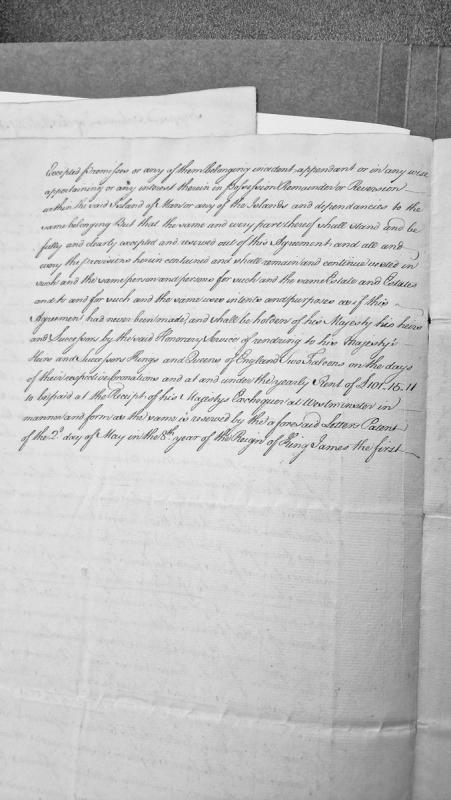
A legal document detailing excepted premises and reserved interests relating to the Isle of Man, referencing the annual rent of £107.15.11 payable to the Exchequer at Westminster and the honorary service of rendering falcons at royal coronations. The text references Letters Patent from 2 May in the 8th year of King James I's reign.
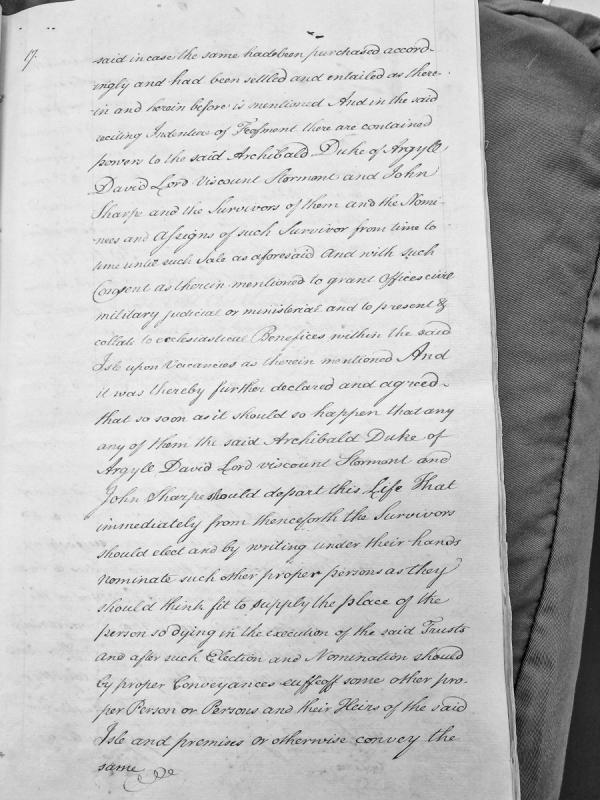
This is an excerpt from a legal document (indenture of feofment) detailing the powers granted to trustees—Archibald Duke of Argyle, David Lord Viscount Stormont, and John Sharpe—regarding the governance and disposition of the Isle of Man. It specifies their authority to grant civil, military, judicial and ministerial offices, present to ecclesiastical benefices, and provisions for succession of trustees upon death.
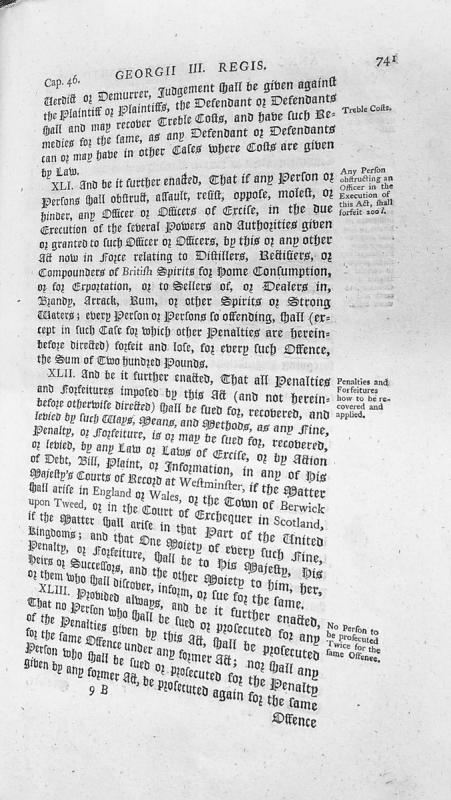
This is a printed excerpt from Chapter 46 of an Act of King George III relating to excise regulations, spirits, and distillation. It sets forth penalties for obstructing excise officers (£200), procedures for recovering penalties and forfeitures, and provisions against double prosecution for the same offence.
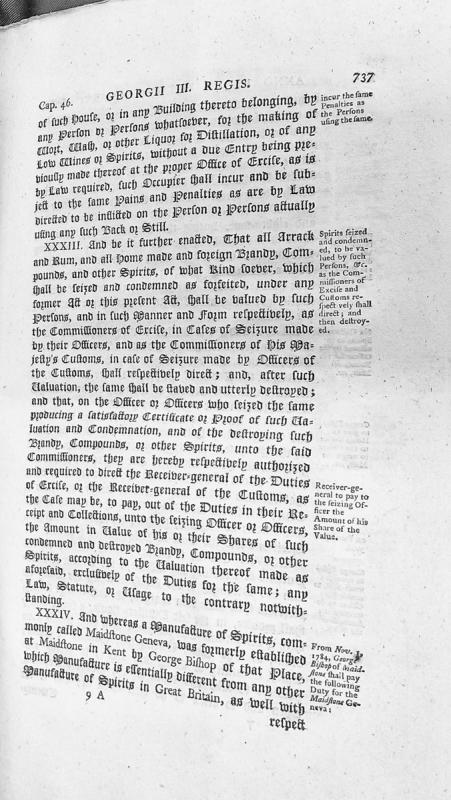
This is an excerpt from a printed Act of Parliament under King George III (Cap. 46, section 737) dealing with excise regulations. It covers provisions for seizing and destroying illicit spirits, valuation procedures for condemned spirits by Excise and Customs commissioners, and compensation procedures for seizing officers. The final section introduces regulations regarding Maidstone Geneva spirits manufactured at Maidstone in Kent.
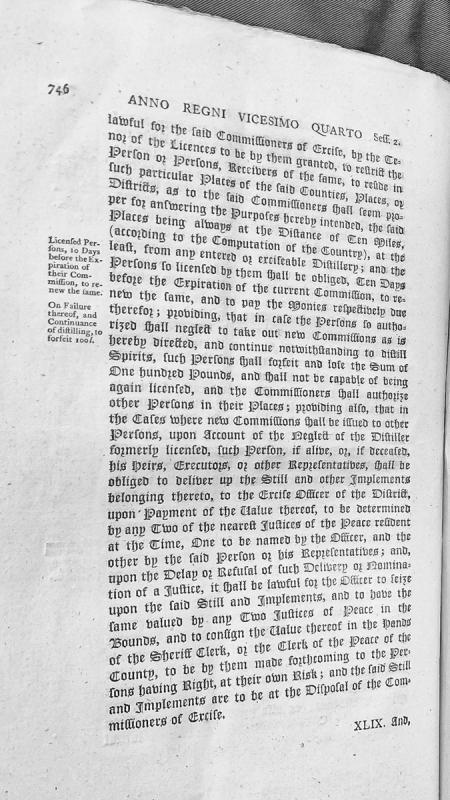
This is an excerpt from legislation (Anno Regni Vicesimo Quarto, Session 2) establishing regulations for Excise Commissioners granting licenses to distillers. It specifies requirements for licensed persons including residential restrictions (10 miles from distilleries), renewal of commissions, penalties for non-compliance (£100 forfeiture), and procedures for seizure and valuation of stills and implements.
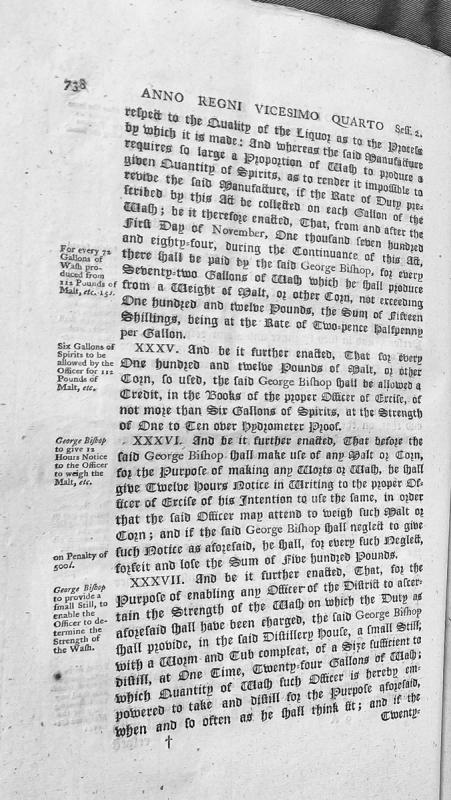
This is an excerpt from an Act of Parliament (regnal year 24) detailing excise duties and regulations for George Bishop's distillery operations on the Isle of Man. The text specifies duty rates on wash production from malt, credit allowances for spirits, notification requirements for excise officers, and equipment specifications for strength testing.