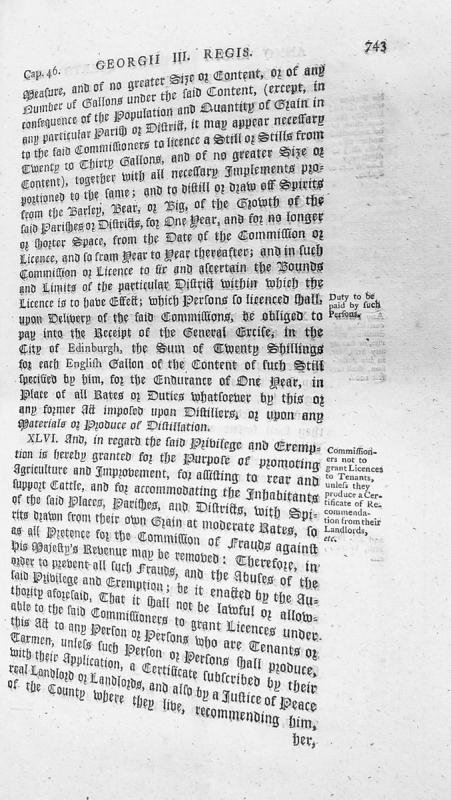
An excerpt from a statute (Cap. 46) under George III concerning licensing of small stills for grain distillation in parishes and districts. The text details regulations for still sizes, duty payments to Edinburgh Excise, and restrictions on tenant licensing requiring landlord certification.
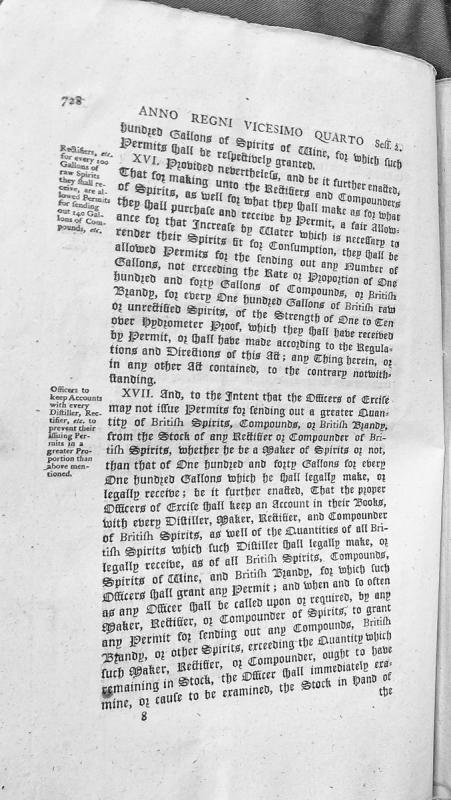
A fragment of legislation (sections XVI and XVII) regulating the excise duties and permit system for rectifiers and compounders of spirits in the 24th regnal year. The text establishes allowances for water dilution in spirit production (140 gallons output per 100 gallons input) and requires excise officers to maintain detailed accounts with spirit makers to prevent over-issuance of permits.
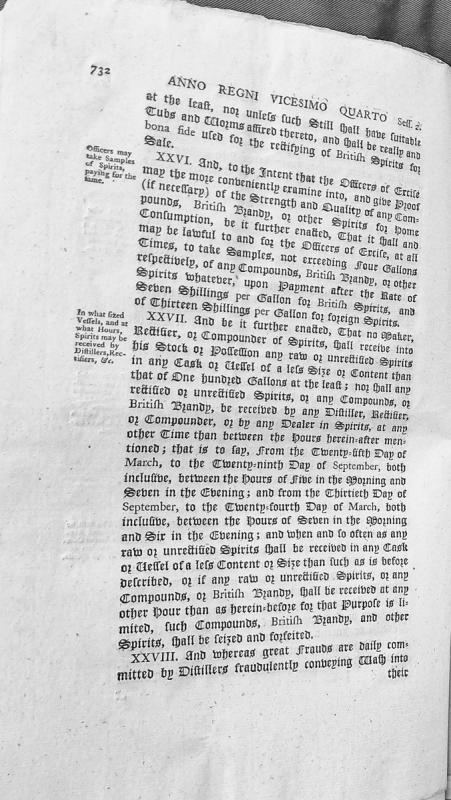
Extract from a printed statutory document outlining excise regulations for the manufacture and handling of spirits in Britain. Details provisions regarding still equipment, sampling procedures for excise officers, vessel sizes for receiving spirits, and hours of operation for distillers and rectifiers.
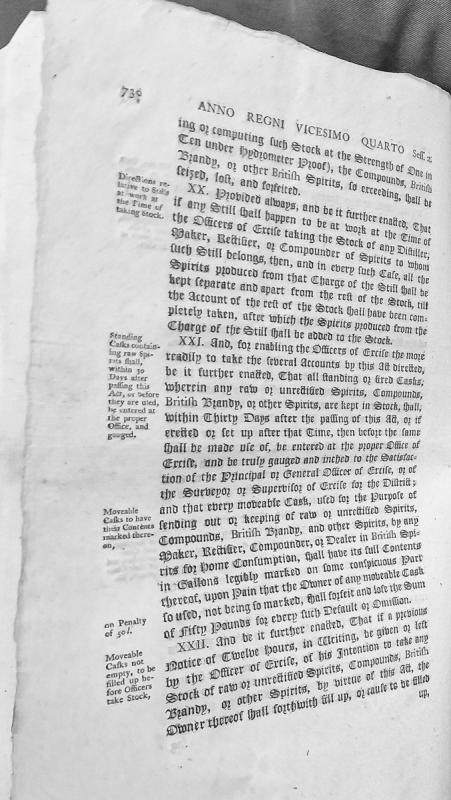
This is an excerpt from a legislative act regulating the excise duties on spirits in Britain. The document outlines provisions for officers to take stock of spirits, requirements for cask marking and registration, penalties for non-compliance, and procedures for handling spirits during stock-taking operations.
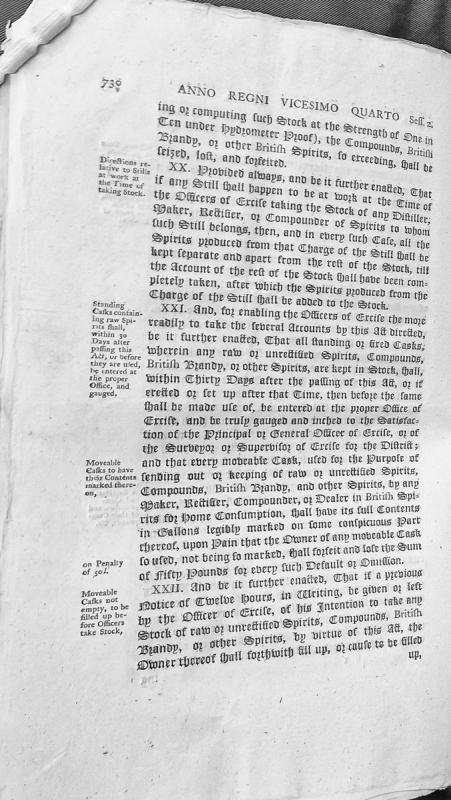
This is an excerpt from legislation (anno regni vicesimo quarto, sessio 2) containing sections XX-XXII detailing excise regulations. It covers procedures for handling spirits when stills are in operation during stock-taking, requirements for entering and gauging standing casks, marking moveable casks with contents, and procedures when officers provide notice before taking stock.
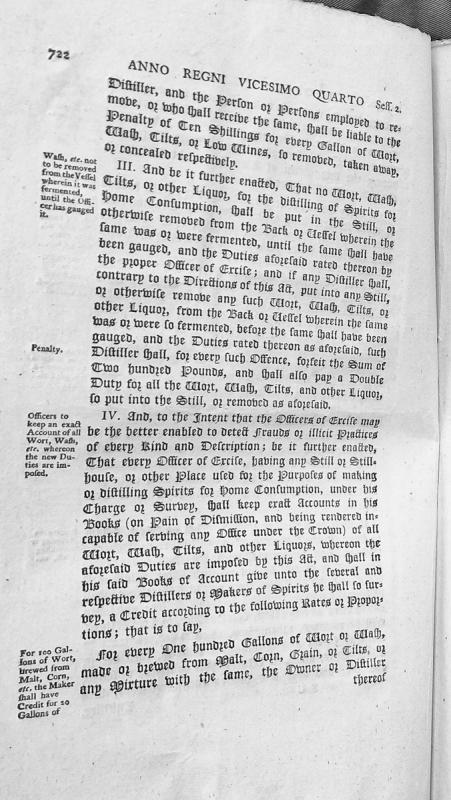
Legislative text (sections III-IV) regulating home spirit distillation on the Isle of Man. Establishes requirements for gauging wort, wash, tilts and low wines before distillation; imposes penalties for unauthorized removal or concealment; mandates record-keeping by excise officers with specified credit ratios for spirit makers.
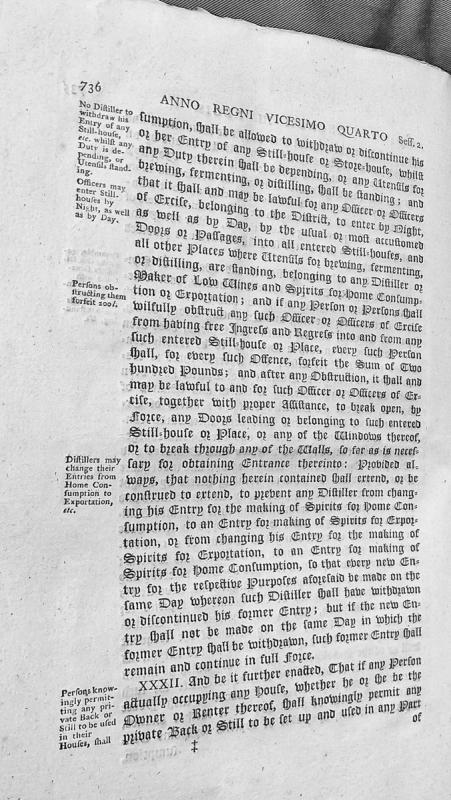
This is a legislative text from the 24th regnal year, second session, containing excise regulations. It details provisions preventing distillers from withdrawing entries while duties are pending, granting excise officers night and day access to still-houses, imposing £200 penalties for obstruction, and outlining procedures for changing entries between home consumption and exportation. The fragment also begins a clause regarding private stills in occupied houses.
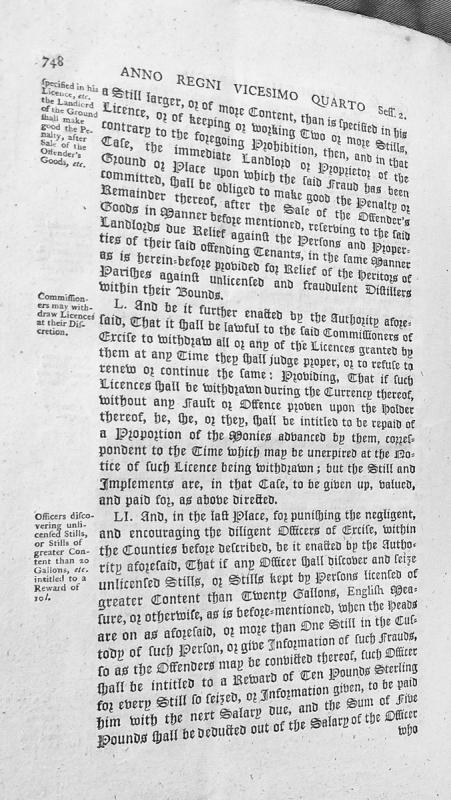
Fragment of legislative text regulating distillery operations, establishing penalties for unauthorized stills, landlord liability for tenant violations, and monetary rewards for excise officers who discover illegal stills. The document appears to be from Scottish or British excise legislation dealing with still licensing and fraud prevention.
William Christian — Illiam Dhone, 'brown-haired William' — was executed at Hango Hill, Castletown. He had surrendered the Island to the Parliamentarians in 1651 to spare the Manx people from siege. After the Restoration, the 8th Earl of Derby had him tried and shot. The parish register of Kirk Malew recorded his death as a martyrdom. The Privy Council later intervened, restoring the Christian estates and disciplining the Deemsters who had convicted him. The Island still mourns him.
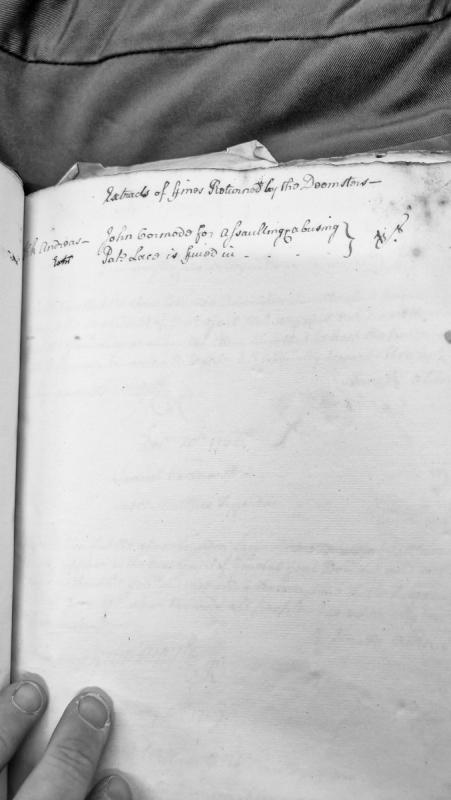
A fragmentary court record documenting fines imposed by Doomsters (judicial officers) for offences including faulting, abusing, and other infractions. The document appears incomplete with partial entries for John Cormode and Pat Lace.
Faaie ny Cabbal, or the Chapel Close, south of the highroad and behind Ballaugh village is still remembered as the site of an early medieval chapel or keeill and burial ground. It would have been in use between approximately AD500 and AD1000.
The ruins evidently existed in 1826 when a Mr Radcliffe gave the measurements of the chapel as "6 yards long by 4 yards broad." The site is marked on the 1869 1:2500 scale Ordnance Survey map but in modern times a house has been built here and there is no trace of either the chapel or its burial ground.
The site of an early medieval keeill or chapel which is thought to have been in use between circa AD500 and AD1000. It was found in the garden of the farm. A stone slab measuring 1.37 metres long by 0.36 metres wide but only 5 to 7.5 centimetres deep, was noted which was thought to have come from a lintel grave.
This is thought to have been an early type of keeill, probably dedicated to St Mark. It was excavated by P.M.C. Kermode in 1910-11. Only a portion of a single section of the inner facing of the north wall remained, but the original dimensions were estimated as at least 5.3 metres long and about 3.3 metres wide.
Nearby to the west, at a slightly lower level, several undisturbed lintel graves were found. A pathway of flat, water-worn stones, extending for about 2.75 metres, was found level with the base of these graves.
A broken cross-slab from the keeill was inscribed with a Celtic cross and circle within a rectangular panel (PRN 0402.20). The slab was also decorated with bird's heads, crosslets and animals and several names, the letters of which indicated a 7th or early 8th century date.
The Fairy Bridge crosses the Santon Burn on the A5 road between Douglas and Castletown/the airport, on the parish boundary between Santon and Malew. Manx tradition holds that it is unlucky not to greet the 'Little People' (Mooinjer Veggey) when crossing, and buses on the route make an announcement asking passengers to say 'Hello Fairies'. The custom was first recorded in an 1816 guidebook describing the nearby original Ballalona bridge, also known as the 'Devil's Bridge', and TT/Manx Grand Prix competitors still visit before racing.
One of the most feared actions of the malevolent fairies was to steal children, especially before baptism. If a child were taken, a decrepit and emaciated fairy would be left in its place. The prettier the child, the greater the risk. Protective measures included laying an iron poker on the child when left alone, tying a red thread around the child's neck, and carrying bread and cheese to give to the first person met on the way to christening. Salt and iron were the most reliable protections. The changeling tradition reflected a world where children were vulnerable and the community had rituals to express and manage that anxiety.
A system of domestic customs designed to maintain good relations with the fairy world. A fire was kept burning in the house through the night so the fairies might come in and enjoy it. Bread was left out for them. Water crocks were filled with clean water before bed, used by the fairies for bathing and thrown out in the morning, never used for any other purpose. Women would not spin on Saturday evenings as this displeased the Mooinjer Veggey. At every baking and churning a small piece of dough and butter was stuck on the wall for fairy consumption. The mountain ash or cuirn, in the form of a cross made without a knife, was placed over the threshold. Yellow flowers growing in a hedge offered protection. These were not quaint survivals. They were practical measures in a world where the fairy folk were neighbours.
Falcon Cliff was built as a residence to a design by architect John Robinson for John Stanway Jackson, manager of the Bank of Mona, who acquired the plot in a lottery when the old Castle Mona estate was broken up and sold. After Jackson relocated in 1855, the house passed to a Mrs Okell, and by 1877 it had been converted into a hotel, with its grounds later developed into a popular entertainment venue that for a time included a large dance-hall pavilion (demolished in the 1890s once the rival Derby Castle and Palace company took control). To overcome its clifftop position, a funicular cliff railway was built in 1887 to link the hotel with the promenade below; it was dismantled in 1896 and re-erected at Port Soderick, and a second, differently aligned railway served the hotel from 1927 until the hotel's closure around 1990. Rather than being demolished, the former hotel was carefully restored and now serves as offices.
Falcon Cliff Terrace consists of a row of four terraced properties which are slate roofed, with rough cast cement over masonry walls all round. The wooden windows are of large rectangular proportion, with modular treatment of opening sizes including dormers in roof. Entrances are emphasised by flat roofed porches extending to adjacent bay window. Stairs are expressed in the facade elevation which relies entirely on solid/void relationships for visual impact, having no decorative features as such. No interior inspections have been made. Although the building visually appear to be in reasonable repair there is evidence that deterioration could occur. In such instances the occupants would not be likely to have the resources or the 'group responsibility' to expend the extra money that might be required to perform repairs 'in the spirit of preservation. The design, by an internationally renowned architect, is significant in providing a solution for terrace housing which is well ahead of its time.