Falklands conflict. Wooden plaque. Seat was originally wooden bench but has been replaced by concrete ended bench. Plaque has been replaced hence mistake in the date.
Memorial unveiled 5 September 1982. Memorial dedicated by Rt. Rev. Vernon Nicholls, Lord Bishop of Sodor and Man. Sponsored by Manx Variety Club.
The findspot of a large urn filled with 'black stuff' was found about 1896, on the broogh at the back of Faragher's thatched cottage in Glengrenick. It was probably a Bronze Age cinerary urn.
Farm Hill Manor on Farmhill Lane, Douglas, is listed as having special architectural or historical interest on the Isle of Man's Registered Buildings register. No further verifiable historical detail about the manor's construction date, builders, or early occupants could be confirmed.
The site of a small, late medieval or post medieval steading and enclosure. The surviving features were conjectured to be a standing stone, stone alignment and mounds but have been explained as being part of a later complex.
Farrane Fing is an early medieval holy well which has not been located in modern times. The site is listed under Lonan parish and thought to fall to the east of the mountain road. Here there are several small streams with spring sources but no feature identificable as a well has been located.
Prehistoric flint scatter.
A single worked prehistoric flint was recovered from Fenella Beach by CH Cowley.
No further details concerning the circumstances of the discovery were recorded and the grid reference relates to centre of the beach for indicative purposes only.
The antiquary Charles Harry Cowley was an avid collector of worked flint and coarse stone artefacts revealed by agricultural activity, mainly on farms located around Peel, and occasionally from further afield. He was active from 1900 until 1943. His entire collection of artefacts, together with a daybook cataloguing his discoveries, was later donated to Manx National Heritage.
A quantity of worked Mesolithic flint was recovered over the course of nearly a century from the site of the Fenella Hotel on Peel Hill by a number of collectors, including Dr C Marsh, PMC Kermode, CH Cowley and BK Corlett.
The flint is mostly of early Mesolithic, microlithic type, leading Dr LS Garrad to describe the area as a major site of the period. Prof PC Woodman subsequently reappraised this area of Peel Hill as 'probably a group of sites rather than a single site. Material from both the Mesolithic and Neolithic can be found in this area'. The area of recovery would appear to be centred a little to the north of Ashton's Battery.
The hotel was built c1875, within the footprint of a former stone quarry, and burnt down in 1896. The earliest finds were made in 1887, so it is unlikely that they were made on the site of the hotel itself. Undisturbed ground just to the south is the more likely location, and this is reflected in the grid reference. A few worked flints have been recovered from the area of eroded footpath immediately adjacent, though no material has been found recently (time of writing, 2020).
A large proportion of the material was recovered by the antiquary Charles Harry Cowley, an avid collector of worked flint and coarse stone artefacts revealed by agricultural activity, mainly on farms located around Peel, and occasionally from further afield. He was active from 1900 until 1943. His entire collection of artefacts, together with a daybook cataloguing his discoveries, was later donated to Manx National Heritage.
Fenella Tower forms part of Peel Castle. St German's Cathedral, possibly on the site of a predecessor, was founded in the 13th-14th centuries but due to the incursions of the raiding Scots was protected by a curtain wall and gatehouse in the later 14th century, a feature that was to develop into the fortress and garrison of Peel Castle during the 15th to 19th centuries.
St German's Cathedral, possibly on the site of a predecessor, was founded in the 13th-14th centuries but due to the incursions of the raiding Scots was protected by a curtain wall and gatehouse in the later 14th century, a feature that was to develop into the fortress and garrison of Peel Castle during the 15th to 19th centuries. The Fenella Tower is part of the 14th century defences.
This is a natural mound which has been formed by two streams, one on either side, which flow from the southeast to the northwest. It is not thought to be of archaeological interest.
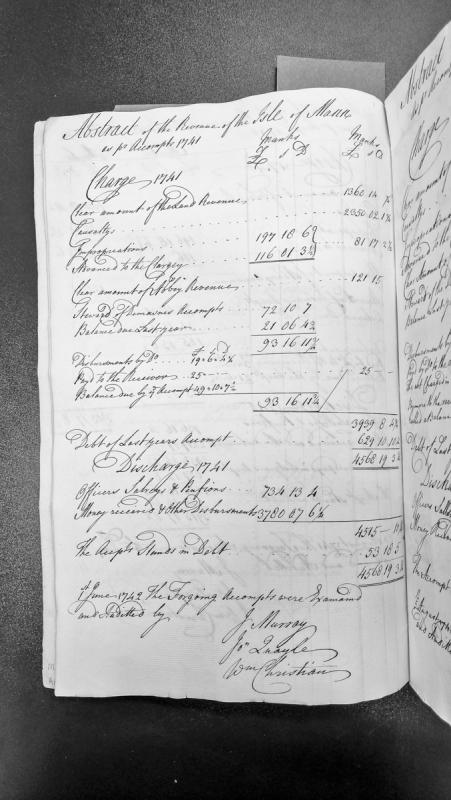
A financial accounting document detailing debts, discharges, officer salaries and disbursements for 1741, with a balance calculation. The account was examined and audited on 1 June 1742 by three auditors.
Former county of colonial Virginia, created in 1772 and extending westwards into territory which included much of present-day Kentucky.
Fincastle County was created from Botetourt County as settlement and surveying moved further west. William Preston served as county surveyor. Under Virginia law, surveys intended to establish legal title had to be carried out by the official county surveyor or by deputies appointed under his authority.
The county consequently appears frequently in the surviving records of western land claims. In 1773 Hancock Taylor, a deputy surveyor, was already working in Kentucky. John Floyd was appointed deputy surveyor on 2 March 1774, and William Russell on 2 August. Their surveys were entered in the Fincastle County books and later formed the basis of numerous Kentucky land titles.
In January 1775 the freeholders of Fincastle produced one of the strongest colonial declarations of resistance to Parliamentary authority. The committee which prepared the resolutions was chaired by William Christian, brother-in-law of Patrick Henry.
The address declared that the settlers would never surrender their liberties "to any power on earth, but at the expense of our lives" and condemned the extension of "the hand of unlimited power" over the colonies. The Fincastle address was dated 20 January 1775.
Fincastle County was short-lived. Its records nevertheless preserve a large part of the early documentary history of western Virginia and Kentucky immediately before the American Revolution.
A resolution and address adopted by the freeholders of Fincastle County, Virginia on 20 January 1775, endorsing the Continental Congress association and expressing loyalty to King George III while asserting constitutional rights against Parliamentary overreach. The document reflects colonial grievances on the eve of the American Revolution and demonstrates the intersection of colonial constitutional thought with British sovereignty claims.
128 names listed in alphabetical order; First World War. Paper roll of honour, mounted behind glass in a wooden frame. 5 columns of names printed underneath the above title. The paper is bordered with a green leaf decoration. An emblem of the Union Jack flag, encircled by a wreath, is above the list of names. Also on the emblem are the words 'For King and Country'. Finch Hill Church opened in 1866. It was demolished in 1997 after a failed attempt to list the building. The memorial was donated to the Manx Museum on 22nd May 1993, by Finch Hill Church. It is in the care of Manx National Heritage, ref no: 1993-0199. The memorial was printed by H.T. Woodrow & Co Ltd of Liverpool. Information provided by the Isle of Man Government Preservation of War Memorials Committee. Find on Map or Report Condition
The findspot of an early Bronze Age flat copper axehead and a Late Bronze Age looped and socketed axehead. Both were found before 1897 near Andreas parish church. Both are now kept in the Manx Museum (Accession Nos. 1954-0792 and 1954-0801).
The findspot of two possible Bronze Age saddle-stones from Arragon and Arragon Mooar. One is a granite boulder with a hollow on one face which was donated to the Manx Museum by Canon Savage (Accession No. 1954-0872). The second is another granite boulder with a hollow in one face which was donated to the museum by Mr Clague (Accession No. 1954-0927).