Arch Tower House, tucked behind a high-walled garden on South Quay, is one of Douglas's more unusual small buildings, with a castellated exterior and an internal spiral staircase leading through a trap-door to a flat roof that gives an extensive view over the town. Despite local legends claiming greater antiquity, a legal document of June 1853 describes it as a 'newly erected, castellated dwelling house,' meaning it was likely built only shortly before that date, probably by Thomas Shimmin, from whose widow it passed to a Mr Perrie in 1860. It later belonged to Mrs Ann Perrie, a widow, and the modest scale of the house belies its architectural charm.
A ditchless, tree and moss covered, bowl barrow with a few stones exposed. It has a diameter of 8.0 metres and a height of 0.6 metres. It forms part of the Archallagan cairn field, a group of Bronze Age burial mounds of disputed number: the 1860s Ordnance Survey recorded 14 cairns in the plantation area, P.M.C. Kermode counted eleven within the plantation and seven beyond the road in 1899, and 1957 Ordnance Survey mappers identified at least eight within the plantation. In 1872 the landowner opened some of the cairns and found inverted urns associated with bones; Rev. A.E. Clarke documented further openings around 1912, publishing illustrations and accounts in the Proceedings of the Isle of Man Natural History and Antiquarian Society. Mounds within the plantation are nominally protected from ploughing but remain vulnerable to damage from tree roots and stump-clearing during replanting.
The site of a Bronze Age barrow within a group of about 18 alleged cairns located in a field to the southwest of Eairy Kelly was visited by an NHAS excursion in September 1912.
The leader of the party, the Reverend A.E. Clarke said that the owner had opened a number of these in 1872 and found inverted urns, 46cm high and some bones. None of the urns were preserved but P.M.C. Kermode had a sketch of one of these cairns which he referred to as typical of the rest. He showed on the OS 6 inch map the position of seven of these cairns which he had been able to identify a 'good many years ago', probably in 1899. They were all ploughed over and indistinguishable, except for a rather long mound which had formed the southwest end of the group.
Across the road, in the Archallagan plantation, Kermode had made out eleven more, evidently a continuation of the same group. This area was thickly planted with trees in 1912.
The site of a Bronze Age barrow within a group of about 18 alleged cairns located in a field to the southwest of Eairy Kelly was visited by an NHAS excursion in September 1912.
The leader of the party, the Reverend A.E. Clarke said that the owner had opened a number of these in 1872 and found inverted urns, up to 46 centimetres high, and some bones. None of the urns were preserved but P.M.C. Kermode had a sketch of one of these cairns which he referred to as typical of the rest. He showed on the OS 6 inch map the position of seven of these cairns which he had been able to identify a 'good many years ago', probably in 1899. They were all ploughed over and indistinguishable, except for a rather long mound which had formed the southwest end of the group.
Across the road, in the Archallagan plantation, Kermode had made out eleven more, evidently a continuation of the same group. This area was thickly planted with trees in 1912.
The site of a Bronze Age barrow within a group of about 18 alleged cairns located in a field to the southwest of Eairy Kelly was visited by an NHAS excursion in September 1912.
The leader of the party, the Reverend A.E. Clarke said that the owner had opened a number of these in 1872 and found inverted urns, up to 46 centimetres high, and some bones. None of the urns were preserved but P.M.C. Kermode had a sketch of one of these cairns which he referred to as typical of the rest. He showed on the OS 6 inch map the position of seven of these cairns which he had been able to identify a 'good many years ago', probably in 1899. They were all ploughed over and indistinguishable, except for a rather long mound which had formed the southwest end of the group.
Across the road, in the Archallagan plantation, Kermode had made out eleven more, evidently a continuation of the same group. This area was thickly planted with trees in 1912.
The site of a Bronze Age barrow within a group of about 18 alleged cairns located in a field to the southwest of Eairy Kelly was visited by an NHAS excursion in September 1912.
The leader of the party, the Reverend A.E. Clarke said that the owner had opened a number of these in 1872 and found inverted urns, up to 46 centimetres high, and some bones. None of the urns were preserved but P.M.C. Kermode had a sketch of one of these cairns which he referred to as typical of the rest. He showed on the OS 6 inch map the position of seven of these cairns which he had been able to identify a 'good many years ago', probably in 1899. They were all ploughed over and indistinguishable, except for a rather long mound which had formed the southwest end of the group.
Across the road, in the Archallagan plantation, Kermode had made out eleven more, evidently a continuation of the same group. This area was thickly planted with trees in 1912.
This feature was described as a long, grass-covered mound orientated west-northwest to east-southeast, measuring 42 metres long and 20 metres wide. It had a maximum height of 1 metre at its southern end. The mound had no ditch and in the east was crossed by a modern hedge bank. East of the fence the slopes were continuous but said to have once existed as a separate mound. At the west end, the mound almost certainly represented three adjoining bowl barrows. East of the road there are another five ditchless, grass-covered possible bowl barrows with diameters from 13 metres to 20 metres and upp to 0.5 metres high. When investigated, the area to the west of the road was covered with heather, tree stumps and coniferous trees and could not be closely investigated but eight possible bowl barrows were seen, averaging between 8 metres and 10 metres in diameter and between 0.5 metres and 1.5 metres high.
The site of a Bronze Age barrow within a group of about 18 alleged cairns located in a field to the southwest of Eairy Kelly was visited by an NHAS excursion in September 1912.
The leader of the party, the Reverend A.E. Clarke said that the owner had opened a number of these in 1872 and found inverted urns, up to 46cm high, and some bones. None of the urns were preserved but P.M.C. Kermode had a sketch of one of these cairns which he referred to as typical of the rest. He showed on the OS 6 inch map the position of seven of these cairns which he had been able to identify a 'good many years ago', probably in 1899. They were all ploughed over and indistinguishable, except for a rather long mound which had formed the southwest end of the group.
Across the road, in the Archallagan plantation, Kermode had made out eleven more, evidently a continuation of the same group. This area was thickly planted with trees in 1912.
The site of a Bronze Age barrow within a group of about 18 alleged cairns located in a field to the southwest of Eairy Kelly was visited by an NHAS excursion in September 1912.
The leader of the party, the Reverend A.E. Clarke said that the owner had opened a number of these in 1872 and found inverted urns, up to 46cm high, and some bones. None of the urns were preserved but P.M.C. Kermode had a sketch of one of these cairns which he referred to as typical of the rest. He showed on the OS 6 inch map the position of seven of these cairns which he had been able to identify a 'good many years ago', probably in 1899. They were all ploughed over and indistinguishable, except for a rather long mound which had formed the southwest end of the group.
Across the road, in the Archallagan plantation, Kermode had made out eleven more, evidently a continuation of the same group. This area was thickly planted with trees in 1912.
Archibald Knox (1864-1933) was a Manx artist and designer born at Cronkbourne, near Tromode, the fifth of seven children in a Scottish family who had emigrated to the Isle of Man. Trained at the Douglas School of Art, where he also taught from 1884, he developed a lifelong fascination with the Island's carved Celtic and Norse stone crosses, studying them on expeditions with the antiquarian Canon John Quine. Together they restored the derelict church of Old Kirk Lonan, and Knox founded the League of St German in 1896 to campaign for the restoration of Peel Cathedral. From 1897 he designed for the Silver Studio and Liberty & Co. in London, producing around 4,000 pieces for the celebrated Cymric silverware and Tudric pewter ranges, work that bridged the Arts and Crafts, Celtic Revival, Art Nouveau, and Modernist movements. Liberty kept their designers anonymous, so Knox's name remained largely unknown during his lifetime despite his designs achieving international recognition. He returned permanently to the Isle of Man in 1913, becoming the Island's lead designer, creating war memorials, gravestones, shop fronts, interiors, furniture, and watercolours. His remodelling of Cadran Cottage in Douglas (c.1910) was listed as a Registered Building in 1996. His illuminated manuscript *The Deer's Cry*, based on St Patrick's Lorica, is held by Manx National Heritage. He was added to the Manx Patriot's Roll of Honour in 2019.
During the First World War, Knox also worked at Knockaloe internment camp, where he ran the censorship department from November 1914 until October 1919. As one of the camp's civilian staff, the blue staff, rather than a military guard, he oversaw the inspection of internees' letters and parcels. By his own account his department handled more than 1.2 million parcels over the course of the war, with some 2,500 arriving from Germany on an average day, and he recorded the internees' attempts to smuggle forbidden items past him, among them newspapers concealed inside tins labelled as preserved meat. His censorship work is confirmed by Manx National Heritage and the Archibald Knox Forum, though it is not mentioned in the Manx Museum's exhibition of his work.
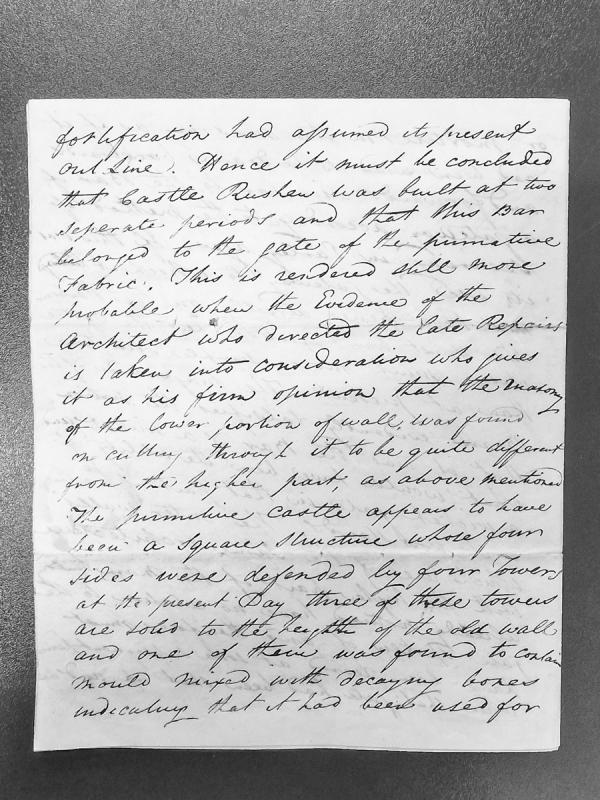
A detailed architectural and historical analysis of Castle Rushen, discussing evidence of two separate construction periods and the structure of the primitive castle. The document references masonry analysis and architectural evidence regarding the castle's original defensive towers.
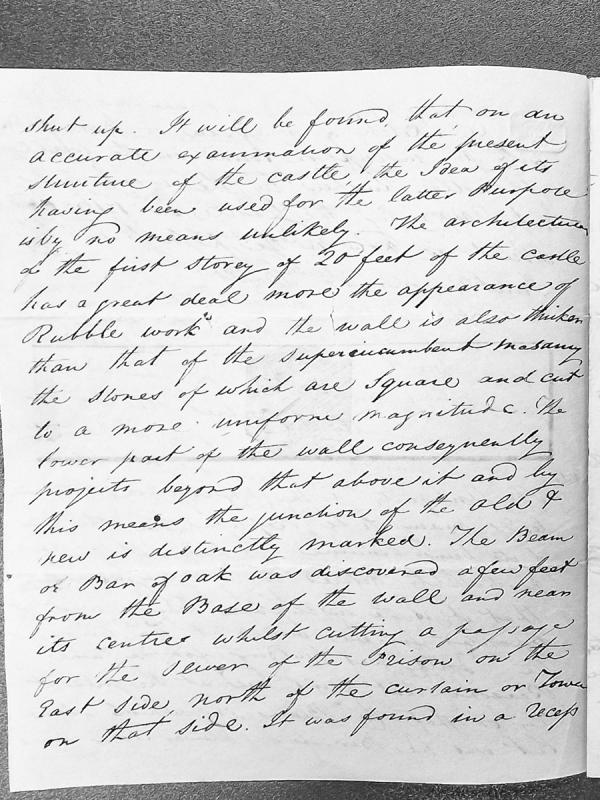
This document appears to be an excerpt from a longer architectural or historical analysis discussing the structure of a castle, particularly examining differences between the lower and upper masonry work. It describes the discovery of an oak beam or bar found during excavation for a prison sewer passage on the east side of the structure.
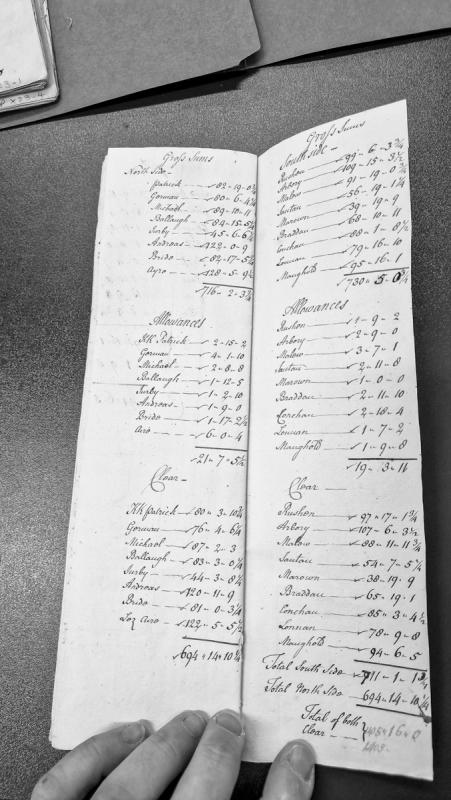
This appears to be a metadata header or placeholder from the Manx Primary Source Archive transcription system. No actual document content is present in the transcription file.
A brief archival entry or reference document containing only an archive reference number (MS 09707/4/37-38) and what appears to be an internal cataloging code (AP 42C). The document provides insufficient content for detailed analysis.
This small broken slab was found at the possible site of a keeill (IOMHER 0567.00) near the Dhoon. The slab shows the remains of a simple 'Celtic' cross with an extended lower limb, set on a broad ring.
A broken slab with a shafted Celtic ring cross. It was found at the site of a keeill on Cooillean Ard (PRN 0567.00) in 1894 and is kept in Maughold Cross House (Manx Cross No. 56). The slab measures 75.5 centimetres high x 55.5 centimetres maximum width and 5 centimetres thick.