A slab which has a Runic inscription along one edge. It was found before 1906 in north transept of Peel Cathedral. It measures 27 inch x 12.5 inch x 3.5 inch and is kept in the Manx Museum. The fragment, built into the walls of the nave of Peel Cathedral, bears the runic text "US THENSI EFTIR ASRITHI KUNU SINA DUTUR UT RAIST", read by one 19th-century antiquarian as commemorating a cross raised to a wife named Asrith, daughter of a man named Oter - though the opening word for 'wife' is imperfectly preserved and may instead read 'mother'. It has been noted that the name Oter also occurs on another Manx cross at Braddan, though it is not certain the two references are to the same person.
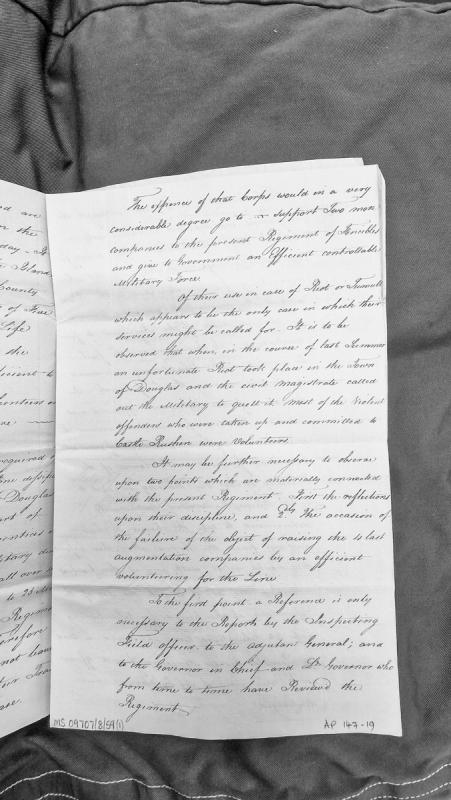
This document discusses the expenses and utility of a military corps in relation to the Regiment of Fencibles, with reference to a riot in Douglas and observations on military discipline and recruitment. It appears to be part of an official report or correspondence regarding military administration on the Isle of Man.
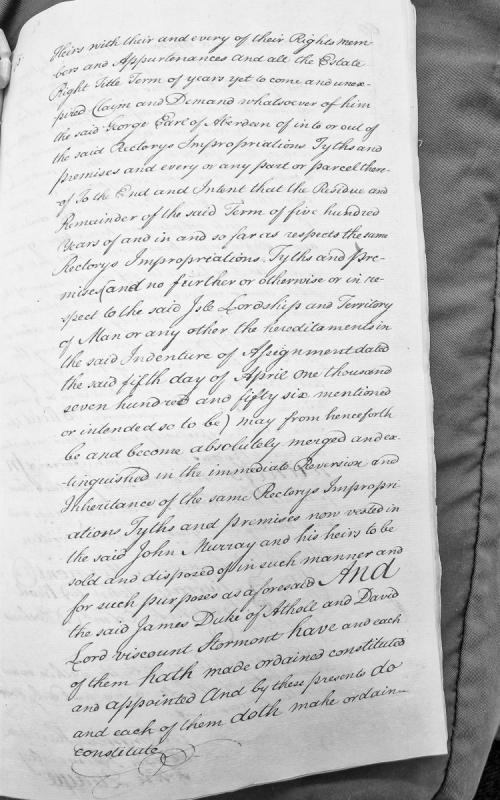
A legal document concerning the assignment and merger of rights to rectorys, impropriationes, tithes and premises. The document references an Indenture of Assignment dated April 5, 1756, and involves the Earl of Aberdeen, John Murray, the Duke of Athole, and Lord Viscount Stormont. The text deals with the extinguishment of a term of five hundred years and the vesting of inheritance rights.
Correspondence between John Murray, 1st Duke of Atholl, and Lord Hawkesbury regarding Atholl's appointment of his brother Lord Henry Murray as Lieutenant Governor of the Isle of Man in August 1804. Hawkesbury firmly rejects the appointment as exceeding Atholl's authority, establishing that only the Crown could confer the Lieutenant Government. The exchange clarifies the constitutional limits of the Duke's powers post-Revestment.
Correspondence between the Duke of Atholl and Lord Hawkesbury (Home Secretary) regarding Atholl's unauthorized appointment of his brother Lord Henry Murray as Lieutenant Governor of the Isle of Man in August 1804. Hawkesbury's stern response clarifies that only the Crown can appoint a Lieutenant Governor, invalidating Atholl's commission. Includes Lord Henry Murray's response acknowledging the invalidity and his limited actions as Commanding Officer.
A collection of letters between the 4th Duke of Atholl and his Isle of Man stewards John Quayle and William Callow (1775–1777), covering post-Revestment manorial administration, revenue collection, mining leases, ecclesiastical affairs, the Governor's House lease negotiations, and interactions with successive governors. Illustrates practical challenges of Ducal sovereignty and relationships with resident authorities.
A curated index and prioritization guide to key documents from the Atholl Papers collection covering the Duke of Atholl's negotiations, valuations, and correspondence regarding the sale of the Isle of Man to the British Crown (1752–1765). Organized by priority level: highest priority documents on the Duke's valuations and decision to sell; second priority on 1764 Treasury and legal correspondence; third priority on smuggling intelligence.
A curated index and finding guide to key Atholl Papers documents covering the Duke of Atholl's negotiations, valuations, and correspondence regarding the sale of the Isle of Man to the British Crown (1752–1765). Organized by priority and topic: highest-priority negotiation documents, 1764 Treasury correspondence, and smuggling evidence. This is a research tool identifying primary sources rather than a primary source itself.
A series of letters exchanged between the 4th Duke of Atholl and his appointed stewards John Quayle and William Callow regarding management of ducal interests on the Isle of Man following the 3rd Duke's death. Topics include revenue collection, mines operations, ecclesiastical matters (Malew Chancel), the Governor's House lease, and administrative concerns. These letters illuminate the transition of Atholl family control post-Revestment and relationships with island officials.
Six letters exchanged between Governors Cochrane and Wood and the Duke of Atholl during Wood's transition to and early tenure as Governor of the Isle of Man (July–December 1761). Letters cover administrative handover, arrival details, revenue remittances (£1500–£2000), appeals procedures, tithes disputes, smuggling activity (spirits and tea imports), and governance procedures. Highly relevant to understanding the administrative structure and revenue dynamics immediately preceding the 1765 Revestment.
A series of six letters from Governor Cochrane and his successor Governor Wood to the Duke of Atholl, covering the handover of the governorship, arrival on the Isle of Man, financial remittances, appeal procedures, revenue collection, and smuggling activity (spirits and tea imports). These letters document the administrative operation of the island under Atholl's sovereignty, shortly before the 1765 Revestment.
Letter from the Duke of Atholl to Lord Hawkesbury (Home Secretary) outlining proposed administrative reforms for the Isle of Man, including Deemster salary parity, a government house for the Lieutenant Governor, judicial authority clarification, and the appointment of a permanent secretary to the Governor. Reflects post-Revestment governance challenges and Atholl's attempts to strengthen executive control over the Keys.
Letter from the Duke of Atholl to Lord Hawkesbury (Home Secretary) outlining administrative proposals for the Isle of Man, including Deemster salaries, Lieutenant Governor housing, judicial procedure, control of the Keys assembly, and creation of a civil secretary post. Reflects tensions between Atholl and the Manx Keys over governance and finances post-1765 Revestment.
Wadsworth Busk, Attorney General, presents evidence to the Commissioners of Inquiry refuting the Duke of Atholl's claims about fair collection of customs revenues prior to 1765. Busk argues that the vast majority of pre-Revestment customs income derived from illicit smuggling in tobacco, East India goods, spirits, and wine—not legitimate trade. He traces the rise of contraband commerce from c.1709, the role of merchant lessees (1720–1727), and subsequent decline due to Parliamentary restrictions and naval enforcement. This document is central to establishing that compensation paid for the Revestment should not have accounted for illegally-obtained revenues.
Letter from Wadsworth Busk, Attorney General, to the Commissioners of Inquiry (1792) presenting evidence that the Isle of Man's customs revenue prior to 1765 was predominantly derived from illicit smuggling—particularly tobacco, spirits, wine, and East India goods—rather than legitimate trade. Busk rebuts the Duke of Atholl's claims that fair revenues were uncollected and could have been increased, arguing that smuggling profits cannot justify compensation and that legitimate customs revenue was minimal (~£100/annum). Critical to understanding the financial justification for the 1765 Revestment.
A legal opinion from William de Grey (Attorney General) dated October 1766, addressing the ownership of fishing rights in Manx waters following the 1765 Revestment Act. The opinion clarifies that sea fisheries (including bay fisheries) belong to the Crown, not to the Duke of Atholl, despite the Duke's reservation of inland waters and fisheries in the Revestment Act. This document is directly relevant to disputes over revenue collection and property rights immediately after the Revestment.
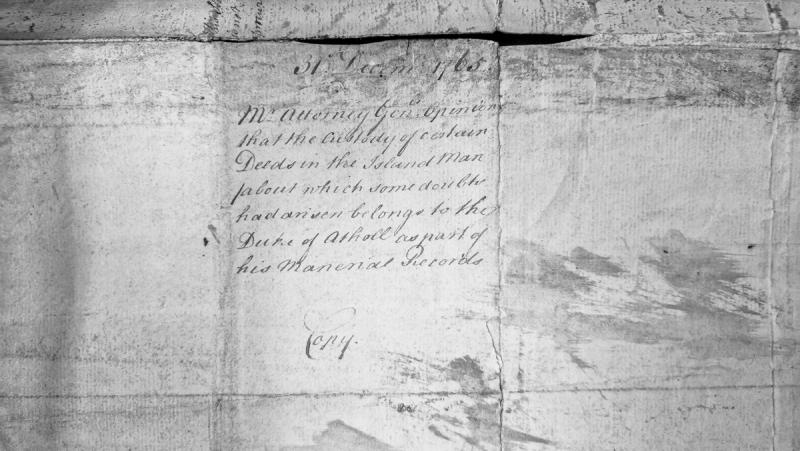
A legal opinion from the Attorney General dated 31 December 1765 addressing questions regarding the custody and ownership of certain deeds held in the Isle of Man. The opinion concludes that these deeds, which had been subject to some dispute, properly belong to the Duke of Atholl as part of his manorial records.
William de Grey (Attorney General) provides a legal opinion on the ownership of Manx fisheries following the 1765 Revestment. The opinion clarifies that while the Duke of Atholl retained certain manorial rights including inland waters and inland fisheries, all sea fisheries (including Bay Fisheries) belong to the Crown. The document addresses a dispute over Lutwidge's possession of Bay Fisheries for the Revenue.
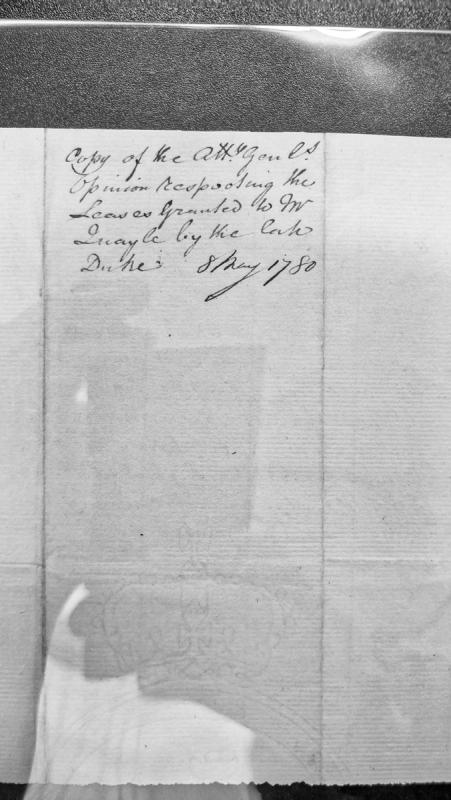
A copy of the Attorney General's legal opinion concerning leases that were granted to Mr Quayle by the late Duke of Atholl. The document provides formal legal advice on the validity and terms of these leases, dated 8 May 1780.
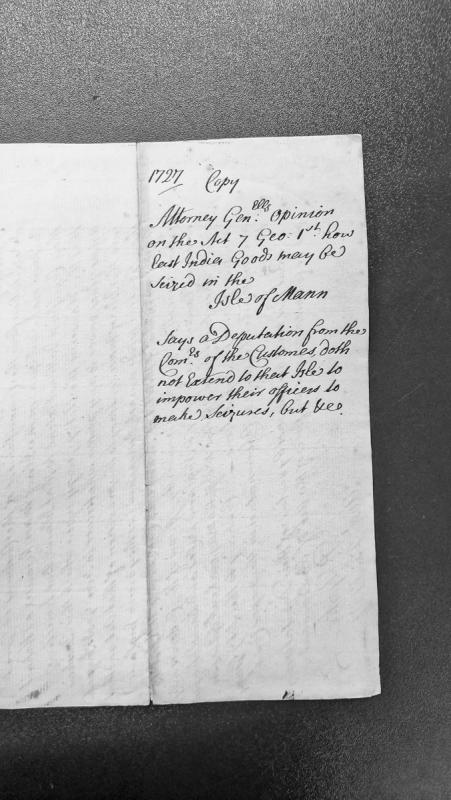
A legal opinion from the Attorney General regarding the application of Act 7 of George I concerning the seizure of East India goods in the Isle of Man. The opinion addresses whether a deputation from the Commissioners of the Customs extends authority to officers in the Isle of Man to make seizures of such goods.
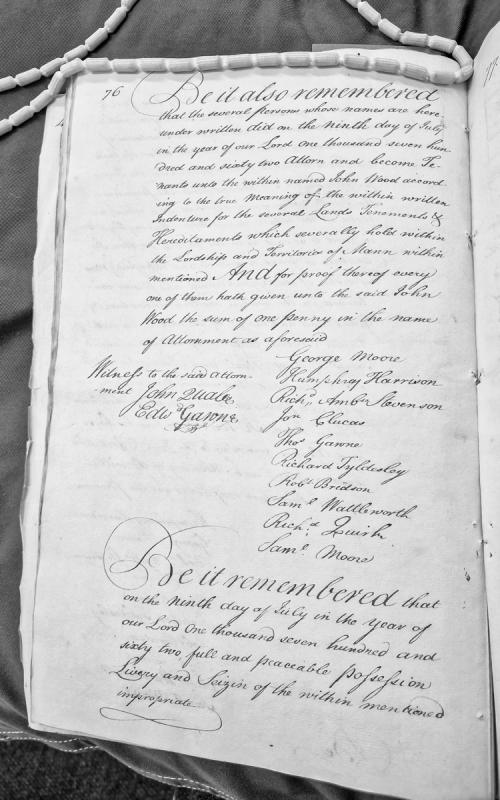
A legal document recording the attornment of multiple tenants to John Wood on behalf of various lands, tenements and hereditaments within the Lordship and Territories of Mann. Each party paid one penny as consideration for the attornment. The document also records the delivery of full possession, livery and seizin of the impropriate lands.
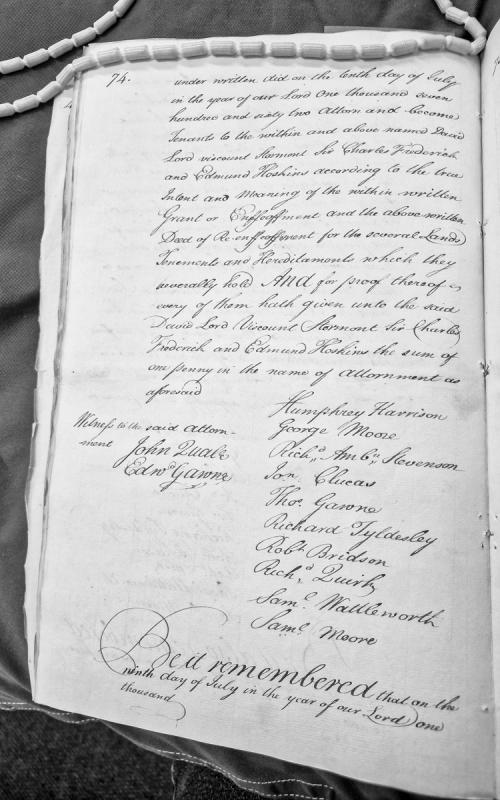
A legal document recording the attornment (transfer of tenancy) of various lands, tenements and hereditaments to David Lord Viscount Stormont, Sir Charles Frederick, and Edmund Hoskins on 10 July 1762. Multiple witnesses attest to the transaction, with symbolic payment of one penny given as proof of attornment.