Royal charter issued by King John granting Reginald, King of Mann, a knight's fee in Ireland (Carlingford, Ulster) and annual corn payments in recognition of homage and service. This document exemplifies the feudal relationship between the English Crown and the medieval Kings of Mann, and their position within the broader Norman-Angevin realm.
Royal charter from King John of England granting a knight's fee in Ireland (Carlingford, Ulster) and annual corn payments to Reginald, King of Mann, in exchange for feudal homage and service. The document establishes the formal relationship between the English Crown and the Manx kingship in the early 13th century, demonstrating Mann's position within the broader feudal hierarchy of the British Isles.
A royal writ from King John ordering the Sheriff of Lancaster to assign twenty librates of land to Reginald, King of Mann, in fulfilment of a prior agreement. This early medieval document establishes the Crown's recognition of Mann's sovereignty and the nature of feudal obligations between the English Crown and the Kings of Mann.
A royal writ from the English Crown ordering the Sheriff of Lancaster to assign twenty librates of land to Reginald, King of Mann, in fulfillment of a prior agreement. This document exemplifies the feudal relationship between the English Crown and the Kings of Mann in the early 13th century, establishing the historical precedent for overlordship claims relevant to understanding the island's sovereignty status by 1765.
Royal charter by Robert II of Scotland, conveying George de Dunbar's grant of one hundred librates of land in the Isle of Man to Sir James Douglas upon his marriage to Agnes de Dunbar. The grant is conditional on recovery of the island through warfare, peace agreement, or composition within forty years. This document illuminates 14th-century Manx tenure, Scottish royal involvement, and the feudal context predating the Revestment era.
A 14th-century Scottish royal grant by King Robert II of Scots, conveying one hundred librates of land in the Isle of Man as a marriage portion to Sir James Douglas upon his marriage to Agnes de Dunbar. The grant is witnessed through letters from George de Dunbar, Count of the Marches and lord of Mann, and represents a key record of Scottish sovereignty over Mann and feudal land transfer practices in the medieval period.
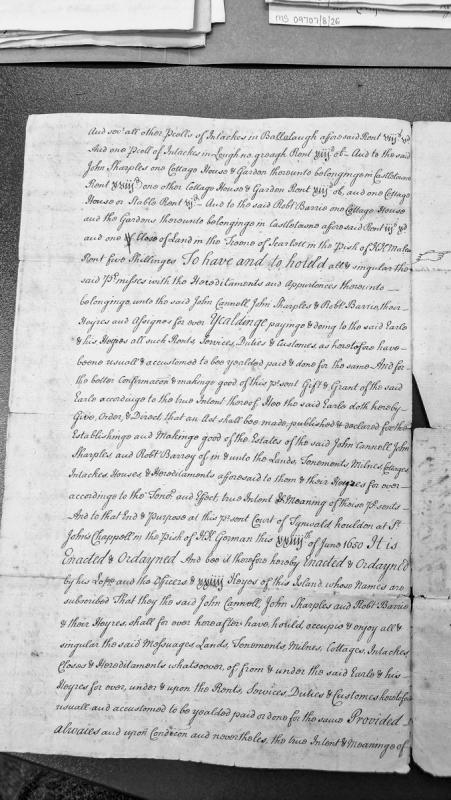
An Act of Court of Tynwald from 1650 confirming the grant of various properties including intakes, cottage houses, and gardens in Ballalaugh, Lough, Castletown, and Scarlett to three named individuals and their heirs. The document establishes their perpetual tenancy under specified rents and customary services to the Earl.
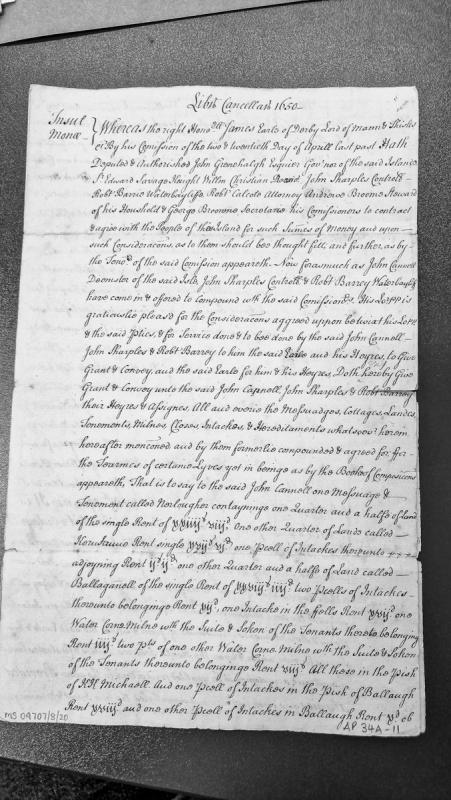
A formal grant document from James, Earl of Derby, conveying various properties, lands, mills and tenements in the Isle of Man to three named parties (John Cannell, John Sharples, and Robert Barrey) in consideration of services rendered and sums compounded. The document details specific properties in the parishes of Kirk Michael and Ballaugh with their associated rents.
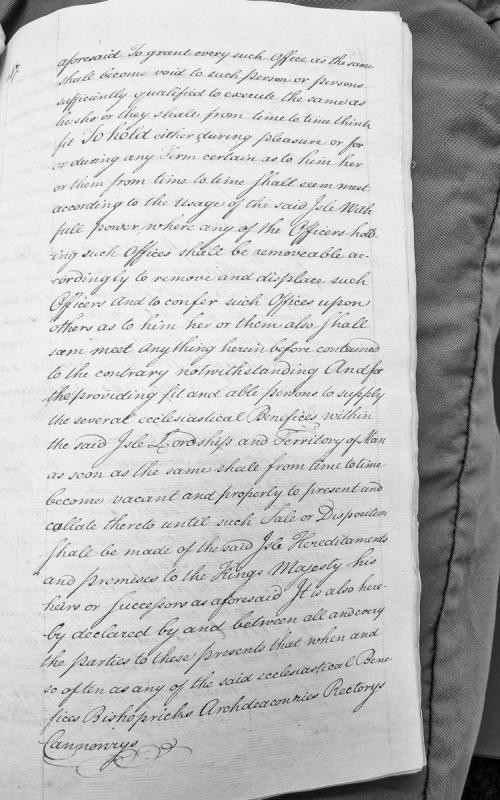
A fragment of a legal document concerning the granting of offices and ecclesiastical benefices (bishoprics, archdeaconries, rectories, canonries) on the Isle of Man. The text addresses the appointment of qualified persons to vacant positions and the powers of presentation and collation until formal disposition of the island's properties.
A Letters Patent from James I granting the rectories of St. Michael and St. Maughold in the Isle of Man to Francis Philips and Richard Moore in perpetual fee farm tenure, with an annual rent charge. The document establishes these lands as former monastic property (Furnes Abbey) transferred to the Duchy of Lancaster, providing evidence of early Stuart administrative control over Manx ecclesiastical property.
A royal grant by Letters Patent under James I, conferring the rectories of St. Michael and St. Maughold in the Isle of Man to Francis Philips and Richard Moore in fee farm, with specified lands and glebes from the former Monastery of Furnes. The document establishes an annual rent of £6 13s. 4d. payable at Lady Day and Michaelmas. This is a transcription from Monumenta de Insula Manniae, a published collection of Manx historical documents.
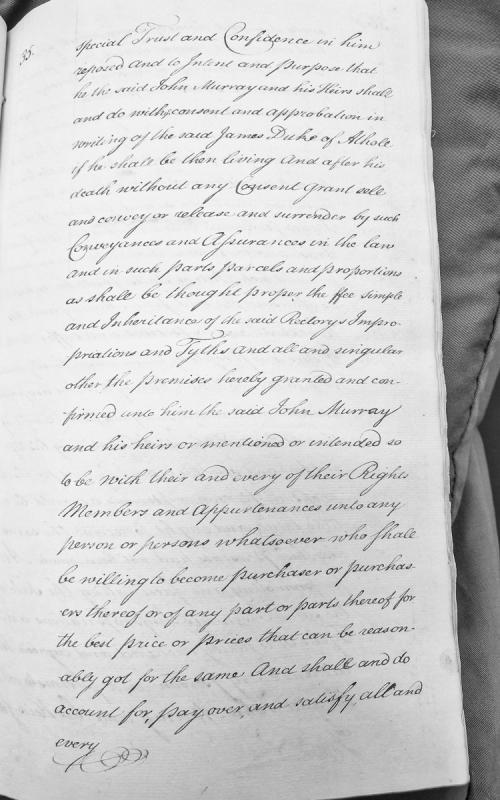
A legal document conferring special trust and confidence in John Murray regarding rectories, impropriationes, and tythes. It grants him and his heirs the fee simple and inheritance of these premises, with authority to sell, convey, or release them with the written consent of James Duke of Athole during his lifetime, and without such consent after his death.
A transcription of a medieval royal grant from the Rotuli Originales in Curia Scaccarii (5 Ed. II) conferring the Isle of Man to Henry de Bello Monte for his lifetime, with full dominion and royal command. The document specifies that the service owed is that traditionally rendered by the lords of Man to the Kings of Scotland.
A royal grant from King Edward II conferring the Isle of Man upon Henry de Bello Monte for his lifetime, with full dominion and royal command. The grant includes knight's fees and appurtenances, conditional on the feudal service traditionally owed to the Kings of Scotland. This is a medieval precedent document establishing lordship and tenure patterns relevant to understanding the constitutional status of Man before the 1765 Revestment.
A transcription of Letters Patent from James I granting the Isle of Man, its castle, and lordship to Henry Earl of Northampton and Robert Earl of Salisbury. The grant was made at the petition of William Earl of Derby and others who were heirs of Ferdinando Earl of Derby. This document illustrates the pre-1765 feudal tenure structure and succession of Manx sovereignty, providing essential context for understanding the property rights that preceded the Revestment.
A royal grant by James I transferring sovereignty of the Isle of Man from Robert Earl of Salisbury and Thomas Earl of Suffolk to William Earl of Derby, Elizabeth his Countess, and James Stanley Lord Stanley. The document enumerates all rights, privileges, ecclesiastical patronage, feudal incidents, and revenues associated with the island. This is a foundational document predating the 1765 Revestment but essential for understanding the hereditary lordship structure that the Revestment would later alter.
Letters patent from James I granting the Isle of Man, Castle, Peel, and all associated rights, revenues, and ecclesiastical patronage to William Earl of Derby, Elizabeth his Countess, and James Stanley Lord Stanley. The grant revokes an earlier 21-year lease to the Earl of Salisbury and Earl of Suffolk (1609). This foundational document establishes the Stanley family's lordship of Man and is central to understanding pre-Revestment governance and property relations.
Letters Patent dated 7 July 1609 (7 Jas. I) granting the Isle of Man, castle, peel, lordship, and all appurtenances to William Earl of Derby, Elizabeth his Countess, and James Stanley Lord Stanley, in fee. The grant follows an earlier demise to Robert Earl of Salisbury and Thomas Earl of Suffolk. This document establishes the Stanley family's lordship of Man and is foundational to understanding pre-Revestment ownership and the feudal/property framework that existed before 1765.
A legal obligation document dated 16 March 1587 concerning the lease of tithes, glebe lands, and church properties in Kirkchriste and Kirkmarron (Isle of Man) granted by Henry, Earl of Derby, Lord of Mann and the Isles, to Robert Salusburye of Denbigh. The document outlines conditions for tenure during the natural lives of specified individuals and includes provisions for reassignment to Roger Bradshawe. Relevant to understanding pre-1765 Manx ecclesiastical and feudal landholding structures under the Derby family's sovereignty.
A patent roll entry recording Queen Elizabeth I's grant by indenture to Thomas Preston of the rectories of St. Michael and St. Maughold in the Isle of Man, with attached glebe lands and revenues. The document indicates these rectories had previously belonged to Furness Monastery (Lancashire) and had been annexed to the Duchy of Lancaster. The grant was for a 31-year term at an annual rent of £6 13s. 4d. This source provides context for Manx ecclesiastical property ownership and revenue in the pre-Revestment period.
The findspot of an early prehistoric flint scatter consisting of 8 waste flakes and a core found as a group, with over 20 flint flakes also found nearby. Many of the pieces were weathered and wind-polished.
Great Britain is the island comprising England, Scotland, and Wales, and the political entity whose government drove the Revestment of 1765. The relationship between Great Britain and the Isle of Man is defined by the Island's status as a Crown Dependency, neither part of the United Kingdom nor a colony, but possessing its own parliament, laws, and traditions.
The purchase was made in the currency of the new state. The contract of 7 March 1765 provided for seventy thousand pounds of lawful money of Great Britain to be paid into the Bank of England, free and clear of all taxes, impositions, fees and other deductions, whereupon the Island should vest unalienably in the Crown.
The constitutional question has never been finally settled. Sir James Gell as Attorney-General had to answer an opinion of the English Law Officers that the Insular Legislature could not legislate on a matter touching Crown rights without an Act of the Imperial Parliament, and he answered it from the precedents of insular legislation. A modern constitutional writer, arguing that Manx emancipation still falls short of independence, holds that the sovereign takes the Island not by descent from the Norse kings but as heir of Henry IV of England, and that the subordinate lordships of the Percys, Stanleys and Murrays are beside the point. That is one view among several and the argument continues.
St German's Cathedral, possibly on the site of a predecessor, was founded in the 13th-14th centuries but due to the incursions of the raiding Scots was protected by a curtain wall and gatehouse in the later 14th century, a feature that was to develop into the fortress and garrison of Peel Castle during the 15th to 19th centuries.