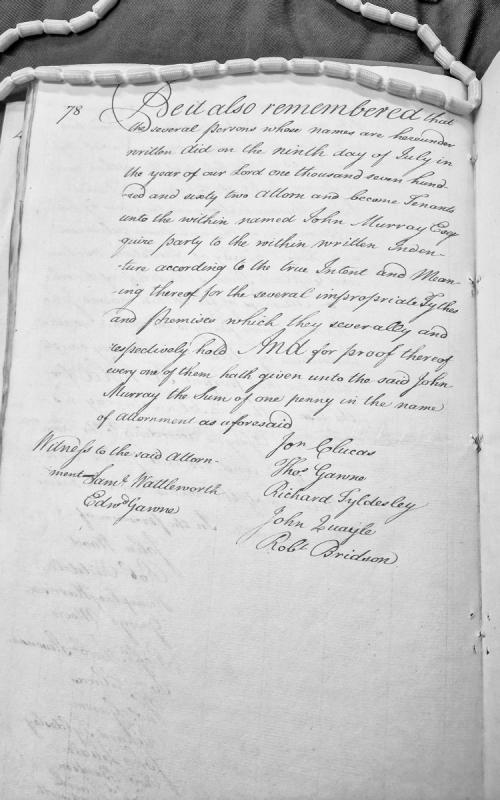
A legal document recording the attornment (transfer of tenancy) of several named persons to John Murray Esquire on 9 July 1762 for impropriate tythes and premises. Each party gave one penny as proof of attornment, witnessed by Samuel Wattleworth and Edward Gawne.
Augustus Henry FitzRoy, 3rd Duke of Grafton (1735-1811), served as Prime Minister from 1768 to 1770. His government oversaw the early aftermath of the 1765 Revestment Act, during which the Crown purchased the lordship of Mann from the Duke of Atholl and sought to suppress the Island's smuggling trade.
Official correspondence from the Home Office (8 July 1788) clarifying that the Duke of Atholl was NOT to be invested with authority or control over the Isle of Man, despite stronger wording in a Treasury letter. Includes Lord Sydney's formal letter authorizing the Duke's summer visit and George Steuart's survey of Crown properties. Demonstrates tensions between the Duke's claims and actual post-Revestment government policy.
The findspot of a slab incised with an inscription in Roman capitals which was found in 1782 when digging in the foundations of the old church. It is now kept against the west wall of the present church (Slab No.29) and is known as the Avitus Stone. It bears an inscription AVIT MONOMENT. It measures 113cm long x 23cm wide with a thickness of 11.5cm. This inscription is usually ascribed to the 5th or 6th century, but there is no firm evidence for such a date.
This slab was found in the foundations of the church in about 1782, subsequently lost, and then rediscovered in the late 1800s. The stone is a roughly dressed, rectangular slab. One face is carefully dressed and into this is cut an inscription in Roman capitals, with the final 'I' placed horizontally: 'AVIT? MONOMENT?', translated as, 'of the tomb of Avitus.' Monuments bearing lettering of a similar style are found in Cornwall, south west Wales and southern Scotland, suggesting contact between these areas during the early Medieval period, perhaps the later 6th century. The name, Avitus, may even indicate contact between the Island and continental Europe, as it was a popular name in northern France.
Two storey, double-fronted, semi-detached house adjacent to 'Cooil Bane'. Originally constructed before 1868 (present on Ordnance Survey 1:2500 1st edition map of that date).
The property was acquired by the Manx Museum and National Trust in 1985.
The reported site of a post-medieval corn mill with a horizontal wheel. The 1870 1:2500 scale Ordnance Survey map does not show any structures at this location.
The reported site of a post-medieval corn mill with a horizontal wheel. The 1870 1:2500 scale Ordnance Survey map does not show any structures at this location.
According to Canon Quine there were many tumuli or burial mounds on the south side of Glen Roy, below the mine powder magazine, which are now long since destroyed.
A scholarly subject catalogue entry that synthesizes primary and secondary sources on Isle of Man smuggling (c.1690–mid-19th century). It traces the rise of the running trade, key figures (McGwire, Poole, George Moore, James Murray), legislative responses, and the role of smuggling as a driver of the 1765 Revestment Act. Includes citations to contemporary reports, historical studies, and manuscript sources.
A subject catalogue entry from the Manx Notebook providing a comprehensive historiographical overview of Isle of Man smuggling (c.1690–mid-19th century). It synthesizes secondary and primary sources, discusses the causes and evolution of smuggling under Manx sovereignty, key merchants (George Moore), governors (James Murray), and the role of customs farming. Directly relevant to understanding the economic and legal context driving the 1765 Revestment.
Post medieval brickworks.
The first recorded brickworks on the Isle of Man was operated in Castletown from 1692, although its precise location is unknown. An inventory from Castle Rushen, prepared in 1694, implies that its location was somewhere near 'the Bagnio'.
This property is now known as Bagnio House in Arbory Street, in the rear garden of which large numbers of waste bricks have been found.
A field on Red Gap farm, a short distance outside Castletown, was still in the 1820s known as 'the Brickfield', implying that here the clay was dug for brickmaking.
This two-storey structure of irregular plan form has cement, spar-dash covered, masonry walls and slate pitched roofing. Although the building is one of a continuous terrace, vehicular access to rear is by means of a passage cut through the ground floor. Spacious yard to the rear. The normal front entrance via a small gated forespace consists of a single door. The whole facade is utterly without decoration and no particular attempt has been made to relate the various rectangular openings that occur. No inspection has been made of the interior. The house gives an appearance of neglect, with evidence of rising damp and crumbling spar dash. It is understood that the house has certain historical associations but there has been no documentation of details at this time. On a purely visual basis the building is a questionable asset to any street. However the scale of Arbory Street has a quality of character arising from its narrow width and consistant architecture. It is elsewhere suggested that the buildings fronting onto Arbory (including the Bagnio) have their frontage treatment preserved as to 'massing' without prejudice as to alterations of compatible character. It is felt that this 'blanket' protection is adequate for Bagnio House without individual listing.
The above description was prepared before the creation of Registered Building and Conservation Area legislation.
Balcony House on The Parade was the town house of Captain John Quilliam, who served aboard HMS Victory as a Trafalgar hero under Nelson; he also had connections to Balladoole, home of his relatives the Stevensons. The tallest house on its side of The Parade, it is notable for its ironwork balcony and fine fanlight over the front door. The house fell into serious disrepair by the mid-2000s, at one point losing roof slates to a would-be developer whom the local Commissioners were powerless to stop, before passing into sympathetic ownership around 2010 and being restored.