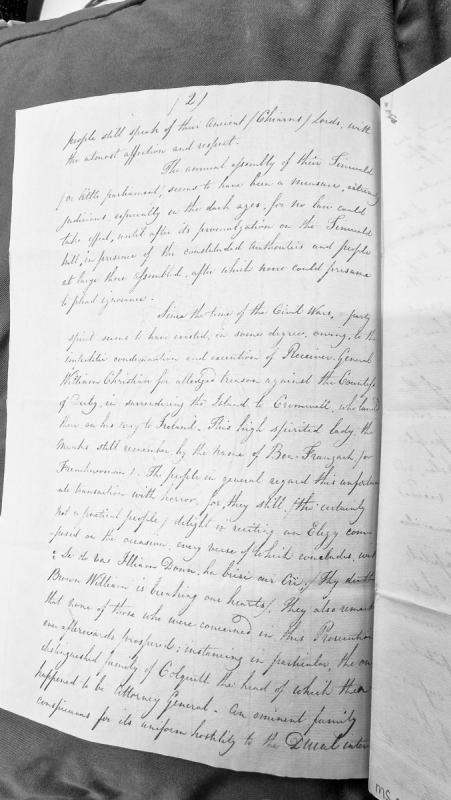
A historical narrative discussing ancient Manx customs, the Tynwald parliament, and the execution of Receiver General William Christian during the English Civil Wars. The passage reflects on party divisions in Manx society stemming from this event and includes references to commemorative Manx poetry and the decline of the Colquitt family.
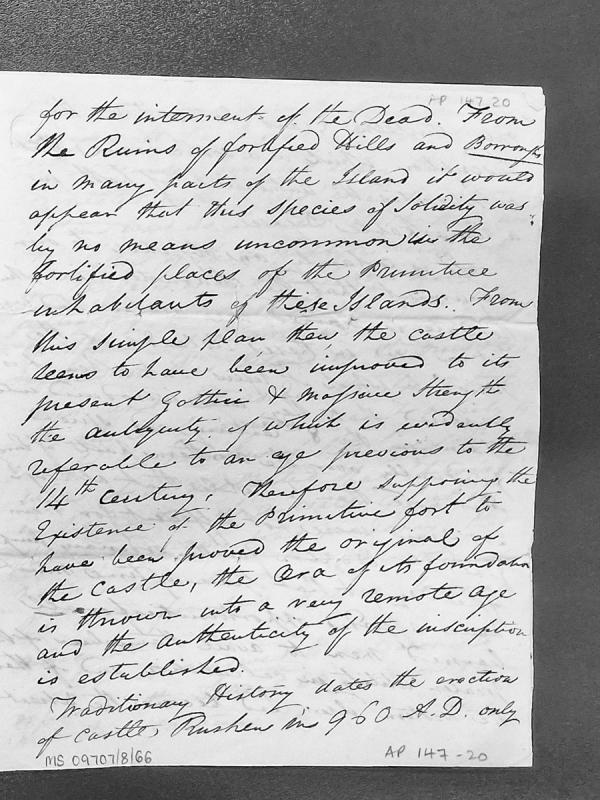
This is an excerpt from a scholarly historical analysis discussing the archaeological and architectural evidence for Castle Rushen's construction and antiquity. It traces the castle's development from primitive fortified structures through to its present Gothic and Massive form, and references traditional dating of the castle's erection to 960 A.D.
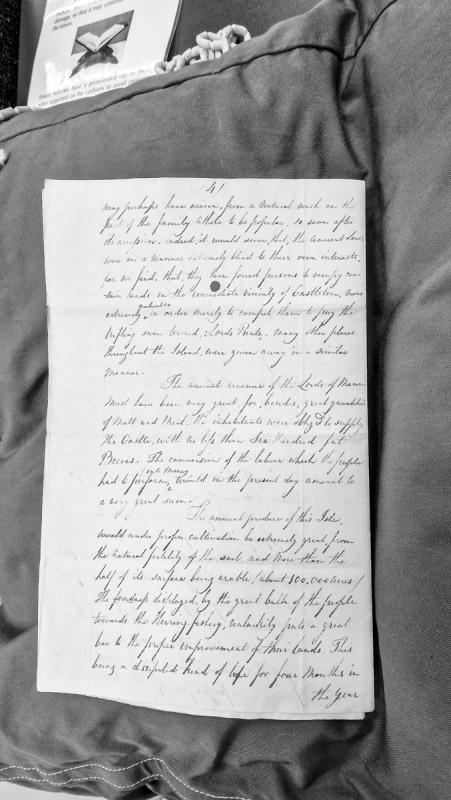
A historical account discussing the ancient revenue systems of the Lords of Mann, including feudal obligations such as the supply of malt, meal, and cattle. The text examines the lords' management of lands near Castletown and comments on the island's agricultural potential and the population's preference for herring fishing over land cultivation.
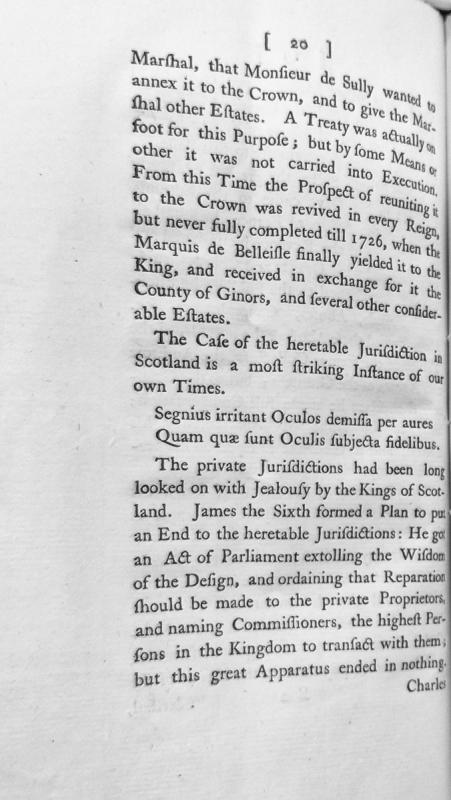
This is an excerpt from a printed pamphlet discussing the history of hereditary jurisdictions, particularly the Maréchalcy in France and private jurisdictions in Scotland. It traces attempts by French kings to annex the Maréchalcy to the Crown, culminating in 1726 when the Marquis de Belleisle yielded it to the King, and discusses similar efforts by Scottish kings including James VI to eliminate hereditary jurisdictions.
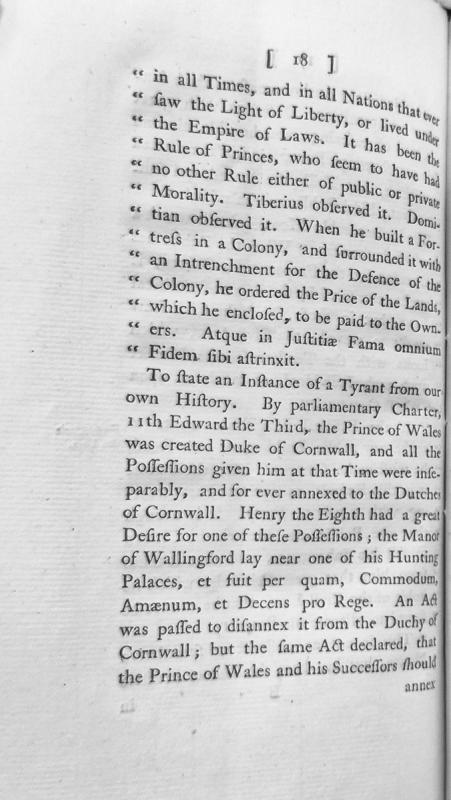
A legal or political treatise examining historical precedents regarding the rights of princes and rules of justice across different eras. The document discusses Roman emperors (Tiberius, Domitian) and English monarchs (Edward III, Henry VIII), arguing principles of property rights and compensation, with particular focus on the Duchy of Cornwall.
A manuscript account by James Stanley, Earl of Derby and Lord of Man, written during his residence on the Isle in 1643, covering the history and antiquities of Man, his administrative proceedings, advice to his son Charles Lord Strange, and observations on Manx customs, governance, and tenure. Originally in Derby's own hand, edited and published in Manx Society volume 3, with introduction from Sir William Dugdale.
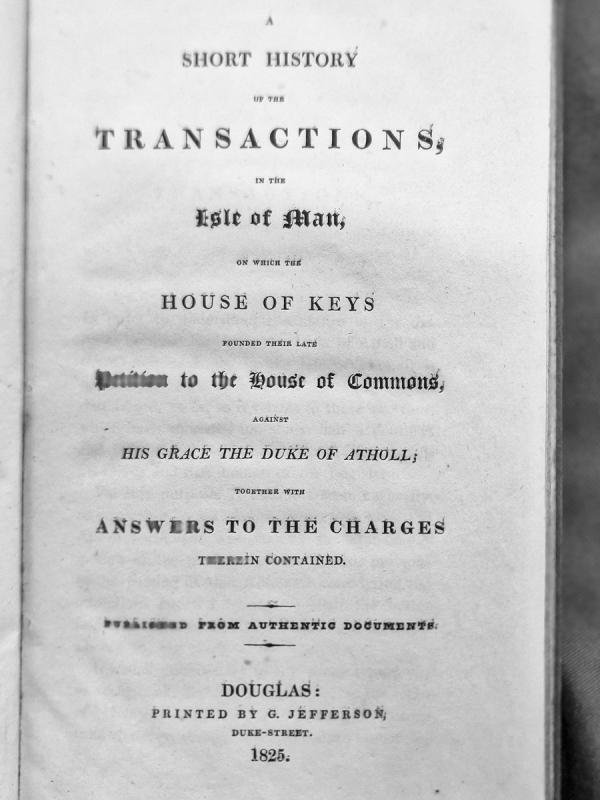
A printed pamphlet published in Douglas in 1825 documenting the transactions and disputes that led to the House of Keys petitioning the House of Commons against the Duke of Atholl, including responses to the charges contained therein. Published from authenticated documents.
An early modern genealogical and historical account tracing the Stanley family from the Norman Conquest through the 18th century, with particular attention to their lands in Staffordshire, Cheshire, and their governance of the Isle of Man. Includes a catalogue of Isle of Man governors from 1417 to 1741, making it directly relevant to understanding the Stanley lordship and administrative structure preceding the 1765 Revestment.
The roll of honour was originally erected in the 'Long Room' at HM Customs and Revenue, London. It is presumed that all Customs and Excise stations throughout the British Isles received a memorial.
Information provided by the Isle of Man Committee for the Preservation of War Memorials.
British government department which became central to Manx financial and administrative affairs during the negotiations for Revestment and after the Crown purchase of 1765.
Treasury involvement increased as British ministers sought to suppress the running trade. The department received memorials from merchants and customs officials describing the effect of Manx imports on British and Irish revenue. It also became one of the principal channels through which proposals for purchasing the Island from the Atholls were considered.
The negotiations involved questions well beyond the price of the lordship. Treasury papers dealt with the value of customs revenues, the rights retained by the Atholl family, compensation, the regulation of Manx trade and the administrative machinery required after purchase.
Following Revestment, Manx customs and revenue became matters of direct Treasury concern. Officials in the Island submitted reports and proposals on duties, permitted imports, port administration and revenue collection. William Lutwidge’s proposals for regulating Manx trade were among the papers sent into this system.
Treasury oversight did not mean that the Island ceased to possess its own legislature or courts. Its role was principally financial and administrative, especially where Manx trade affected British customs revenue or where expenditure required approval from London.
The department also appears repeatedly in later disputes over salaries, public expenditure and the costs of Crown administration in Mann.
HMS King Orry was a vessel named after Godred Crovan (King Orry), the Norse king who conquered the Isle of Man in 1079 and established the dynasty that ruled the Island for nearly two centuries. The name reflects the enduring significance of Norse heritage in Manx culture and identity.
The wreck of the Royal Naval brig Racehorse (18 guns) which sank on 14th Dec 1822 off Langness. HMS Racehorse was a Cruizer-class brig-sloop built in 1806 at Hamilton and Breed's yard in Hastings. She was sailing to the Island to pick up survivors from a previous (October) shipwreck. High wind and heavy seas pushed the Racehorse against the rocks near the Skerranes, Langness Point.
Due to efforts of crew and locals, most crew were saved, but 6 crew lost their lives along with 3 locals who had gone to the ship's aid. Neither Captain Suckling or his officers were blamed, but the master, William Hodder and the pilot, William Edwards, were reprimanded for navigational error.
The wreck lies in 10m depth of water and is legally protected and owned by the IOM Sub Aqua Club, and may not be dived without permission. Exploration by the club has led to the recovery of many finds from the sea bed.
No names listed; Second World War. Marble plaque with black incription. Information provided by the Isle of Man Government Preservation of War Memorials Committee. Image courtesy of Chris Blyth, Isle of Man Photographic Society. Find on Map or Report Condition
No names listed; Second World War.
Brass plate on wooden base measuring approximately 9 x 6 inches. Engraved with St George emblem.
The memorial was unveiled on 23 April 1991. The cost of the memorial was between £100 - £120. The memorial was originally located in the building where members of H.M.S. St George trained. The training camp was demolished and the plaque was relocated. In 2000, the area where this memorial was sited was reorganised, resulting in the plaque and its column having to be re-sited. A new location was found, on the door of an unused small castellate building where it now rests. Shoprite own the building and with their consent, an office housing the I.L.S Group decided to re-paint the building where the plaque now stands.
The memorial was designed by G.H. Corlett, Castle Street, Douglas, Isle of Man. It was built by the employees of Shoprite Plc.
Wooden-framed brass plaque (plaque 1). Wooden plaque (plaque 2).
Unveiled by Lord Gort on 25 April 1991. Sponsored by Isle of Man Dept of Tourism. Built by G.H. Corlett Ltd, Castle St, Douglas.
Second World War.
Wooden carved table, covered with altar cloth of several materials. Above the altar table their is an altar piece of religious design. There is an altar rail and kneeling stools.
HMS Valkyrie was a shore based Naval establishment where Naval recruits were trained prior to their posting to sea-going vessels.
No names listed; Second World War. Brass plate on wooden base measuring approximately 6 x 4 inches. Engraved with Valkyrie emblem. Mounted on the left-hand side wall at the entrance to Manx Radio.
The memorial was unveiled on 23 April 1991 by Lt Com Reville Flanaghan. It was sponsored by the Department of Tourism. The cost of the memorial was £120. The memorial was designed by G.H. Corlett, Castle Street, Douglas, Isle of Man.
No names listed; Second World War. Wooden plaque with carved gold inscription. An emblem of a crown in gold, white, red and blue is affixed to the plaque, above the inscription. The plaque was erected in memory of those men who served on HMS Valkyrie, a shore based establishment on Loch Promenade during 1939 - 1945 and attended Loch Parade Church during their time serving on HMS Valkyrie. The memorial was originally situated in the old Loch Parade Church. When the church was demolished and replaced by the new Loch Parade Church, the plaque was relocated in 1972. Note regarding other memorials in Loch Parade Church: Prior to 1972 there were two Methodist Churches in lower Douglas; Loch Parade and Victoria Street. Due to dwindling congregations it was decided to demolish both, sell the Victoria site and build a purpose built one on the Loch Parade site. On the demolition of the churches, several memorials were saved and finding a place for them proved difficult. Victoria Street minister and congregation would not agree to have their plaque displayed in Loch Parade. After much deliberation it was sadly decided that neither memorial should go on display. After much discussion it was decided that both memorials would be incorporated in the foundations of the new Loch Parade, and so they were, in their undamaged form and with a certain amount of care. [Information courtesy of Hector Duff, Isle of Man Committee for the Preservation of War Memorials, 2012]. Information provided by the Isle of Man Government Preservation of War Memorials Committee. Image courtesy of Chris Blyth, Isle of Man Photographic Society.
A detailed calendar listing of 1823 Home Office correspondence and administrative papers concerning Isle of Man governance, including disputes over judicial authority, the dismissal of Deemster Gawne, constitutional questions about the House of Keys' role in courts, charitable funds, and legislative measures (tithe commutation, poor rates). Key figures include Duke of Atholl (Governor), James Clarke (Attorney General), and Henry Hobhouse (permanent Under Secretary).
Extract from Holinshead's Chronicle describing events of 1388, including a Scottish military expedition to Ireland led by Robert, earl of Fife, and William Douglas. The passage notably mentions the spoilation of the Isle of Man during their return voyage. This source is relevant to understanding the Isle of Man's position as a target for raid and plunder in the medieval period, and its strategic vulnerability prior to the Revestment.
Extract from Holinshead's Chronicle (16th-century historical compilation) describing 1388 military campaign by Scottish nobles Robert, Earl of Fife and William Douglas into Ireland, with incidental mention of the Isle of Man being spoiled during their return voyage. Included in Manx Society Vol. 4 (Monumenta de Insula Manniae Vol. 1) as a contextual primary source on medieval Manx vulnerability to foreign military action.
Holland, the Netherlands, was a major trading partner in the European commerce that connected the Isle of Man with Continental markets. Dutch goods featured among the foreign merchandise imported into the Island during the smuggling era, and Manx commercial and cultural contacts with the Low Countries date back to the medieval period.
Tea was the trade that mattered. The East India goods brought into the Island in the years before the Revestment consisted predominantly of tea, and it could be had more cheaply from the Dutch and Danish East India Companies than from the English one. Governor Wood reported to the Duke of Atholl in the early 1760s that the Manx merchants, and John Taubman above all, were major importers of it, and that it arrived in large vessels from Holland. Taubman ran it on from the Island to Great Britain and Ireland, and the fourth Duke of Atholl afterwards blamed him for the British government's decision to force the Revestment on the family.
The Dutch fisheries were a British grievance in the same waters. In 1608 the Dutch were compelled to pay an acknowledgment for the liberty of fishing on the British coasts, a source of revenue that later reigns tried to enforce more fully.
The great November hiring fair, held at Martinmas (12 November). The principal day in the Manx agricultural calendar when farm servants were hired for the coming year and families moved between farms. Hollantide marked the beginning of the Manx winter half-year. It was a day of reckoning, settlement, and transition. The fair combined practical economic business with social gathering, and the movement of servants between farms maintained the connections across parishes that held rural communities together.
Holly Bank House and Myrtle Bank House are a pair of semi-detached two storey houses constructed of brick with tiled roofs. The natural unglazed brownish bricks are exposed on the ground floor at the front and sides the second floor being roughcast and 1/2 timbered on the front elevation where the roof pitch is turned so that the bedroom windows are organised into a series of four gables. Small windows also appear in the attic of the central pair of these 4 gables and the timber applied detailing emphasises their presence as a feature of the facade decoration. The rear elevations by comparison are simple statements of rectangular windows in roughcast wall surfaces. No interior inspections have been performed. Both properties appear to be in good repair and still maintaining their original details including windows. The buildings have architectural interest resulting from their author and because they were speculatively built by him and may therefore be assumed to reflect a combination of his own and public taste of the time.
Holly Bank in Little Switzerland was designed in 1895-96 by the Arts and Crafts architect M. H. Baillie Scott, built as a pair alongside the neighbouring Myrtle Bank in the same short development phase. It forms part of a small cluster of Baillie Scott houses that Little Switzerland acquired in the 1890s, following his slightly earlier commission for nearby Ivydene, from the period when Baillie Scott ran his practice from offices on Athol Street in Douglas.