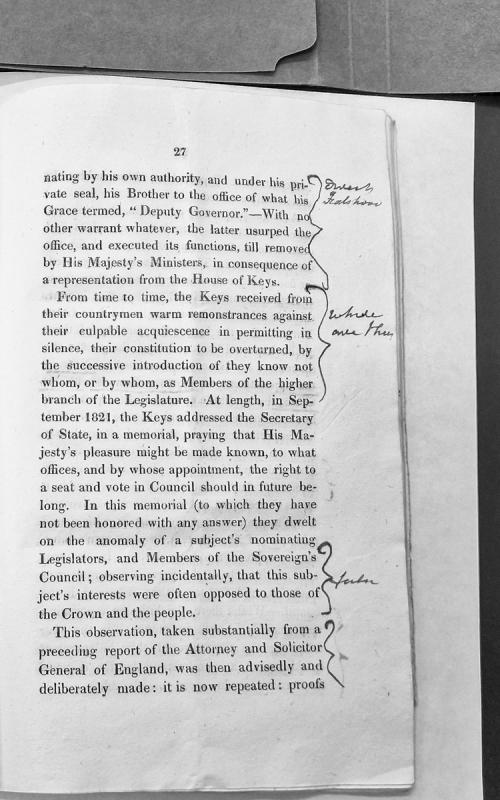
A political document discussing the House of Keys' concerns about the irregular appointment of legislators and council members by private authority. It references a September 1821 memorial to the Secretary of State regarding the anomaly of a subject nominating members to the sovereign's council, with observations that such a subject's interests may conflict with those of the Crown and people.
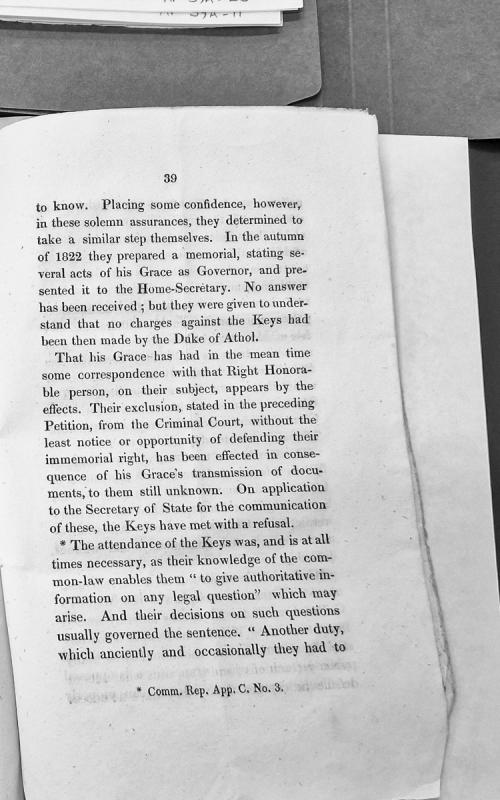
Extract from a petition by the House of Keys describing their exclusion from the Criminal Court and their attempts to address grievances with the Governor (Duke of Athol) through formal channels. The document references a memorial presented to the Home-Secretary in autumn 1822 and discusses the Keys' traditional legal role and rights.
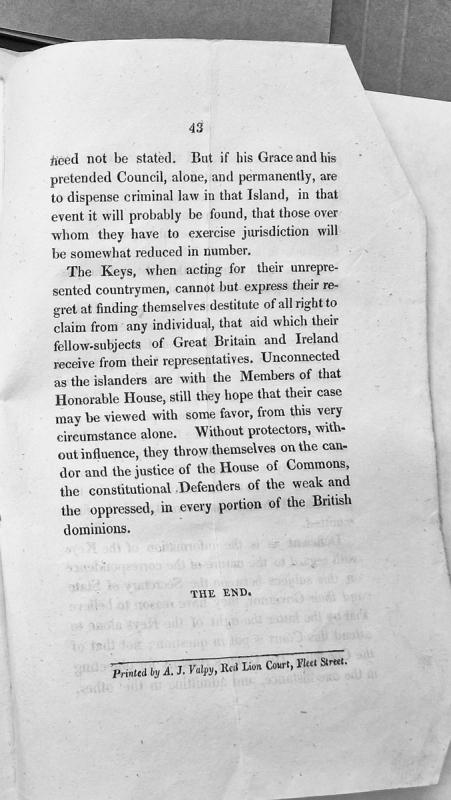
This is the concluding page of a printed pamphlet representing a petition or formal appeal by the House of Keys (the Manx parliament) to the House of Commons. The passage addresses concerns about the concentration of criminal law dispensation in the hands of the Duke of Atholl and his council, arguing that Manx islanders deserve representation and protection similar to other British subjects.
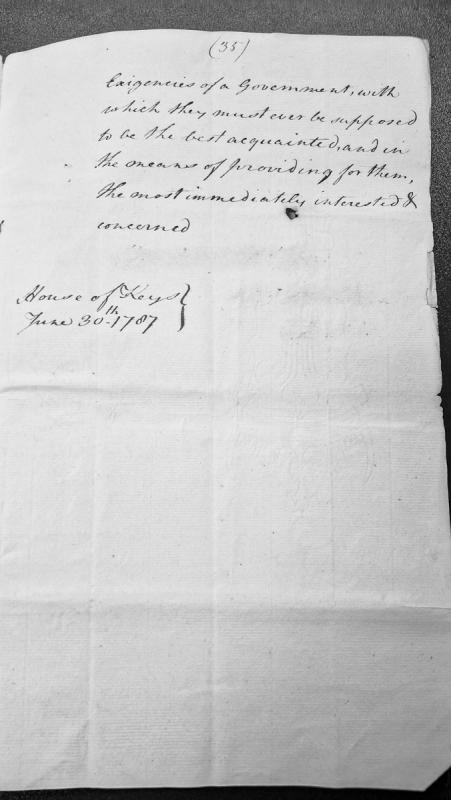
A fragment of a House of Keys document dated June 30th 1787 concerning the exigencies of government and the means of providing for them. The text appears to be part of a larger judgment or resolution discussing governmental matters and the responsibilities of the House of Keys.
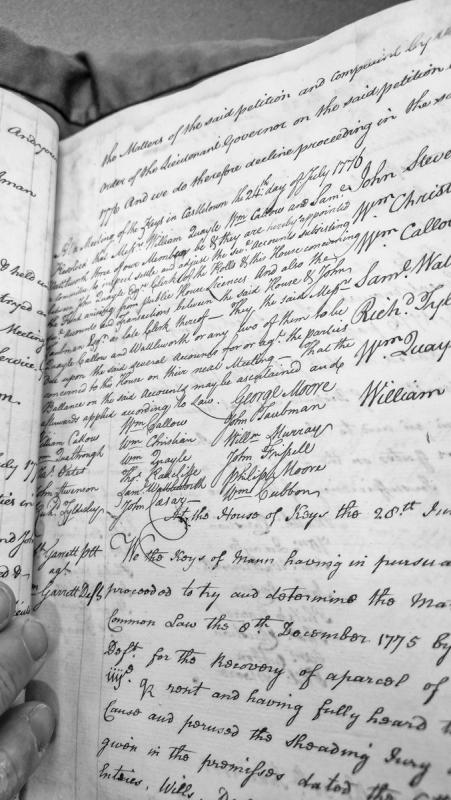
Two House of Keys documents: (1) A resolution from 24 July 1776 appointing a committee to inspect and settle accounts between the House and John Quayle Esq. (Clerk of the Rolls) concerning fines from Public House Licences, and accounts with John Taubman Esq. as late Clerk; (2) A judgment record dated 28 June regarding a Common Law case tried on 8 December 1775 between Sgt Garrett (Plaintiff) and Garrett (Defendant) for recovery of property with associated rent claims.
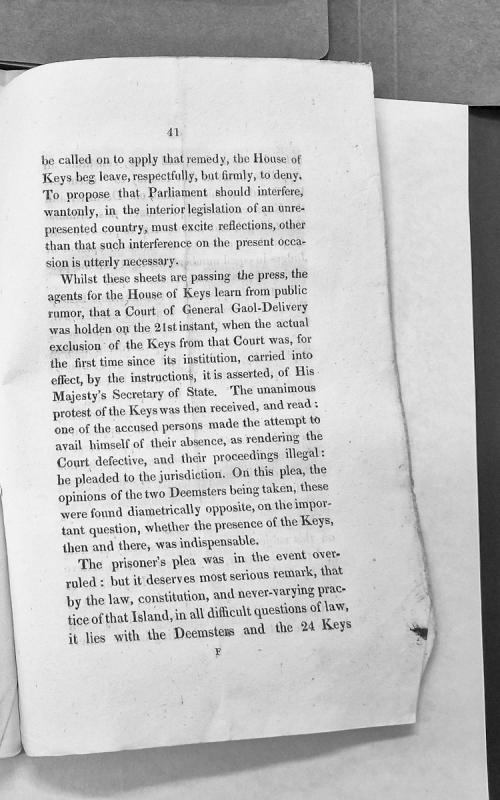
A printed pamphlet page presenting the House of Keys' formal objection to their exclusion from a Court of General Gaol-Delivery held on the 21st instant, allegedly by instruction of His Majesty's Secretary of State. The document discusses the constitutional and legal implications of this unprecedented exclusion and notes a disputed jurisdictional plea by an accused person regarding the absence of the Keys.
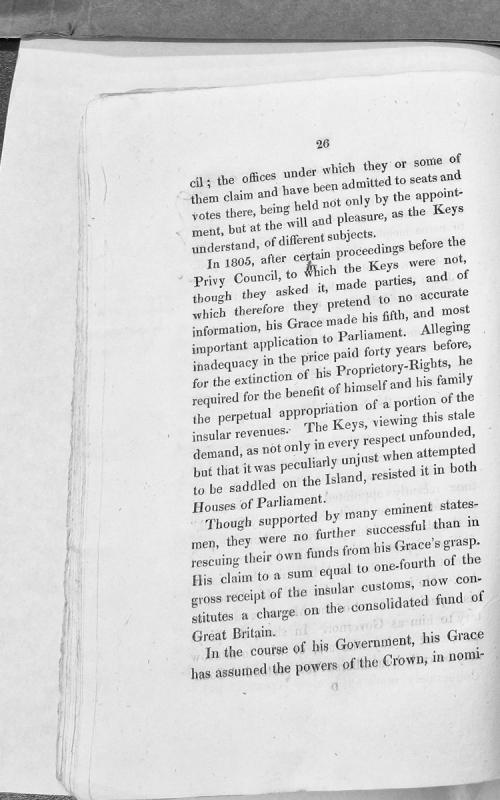
Extract from a legal or political document discussing the House of Keys' opposition to successive applications by a Duke (likely the Duke of Atholl) for financial compensation and appropriation of insular revenues. References proceedings from 1805 before the Privy Council and Parliament regarding inadequacy of compensation paid for extinction of proprietory rights.
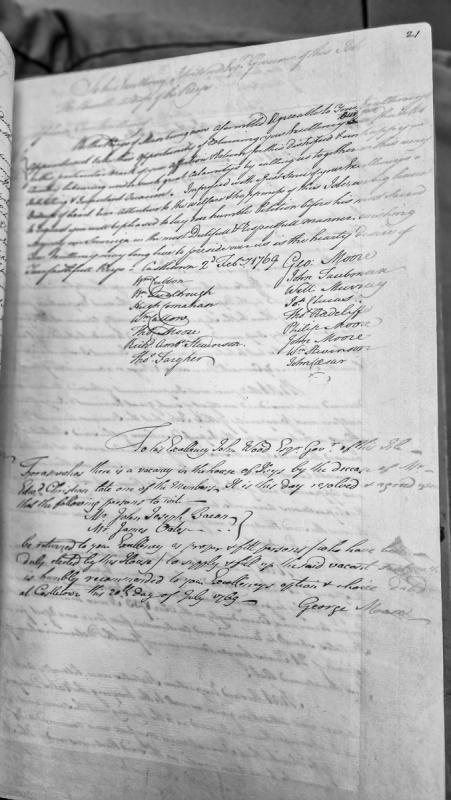
A formal resolution from the House of Keys to Governor John Wood Esq, dated 20 July 1769, recommending two candidates, John Joseph Bacon and James Oates, to fill a vacancy created by the death of Ewan Christian. The document requests the Governor's approval of the elected candidates.
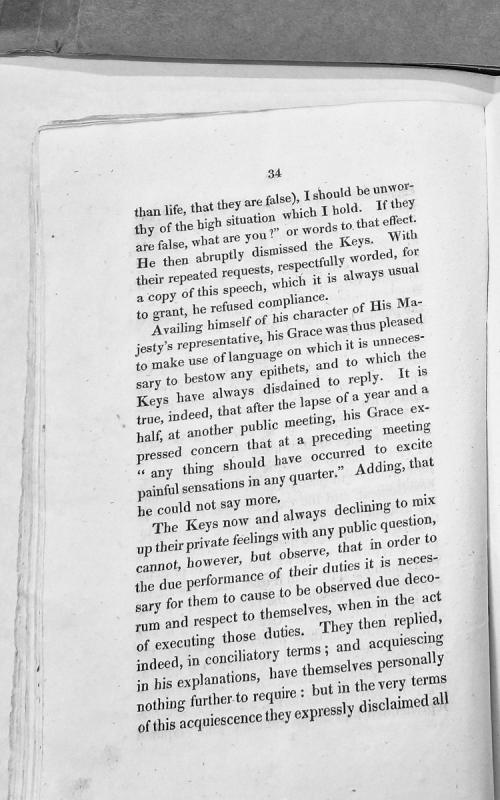
This document records a dispute between the House of Keys and the Governor (referred to as 'his Grace'), regarding the Governor's intemperate language during a meeting and his subsequent refusal to provide a copy of his speech. The Keys describe how the Governor dismissed them abruptly after making what they characterize as insulting remarks, and note that a year and a half later he only expressed vague concern about the incident. The Keys assert their need to maintain decorum and respect in their official duties.
The House of Manannan in Peel occupies the town's former railway station, built in 1873 and closed with the rest of the Peel line in 1968. The building had housed the Viking longship replica Odin's Raven, which arrived in Peel on 4 July 1979, before undergoing a major £5.5 million redevelopment in 1997 to create the present interactive museum, named for the Manx sea-god Manannan mac Lir. It won the National Heritage 'Museum of the Year' award in 1998, sharing the honour with the Jersey Maritime Museum. Exhibits trace the island's story from the Celtic period to the modern day, including reconstructed Celtic roundhouses and a recreated 19th-century Manx streetscape, with Odin's Raven remaining a centrepiece attraction. More recent reports have noted a decline in maintenance and investment at the site.
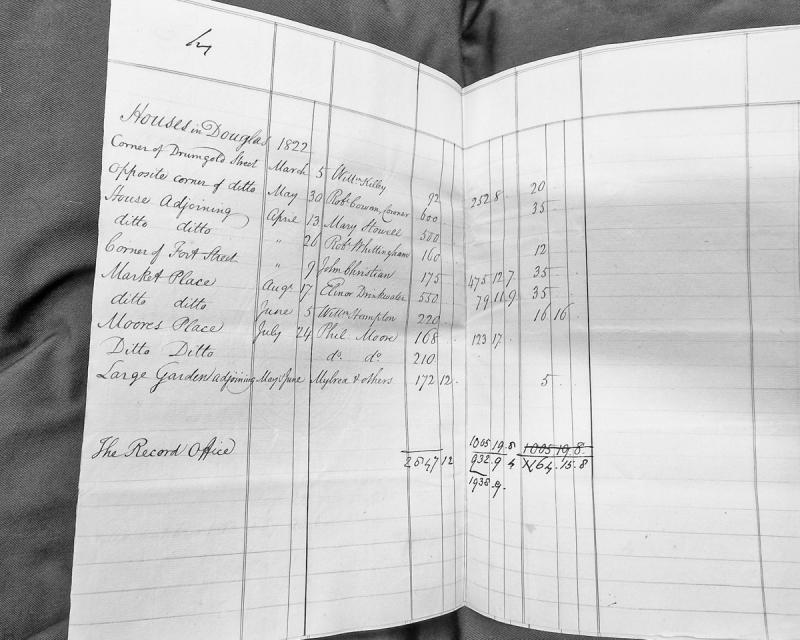
A revenue abstract listing properties in Douglas, Isle of Man during 1822, with owner names, dates of entry, and associated financial values. The document appears to be an official record maintained by The Record Office, detailing house valuations and tax assessments for various locations including street corners and market places.
The routes by which Manx people reached the American colonies in the seventeenth and eighteenth centuries are poorly documented. No passenger manifests survive for the period, and the Manx pass system made unofficial departure risky. Several routes were possible. A Manx person could obtain the Governor's licence and take passage from Douglas or Ramsey to Liverpool or Whitehaven, then board an Atlantic vessel. They could cross to Ireland first and embark from Dublin, Belfast, or Londonderry, where the emigrant trade was well established by the eighteenth century. They could join the crew of a trading vessel and leave it in an American port. Or they could enter an indenture with a colonial planter's agent operating in the British Isles, exchanging years of labour for passage and the promise of land at the end of the term. The running trade itself provided another possibility: Manx vessels trading goods between Mann, Ireland, and the continental ports would have offered informal passage to anyone willing to pay or work. After the Revestment of 1765, when the Island's commercial economy collapsed, the emigration intensified and became better documented. The 1827 ships to Ohio were chartered specifically for Manx emigrants, and the press notices of the 1830s and 1840s recorded departures by parish and number. But the earlier, colonial-era movement left few traces beyond the headright patents and land grants in which Manx surnames appear.
Moore records the tale. All the fish were summoned to choose a king. The herring was elected, and all the fish came to pay homage — all except the fluke, who arrived late. When the fluke heard that the herring had been made king of the sea, he twisted his mouth to one side and said "The Herring, king of the sea!" — and his mouth has been on one side ever since.
The story connects directly to one of the most distinctive oaths in Manx law. The Deemsters, in their oath of office, swore to execute the laws of the Isle "as indifferently as the herring's backbone doth lie in the midst of the fish." The herring's backbone runs perfectly straight through the centre of the fish — and so the Deemster must hold the balance of justice, favouring neither side. The same fish that ruled the sea by election governed the courtroom by metaphor.
The oath is ancient. The six days of creation are invoked, and the herring backbone is the standard of impartiality. The tale and the oath belong together: the herring earned its kingship by consent, and the Deemster earned his authority by the same principle. Both systems — the fish and the court — worked because they held the centre.
Modern chapel. The Wesleyan Methodist chapel at the Howe was constructed in 1850. Subsequent extensions have provided an entrance porch and a small annexe. No further published detail on this chapel's later history has been located; it should not be confused with the separate Wesleyan Methodist chapels recorded in nearby Port St Mary itself.
Neolithic stone axehead.
A late Neolithic polished and roughened-butt axe of the local Ronaldsway type was found in the course of gardening at 'Heathercliffe', 7, King Edward Road, Onchan, in 1917. The grid reference is centred on the property curtilage.
The artefact was donated by the finder to Manx National Heritage and bears the accession no. 1954-0580.
The findspot of a Bronze Age cup-marked stone which was found during building work and retained in the ownership of the finder. The stone had 3 cup-marks on one face and one cup-mark on the opposite face. Some flints were found at the same site.
Member of the House of Keys, and one of the two commissioners the Keys sent to Britain over the sale of the Island.
In March 1765 the Keys resolved that Thomas Moore and Hugh Cosnahan, gentlemen and members of their House, should be their commissioners in the name and on behalf of the people of the Isle, to take such steps as they were advised to support and maintain the constitution, rights and privileges of the Island by application to the ministry or parliament of Great Britain, and to obtain such terms as were consistent with the welfare of the Isle. The two of them presented a petition to the House of Commons on behalf of themselves and the rest of the Keys as representatives of the people.
His evidence to the 1792 inquiry is the reason the delegation matters to the record. Examined at Douglas on 27 September 1791, and cross-examined by the Duke of Atholl, he said that January 1765 was the first time any rumour of the treaty for the sale reached the Island. The commissioners used the Keys' petition to prove two things: the delegation itself, and that no meeting of the Keys was called by the Governor until 19 March, nearly a month after the transaction of the sale was closed. In another examination the moment is dated more precisely still, when Hammersley asked Quayle whether he had let the inhabitants know of the treaty and Quayle said that he had, at which Cosnahan and others present declared that they had received no notice of it and must have heard had any been given.
He was still writing on Island business two decades later, in letters to George Farquhar from Douglas in May 1789 and April 1790.
Hugh Stowell (3 December 1799 - 8 October 1865) was a Church of England clergyman born in Douglas, the son of the rector of Ballaugh, who was educated at St Edmund Hall, Oxford before becoming a prominent evangelical preacher in England, ultimately serving as rector of Christ Church, Salford, from 1831. He was a prolific hymn writer, best remembered for 'From Every Stormy Wind That Blows' (1828), and was appointed an Honorary Canon of Chester Cathedral in 1845.
A midwinter tradition observed on 26 December, St Stephen's Day. Groups of men and boys would hunt a wren, carry it on a decorated pole, and process from house to house singing the Wren Song. The wren was the king of the birds, hunted at midwinter as part of the ritual turning of the year. Still practised on the Island today, making it one of the oldest continuously observed folk customs in the British Isles.
Hutchinson Square is a public space in Douglas, the capital of the Isle of Man. It has served as a civic focal point within the town. No further sourced detail was found; Wikipedia's Douglas, Isle of Man article does not mention Hutchinson Square, only the unrelated WWII Hutchinson Internment Camp.