A post-medieval lead mine in Laxey. The Great Laxey Mine was worked for lead, zinc, silver and copper from around 1782 until closure in 1929 (with residual working of spoil continuing to about 1934), and consisted primarily of three main shafts - the Welsh Shaft, Dumbell's Shaft and the Engine Shaft - linked by a series of levels reaching a depth of over 2,200 ft (670 m). By 1833 it employed more than 200 men and was, for a time, extremely profitable, with its ore including a galena specimen that holds the world record for the largest sulphide crystal by both volume and mass, now on display at the Natural History Museum, London. The mine's pumping was powered by the Laxey Wheel (the "Lady Isabella"), built during the mine's period of greatest prosperity. A fire in the Welsh Shaft in March 1904 was safely contained, but an accident in December 1904 killed four miners who fell into a flooded sump; they were buried at Lonan Churchyard.
The site of a modern turbine house. A power station which housed a water turbine is located at this location. It provided additional power to the power station upstream (PRN 2373.30).
The turbine house was served by a 380 metre race drawing water from the tail race serving the larger power station upstream. The race is now incomplete, having been breached by floods and riverine erosion 160 metres above the turbine house.
The site of a modern water mill. A suspected water mill is shown on the Ordnance Survey First Edition mapping of 1869 at this location; its purpose is not clear.
It was served by a short race running 140 metres upstream. The OS mapping also shows a tail race extending 190 metres downstream, exiting into the harbour below the bridge. It is not clear if this also served the later turbine house, or whether the latter had a shortened tail race rejoining the river close by. The tail race is now largely obscured, but its line can be picked up intermittently.
The site of a modern tail race. The Ordnance Survey First Edition mapping of 1869 shows a mill race extending 190 metres downstream from a suspected water mill (PRN 2374.30), exiting into the harbour below the bridge at the grid reference provided.
It is not clear if this race also served the later turbine house, or whether the latter had a shortened tail race rejoining the river close by. The tail race is now largely obscured, but its line can be picked up intermittently, and its exit is still visible.
The site of a modern turbine house. A power station which housed a water turbine is located at this location. It provided additional power to the power station upstream (2373.30). The turbine house was served by a 380 metre race drawing water from the tail race serving the larger power station upstream. The race is now incomplete, having been breached by floods and riverine erosion 160 metres above the turbine house.
The turbine house stands on the site of a suspected water mill which is shown on the Ordnance Survey First Edition mapping of 1867. The mill's purpose is not clear. It was served by a shorter race running 140 metres upstream. The mapping also shows a tail race extending 190 metres downstream, exiting into the harbour below the bridge. It is not clear if this also served the later turbine house, or whether the latter had a shortened tail race rejoining the river close by. The tail race is now largely obscured, but its line can be picked up intermittently.
The site of a modern mill race. A mill race extended 380 metres from this point to a turbine house located further down the valley (PRN 2374.10) which provided additional power to the adjacent power station (PRN 2373.30). The race is now incomplete, having been breached by floods and riverine erosion 160 metres above the turbine house.
The Laxey Wheel, known as 'Lady Isabella', is the largest surviving original working waterwheel in the world, built in 1854 to a design by mining engineer Robert Casement. It was constructed to pump water from the Glen Mooar section of the Great Laxey Mines, a lead- and zinc-mining operation, at a time when the Isle of Man had no coal supply to power steam alternatives. The wheel takes its name from Lady Isabella, wife of then-Lieutenant Governor Charles Hope. With a diameter of 72 feet 6 inches and a backshot design, it remains a landmark of Victorian mining engineering. Maintained today by Manx National Heritage, the wheel appears on the reverse of the Isle of Man £20 banknote.
The Laxey Wheel or Lady Isabella measures 22 metres in diameter and is 1.8 metres wide. It was built in 1854 and is a pitch back-shot wheel powered by water supplied from a cistern on the hillside.
The viaduct carrying the pump-rods is shown at SC 432853 on the 1957 1:10560 scale Ordnance Survey map. The viaduct leads from the wheel and up the valley to the pump head and engine shaft. The wheel was built to work the pumps in the Engine Shaft some 410 metres away. Its power was transmitted by a sectional timber beam running on miniature, railway-type , bogies on tracks carried on an arched stone viaduct. An extensive system of lades brought water to drive the wheel itself and numerous other pieces of water-powered equipment.
The site of a pump head and engine shaft served by the Laxey Wheel, which is located 175 metres to the south. They date to 1854 and were part of the Great Laxey mine complex.
A viaduct built to carry the pump-rods leads from the Laxey Wheel and up the valley to the pump head and engine shaft of the mine. The wheel was built to work the pumps in the Engine Shaft some 410 metres away. Its power was transmitted by a sectional timber beam running on miniature, railway-type, bogies on tracks carried on this arched stone viaduct. An extensive system of lades brought water to drive the wheel itself and numerous other pieces of water-powered equipment.
The former Laxey Working Men's Institute on New Road, Laxey, is registered as a onetime workingmen's club, reflecting the strong tradition of miners' and workers' self-help institutions that grew up around the Great Laxey mines in the nineteenth century. No further verifiable detail specific to this building's history could be found online beyond its listing.
Sir William le Scrope was inaugurated as Lord of Mann at Tynwald — the first recorded formal installation of a lord at the ancient assembly site. He was executed six years later in 1399, his lordship forfeit.
Leafield, on King Edward Road in Onchan, is registered on the Isle of Man's Protected Buildings Register (registered 11 September 1989) with the description 'House (Knox)', the same designation given to its neighbour Braeside. Beyond its listing as a registered house, no further verifiable history of the building's construction, design, or occupants was found.
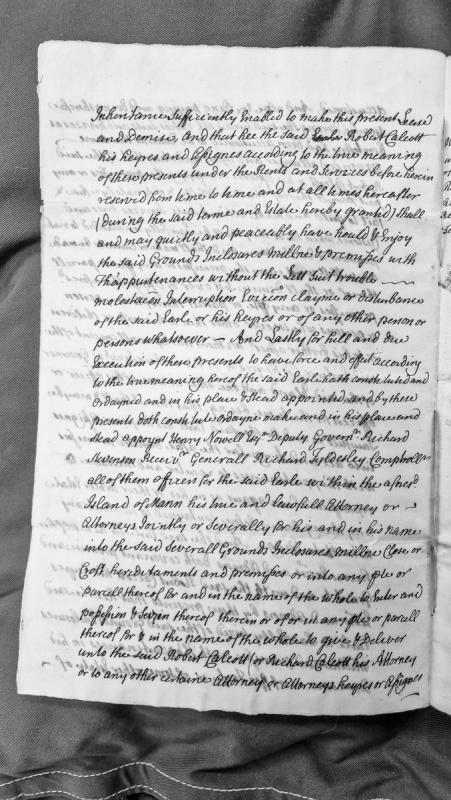
A legal lease document transferring grounds, enclosures, a mill and premises to Robert Calcott, with warranty against disturbance and appointment of attorneys for possession and seizin. The document appears to be part of a larger conveyance, with the Earl as grantor appointing officers as his legal representatives.
Two related administrative documents from the Atholl Papers concerning the lease of the Governor's house on the Isle of Man. The first (November 1769) is a rent assessment by appointed valuers Thomas Moore and Samuel Wattleworth, setting the annual rent at 24 pounds Manx currency. The second (June 1770) is a letter from the Duke of Atholl granting approval for repairs (£81 4s 6d) and offering a lease during the Governor's tenure. Relevant to governance structures, post-Revestment administrative relations, and the Duke's retained interests in Manx properties.
Two documents relating to the lease and maintenance of Governor John Wood's residence on the Isle of Man. The first (23 Nov 1769) is an arbitrated valuation by Thomas Moore and Samuel Wattleworth of a reasonable yearly rent (£24 manx) for the Governor's lands and recommendation for house repairs. The second (9 June 1770) is a letter from the Duke of Atholl granting consent to repairs (£81 4s 6d) and offering a lease during Wood's governorship with compensation provisions. Provides insight into post-Revestment governance arrangements and the Duke's property interests.
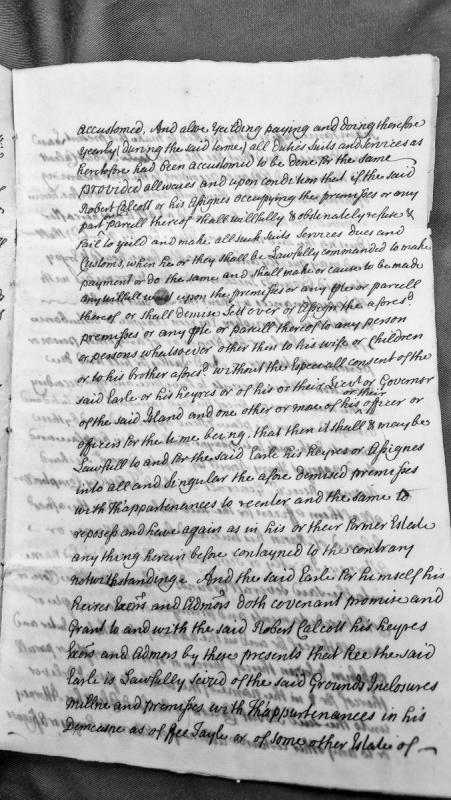
This is an excerpt from a lease or property grant document establishing the terms under which Robert Calcott may occupy and use certain premises including grounds, enclosures, and a mill. The document outlines required duties, suits, services, and customs to be performed, conditions for forfeiture including wilful waste or unauthorized assignment, and the Earl's covenant regarding lawful seizin of the property.
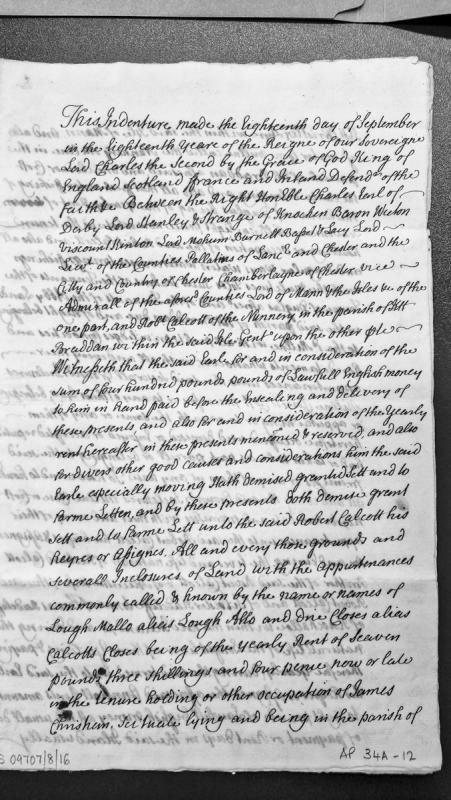
An indenture dated 18 September 1666 between Charles, Earl of Derby (Lord of Mann and the Isles) and Robert Calcott of the Nunnery parish, Kitt Braddan. The Earl leases to Calcott lands known as Lough Mallo and Drie Closes (Calcotts Closes) in exchange for £400 and an annual rent of £7 3s 4d. The document specifies terms of the lease and identifies the previous tenant as James Chrishem.
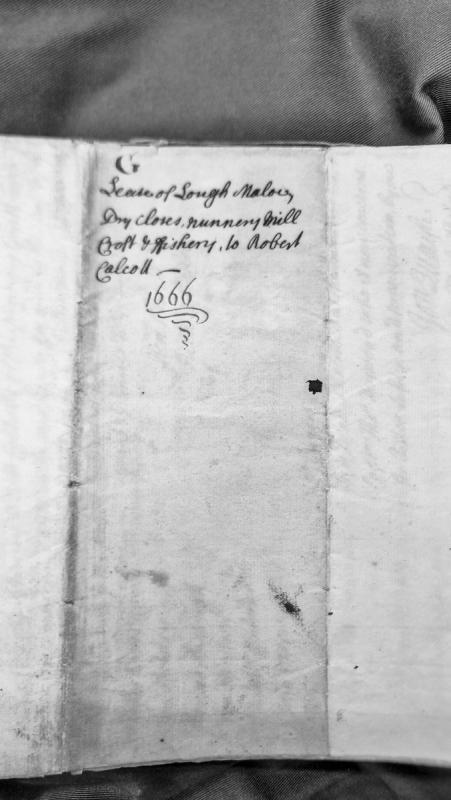
A lease document from 1666 concerning the rental of multiple properties and fishing rights to Robert Calcott. The lease covers Lough Malow (a lake), Dry Closes (enclosed fields), nunnery Mill Croft, and fisheries, representing a substantial property arrangement in 17th-century Isle of Man.
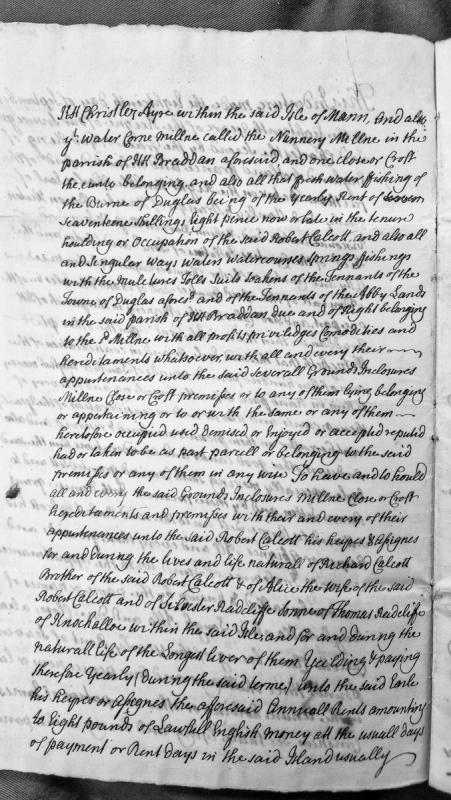
A lease document granting Robert Calcott tenure of the Nunnery Mill in Braddan parish, Isle of Man, along with associated water rights, fishing privileges, and lands in Douglas. The lease is granted for the natural lives of Richard Calcott, Alice Calcott, and Silvester Radcliffe, with annual rent of eight pounds due to the Earl.