A legal opinion from the State Paper Office, Scotland (c.1607) addressing whether an Inquisition Post Mortem regarding Thomas Earle of Derby's death and the Isle of Man could be used to secure dower rights for Anne Countesse Dowager of Derby. Chief Judge Brundell, with consent of Coke, Brooke, Fitzherbert and the King's Council, ruled the enquiry void on the grounds that the Isle of Man is not part of the English Realm and does not use English law, comparing it to Turney, Normandy, and Gascoine. This document establishes the constitutional status of Man as distinct from England, Wales, Ireland, and the Isle of Wight.
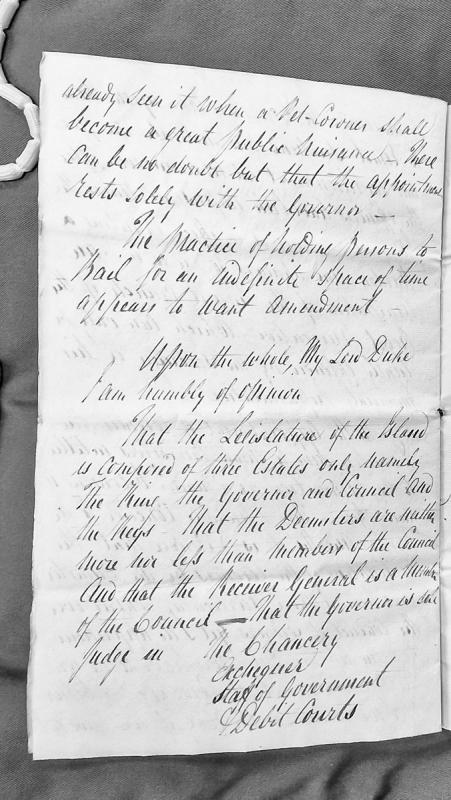
A fragment of a legal opinion addressing the composition of the Isle of Man legislature, the status of Deemsters and the Receiver General, and the Governor's judicial authority. The document discusses issues including Set-Coroner appointments and bail practices.
A formal legal opinion by Attorney General Charles Searle and Deemster Peter John Heywood on John Quayle's memorial claiming ancient privileges belonging to the Barony of St. Trinions. The opinion addresses feudal tenure, fealty obligations, and the distinction between services owed to the chief lord versus the crown following the 1765 Revestment. It establishes that fealty arising from the barony can only be owed to the Duke of Athol, not the King.
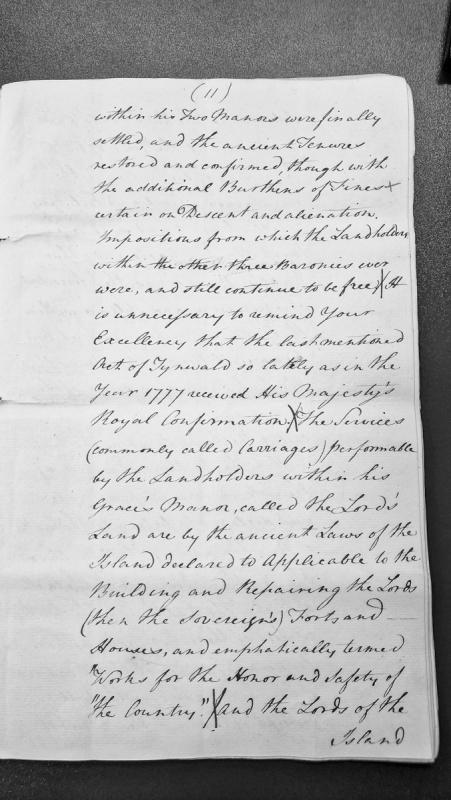
A fragment of a legal document discussing manorial tenures, fines, and services (carriages) owed by landholders within the Lord's Manor. References a 1777 Act of Tynwald confirmed by His Majesty, contrasting the burdens imposed on landholders in two manors versus the other three baronies. The document discusses ancient laws regarding services for building and repairing the sovereign's forts and houses.
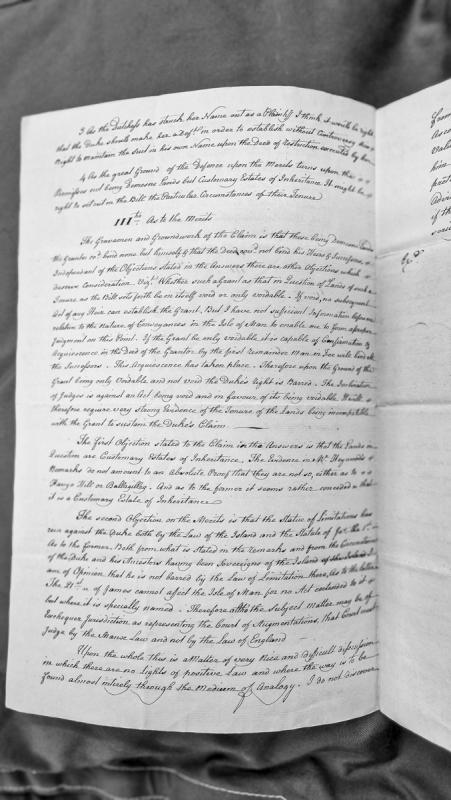
A legal opinion analyzing a land dispute concerning whether certain properties are Demesne lands or customary estates of inheritance. The opinion examines procedural matters, the nature of grants, statutes of limitation, and applicable law in the Isle of Man, concluding that the matter requires careful analysis through legal analogy.
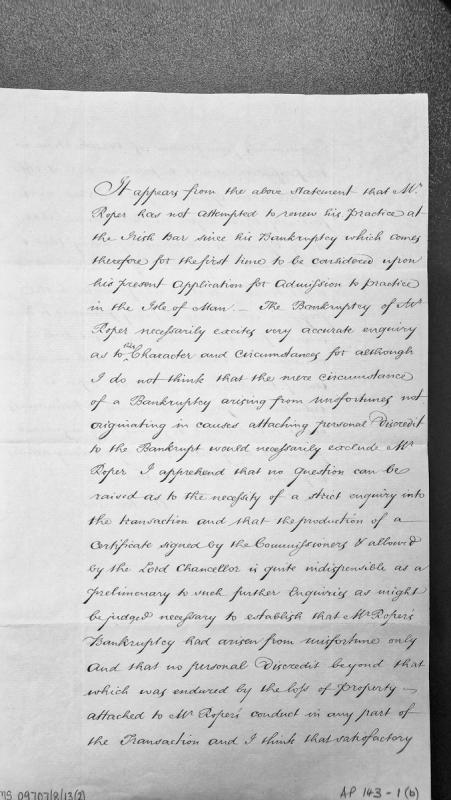
A legal opinion addressing Mr. Roper's application for admission to practice law in the Isle of Man, examining the implications of his prior bankruptcy at the Irish Bar. The document discusses the necessity of strict inquiry into the circumstances of his bankruptcy and the requirement for a Certificate signed by Commissioners and allowed by the Lord Chancellor before further proceedings.
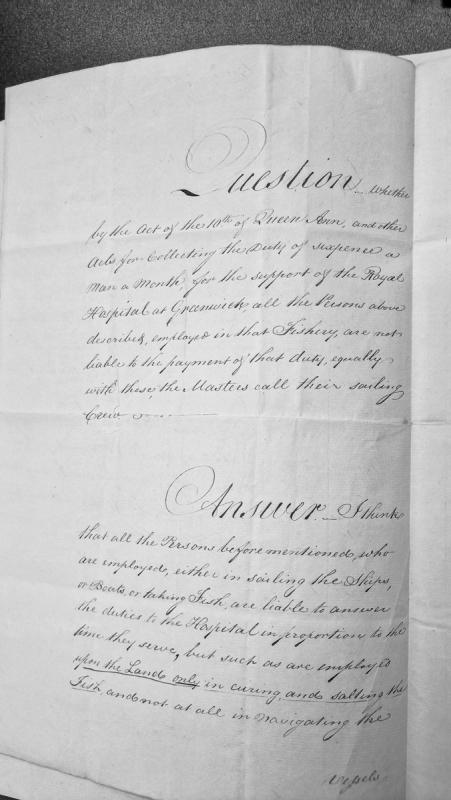
A legal opinion addressing whether persons employed in the fishery are liable for the sixpence monthly duty to support the Royal Hospital at Greenwich under the Act of the 10th of Queen Anne. The opinion concludes that those engaged in sailing ships/boats or taking fish are liable proportionally, while those employed only in land-based curing and salting are not.
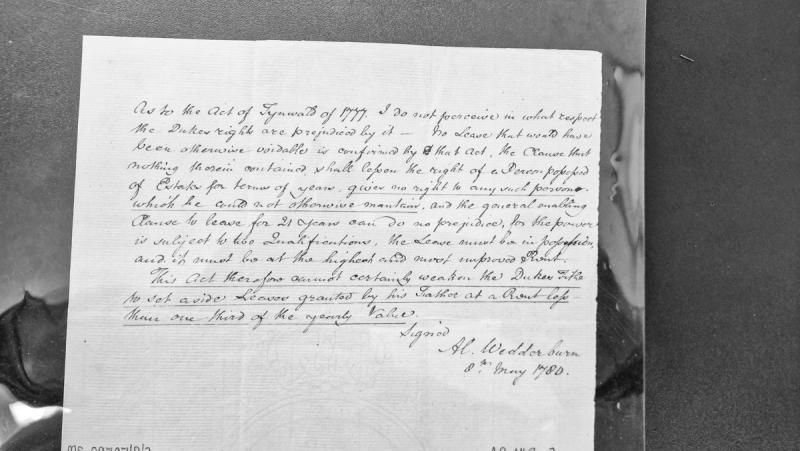
A legal opinion by Al. Wedderburn regarding the Act of Tynwald of 1777, specifically addressing whether the Duke's rights are prejudiced by the act. The opinion concludes that the act does not weaken the Duke's title to set aside leases granted at below-market rent.
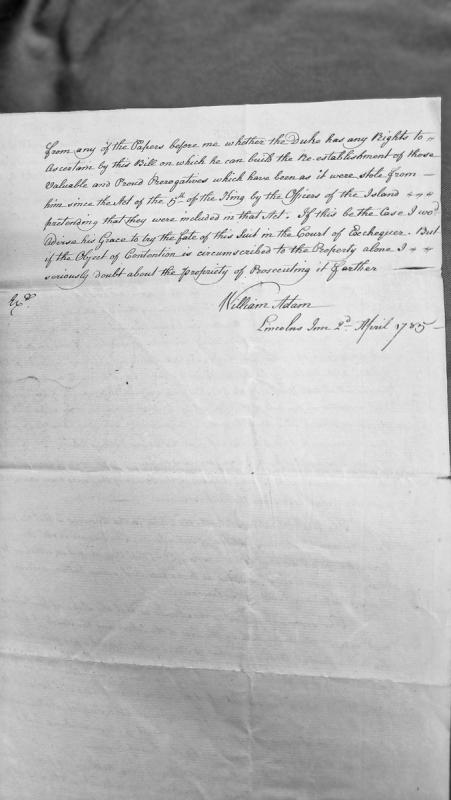
A legal opinion from William Adam addressing whether the Duke possesses rights under a Bill concerning the re-establishment of prerogatives allegedly taken by island officers since an Act of the 5th of the King. Adam advises pursuing the matter in the Court of Exchequer if the Duke's rights are disputed, but expresses doubt about further prosecution if the dispute concerns property alone.
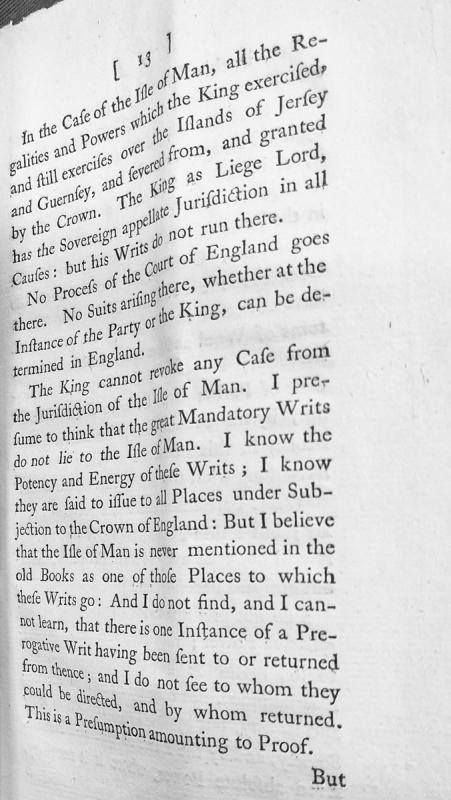
This is a legal opinion discussing the constitutional status of the Isle of Man, comparing its relationship to the Crown with that of Jersey and Guernsey. It addresses the King's appellate jurisdiction, the non-applicability of English writs, and argues that mandatory writs do not extend to the Isle of Man.
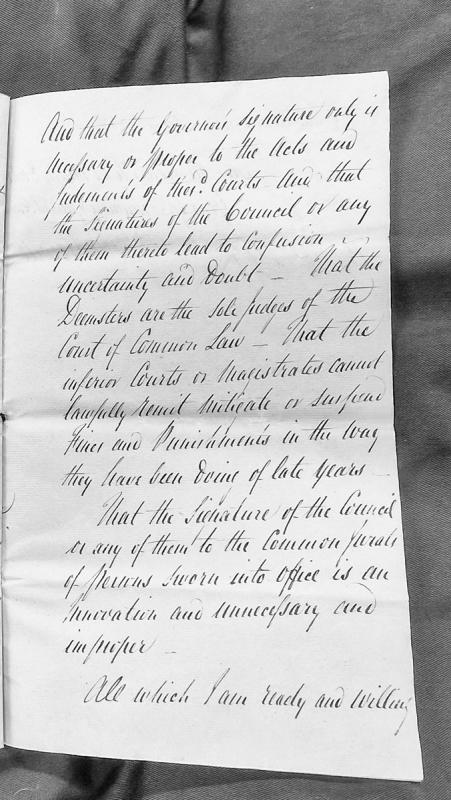
Fragment of a legal opinion addressing the proper authority for signing acts and judgments of courts, the role of Deemsters as sole judges in common law, and limitations on inferior courts' powers regarding fines and punishments. The document discusses whether Council signatures are necessary or proper to legal instruments.
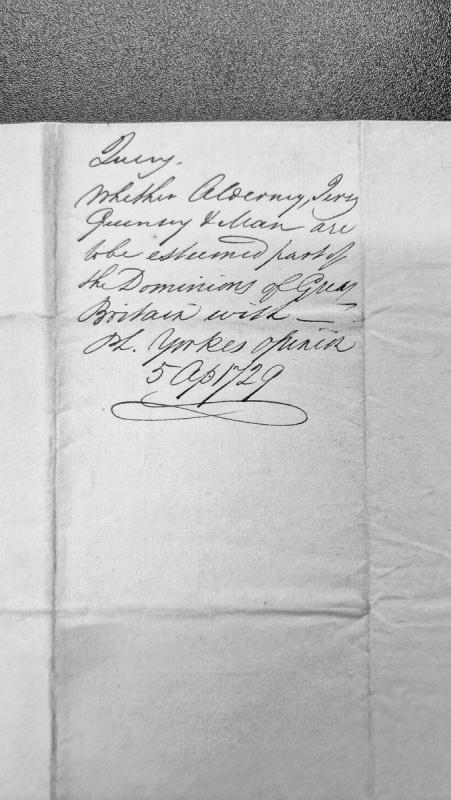
A legal query posed to Sir Yorke concerning whether Alderney, Jersey, Guernsey, and the Isle of Man should be considered part of the dominions of Great Britain, with Sir Yorke's legal opinion dated 5 April 1729.
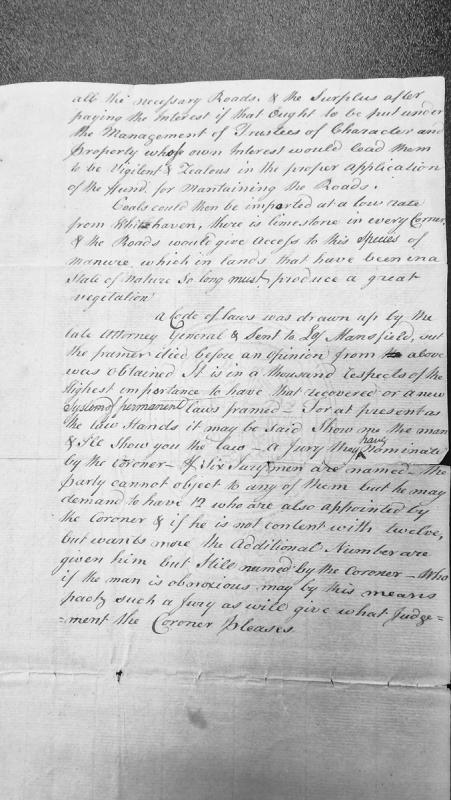
Fragment of a legal opinion discussing proposed improvements to roads and infrastructure on the Isle of Man, including coal imports from Whitehaven and lime-based fertilizer distribution. The document critiques the current legal system, particularly jury selection procedures dominated by the Coroner, and references a code of laws previously sent to Lord Mansfield by a deceased Attorney General.
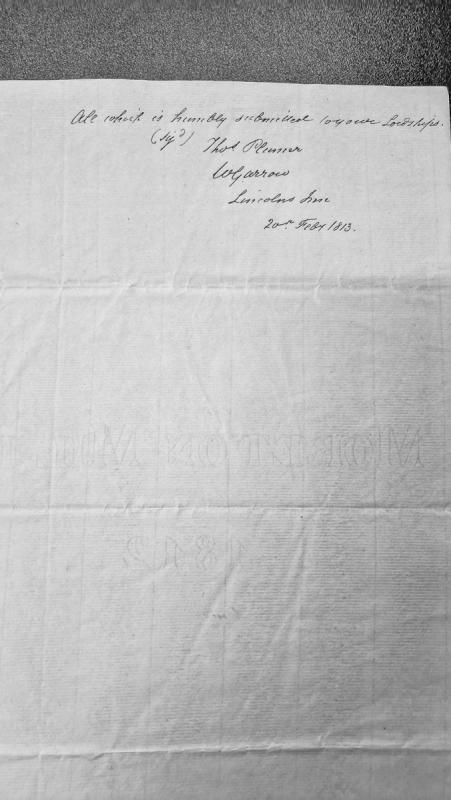
A legal document submitted to the House of Lords, signed by Thomas Plumer and W Garrow from Lincoln's Inn on 20th February 1813. The fragment represents the concluding submission of a legal opinion or petition.
A page from a legal treatise discussing the jurisdictional framework of the Channel Islands (Guernsey, Jersey, Alderney, Sark) and the Isle of Man under English law. The text examines various writs and legal procedures that apply to island territories, including Quo Warranto, Quare impedit, Habeas Corpus, and a historical writ concerning attorney appointment.
An excerpt from a legal opinion discussing the principles of eminent domain and state authority over private property. The document cites works by Puffendorf and Hertius, engaging with debates about whether governments can seize private property without compensation, referencing Hobbes's theories of absolute sovereign power.
This hall on Bromet Road was built by the Admiralty during the Second World War as a cinema and gymnasium for personnel of H.M.S. Urley, the Royal Naval air station established at Ronaldsway in 1943-44 to help meet Britain's wartime need for naval air training bases. It stood within the Castletown Camp, a domestic site housing naval personnel in Nissen huts nearby; when the station was decommissioned after the war and its camps converted to housing, this building was the sole structure from the site left standing. In May 1960 Tynwald gave the building to the Castletown branch of the Royal British Legion at no charge, and it has remained the Legion Hall ever since, still largely retaining its original entrance foyer, dance floor, stage and projection room, making it a rare and largely unaltered survivor of the Island's wartime military architecture.
Legislative text from the 24th regnal year, sections XLVII-XLVIII, establishing penalties for unlicensed distillation of spirits from grain and materials. Specifies £100 forfeiture per offence, seizure of stills and equipment, with proceeds divided between parish poor and informers.
A 16th-century state paper from the Scottish State Paper Office reporting on military activity by men-of-war from Scottish ships operating off the west coast of Scotland. The document notes that vessels initially positioned to intercept victuallers instead caused damage to the Isle of Man and subsequently withdrew due to fear of invasion. This provides historical context to Manx vulnerability and Scottish-English tensions during the Tudor period, predating the 1765 Revestment.
A ditchless, grass-covered bowl barrow which measures 10.0 metres north to south by 7.0 metres and is 1.2 metres high. It has been clipped by the plough and damaged by sheep rubbing into the sides of the mound. It was described as being damaged as early as 1895. The mound has been subject to excavation by Dr Larch S. Garrad and evidence of funerary urns and human bones has been recorded here.
A ditchless, grass-covered bowl barrow which measures 10.0 metres north to south by 7.0 metres and is 1.2 m high. The mound has been subject to excavation by Dr Larch S. Garrad and evidence of funerary urns and human bones has been recorded here.
Leodest Methodist Chapel on Leodest Road, Andreas, is registered simply as a chapel. No further verifiable historical detail about this specific building could be found online.
Letitia Christian Tyler (1790-1842) was the first wife of John Tyler, the tenth President of the United States, and served as First Lady from 1841 until her death. She was descended from the Christian family of the Isle of Man, her ancestors having emigrated from Mann to colonial Virginia in the seventeenth century.