A letter from Bishop John Meryck of the Isle of Man to the Lord Treasurer of England dated 4 April 1590, detailing his financial hardships and debts incurred while serving between Wales and Man, and seeking protection from legal process. The letter provides insight into ecclesiastical administration, personal finances of the Manx bishopric, and the bishop's precarious position in the late 16th century.
A petition from the Bishop of Sodor and Man (Phillips) to the Earl of Salisbury, Lord High Treasurer of England, dated June 1610, complaining of his dispossession by the Lieutenant (Mr Ireland) of traditional turfery rights belonging to the Bishopric. The Bishop describes his efforts to repair the ruinous Bishopric and his financial losses, and requests leave to travel to England for redress and to attend to his personal affairs.
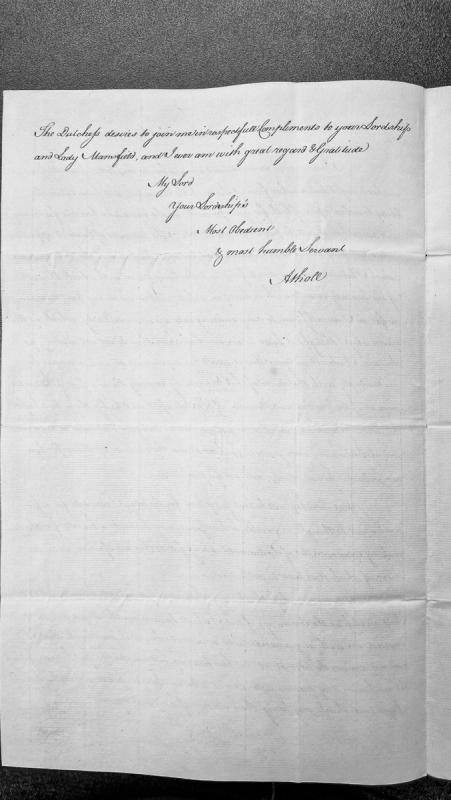
A brief closing portion of a letter expressing respectful compliments from the writer (Atholl) and the Dutchess to Lord Mansfield and Lady Mansfield. The fragment demonstrates formal 18th-century correspondence conventions with expressions of regard and gratitude.
A letter from Gerard (likely governor or revenue official for the Isle of Man) to Robert Cecil, Earl of Salisbury and Lord High Treasurer of England, concerning accounts and revenue from the island. The writer disputes charges against him and discusses arrangements for transporting revenue to England via Liverpool. Demonstrates early 17th-century administrative oversight of the island and revenue management.
A letter from Gerard (at Bromley) to Robert Cecil, Earl of Salisbury (Lord High Treasurer of England), discussing administrative and financial matters related to the revenue of the Isle of Man. The letter addresses discrepancies in a commission for the Island's revenue, references the Countess of Derby's receipts, and confirms arrangements for transporting revenue by bark from Liverpool. Provides early 17th-century context for feudal lordship and revenue collection under the Stanley/Derby family.
A foundational historical account from the 7th Earl of Derby describing the Isle of Man's governance structure, ecclesiastical jurisdiction, and legal framework under the Derby lordship. The letter traces the island's transition from kings to lords, details the succession dispute following Ferdinand's death, and explains the establishment of the House of Derby's sovereignty through Parliamentary confirmation in King James I's reign. Essential primary source for understanding the constitutional basis of Manx governance prior to the 1765 Revestment.
A letter from James Stanley, 7th Earl of Derby, written during the English Civil War, describing the rebellion of 1643, his activities in Lancashire, and his decision to travel to the Isle of Man to secure it for the King against Scottish and Parliamentary threats. The letter provides contemporary perspective on the political and military crisis affecting the island during the Interregnum period, directly contextualizing pre-Revestment Isle of Man governance and sovereignty issues.
A reflective letter from James, 7th Earl of Derby, discussing his methods for consulting with officers before a significant meeting, his use of spies and intelligence, and principles of sound counsel. The letter reveals governance practices in the lead-up to a critical assembly and offers insight into the Earl's constitutional thinking and management of dissent among his advisers.
A chapter from the Manx Society collection presenting advice from James, 7th Earl of Derby, on managing grievances and petitions from the Manx people. The Earl describes his strategy of calling a public meeting at Castle Rushen to hear complaints, his method of dividing factious opposition through subtle diplomacy, and his counsel to his son on handling petitions. Relevant to understanding the character and methods of the Earl during the period leading to the 1765 Revestment.
An extract from Manx Society vol. 3 (part 1) containing a letter attributed to James, 7th Earl, discussing his arrival on the Isle of Man, the role of his lieutenant (Captain Greenhalgh) in managing civil unrest, and principles of governance emphasizing judicial balance, popular management, and careful choice of subordinates. Relevant to understanding aristocratic control and administrative structures during the period preceding the Revestment.
Excerpt from a letter by James, 7th Earl of Derby, discussing his vision for developing commerce in the Isle of Man, the island's strategic geographic position, and his observations on the character and loyalty of the inhabitants upon his arrival. The letter reflects early-modern colonial thinking about economic development and administrative oversight.
An extract from the 7th Earl of Derby's letter addressing reasons why he does not assume the title of King of Man, emphasizing loyalty to the English Crown and prudent governance. The text includes extensive biographical material on Edward, Earl of Derby, as a model of faithful service and excellent estate management. Relevant to understanding the constitutional relationship between the Lords of Man and the English monarchy prior to the 1765 Revestment.
A 1577 letter from John Merick, Bishop of Sodor and Mann, to an unnamed correspondent (likely Richard Hakluyt) discussing the antiquities, language, history, and governance of the Isle of Man. The letter refutes inaccuracies in Holinshed's Chronicles, defends the Manx language as Greek-derived, explains the island's judicial and administrative structures (Deemsters, Keys), and praises the Earl of Derby's governance. The original Latin text is included alongside the English translation.
A 1577 letter from John Merick, Bishop of Sodor and Mann, to an unknown correspondent discussing the antiquities, history, language, constitutional governance, and contemporary condition of the Isle of Man. Addresses Manx etymology, linguistic parallels to Greek and Welsh, the island's legal system (Deemsters and Keys), ecclesiastical and civil administration, and corrects misconceptions propagated by Ralph Holinshed. The letter provides valuable contemporary testimony on Manx governance structures and the island's relationship to the Earl of Derby.
A royal letter from King Henry III to Olave, King of Man, instructing him not to interfere with Furness Abbey or its monks and property. The document is bilingual (English and Latin) and demonstrates early 13th-century English claims to overlordship of the Isle of Man through ecclesiastical protection. It illustrates the feudal relationship and external pressures on Manx sovereignty.
A 1193 royal letter from Olave II, King of the Islands (the Hebrides and Isle of Man), to the Dean and Chapter of York requesting the consecration and dispatch of Nicholas as bishop. The letter demonstrates the ecclesiastical and diplomatic ties between the medieval Manx crown and the English church hierarchy, and provides evidence of Manx royal authority and sovereignty in the late 12th century.
A bilingual (Latin/English) transcription of a 12th-century royal letter from Olave II, King of the Isles (Hebrides and Isle of Man), to the Dean and Chapter of York requesting the consecration and return of his bishop-elect, Nicholas. The document demonstrates the ecclesiastical jurisdiction and political relationship between the Manx kingdom and English church authority, and establishes the historical precedent of Isle of Man's constitutional status within broader British isles governance.
A letter from Lord Strange (dated 27 March 1634) to the Admiralty Lords explaining his efforts to summon Captain Christian of the Isle of Man to appear before them. Strange reports that Christian was found dangerously ill and unable to travel, but undertakes to have him attend as soon as his health permits. The letter illustrates early 17th-century administrative procedures regarding Isle of Man governance and Admiralty jurisdiction.
A letter from Lord Strange (dated 27 March 1634) to the Lords Commissioners for the Admiralty, reporting on his attempts to summon Captain Christian from the Isle of Man to appear before them. The Captain was found to be dangerously ill, preventing travel. The letter demonstrates early 17th-century administrative procedures for Isle of Man governance and Admiralty oversight.
A formal ecclesiastical letter dated 1299 from Marc, Bishop of Sodor, confirming the appropriation of two churches in Man (St. Michael and St. Michaldus) to the Abbot and Monks of Furness Abbey. The letter, issued from Russyn Abbey, establishes early medieval ecclesiastical governance and property relations in the Isle of Man, with the bishop's assertion of free will in making the appropriation despite the abbot's custody of the island at that time.
A formal episcopal letter from Marc, Bishop of Sodor, dated 1299, confirming the appropriation of the churches of St. Michael and St. Michaldus in Man to the Abbot and Monks of Furness Abbey. The letter protests the free and voluntary nature of the transfer, made without coercion. Provides evidence of ecclesiastical governance, monastic property interests, and early Manx church administration during the medieval period.
Papal letter from Pope Honorius III to Reginald, King of Man, exhorting him to provide free land to churches within his kingdom for the building of priestly dwellings. The letter emphasises the king's role as patron of churches and his obligation to support religious institutions through charitable donation. This document establishes the ecclesiastical relationship between the Papacy and Manx sovereignty in the early medieval period.
A papal letter from Pope Honorius III (Anno VII, Epistle 76) to the King of Man, dated 13 January 1223 (20th January). The letter exhorts the Manx king to provide free land (at least thirty paces) to churches in his kingdom for the construction of priestly dwellings, emphasizing the king's duty as patron of the churches and the spiritual benefits of such pious works. This source is relevant to understanding the medieval ecclesiastical framework and the king's constitutional obligations within the Isle of Man before the Atholl period.
A formal letter from King Reginald of the Isles to Pope Honorius III (dated 1219) documenting the feoffment of the Isle of Man to the Roman Church and establishment of a perpetual annual tribute of twelve marks sterling payable at Furness Abbey. This is a foundational document on ecclesiastical sovereignty over Man and demonstrates the island's feudal relationship to Rome prior to later secular claims.
A Latin and English transcription of a 1219 letter from Reginald, King of the Isles, to Pope Honorius III documenting the formal feoffment of the Isle of Man to the Roman Church and the establishment of an annual tribute of twelve marks sterling. The document records the ecclesiastical investiture and witnesses, and is foundational to understanding the island's medieval constitutional status and the layered sovereignty claims that would later affect the 1765 Revestment.