A formal letter from the Scottish guardians, prelates, counts, and barons to King Edward I of England concerning a proposed marriage between Edward's eldest son and the heiress of Scotland (Margaret of Norway). Dated 1289, it represents diplomatic correspondence regarding succession and political union. The document is presented in both English and Anglo-Norman French versions, reflecting medieval diplomatic practice.
A 1289 letter from Scottish Guardians, Prelates, Counts and Barons to Edward I of England, consulting him on a proposed marriage between his eldest son and the heiress of Scotland (Margaret of Norway). The letter is presented in both English and Norman French versions, and was published in the Manx Society's Monumenta de Insula Manniae. The inclusion of the Bishop of Man as a signatory provides evidence of Man's ecclesiastical integration within the medieval British Isles political structure.
Letter from George Nicolson in Edinburgh to an unnamed correspondent describing Angus MacDonnell's petition to the Scottish King for permission to invade the Isle of Man and force it into the king's obedience. The king refused the request but instructed MacDonnell to preserve peace with Her Majesty's subjects. The letter demonstrates early 16th-century Scottish interest in Isle of Man sovereignty and the geopolitical tensions surrounding the island.
Letter from the Duke of Grafton (Secretary of State) to the Lords Commissioners of the Treasury regarding approval of barracks construction plans for the Isle of Man, specifically at Castle Rushen and Castletown. The King approves the plans except for stables, as the cavalry quartered there is being withdrawn. Demonstrates post-Revestment military infrastructure development and defence concerns.
Official correspondence from the Duke of Grafton (Secretary of State) to the Lords Commissioners of the Treasury regarding Royal approval for barracks construction in the Isle of Man. The letter approves plans for Castle Rushen and Castletown barracks but confirms that stables are unnecessary as horses are being withdrawn from the island. Reflects post-Revestment military organisation and royal control of Manx defence.
Administrative letter from E. Smith to John Robinson (Secretary to Lords Commissioners of the Treasury) concerning difficulties in procuring cash to pay the Corps of Fencibles raised in the Isle of Man. Smith proposes using regimental draughts on the London Agent as a solution, and requests assistance with warrant for new establishment and salary payment directions to Lutwidge.
Administrative letter from E. Smith to John Robinson (Secretary to the Lords Commissioners of the Treasury) regarding difficulties in procuring cash to pay the Isle of Man Fencibles Corps, and proposing use of regimental draughts on the London agent as a solution. Also requests warrant for new establishment and directions regarding Smith's salary payment. Provides insight into post-Revestment financial and military administration of the Island.
Correspondence from Treasury valuer Webster to Baron Maule regarding the valuation of Castle Mona and the Duke of Atholl's manorial rights during final negotiations for the Revestment. Webster argues for Government acquisition of Castle Mona as Governor's residence and warns of ongoing social unrest over tithe disputes and the Bishop's impending departure.
A letter from Treasury valuer Webster to Baron Maule (23 May 1826) regarding the potential Government acquisition of Castle Mona as part of negotiations over the Duke of Atholl's manorial rights. The document reflects tensions over tithe enforcement, the Bishop's impending departure, and strategic arguments for Government possession of the castle for administrative purposes.
Charles Lutwidge reports to Grey Cooper at the Treasury on the destruction of Douglas Pier by severe storms. The letter notes the pier's strategic importance for naval sloops and navigation in St George's Channel, and references the recent acquisition of Isle of Man ports by the Crown following the 1765 Revestment.
Letter from D. Mylrea and J. Quayle to the Duke of Atholl reporting on consultations with Manx Keys (local gentry) regarding a proposed East India Company Regiment stationed on the Isle of Man. Discusses economic benefits and security concerns, and provides an update on military garrison changes at Castle Rushen since the 1765 Revestment.
Letter from D. Mylrea and J. Quayle to the Duke of Atholl reporting on consultations with Keys (Manx assembly members) regarding a proposed East India Company Regiment garrison. Discusses economic benefits and public safety concerns, mentions current military arrangements at Castle Rushen (42nd Regiment), and includes financial remittance details. Provides contemporary perspective on post-Revestment economic conditions and military presence on the Isle of Man.
A brief administrative letter from Charles Lutwidge in Douglas, Isle of Man, dated 2 November 1765, complaining about the lack of regular packet boat service and the resulting uncertainty in mail delivery. Lutwidge requests that future letters be forwarded via Whitehaven rather than Liverpool, citing it as a speedier and safer route. The letter references an earlier missive of 29 October regarding troops, and notes the delay in receiving correspondence from Mr Lowndes. Editorial notes indicate that a fortnightly packet service to/from Whitehaven was subsequently established around Christmas 1765.
Brief administrative letter from Charles Lutwidge (likely Lieutenant Governor) to an unnamed correspondent, dated 2 November 1765, complaining about the absence of a regular mail packet service from the Isle of Man and requesting that future correspondence be routed via Whitehaven. The letter references earlier correspondence regarding troops and notes the poor reliability of mail delivery via Liverpool. Provides context for communications infrastructure challenges during the immediate post-Revestment period.
Letter from Anthony Bacon, Army contractor, to the Lords of the Treasury requesting directions on provisioning troops being sent to the Isle of Man following the Revestment. Addresses logistical concerns including officer designations, storage facilities, and customs clearance for forage imports from Ireland. Provides context on troop movements and pre-Revestment garrison arrangements.
A letter from Anthony Bacon, London-based army contractor, to the Treasury requesting directions on delivering provisions and forage to troops stationed on the Isle of Man following the Revestment. The letter addresses logistical concerns about storing flour, issuing weekly rations, and potential customs difficulties under the recent Act of Parliament. It provides evidence of the military occupation of the Island in summer 1765 and associated provisioning challenges.
Official letter from Anthony Bacon, Army contractor, to the Board of Ordnance (or Treasury Lords) dated 14 August 1765, requesting directions on provisioning and billeting troops stationed on the Isle of Man following the Revestment. Addresses logistical challenges including forage importation, storehouse provision, and customs compliance under recent Acts of Parliament. Includes substantial editorial notes on troop composition, timeline, and context.
Extract of a letter from Dutch merchant Herman van Yzendoorn to Mr Taubman (presumed intermediary to the Duke of Atholl) reporting the seizure of three vessels in Liverpool carrying East India goods, and their owners' forced payment of £2,600 bail. Van Yzendoorn references a 40+ year old Act of Parliament (7 Geo 1 and 12 Geo 2) confiscating vessels that brought East India goods to the Isle of Man, and argues this violates the Duke's sovereignty over the island, contrasting the Isle's status with that of Guernsey and Jersey which belong to the Crown.
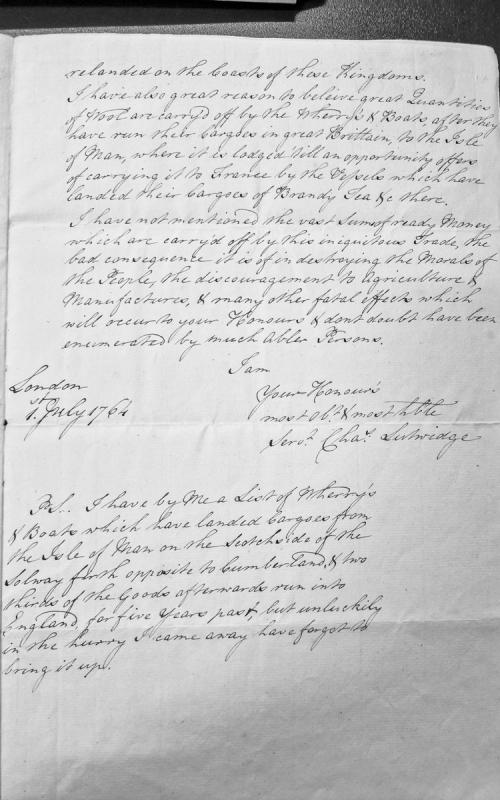
A letter from Charles Lutwidge to unnamed authorities ("Your Honours") detailing smuggling operations centred on the Isle of Man. The writer describes how contraband goods (brandy, tea, wool) are transported between Great Britain, the Isle of Man, France, and Scotland via small vessels. The letter emphasizes the economic and moral damage caused by this illicit trade.
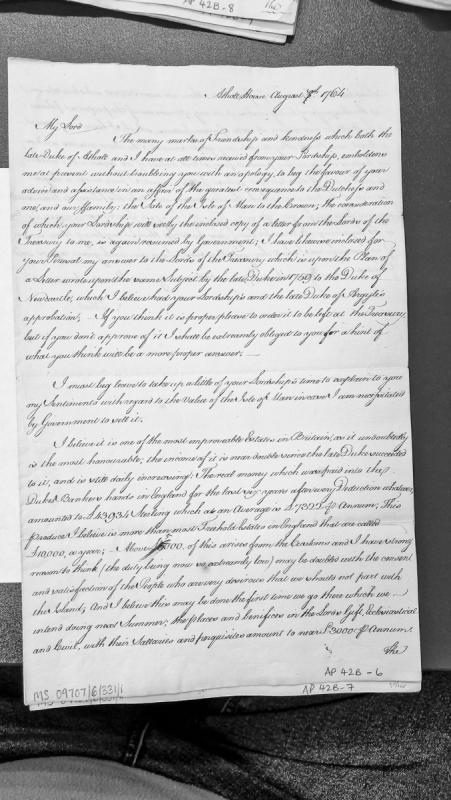
A letter from the Duke of Athole to an unnamed Lord regarding the potential sale of the Isle of Man to the Crown. The Duke seeks advice on his response to the Lords of the Treasury and provides detailed financial information about the island's income and value, arguing it is an improveable and honourable estate.
A letter from Richard Dawson (Governor of the Isle of Man) to the Treasury dated September 1778, detailing the acute shortage of copper coinage on the island and requesting Crown authorization to mint 300 pounds worth of Manx pence and 150 pounds of halfpence. The letter explains the historical distinction between Manx and English copper currency, notes that no coinage has been issued since 1758, and references pre-Revestment practices when the Lord Proprietor would authorize such mintage. Relevant to understanding post-Revestment governance and economic administration of the Island.
A letter from Richard Dawson (Governor of the Isle of Man) to a senior government official (addressed as 'My Lord') requesting permission to issue copper coinage to alleviate a shortage of small change affecting trade, particularly the herring fishery. The letter outlines the historical distinction between Manx and English copper currency, the 1758 date of the last coinage, and proposes a three-hundred-pound issue of pence and one-hundred-fifty-pound issue of half-pence bearing the King's head and the Island's arms.
A State Paper from the Office of Scotland (5 Jas I) addressing a petition by the Earl of Derby and co-heirs regarding their claim to the Isle of Man. The letter, from Privy Council members to Lord Chief Justice Popham and senior judges, requests legal examination of patents and defects in title following Queen Elizabeth I's assumption of sovereignty. This document illuminates early Stuart-era disputes over Manx sovereignty and the Crown's assertion of rights over the island.
Correspondence from Major Joseph J Durbin to James McCrone requesting patronage from the Duke of Atholl for a subscription to build a school for poor children at Foxdale lead mines. The letter indicates local landowner Mr Cain has offered ground and construction oversight, with hopes for community donations. Relevant to understanding post-Revestment Atholl interests and social conditions in Manx mining communities.
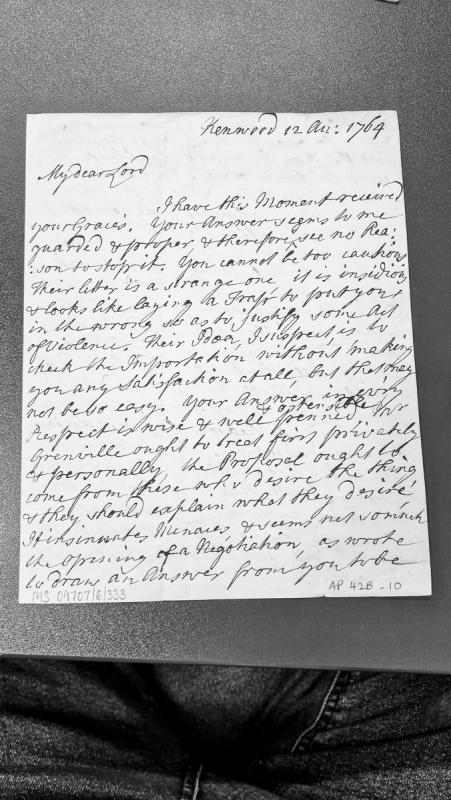
Private letter from a correspondent to a nobleman (addressed as 'My dear Lord' and 'Your Grace') discussing a recent answer to what appears to be a proposal regarding importation restrictions. The writer advises the recipient that his response is appropriately guarded and proper, warns against what he perceives as a trap in the other party's letter, and criticizes the approach taken, suggesting Mr. Grenville should negotiate privately and personally.