A royal licence granted by King Henry IV permitting John Mathoren and William Hobson, servants of the Earl of Northumberland, to purchase four weyes of corn in Ireland and transport them to the Isle of Man and Carlisle. The document is transcribed from the Rotuli Patentium et Clausarum Cancellariae Hiberniae and represents early medieval trade regulation between Ireland, Man, and England.
A royal licence granted by Henry IV of England authorising Robert Yvenhowe of Mann to transport two ways (units) of corn to the island. This is a transcription from the Rotuli Patentium et Clausarum of the Irish Chancery, providing early evidence of trade regulation and royal authority over Manx commerce in the medieval period.
A royal licence issued by King Henry IV permitting Robert Yvenhowe of Mann to transport two weys of corn to the island. This document illustrates early medieval trade regulation and royal control over Isle of Man commerce, providing context for the later 18th-century customs and smuggling issues central to the Revestment study.
The apparent site of a 1st century AD stone Roundhouse or enclosure. Topographically and by its size it is comparable to the Braaid Circle which was classified as a stone Roundhouse of the 1st Century AD. Its diameter is 26.0 metres northeast to southwest. The northeast half consists of a semi-circular loose stone wall, now largely fallen down into the interior, partly faced on the outside with stone slabs. The average external height of the walls is 0.3 metres. The southeast half of the circle has apparently been destroyed by a landslip, evidence of which exists in a build up of earth on the side of a steep slope to the southeast. In the southwest of the remaining portion is one leaning orthostat, its length is 1.0 metres with sides of 0.3 and 0.4 metres. Extending to the northeast and towards the centre of the circle at a distance of 4.0 metres from the orthostat is a small possible hearth lined on two sides by flat stone slabs. Its sides are 0.5 by 0.3 metres. There is a considerable amount of loose stone in the interior and in the north is an in-turned entrance some 4.0 metres wide and lined on the west side by a stone slab 1.5 metres long by 0.5 metres high. This 'entrance' is in an illogical position being in a water path. It may be the result of human mutilation or it may result from water rushing down the hillside. It is probable that the majority of the stones from this site have been removed to the nearby walls.
Letter from Lieutenant Governor R. Dawson to an unnamed superior (likely the Secretary of State or Lord Lieutenant) reporting an attempt by the Duke of Atholl's Seneschal to claim possession of the Court Room in Peel (Douglas). The letter details the legal basis for Crown possession following the 1765 Revestment Act, explains how the Douglas Court Room came to be held by Atholl's agent, and defends Dawson's refusal to surrender Crown property without proof of legal right.
A letter from newly appointed Lieutenant Governor Alexander Shaw to Evan Nepean (Under Secretary of State) dated 26 February 1791, requesting copies of gubernatorial instructions and records that were not provided by his predecessor, Lieutenant Governor Dawson. Shaw references instructions from 1765 relating to the Crown's vesting of the Isle of Man and seeks guidance on his administrative duties.
Lieutenant Hawkes commanded HMS Maria and arrived at Douglas in August 1811. He assured the High-Bailiff, Norris Moore, that he did not intend to impress fishermen. On the night of 17 August, he broke his word, impressing fishermen and working men after what contemporary accounts describe as a hard fight, in which several men were dangerously wounded. The Admiralty initially refused to release the men, citing the "very improper conduct of the people of Douglas," before eventually ordering their return.
Lieutenant-Governor Alexander Shaw's formal letter to the Commissioners of Inquiry (1792), submitted 19 October 1791, detailing the constitutional structure of the Isle of Man, the composition and powers of the three Estates (Sovereign, Governor and Council, House of Keys), and critical observations on governance including the exclusion of clerical members from Council and abuses of appeals to the King in Council. Directly relevant to post-Revestment constitutional arrangements and administrative practice.
Letter from Lieutenant-Governor Alexander Shaw to the Secretary of the Commissioners of Inquiry (1792), submitted 19 October 1791, detailing the constitutional structure, legislature, laws, and governance of the Isle of Man. Covers the three estates (Sovereign, Governor and Council, House of Keys), the composition and election of the Keys, the controversy over clerical members of the Council, and extensive discussion of the problem of appeals to the King in Council. A key post-Revestment administrative document.
An extensive biographical and historical introduction to the life of Robert Clive, focusing on the political and military state of India at the outset of his career (1746). The text covers the decline of the Mughal Empire, the rise of European trading companies (especially the East India Company), the Carnatic Wars, and key figures like Dupleix, La Bourdonnais, and various Indian rulers. While primarily biographical, it provides crucial context for understanding the geopolitical environment that shaped the events leading to the 1765 Isle of Man Revestment by illustrating how overseas colonial ventures and commercial rivalries drove imperial expansion.
A comprehensive biography of John Wilkes (1725–1797) by Horace Bleackley, published in 1917 by John Lane. While primarily a biography of the radical politician Wilkes, the work contains extensive contextual material on 18th-century British politics, Parliamentary procedure, radical journalism, and constitutional conflicts that provide important background for understanding the political climate leading to the 1765 Revestment debate.
Comprehensive biography of John Wilkes (1725–1797), the radical politician and libertarian activist whose career paralleled the 1765 Revestment period. Covers Wilkes's political agitation, Parliamentary activities, publishing ventures (The North Briton), and constitutional conflicts with George III. Relevant to the Revestment project for context on 1760s–1770s political radicalism, Parliamentary procedure, and the ideological climate affecting colonial and constitutional questions.
The Lifeboat House on the Quay at Port St Mary serves the village's RNLI lifeboat station, which was established in 1896, making it one of the longer-serving stations on the Isle of Man. Today the station's lifeboat, the Gough Ritchie II, is kept at a permanent floating mooring just inside the outer breakwater rather than housed on a slipway, with the historic lifeboat house remaining part of the harbour's working fabric. The building is a visible reminder of Port St Mary's long relationship with sea rescue around the island's rocky southern coast.
Known locally as "Winkie," this secondary lighthouse stands on the beach at Cranstal, near the Point of Ayre, the Isle of Man's northernmost tip. It was built in 1899, sited around 750 feet seaward of the main Point of Ayre lighthouse, because shifting shingle and gravel deposited by strong currents in the area meant a lower, closer light was needed to guide vessels safely around the sandbanks. It was moved a further 250 feet in 1950 to keep pace with the changing coastline, before finally being discontinued on 7 April 2010 as navigational technology moved on.
The lighthouse at Cranstal is the Point of Ayre Lighthouse, marking the northernmost tip of the Isle of Man. It was built by the Northern Lighthouse Board's chief engineer, Robert Stevenson, following an 1815 Act of Tynwald authorising its construction, and was first lit in 1818, making it the oldest operational lighthouse on the island; the keepers arriving before the building was finished reportedly had to lodge with a farmer two miles away. Its powerful foghorns, once audible as far as the Mull of Galloway 26 miles distant, have since been retired, and the light itself was automated in 1993. It was registered as a protected building in November 1993.
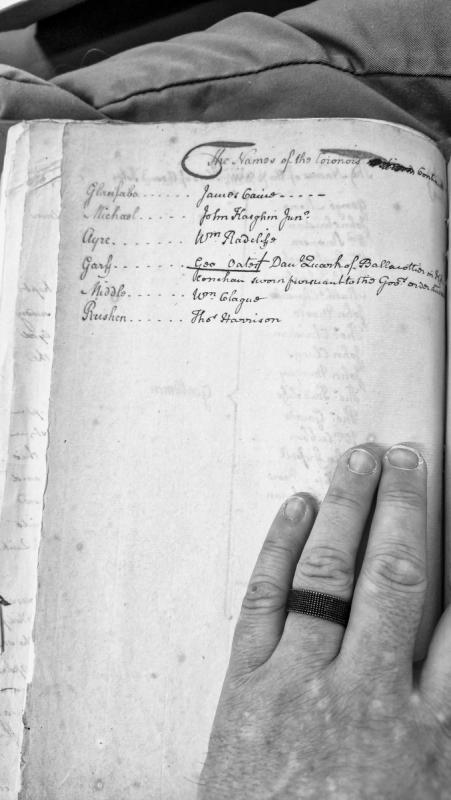
A partial administrative record listing coroners appointed for various parishes (Glenfaba, Michael, Ayre, Garff, Middle, Rushen) in the Isle of Man. The document appears to be a continuation of a larger list, with some names struck through and annotations regarding oaths taken under gubernatorial direction.
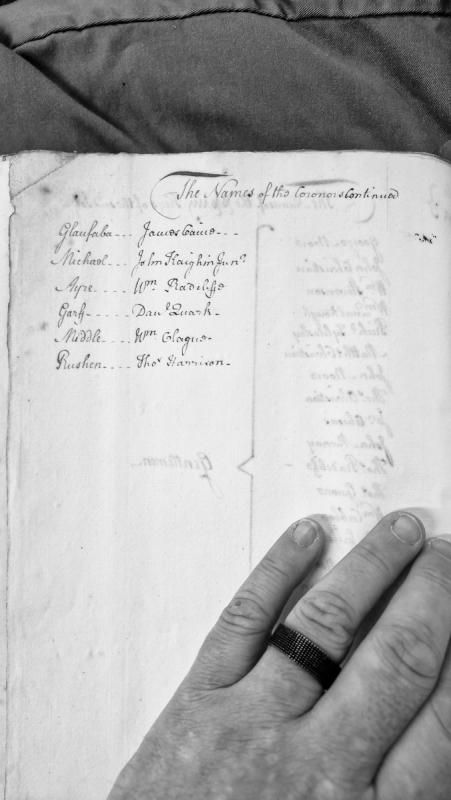
A continuation of a list of coroners appointed to the six parishes (sheadings) of the Isle of Man. Each parish is paired with the name of its coroner, including James Cains (Glaufaba), John Kaughin Jun. (Michael), William Radcliffe (Ayre), Daniel Quark (Garff), William Clague (Middle), and Thomas Harrison (Rushen).
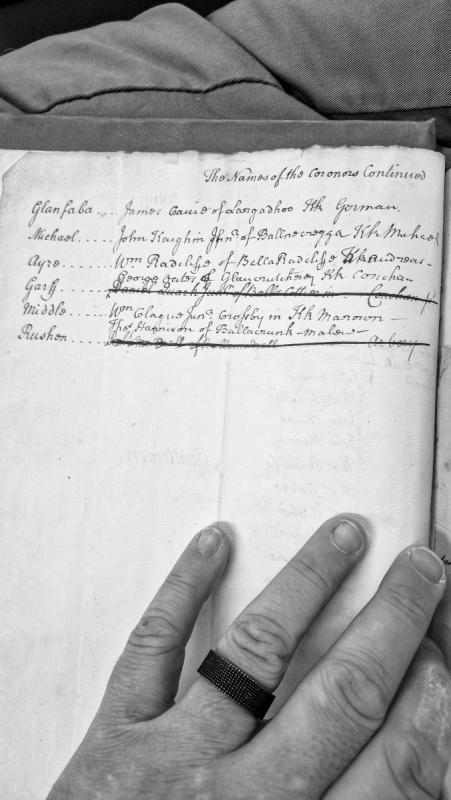
A continuation of a list naming coronors (coroners) for various Manx parishes including Glanfaba, Michael, Ayre, Garff, Middle, and Rushen, with their residences and associated districts. Some entries are crossed out or illegible, suggesting this is a draft or working document.
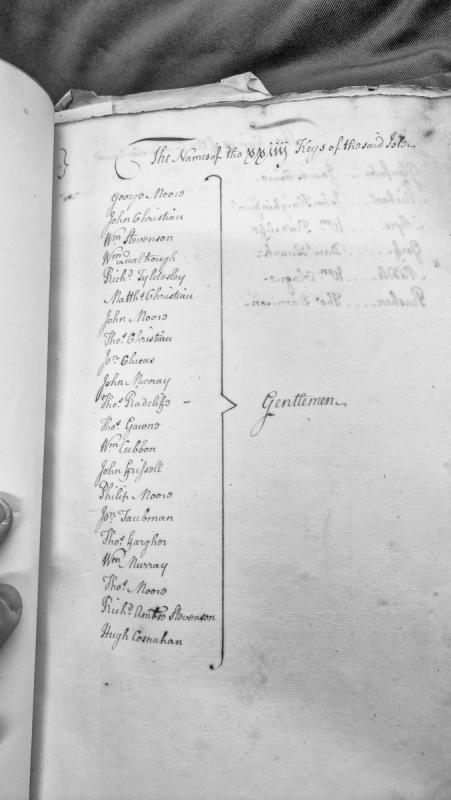
A register of the twenty-four members (Keys) of the House of Keys legislative body of the Isle of Man. The document lists the names of gentlemen serving in this capacity, though the exact date of composition is not specified in the transcription.
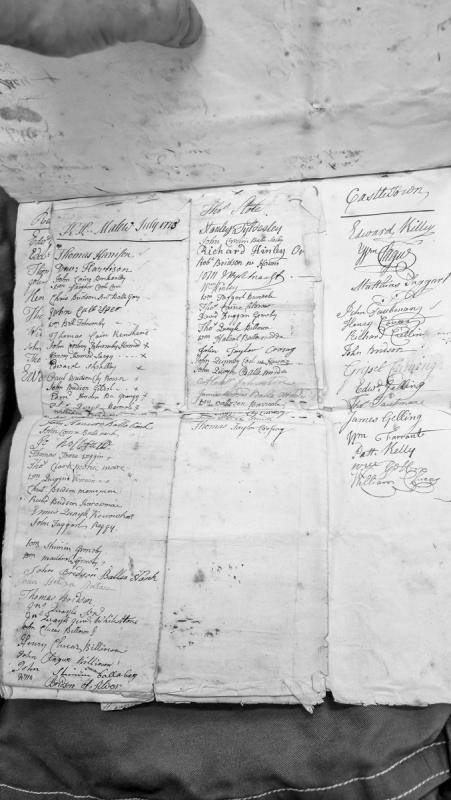
A handwritten document from July 1773 listing numerous names of individuals associated with various parishes and locations across the Isle of Man. The document appears to be an administrative or census-related record, with names organized by geographical location. Many entries contain place names and personal identifiers, though legibility is significantly compromised throughout.
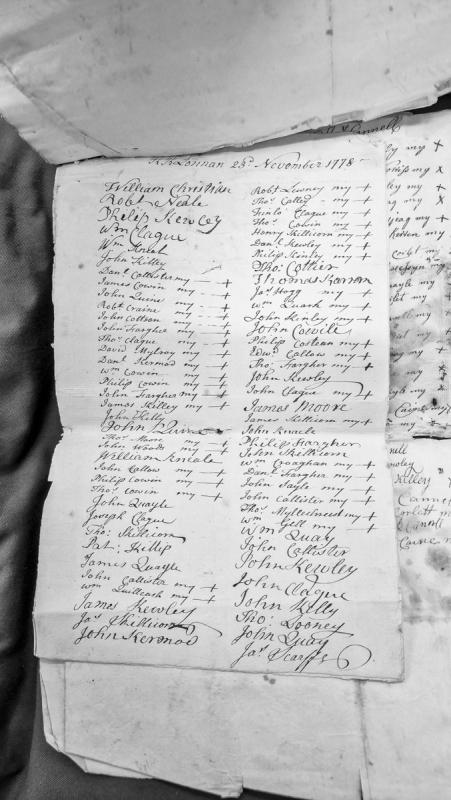
A document listing approximately 80 names from K.K. Lonnan (Kirkby, Kirk Lonan parish) dated 23 November 1778. Many names are marked with 'my' and '+' symbols, possibly indicating some form of parochial or manorial listing, tax assessment, or household enumeration. The purpose and significance of the marks remains unclear without additional context.
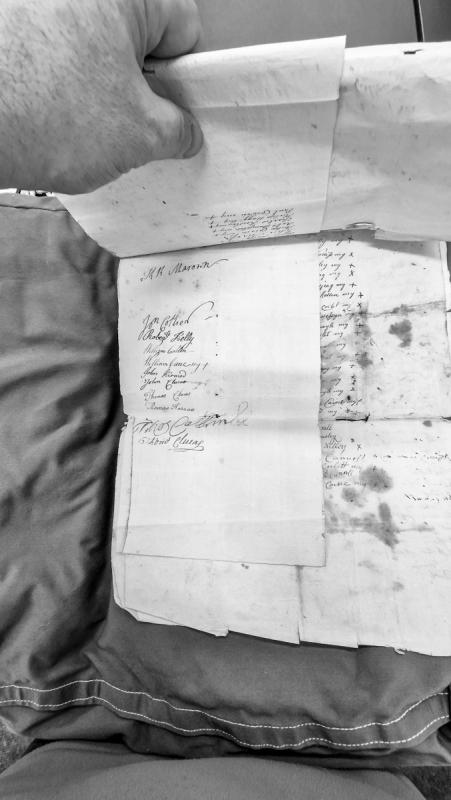
A manuscript list of names from the Marown parish, organized in two columns with various marks ('+', 'x', 'my') beside entries. The right column is substantially obscured by staining and damage. The document appears to be a record or register of local residents.