Worked prehistoric flint of Mesolithic (heavy bladed) type, including flakes, blades and a scraper, found in Ordnance Survey Field no. 1528, Lower Ballavarkish, Arbory. The material was found towards the southern side of the field.
The artefacts are in the Manx National Heritage collections, accession no. 1986-0046.
Worked and unworked flint found in Ordnance Survey Field no. 1528, Lower Ballavarkish, Arbory. The worked flints are of late Mesolithic (heavy bladed) character, whilst the unworked flint demonstrates the type of raw material potentially available in the past.
The artefacts are in the Manx National Heritage collections, accession no. 1986-0261.
The grid reference is centred on the middle of the field.
Worked prehistoric flint of Mesolithic (heavy bladed) type, found in Ordnance Survey Field no. 1526, Lower Ballavarkish, Arbory.
The precise findspot is not recorded and the grid reference refers to the centre of the field.
The artefacts are in the Manx National Heritage collections, accession no. 1986-0262.
The Lower Lighthouse is one of a pair of lighthouses built in 1818 on the Calf of Man, the small island off the Isle of Man's south-western tip, under the Isle of Man and Calf of Man Lighthouses Act 1815. It was designed by the noted Scottish lighthouse engineer Robert Stevenson to warn shipping of the Chicken Rock reef lying off the Calf's southern end. Together with its twin, the Upper Lighthouse, it guided mariners for over half a century until 1875, when both were superseded by a single new lighthouse built directly on Chicken Rock itself, better placed to warn ships in foggy conditions. The two early Calf lighthouses have been disused as navigational aids ever since, though they survive as among the oldest lighthouse structures associated with the Isle of Man.
Lighthouse. This lighthouse, together with its twin nearby, was built in 1818 for the Northern Lighthouse Board to the designs of Robert Stevenson, one of the Board's most famous engineers.
The two lighthouses worked in tandem, indicating to passing ships if they were in danger of colliding with the Chicken Rock nearly 2km to the south. The Stevenson lighthouses were replaced by a lighthouse on the Chicken Rock itself in 1875, after several difficult years of construction. More recently a modern light, warning of the dangers of the Calf of Man itself rather than the sinister reef to the south, was installed close to the old Stevenson towers in 1967, but this was decommissioned in 2007 as unnecessary in the modern age of satellite-enabled navigation and global positioning. The Chicken light was upgraded at the same time so that its light is visible from a distance of 21 miles.
In common with many of the NLB's installations, each lighthouse was attached to a keeper's house, with adjoining garden and other basic facilities. The buildings are now maintained as nesting sites for birdlife in keeping with the status of the Calf of Man as a nature reserve and bird observatory.
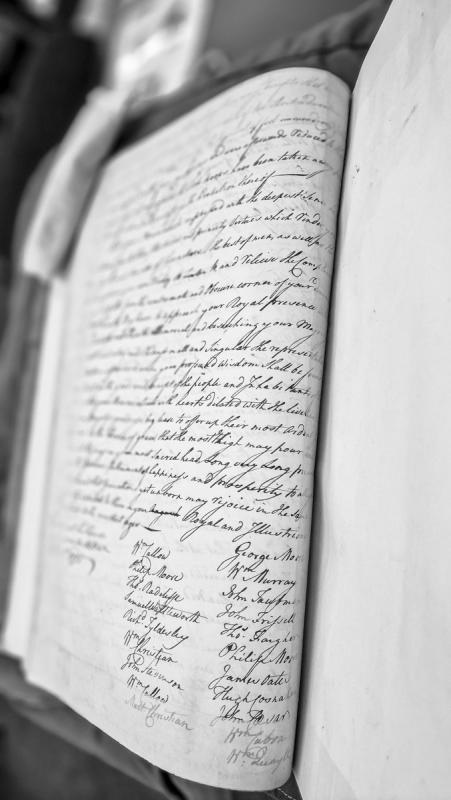
A fragmentary loyal address, likely from the House of Keys to the reigning monarch, expressing devotion and seeking royal guidance. The document conveys the representatives' deep concern for the welfare of the Isle of Man and its people, with prayers for the monarch's long life and prosperity. Significant portions are obscured due to photography angle and document damage.
"Round Ellan" or "Loyal Fort" is a circular earthwork of unknown purpose and date. It is visible on modern aerial photographs and the present field boundaries respect its present, curving around the outside of its western and southern sides. A rim sherd of poorly glazed micaceous ware, considered to be 'medieval' as been found just inside east margin of the plateau surrounded by the earthwork and are now kept at the Manx Museum (Accession No. 1967-0125).
Stone cists have been reported in the past as being uncovered whilst digging drainage trenches in the field to the east of the enclosure. The authorities given for this information were the Venerable Archdeacon J.C. Moore. M.A., Mr F. Ratcliffe, and Mr D. Quirk, Kirk Andreas.
A lengthy letter from Lieutenant Governor Alex Shaw to the Duke of Atholl discussing parliamentary addresses, the threat of French invasion, proposals to garrison prisoners of war on Langness, legislative measures against smuggling (wine and salt trade), and broader concerns about effective governance and administrative harmony on the Isle of Man. Reflects contemporary tensions over smuggling enforcement, political dysfunction, and the relationship between the Island's government and Westminster.
Letter from Lieutenant Governor Alexander Shaw to the Duke of Atholl discussing Island governance, potential prisoner-of-war depot at Langness, legislative remedies for smuggling (wine, salt), creditor laws, and the need for effective government presence. Shaw advocates for the Duke as Governor-in-Chief and discusses tensions between administrative efficiency and party politics on the Island during the Napoleonic Wars.
Letter from Lieutenant Governor Alex Shaw to the Duke of Atholl reporting on anti-smuggling operations, suspected arms caches at Port Erin intended for Ireland, seizure of contraband wine and tobacco, and measures to control the smuggling trade. Reflects post-Revestment governance challenges and the effectiveness of revenue enforcement under the new Crown jurisdiction.
Letter from Lieutenant Governor Alexander Shaw to the Duke of Atholl reporting on smuggling activity, suspected arms shipments to Ireland, seizures of contraband at Port Erin, and challenges in enforcing revenue laws on the Isle of Man. Shaw requests greater military resources and advocates for duty allowances on gin and brandy to undercut smugglers. Provides insight into post-Revestment governance challenges and the persistence of the running trade.
Letter from Lieutenant Governor Alexander Shaw to Home Secretary Lord Pelham reporting on Irish arrivals to the Isle of Man following the Dublin disturbances of July 1803. Shaw details security measures implemented to register and examine strangers, including three or more Roman Catholic priests, and expresses concerns about potential political refugees or fugitives. The letter contextualizes post-rebellion security protocols and military preparedness on the island.
Letter from Lieutenant Governor Alexander Shaw to Home Secretary Lord Pelham reporting on the arrival of Irish strangers on the Isle of Man following the 1803 Dublin disturbance (Robert Emmet's rebellion). Shaw describes measures taken to register and examine suspicious arrivals, including several Catholic priests, and requests military reinforcement for Castle Rushen. While post-dating the Revestment by 38 years, this document illustrates the Island's strategic importance in security matters and cross-Irish Sea movements.
Letter from newly arrived Lieutenant Governor Charles Smelt to Home Office official John King reporting on repairs to Castle Rushen Government House and requesting permission for a month's leave to England to obtain furniture and prepare his family. Includes contemporary newspaper notice of the auction sale of his predecessor's household effects, providing context on conditions for incoming governors.
Letter from Lieutenant Governor Charles Smelt to John King at the Home Office, dated 25 July 1805, reporting on repairs to Government House in Castle Rushen and requesting permission to travel to England for one month to prepare his family for relocation to the Isle of Man. Accompanied by editorial notes on the auction of his predecessor Alexander Shaw's household goods (1804) and commentary on post-Revestment property arrangements.
Letter from Lieutenant Governor John Dawson to Governor Smith expressing concern about the Duke of Atholl's planned visit to the Isle of Man. Dawson fears public disorder and lack of proper royal dignity, and seeks advance knowledge of his instructions from the Secretary of State. The letter reflects tensions between the Duke's residual authority and the Crown's governorship on the island.
A letter from Isle of Man's Lieutenant Governor Dawson to Governor Smith expressing concern about the Duke of Atholl's planned visit to the island on 13 June 1788. Dawson fears public adulation of the Duke will undermine Crown authority and requests advance notice of any instructions from the Secretary of State regarding the visit.
Lieutenant Governor R. Dawson reports to his superior on a dispute over possession of the court room in Douglas. The Duke of Atholl's agent claims the room on behalf of the Duke, but Dawson argues it was surrendered to the Crown under the Vesting Act and should remain in royal possession until legal title is demonstrated. The letter details how the room fell into the Seneschal's hands through an informal arrangement with the Clerk of the Rolls.