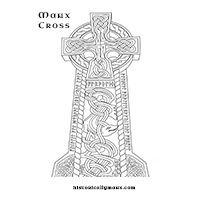
3 names listed by year of death; First World War. Grey-green slate with inscriptions in gold. The memorial was unveiled by Sir William Fry, Governor of the Isle of Man, on Thursday 25 May 1922 in its original location of the Old Courthouse. It was moved to its present location in May 1979 when the Old Courthouse was demolished.
Memorial designed by Archibald Knox and executed by Mr Thomas Quayle of Douglas.
The Manx Choral Society in Cleveland, Ohio, was a musical organisation serving the Manx diaspora community in the city. Cleveland's estimated 25,000 to 30,000 people of Manx origin sustained a vibrant cultural life, with the Choral Society reflecting the strong traditions of communal music-making brought from the Island.
Comparative table of customs duty rates on imports and exports in the Isle of Man across four centuries (1577, 1677, 1692), differentiated by native and foreign merchants. Covers staple commodities including agricultural products, alcohol, textiles, and colonial goods. Directly relevant to understanding the revenue base and trade patterns that made the Revestment fiscally significant.
Customs administration operated under the Lords of Man before the Crown acquired the Island in 1765.
Before Revestment, the Manx customs system belonged to the lordly administration rather than to the British customs service. Duties on goods entering and leaving the Island formed an important part of the Lord’s revenue, and customs officers operated at Manx ports under local authority.
The system sat at the centre of the eighteenth-century running trade. Goods could be imported into Mann under Manx duties which were substantially lower than those imposed in Britain and Ireland. Tea, tobacco, spirits, wine, silk and other goods were then sold to merchants and smugglers who carried them across the surrounding seas.
British officials increasingly treated the Manx customs structure as a major weakness in imperial revenue enforcement. Parliamentary reports on customs fraud repeatedly referred to tobacco being re-landed or smuggled through Mann, while Whitehaven merchants complained that Manx tobacco manufacture and re-export damaged their lawful trade.
The local administration nevertheless remained a functioning revenue system in its own right. Manx officials collected the Lord’s duties, kept accounts and enforced the Island’s own customs legislation. The distinction between this lawful Manx system and the illicit landing of goods elsewhere was fundamental to the disputes surrounding the running trade.
The 1765 purchase transferred the lordly customs revenues and administrative authority to the Crown. The existing Manx arrangement was then replaced by a Crown customs establishment operating under British authority.
A popular historical essay tracing the Standish family's connections to the Isle of Man and arguing that Myles Standish and his wife Rose (and later her sister Barbara) were of Manx origin before emigrating aboard the Mayflower in 1620. The work examines family genealogy, Manx Church records, property entailments, and the Standish family's subsequent role in Manx political life, including House of Keys membership.
Locally raised military force formed for the defence of the Isle of Man during the later eighteenth century.
The proposal emerged during the renewed threat of war in 1779. Lieutenant-Governor Dawson reported that the Island required stronger defence and suggested raising companies of fencibles alongside a request for regular troops. The Keys also discussed measures for increasing the available manpower.
By August 1779 Dawson was asking for 300 regular troops and considering three companies of fencibles. The surviving correspondence then records lists of potential officers and negotiations with the Duke of Atholl, the Keys and ministers in London.
The force proved difficult to organise. In February 1780 Dawson sent a report which included a memorial from the Keys and described serious problems with enlistment. The Duke of Atholl separately offered to fund and appoint the officers of one company, arguing from his position as the largest territorial proprietor on the Island.
The Fencibles remained part of Manx defence planning until the return of peace. In February 1783 Dawson reported on the probable disbandment of the force, while continuing to argue that the Island still required troops.
The name survived into later military administration. Home Office papers from 1807 include correspondence over the cost of providing sentry boxes for the Manx Fencibles, showing that locally raised defensive forces continued to form part of the Island’s military establishment.
The native language of the Isle of Man, a Goidelic Celtic language closely related to Irish and Scottish Gaelic. Spoken on the Island since at least the fifth century. By the eighteenth century, the vast majority of the population spoke Manx: of 20,000 people, few knew English. The language was the medium through which the island knew itself. Without it, the identity survived but in diminished form, like a landscape seen through glass. The first printed book in Manx was Wilson's Coyrle Sodjeh in 1707. The complete Bible was finished in 1772, seven years after the Revestment. The language went from universal to extinct in two hundred years. Ned Maddrell, the last native speaker, died in 1974. But the revival began before he died, and by 2011, 1,823 people claimed some ability in Manx. UNESCO reclassified it from extinct to critically endangered.
The Manx Grand Prix began on 20 September 1923 as the Manx Amateur Motor Cycle Road Race Championships, founded by the Manx Motor Cycle Club as a response to concerns that the TT was becoming dominated by professional, factory-backed riders. The first races, for amateurs and private entrants only, covered five laps (one fewer than the TT) in a single 500cc class, with a special award for the best 350cc performance. The event was renamed the Manx Grand Prix in 1930 and has continued as the amateur counterpart to the TT ever since, distinct from the TT's own racing history and records.
The language lived longer in Ohio than it would live on the Isle of Man. Thomas Kelly's letter from Ohio in 1828 dropped into Manx twice. On the night the emigrants arrived, thirty-three Manx people gathered in one house and Manx was spoken in plenty. Pastor Cannell held services in Manx. George Borrow met a woman whose son lived in a place where Manx was spoken. But the arc was the same: Manx spoken freely by the first generation, used as a secret parents' language within a generation, then gone. The institutional supports were unnecessary in Ohio because the Manx had each other. But as the community dispersed, the language dispersed with it.
Cycle racing on the TT Mountain Course began with the 'Bicycle TT' in 1936, when organiser Curwen Clague staged a single-lap massed-start race for 100 riders on 18 June 1936. It grew into the Manx International Cycle Week, run continuously (barring wartime interruption) until 2003, attracting Tour de France winners including Fausto Coppi, Jacques Anquetil, Laurent Fignon and Eddy Merckx, as well as riders such as Sean Kelly, Tom Simpson and Robert Millar. Competitors were locally nicknamed 'the silent ones' in contrast to the roaring motorcycles of the TT.
The language lived longer in Ohio than it would live on Mann. In the 1830s and 1840s, Manx was still a living tongue in Ohio — spoken in homes, in chapel, in the fields where they cleared the American forest. Pastor Cannell, the seventy-two-year-old Wesleyan who had crossed on the Ocean, held services in Manx in his own log house. No Governor could withdraw it. No bishop could declare it unnecessary. No school board could replace it with English, because there were no schools in the Ohio settlements that the Manx had not built themselves. The language died in Ohio too, eventually. Margaret Murray remembered the same pattern as on the island: the old folks would talk Manx when they did not want the children to understand. But for a time, the institutional supports that had sustained Manx on the island and been removed by the Revestment were unnecessary in Ohio — the Manx people had each other.
The Manx Museum in Douglas opened on 2 November 1922 in a former hospital building on Crellin's Hill, following passage of the Museum and Ancient Monuments Act 1886, which established a national institution to safeguard the island's heritage. After Noble's Hospital relocated in 1912, the vacated building passed to museum trustees; under founding director P. M. C. Kermode it developed collections spanning some 10,000 years of Manx history, from the Stone Age to the present. A major redevelopment between 1986 and 1989 added a lecture theatre, cinema, and art gallery, and Queen Elizabeth II formally reopened the expanded museum in 1989. Today it is run by Manx National Heritage and shares its site with the National Art Gallery and the Manx National Library and Archives, hosting permanent archaeology and natural history galleries alongside changing temporary exhibitions.
A record for the Manx Northern Railway which was a 3-foot gauge railway line which operated from 1877. In 1904, it amalgamated with the Isle of Man Railway. It ran from St John's to Ramsey, via Kirk Michael, Ballaugh and Sulby. The railway closed to passengers in 1968, and was dismantled in the 1970s.
A record for the Manx Northern Railway which was a 3-foot gauge line which operated from 1877. In 1904, it amalgamated with the Isle of Man Railway. It ran between St John's to Ramsey from grid reference SC 272819 to SC 448946, via Michael. The railway closed to passengers in 1968.
The site of the terminus station of the Manx Northern Railway, which is now built over. This was a 3-foot narrow-gauge line, completed in 1877 and amalgamated with the Isle of Man Railway in 1904. It ran from St John's to Ramsey, via Kirk Michael, Ballaugh and Sulby. The railway closed to passengers in 1968, and was dismantled in the 1970s.
A copyright notice from the Manx Notebook website clarifying the terms of use for HTML editions of scanned historical texts. It asserts copyright over the digital edition while acknowledging that underlying source texts are out of copyright, and sets conditions for linking and reproduction.
Contact page for the Manx Notebook website, providing editor Frances Coakley's email and instructions for research inquiries. Notes her substantial Manx library (1500+ monographs, maps, prints) and research support capabilities. Indicates the site contains 15,000+ pages of Manx historical content and references availability of a CD-ROM archive.
An annotated bibliography and index page cataloguing full-text transcriptions of books, documents, and extracts relating to Isle of Man history, society, and culture. The collection spans from 1656 to 1950, including primary sources, travel accounts, historical studies, and genealogical works. Relevant to the Revestment project as it identifies key contemporary sources from the 1765 period and contextual historical materials.