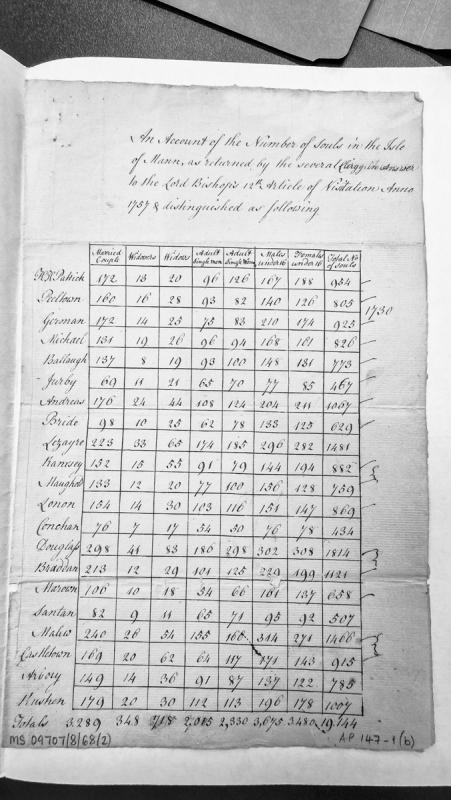
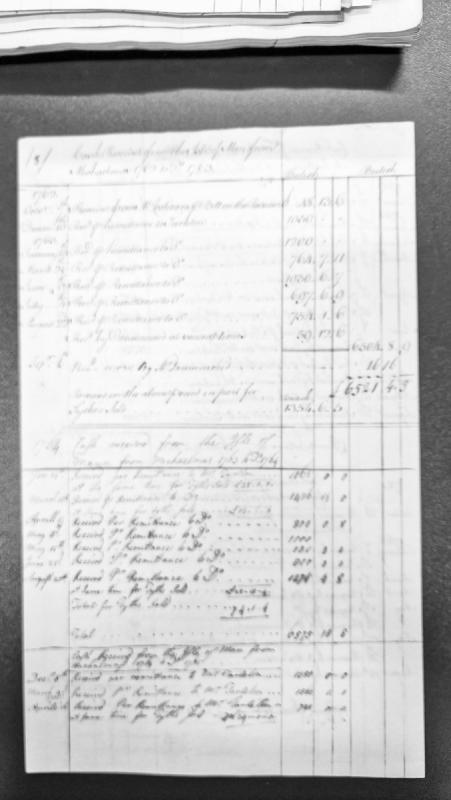
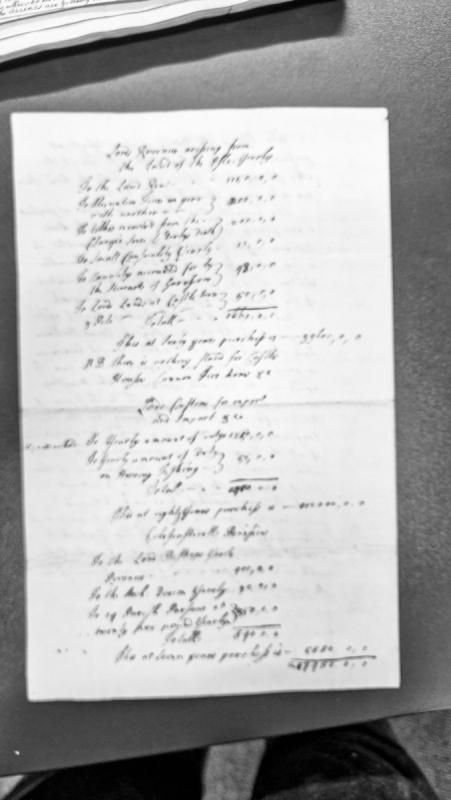
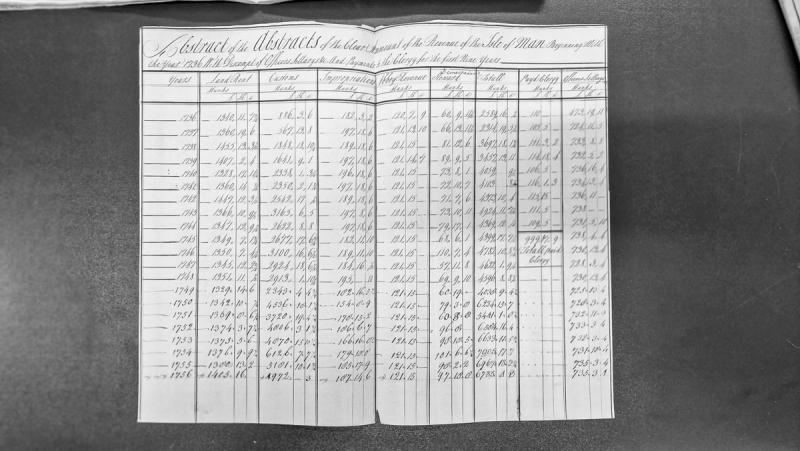
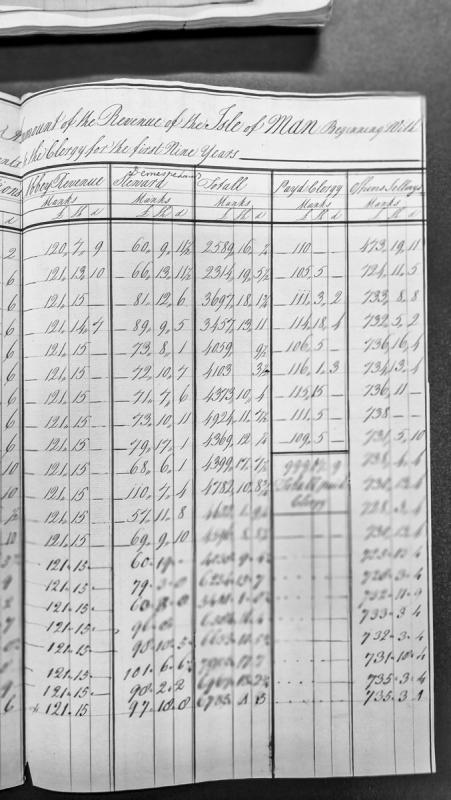
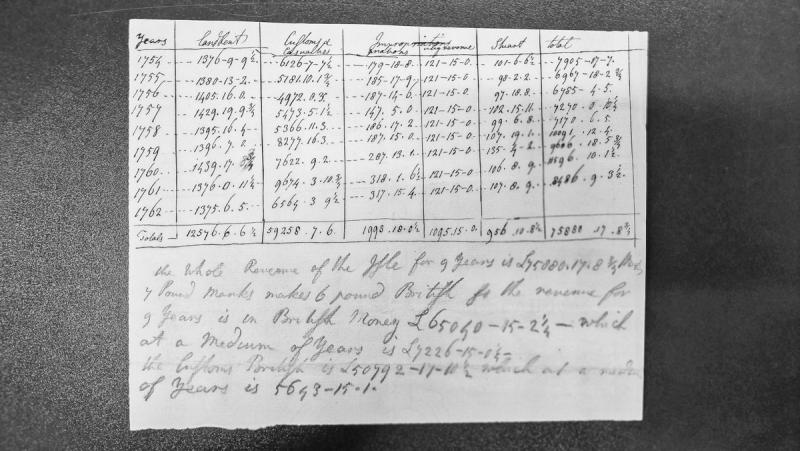
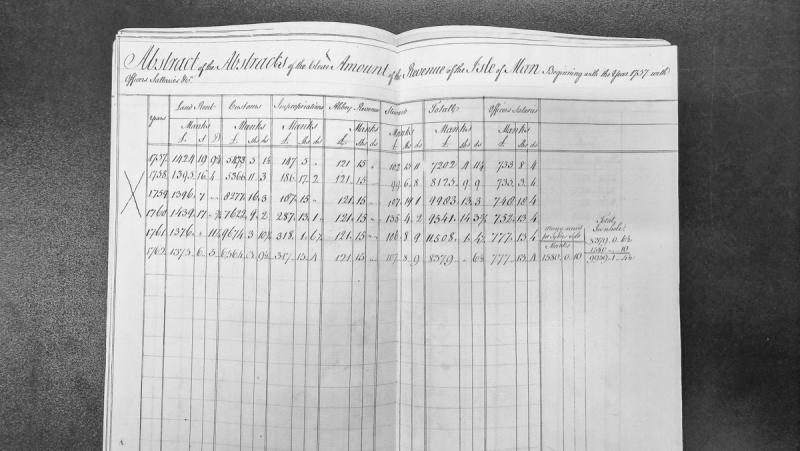
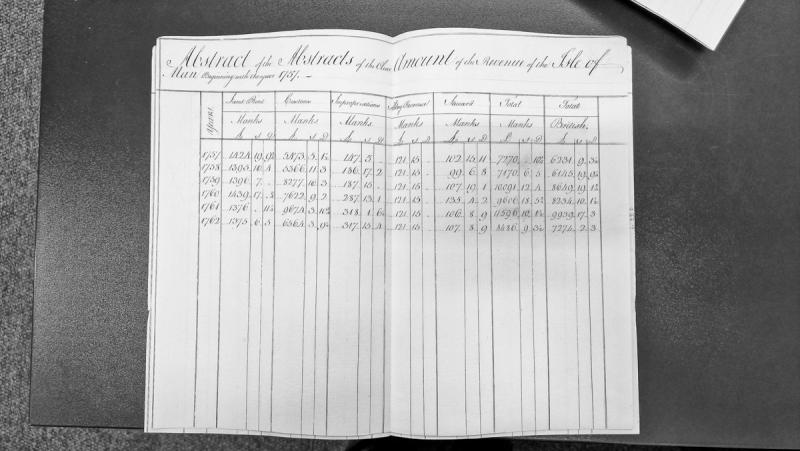
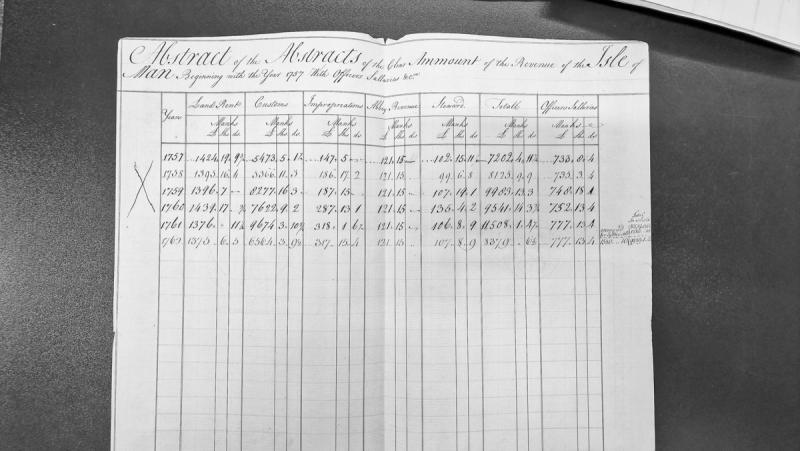
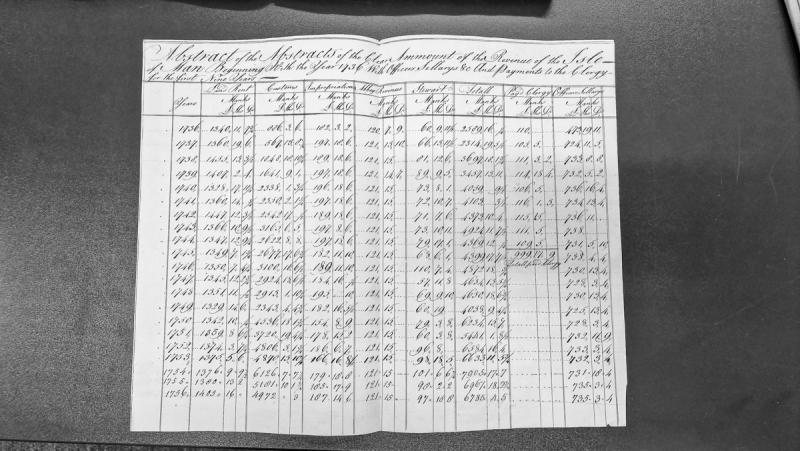
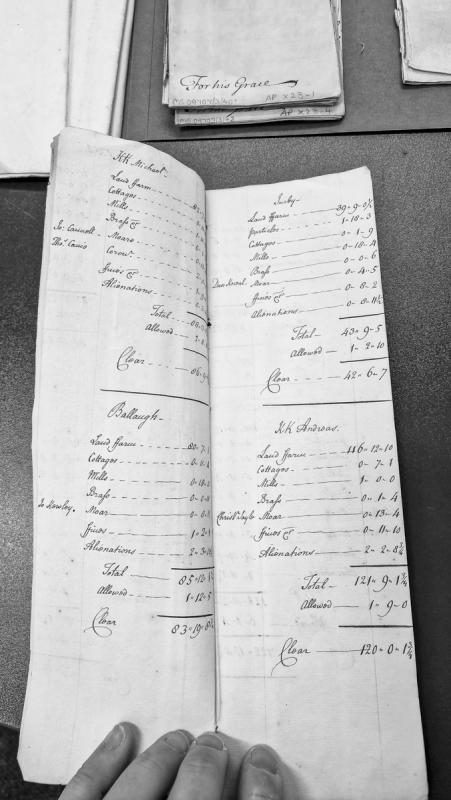
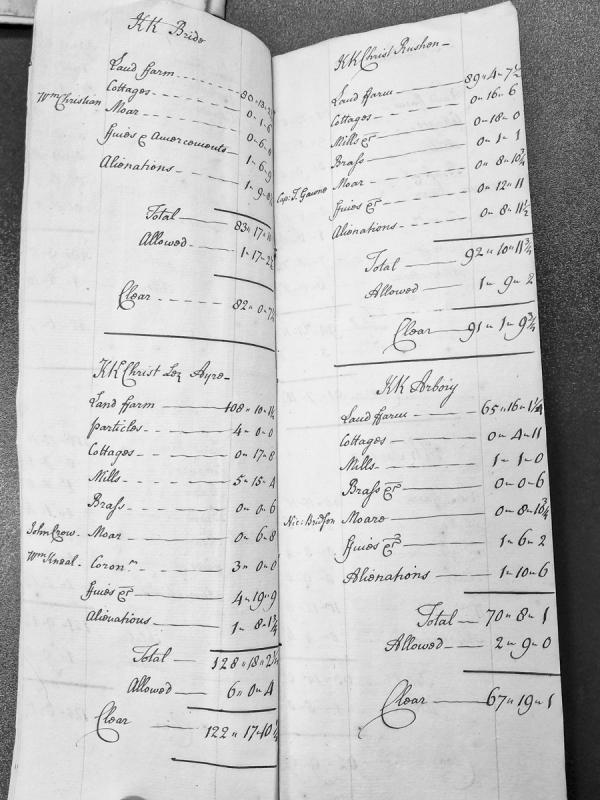
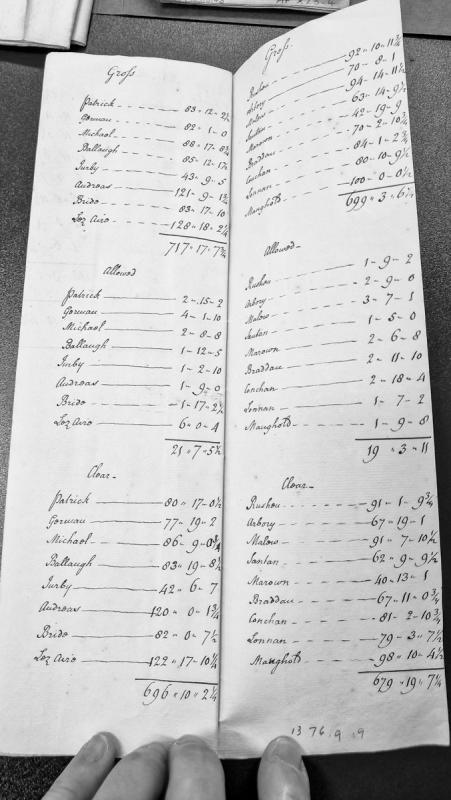
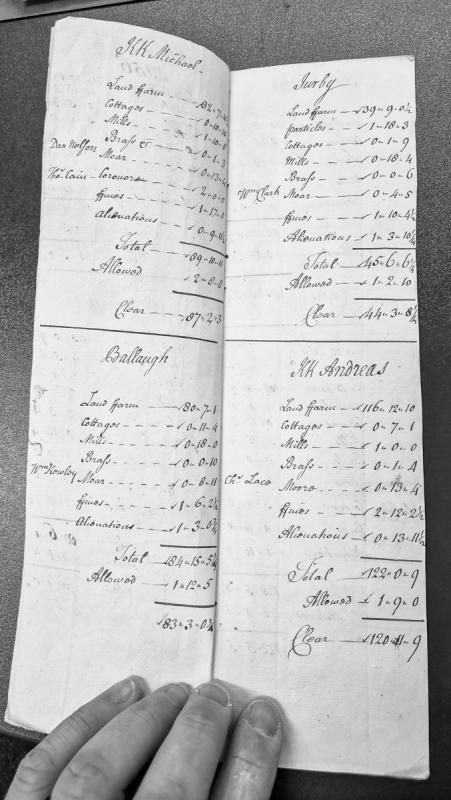
A tabular revenue abstract or statistical summary organized by Manx parishes and districts, with numerical data across eight columns totaling 19,144. The document appears to be administrative record-keeping, possibly relating to taxation, population, or property valuation by parish.
This former warehouse was built in 1866 by Richard Rowe, the Captain of the Laxey Mines and was used as a grain store for the Laxey Glen Flour Mill and also for storing coal and corn. It was used as a smoking pipe factory from the 1960s until closure in the early 21st century.
The four storey building is constructed of stone with a hipped slate roof. The rectangular plan has been retained but otherwise the building has been completely renovated. The north facade has been left in approximately its original expression. The other elevations have been altered due to modernisation, particularly the main entrance from the quay. With the replacement of the original roof the attic space has been finished and a series of roof lights installed with superimposed ventilators. The four storeys of the main building have been retained. The building is set directly on the quayside with no enclosing parcel of land. No interior inspection has been made. The present state of repair appears excellent. The building represents a fine example of Manx stone industrial building.
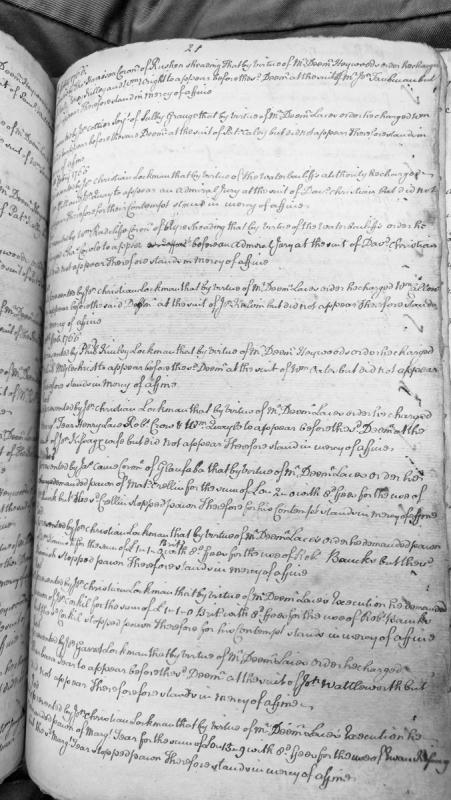
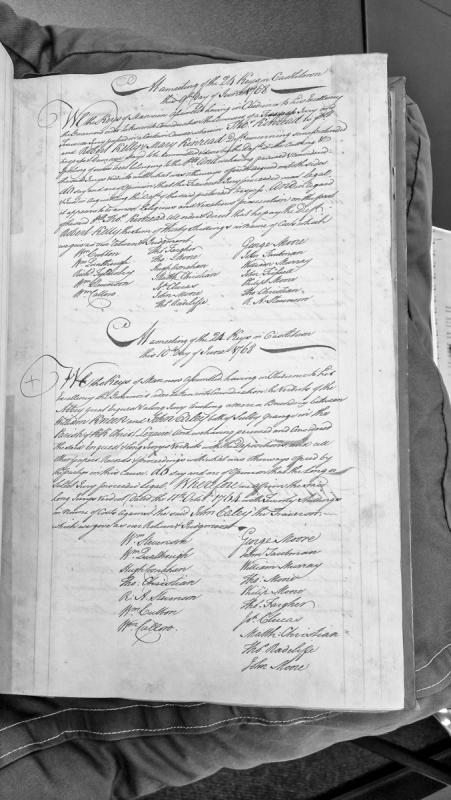
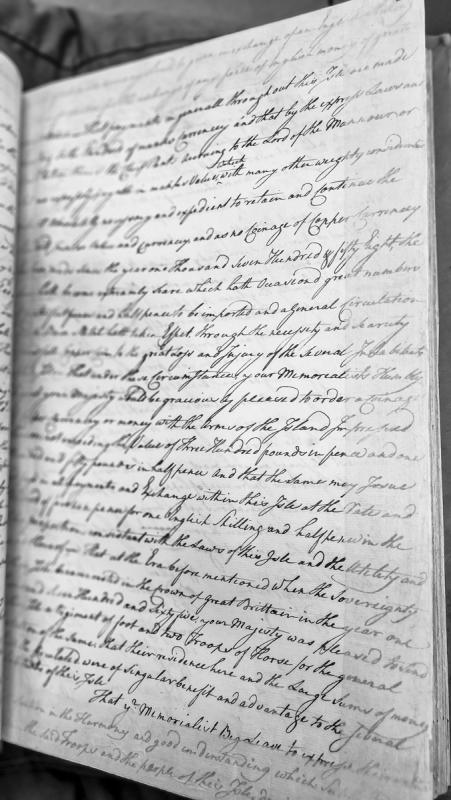
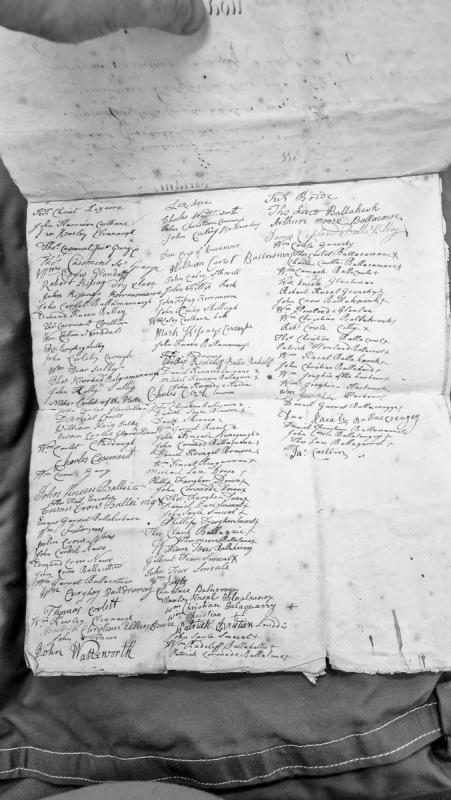
This is a metadata entry for a transcription project at the Manx Museum, indicating an automated transcription was generated on 2026-02-25. The source image reference is provided but the actual document content is not included in this file.
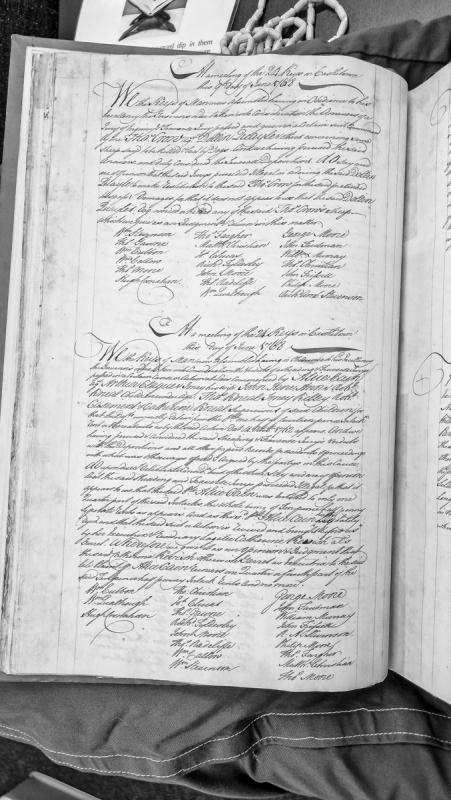
This is a metadata record for an automated transcription from the Manx Primary Source Archive. The actual document content is not present in the transcription file provided, only header information about the transcription process and source image reference.
This is a metadata record for a transcribed document from the Manx Primary Source Archive. The source image file is identified as 20260218_124832.jpg, with transcription completed on 2026-02-25 using automated processing via Claude Batch API.
This is a metadata header for an archived transcription, indicating automated processing of a Manx historical source. No substantive document content is present in the transcription provided.
This is a metadata record for an automated transcription from the Manx Primary Source Archive, indicating a source image file but containing no actual document content to analyse.
This is a metadata header for a transcription from the Manx Museum's archival collection, indicating an automated transcription was performed on 2026-02-25. The actual document content is not present in the provided text.
This is a metadata record for a transcription from the Manx Primary Source Archive, indicating an automated transcription was performed on 25 February 2026 using Claude Batch API. The actual document content is not present in the provided text.
Metadata record for a Manx Museum archival item. The transcription appears to be incomplete or consists only of header information without substantive document content.
This is a metadata record for an automated transcription from the Manx Primary Source Archive, indicating an image file was processed but no document content is present in the provided transcription.
This is a metadata header from an automated transcription of a Manx Museum document. The actual document content is not present in the provided transcription file, which contains only the processing metadata indicating the source image file, transcription date, and method used.
This is a metadata header from an automated transcription process for a Manx Museum manuscript. The actual document content is not present in the provided transcription file—only the processing metadata is visible.
This is a metadata header for a transcribed Manx primary source document. It records the source image file, transcription date, and transcription method but contains no actual document content to analyze.
This is a metadata header from an automated transcription process, indicating a document from the Manx Primary Source Archive has been processed. The actual document content is not included in this transcription file.
This is a metadata record for a transcribed primary source from the Manx Museum archive, showing transcription details rather than the actual historical document content. The transcription was completed on 2026-02-25 using automated processing.
This is a metadata header record from the Manx Primary Source Archive indicating a transcribed document. The record provides source image reference, transcription date, and processing method but contains no actual document content for analysis.
This is a metadata record for a document transcription from the Manx Primary Source Archive. The actual document content is not provided in this transcription file, which only contains header information about the transcription process and file references.
This is a metadata record for a transcription workflow, not a historical document itself. It indicates an automated transcription was processed through the Claude Batch API on 2026-02-25, but the actual document content is not included in this file.
This is a metadata record for an automated transcription from the Manx Museum archive, indicating a source image file and transcription processing details. No actual document content is present.
On 21 October 1805, the combined fleets of France and Spain met the Royal Navy off Cape Trafalgar. Manx sailors were there — because the herring fleet had trained them, because the Irish Sea had hardened them, because the press gangs had taken them or because, impoverished with no work at home, they had volunteered for the only employer hiring. They carried Manx names — Quilliam, Cawle, Bainbridge, Christian, Crow — and served on Nelson's ships alongside men who had never heard of Tynwald Hill. The battle that would be remembered as the greatest moment in British naval history was fought, in part, by men from an island whose own parliament had been silenced and whose harbours had been left to rot.
First World War One of the ceramic First World War Centenary poppies that were laid out at the Tower of London in 2014, in a glazed wooden case with sloping top on the underside of which is laser-cut an inscription. Positioned on a shelf immediately below the First World War and Second World War memorial tablets in St Columbas Church, Arbory.
Copper-mining district in the northern Rocky Mountains which drew Manx miners from the late nineteenth century.
Montana has produced copper for something over eighty years, principally around Butte, a site which has been called the richest hill on earth. Silver, gold, lead and zinc were worked there as well. The district's Manx element was strong enough to support a branch of the North American Manx Association, and the men who went out included Wilson Jenkinson, a Foxdale miner whose great-grandfather had come from the English Lake District.
The connection is one of skill rather than of chance. Foxdale was the Island's own lead and zinc field, and the mining districts of Montana recruited the kind of men it trained.
Nothing further about the settlement survives in the corpus consulted. Of the sixteen passages returned for this item, fifteen are false positives on the word Butte, mostly Butteland in Northumberland, the Earl of Bute and the Butte de Tumiac in Brittany.
Chicago attracted Manx settlers particularly after the great fire of 1871, when reconstruction work brought over many Manx builders and carpenters. By the mid-twentieth century, the city contained a substantial population of Manx descent, with about half of the North American Manx Association's Illinois membership residing in and around Chicago.
The Manx had reached Illinois well before the city drew them. Although the state entered the Union in 1818 its settlement was not rapid, because access from the east was awkward until the railway got through to Chicago from Detroit in 1852. The easier way in was from the south, by New Orleans and the Mississippi, and that was the route the first recorded Manx settlers took: the Kelly family from Onchan. Small groups of farmers from the Island arrived at Brimfield in 1848 and 1849 and spread from there into the adjoining counties, so the Galva and Peoria districts can claim to be the oldest Manx settlements in the state. Most of the association's Illinois members outside Chicago still lived in those districts in the 1950s.
Chicago itself drew Manx people from other parts of North America as well as directly from the Island. One of them turned the city's growth to account: in 1884 John J. Keig from Ballaugh was opening trading posts and carting produce to and from Chicago along the old plank roads. No estimate has ever been made of how many people of some Manx descent the city holds, and they are found in a wide variety of occupations.
Galva, in the north-central section of Illinois, was settled by Manx farming families from 1848 and 1849 onwards, with emigrants coming particularly from Onchan, Crosby, Peel, and northern parishes such as Bride and Andreas. The Galva Manx Society held meetings attended by several hundred persons, and the settlement formed part of a broader Manx presence across the Illinois prairie farmlands.