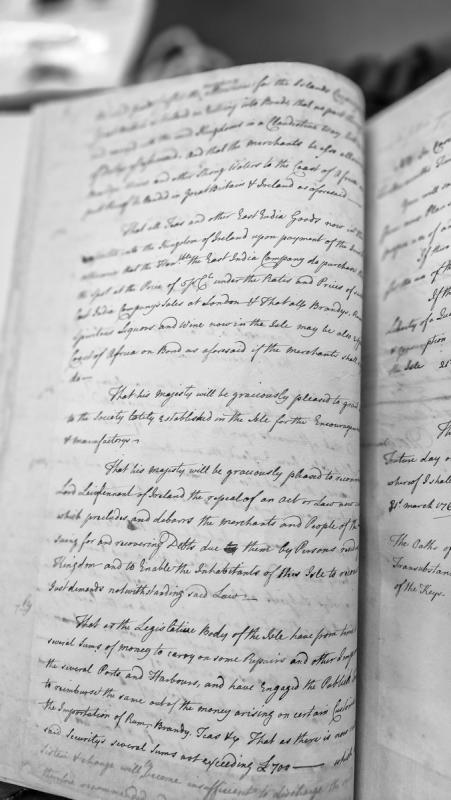
Comparative text of the oath sworn by members of the House of Keys (Tynwald's lower house) before and after the 1765 Revestment. The pre-Revestment oath pledged allegiance to the Duke of Atholl as Lord of Man; the post-Revestment version transfers allegiance to the Crown. This document is part of a 1792 Commissioners' Inquiry report and directly illustrates the constitutional shift effected by the Revestment.
A partially legible document from March 1763 (or nearby year) relating to oaths, possibly transubstantiation oaths, associated with the House of Keys. The right-hand page is heavily obscured with multiple illegible sections.
Two versions of the oath of allegiance required of the Bishop of Man in 1608 (6 Jas. I). The first oath swears loyalty to the heirs of the Isle and the Captain/Governor; the second swears loyalty to Robert Cecil (Earl of Salisbury) and Thomas Howard (Earl of Suffolk) as representatives of the Crown's interest, and to William Stanley (Earl of Derby) as the hereditary lord. This document illustrates the constitutional and political relationships governing the Isle of Man under early Stuart rule and the division of authority between Crown interests and the Stanley lordship.
Two versions of the oath required of the Bishop of Man in 1608 under James I, showing the shift from allegiance to the heirs of the Isle to specific English nobles (Robert Cecil, Earl of Salisbury and Lord Treasurer; Thomas Howard, Earl of Suffolk; and William Stanley, Earl of Derby). Demonstrates the evolving constitutional relationship between the Isle of Man and English Crown interests, and the role of powerful English lords in governing the island.
The site of a Bronze Age burial cist recorded on an annotated 1:10560 scale map produced by P.M.C. Kermode. It measured 0.8 metres by 0.6 metres and, elsewhere, Kermode states that it was composed of thin slabs and contained ashes.
A burial cist noted by P.M.C. Kermode, who recorded that 'When the old highway quarry at Ballavale was being cleared, there was found a small Cist of thin slabs, 2 foot 9 inch square by 2 foot deep, with ashes. This was close to the OS Triangulation mark, 393 feet.' There may be some confusion between this record and PRN 0504.10.
The site of an early medieval cemetery recorded on an annotated 1:10560 scale map produced by P.M.C. Kermode. Its proximity to the Bronze Age burial cist PRN 2202.00 suggests that one or the other of these records may be erroneous.
The reported site of a stone circle or possible a ruined round barrow with its kerb stones exposed. A stone axehead is said to have been found here also.
Kermode recorded that 'When the old highway quarry at Ballavale was being cleared, there was found a small Cist of thin slabs, 2 foot 9 inch square by 2 foot deep, with ashes. This was close to the OS Triangulation mark, 393 feet.'
In the nearby granite quarry, circa 1900, Mr T.W. Moore on clearing the ground found stone axeheads (kept at the Manx Museum, Accession Nos. 1954-0600 & 1954-0591) and pounders (Accession Nos. 1954-0620 & 1954-1654) in what appeared to have been a circle of stones.
The Neolithic/Bronze Age implements are listed under 'Oatland' or 'Oatland Granite Quarry' with the addition of a stone axehead chipped to sharp edges, the cutting end ground and polished, Accession No. 1954-1653 donated by Mr R. Lace in 1918.
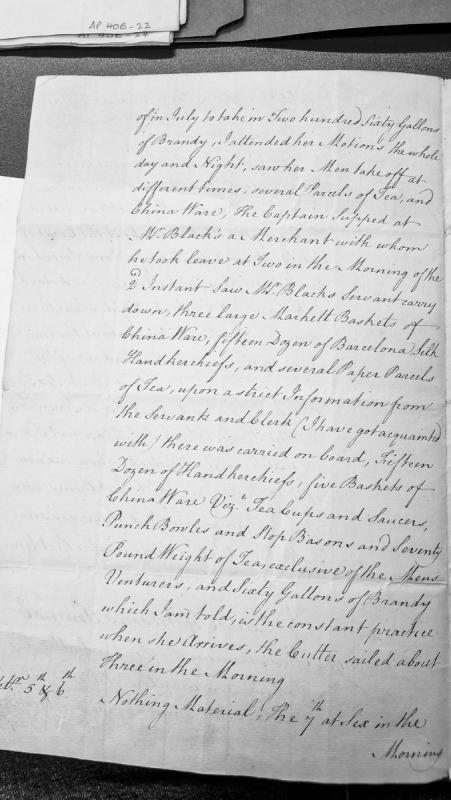
A witness account describing the observation of smuggled goods being loaded onto a ship in July, including brandy, tea, china ware, and silk handkerchiefs. The deponent details surveillance of the vessel's crew and cargo movements, with specific quantities recorded. This appears to be part of a larger court or revenue investigation document.
Official report by Commissioner Reid examining the Duke of Atholl's allegations concerning pre-Revestment (pre-1765) customs revenue collection and smuggling/illicit trade on the Isle of Man. Responds to arguments by the Attorney-General of the Isle regarding the legality and extent of revenue derived from contraband (tea, tobacco, East India goods). Central to disputes over compensation owed to the Duke following the 1765 Crown purchase of sovereignty.
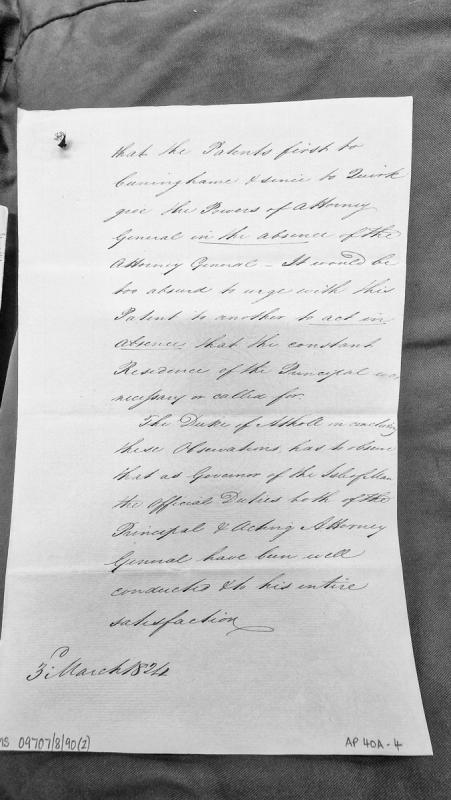
A legal opinion addressing the powers granted by Patents to act as Attorney General in the absence of the principal. The Duke of Atholl, as Governor of the Isle of Man, observes that the Official Duties of both Principal and Acting Attorney General have been well conducted to his satisfaction.
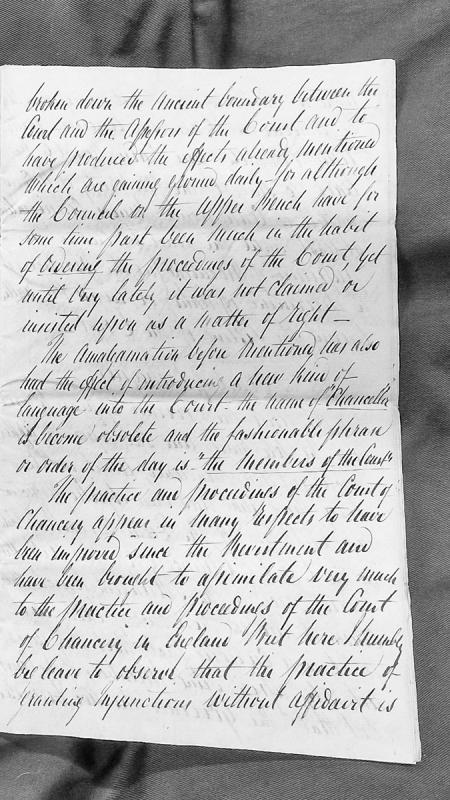
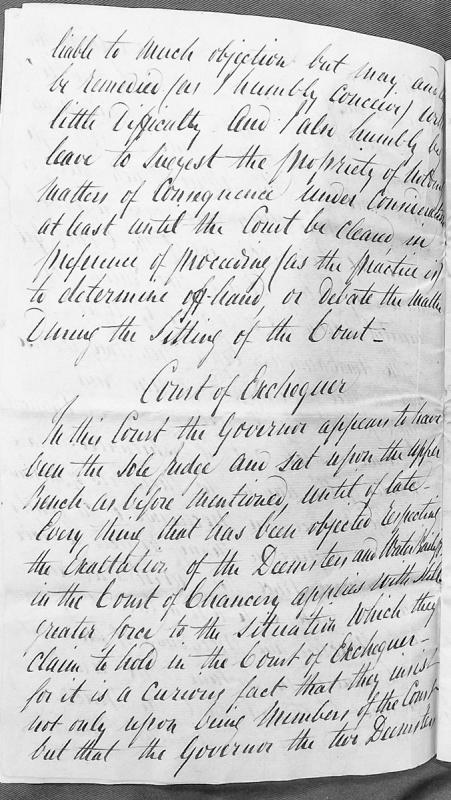
A fragment of a legal opinion discussing institutional changes to the Isle of Man Court following the Revestment, including the amalgamation of court and officers' roles, terminology shifts (obsolescence of 'Chancellor'), and procedural reforms aligning with English Chancery practice. The author raises concerns about the practice of granting injunctions without affidavit.
A fragment of a legal document discussing procedural improvements in court management, with particular focus on the role of the Governor and Deemsters in the Court of Exchequer. The author advocates for clearing the court before deliberating on matters of consequence and objects to the elevated status claimed by judicial officers.
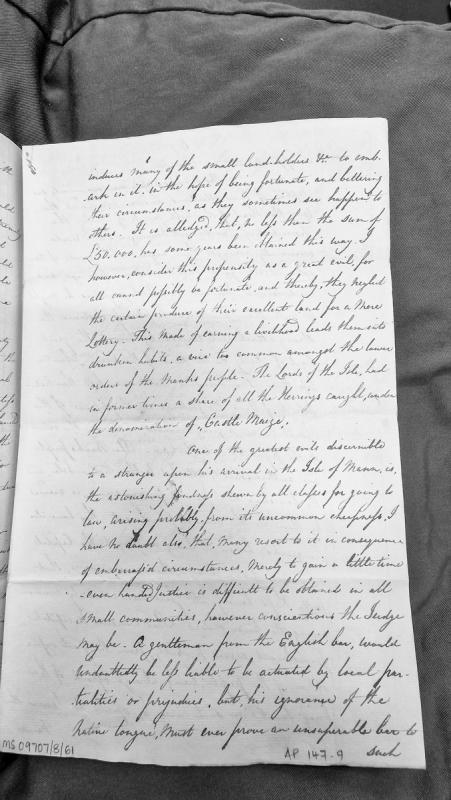
An analytical passage discussing the prevalence of herring fishing lotteries among small landholders in the Isle of Man, their negative social effects including drunkenness, and the unusual propensity for litigation among all social classes. The author critiques the lottery system as a distraction from productive land use and discusses challenges in administering justice.
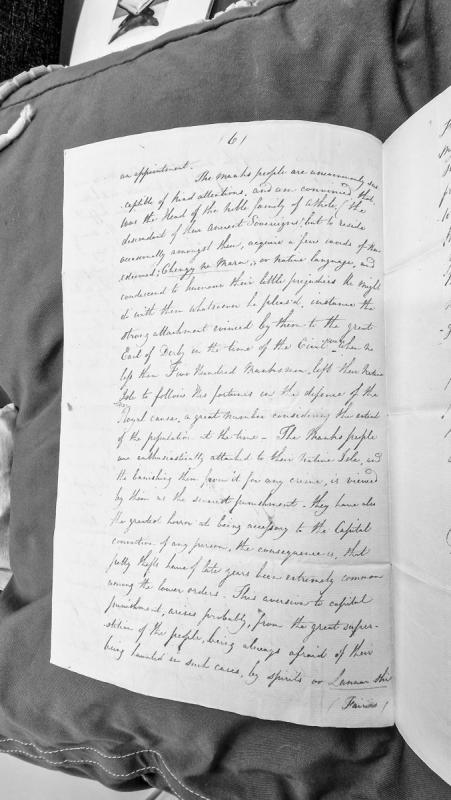
A fragment of text discussing the Manx people's susceptibility to kindness, their attachment to their native language (Chengey ny Mara), historical loyalty to the Earl of Derby during the Civil Wars, and their aversion to capital punishment which the author attributes to superstitious beliefs about spirits (Lannan shi/Fairies).
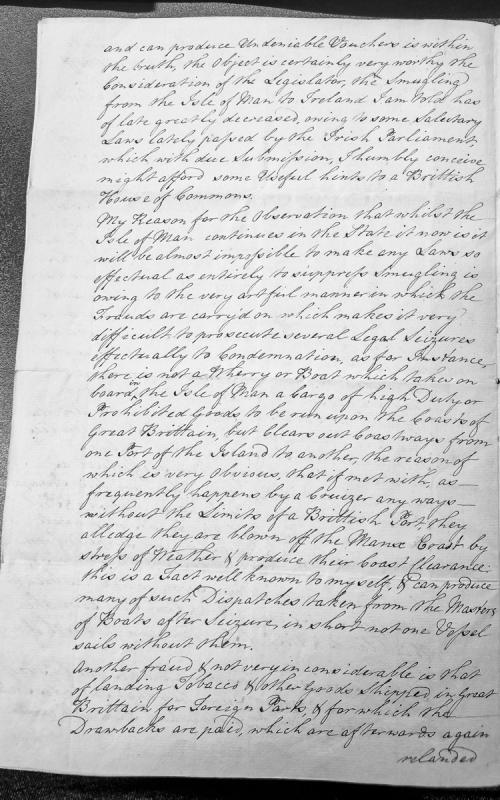
A legal or administrative opinion discussing the difficulties of suppressing smuggling from the Isle of Man to Great Britain and Ireland. The author argues that current laws are ineffectual due to fraudulent practices such as false coast clearances and misuse of export drawbacks, and suggests that Irish parliamentary legislation offers useful precedents.
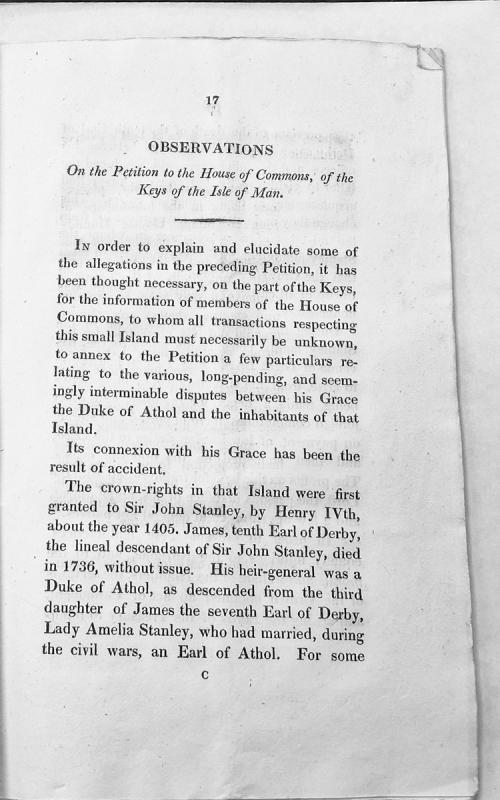
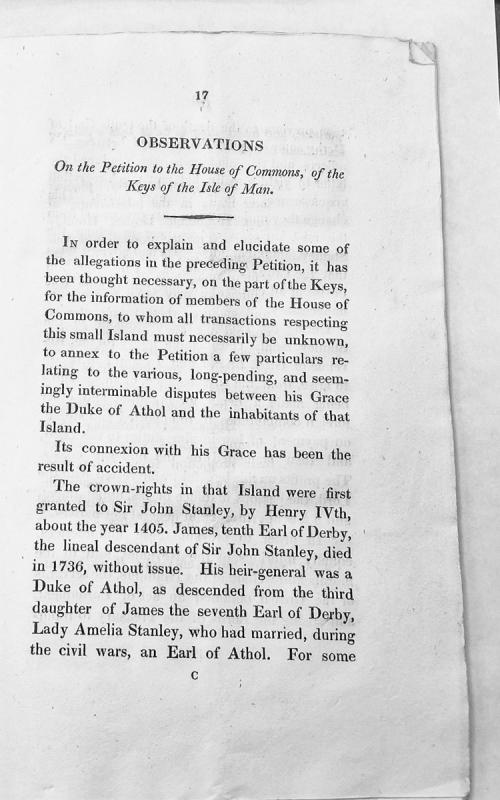
This is a printed pamphlet containing observations explanatory of a petition from the House of Keys to the House of Commons concerning long-standing disputes with the Duke of Athol over the Isle of Man. It provides historical context on the crown-rights granted to Sir John Stanley in 1405 and the succession through the Stanley and Athol families.
A printed pamphlet presenting observations and clarifications on a petition submitted to the House of Commons by the Keys of the Isle of Man. The document provides historical context on disputes between the Duke of Athol and the inhabitants of the Isle of Man, tracing the island's connection to the English crown through grants beginning in 1405.
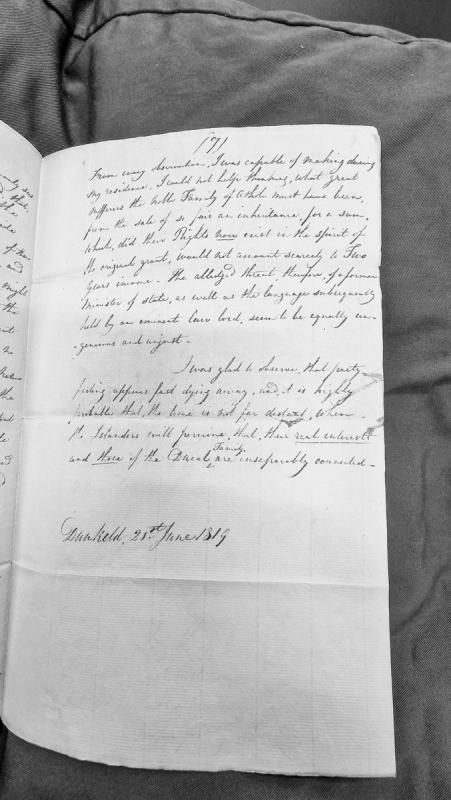
A reflective legal or political commentary discussing the sale of the Athol family's Isle of Man inheritance for an inadequate sum, criticizing threats made by a former Minister of State and a law lord. The author expresses optimism about declining party divisions and the interconnection of Islanders' interests with those of the Ducal family.
An undated administrative report (c.1764) analysing the illicit trade through the Isle of Man, detailing smuggling routes to Ireland, Wales, Scotland and the Solway Firth, the vessels employed, and estimated annual revenue losses to the British Crown (£200,000). The document provides quantitative data on goods flows, duties collected by the Duke of Atholl, and specific seizure records.
An undated but c.1764 analysis of smuggling trade through the Isle of Man, detailing imports (tea, silks, tobacco, wine, brandy), vessels employed, routes to Scotland, Ireland, Wales, and estimated annual revenue loss to the British Crown (£200,000). Provides specific duty rates and cargo weights from seized vessels. A key document for understanding the scale and organization of the running trade that prompted the Revestment.
This stone was originally found built into the church tower as a door lintel, before being displayed for a time in the churchyard during the second half of the 19th century. The stone is incomplete and consists of the lower part of a broken shaft very similar to Manx Cross 135.
One face shows two scaley dragons trapped in entwined bands. A horizontal band of step-pattern forms a border below. The other face has been divided into panels divided by similar bands; the lower one shows triquetra knots ending in spirals and notches; above is a panel of plait-of-seven; there must have been a third panel, now lost.
One edge bears a plain step-pattern along its surviving length. The other edge carries an inscription in runes which is now incomplete, the surviving portion translating, 'Odd raised this cross to Frakki his father but Thor...'
The carving is a typical example of the Mammen style which was current in the later 10th century.
Odd's Cross dates to the late Norse period. It is the broken shaft of a pillar cross and has a runic inscription. It measures 87.5 centimetres high x 28 centimetres maximum width x 16.5 centimetres minimum width and 9 centimetres thick. It was found at a mound in the churchyard which can no longer be identified on the ground. It is kept in Braddan Church and is recorded as Manx Cross No 136 (109).