Medieval carved stone crosses.
The Ordnance Survey 1:2500 First Edition mapping of 1867-8 shows Braddan parish church and its burial ground at this location.
The present parish church was built in 1773, but incorporates masonry and individual stones of much older date. The 1773 rebuild seems likely to have resulted in the present arrangement of fenestration, and it is noteworthy that at least one window-head includes re-used sculptural fragments from an earlier structure. An early stone gable cross also implies an earlier church on the site. A reference to a synod held at Braddan in 1291 suggests further tantalising potential for Medieval structures.
The burial ground is likely to have its origins in the medieval period, the extent of which is unknown. The recovery of nine carved stone cross slabs and fragments (Manx Crosses 63, 64, 72, 78, 112, 135, 136, 138, 146) confirms the site's continued use during the 10th century for the burial of Christians of Scandinavian heritage.
Oliver Cromwell (1599-1658) was Lord Protector of England, Scotland and Ireland from 1653 to 1658. During the English Civil War, the Isle of Man was one of the last Royalist strongholds to fall; following the surrender of the Island in 1651, Parliament appointed Thomas Fairfax as Lord of Mann, and the Island was governed by Parliamentarian appointees, including the governor James Chaloner.
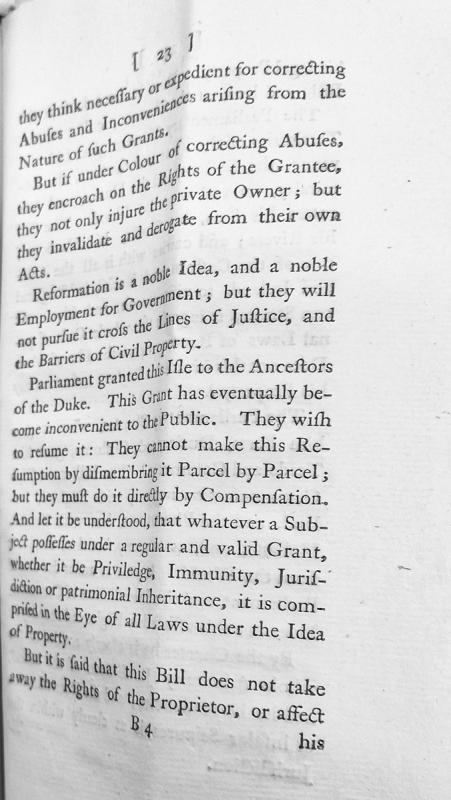
A legal opinion arguing that while Parliament may reform abuses arising from grants, it cannot encroach on the rights of grantees without compensation. The text discusses Parliament's grant of the Isle of Man to the Duke's ancestors and argues that any resumption of such grants must be done through direct compensation rather than piecemeal dismemberment, as property rights are protected under law.
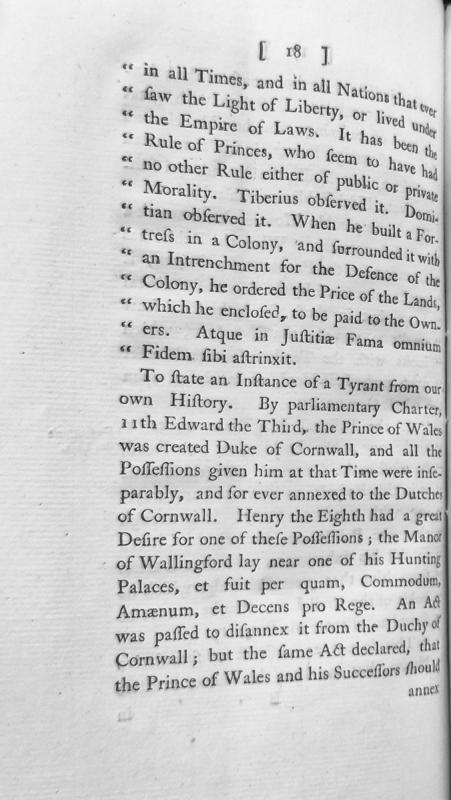
A legal or political argument discussing the principles of justice and tyranny, with historical examples from Roman emperors (Tiberius, Domitian) and English history (Edward III, Henry VIII). The passage argues that even tyrants have recognized the principle of compensating owners for seized lands, citing the example of Henry VIII's seizure of Wallingford Manor from the Duchy of Cornwall.
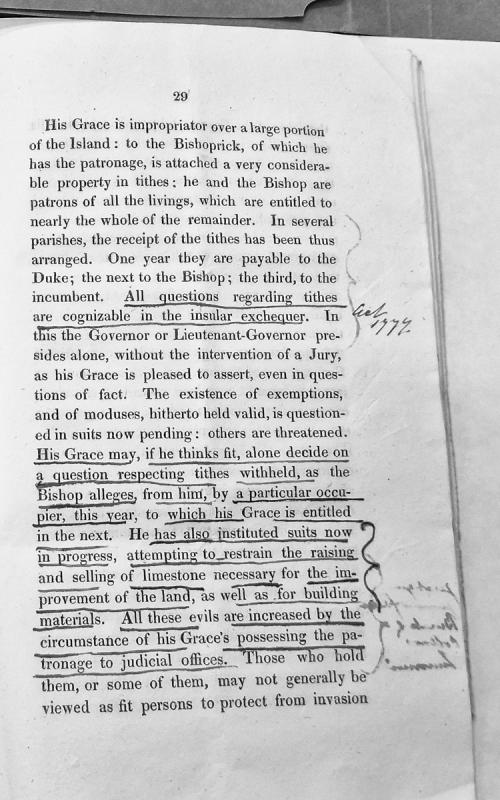
A critical examination of the Duke of Atholl's extensive powers over tithe collection, church patronage, and judicial appointments in the Isle of Man. The document details how tithes are distributed cyclically among the Duke, Bishop, and incumbents, and raises concerns about conflicts of interest arising from his control of both tithe disputes and judicial offices.
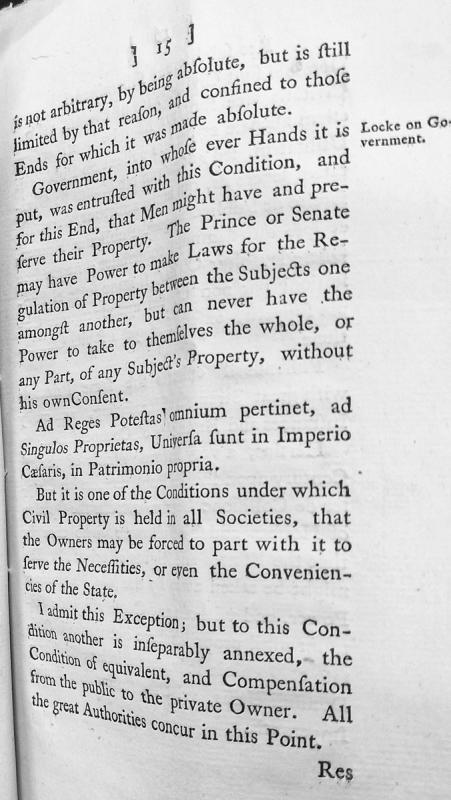
A legal or philosophical treatise discussing the nature of absolute government power and its limitations regarding subjects' property rights. The document cites Locke on Government and Latin legal principles, arguing that while governments may regulate property between subjects, they cannot take property without consent, though exceptions exist for state necessity with compensation.
Onchan is a parish adjoining Douglas on the Isle of Man. It is home to St Catherine's Church with its notable Viking-age cross, and was one of the parishes from which significant numbers of emigrants departed for America during the nineteenth century, particularly to the Illinois settlements.
Roman coin.
A single silver coin was found in Scouts' Glen in 1942. The coin is a silver denarius from the reign of Trajan, and has been dated to AD101-2.
The precise findspot is unknown. Scouts' Glen is a narrow side valley on the left bank of the River Glass: its mouth lies at the grid reference given.
The coin is in the collections of Manx National Heritage, accession no 1954-5535.
Medieval burial ground.
Six lintel-graves were uncovered during residential construction work, and were examined by AM Cubbon (director of the Manx Museum 1957-84) under rescue conditions.
The findspot was recorded as Ballachurry Park, but a more precise address was not indicated. A summary report in Medieval Archaeology gives a grid reference of SC394784, which must be for indicative purposes only. The grid reference here provided refers to the entrance to Ballachurry Avenue.
There were no finds apart from fragmentary human bones which were placed in the Manx National Heritage collections in May 1971, accession no. 1971-0272.
This broken slab was found re-used as a lintel in an outbuilding at the vicarage in 1890. One face bears the incomplete remains of a cross set within an oval frame. Each arm has a cross-bar, and those at the ends of the upper and lower limbs are set within small circles.
The early history of this stone is unknown. It comprises a fragment of a broken wheel-headed cross, bearing an equal-limbed cross set in a ring with broad borders. The cross, and the borders of the ring, are covered with continuous but sometimes irregular interlacing. The short shaft below the cross shows two dog-like monsters.
This large rectangular cross slab stood close to the old church. It would originally have been larger, as demonstrated by the truncation of the carving at the foot of the slab. One side bears a cross with widely expanding arms which extend beyond a small ring. The spaces between the arms and the centre of the cross are marked with flat bosses. The arms and ring are decorated with double and triple-lined edges, but are otherwise plain, while the shaft is filled with a five-stranded plait.
The design on the other face is similar, though more complex. The arms are not so widely splayed, and the ring is instead bound to the cross by an endlessly looping band. The shaft is decorated with a double twist and ring interlace motif.
This broken slab was found in the village. One face shows the remains of a wheel-headed cross, which was carefully proportioned so that the shaft, arms and ring were of similar widths, allowing an interlace to be laid out with great precision. The interlace begins as a multi-stranded plait in the shaft before dividing into the arms and around the ring where the pattern becomes one of twists and rings. The cross shaft, which would otherwise have been rather narrow, is strengthened by bands which end in volutes and provide at the foot of the shaft a seat for the beast which fills the panel to the right of the shaft.
This beast is the most striking feature of this cross slab. Similar to others which are portrayed on several of the Onchan stones, it sits upright, its back against the cross, its spiral-decorated haunch resting on the volute at the foot of the cross shaft. It appears to have a collar, which implies a measure of control, yet its open, tooth-filled mouth and round, staring eye suggest great savagery. Although fragmentary, there is just enough surviving to show that the beast would have been partnered by another in a similar pose to the left of the shaft.
The memorial was previously located in an almost adjoining site on Whitebridge Road, however it was moved to its present site in 1982 due to a road widening scheme.
34 names listed; First World War.
37 names listed; Second World War.
1 name listed; The Troubles (N.Ireland).
1 name listed; Gulf War.
Celtic style cross carved onto tall upright tablet made of Irish limestone. Below this, three stone tablets are set side-by-side. The memorial was unveiled in its original location on Sunday 16 November 1924 by Mr and Mrs R.H. Broadbent. The memorial was dedicated by Rev. R. Wakefield, Vicar of Onchan. It was sponsored by public subscription. The architect of the memorial was Archibald Knox and the sculptor was Thos. Quayle. The architect and sculptor for the plaques added to commemorate the Second World War was Thos. Quayle.
Medieval pinfold.
The parish pinfold for Kirk Onchan stood on the west side of the main highroad near Hillberry. It was not annotated as such on the Ordnance Survey 1:2500 First Edition mapping of 1867-8, but is indicated as OS Plot no. 1102, centred at the grid reference provided.
In 1940 the pinfold was described as rectangular with sod hedging on three sides faced internally with unmortared stones. The entrance, in the centre of the east wall, appeared more recent, stone-built, and with a slate lintel.
In 1971 the site was still complete, though it appeared that the east wall had been rebuilt, as the entrance was placed at the south end of the east wall. The enclosure was recorded as measuring 14.7m E-W, and 14m N-S.
The pinfold has since been heavily altered as a result of road improvements.
Each parish was responsible for the maintenance and repair of its own pinfold. Their origins are uncertain although an early statute of 1422 confirms that the customary laws relating to their maintenance and use were already well established.