A comprehensive collection of legal opinions from English attorneys-general, solicitors-general, judges, and other eminent lawyers on constitutional and commercial matters affecting the British colonies, compiled by George Chalmers from Board of Trade archives and other depositories. Originally published in London in 1814; this is the 1858 American edition. Covers the King's prerogative, colonial constitutions, taxation, trade regulation, and sovereignty questions relevant to Isle of Man and American colonial law.
A comprehensive collection of legal opinions from prominent English barristers and law officers (Attorneys-General, Solicitors-General, Chief Justices) spanning the 17th and 18th centuries, compiled by George Chalmers from Board of Trade archives and other depositories. Covers the King's prerogative abroad, colonial constitutions, ecclesiastical authority, land grants, taxation, trade regulation, and statutory extension to colonies and overseas territories, including opinions on the Isle of Man.
A compiled collection of legal opinions from prominent English lawyers on colonial, fisheries, and commerce matters, arranged thematically by George Chalmers. The work draws on original documents from the Board of Trade and other depositories, covering royal prerogative, colonial constitutions, navigation acts, and commercial law from the late 17th century onward. Directly relevant to understanding the legal framework governing the Isle of Man and colonial dependencies during the Revestment period.
George Chalmers's 1784 treatise examining the legal and commercial consequences of American independence for Britain. Addresses the status of American citizens under English law (aliens vs. subjects), rights of loyalists, treaty interpretation, and comparative constitutional parallels (Scotland, Normandy, etc.). Directly relevant to post-Revestment constitutional and commercial policy questions.
A royal mandate from King Edward I (dated 29 August 1296) commanding Robert de Joneby, bailiff of Dumfries, to bring Marc, Bishop of Sodor, to the King at Berwick to perform homage. This document evidences early English Crown assertion of authority over the Isle of Man ecclesiastical hierarchy and broader medieval suzerainty claims.
An Episcopal Registry order from the Isle of Man, dated 1684, directing the executors of the late Bishop Bridgman to refund monies awarded for repairs to the Cathedral at Peel Castle and other ecclesiastical buildings. The document addresses a dispute over repair obligations, specifically regarding reconstruction of the Bishop's Court tower, and clarifies customary practice regarding episcopal maintenance responsibilities.
An official order from the Episcopal Registry of the Isle of Man dated 1684, directing the executors of the late Bishop Bridgman to refund £75 14s 2d to the current Bishop Lake for repairs to the cathedral and parish church chancels. The document also addresses a disputed claim for £30 regarding tower repairs at the Bishop's Court, determining that custom does not obligate the executors to undertake major reconstruction.
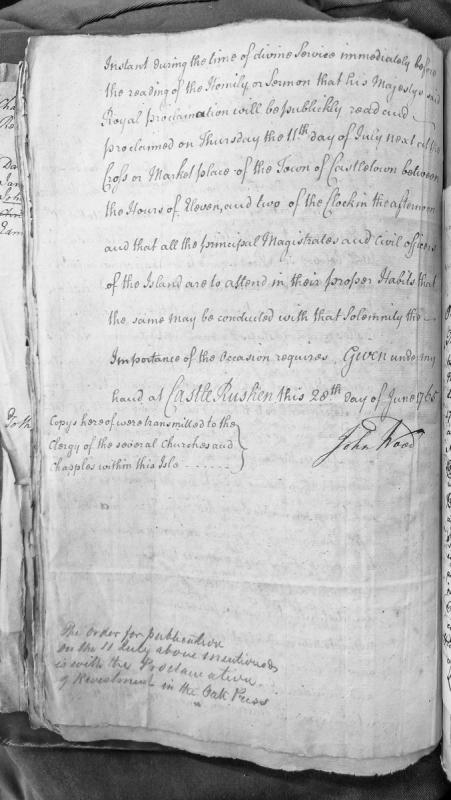
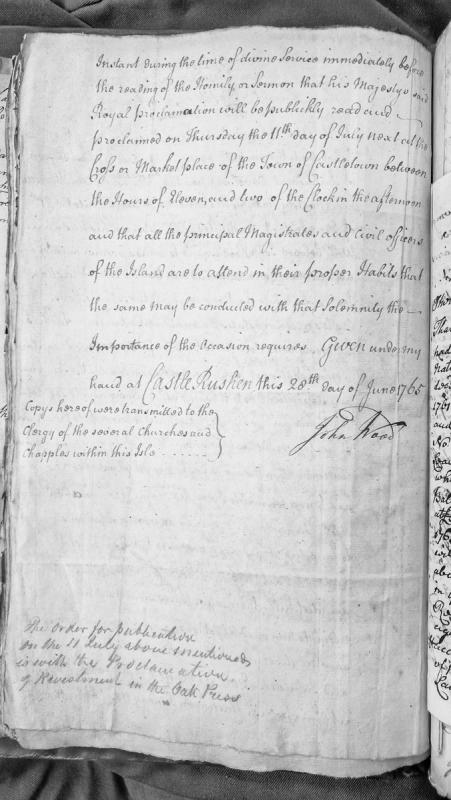
Administrative order directing the public reading and proclamation of a Royal Proclamation at the Market Cross in Castletown on 11 July 1765. The document specifies the time (11 a.m. to 2 p.m.), requires attendance of principal magistrates and civil officers in formal dress, and notes that copies were transmitted to clergy of churches and chapels throughout the Isle of Man.
An administrative directive from Castle Rushen dated 28 June 1765 ordering the public reading of a Royal Proclamation at Castletown market cross on 11 July 1765. The proclamation is to be read between 11am and 2pm with all principal magistrates and civil officers attending in formal dress. Copies were transmitted to clergy throughout the island.
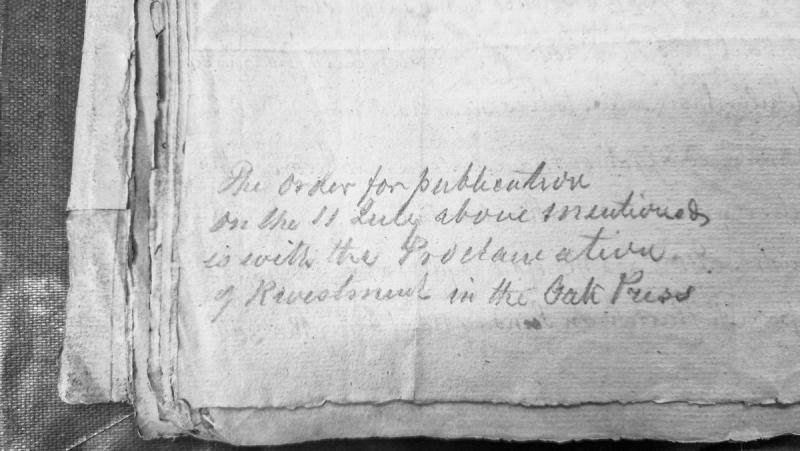
A brief administrative note referencing an order for publication dated 11 July and its association with a Proclamation of Revestment. The document indicates these materials are filed together in the Oak Press archive.
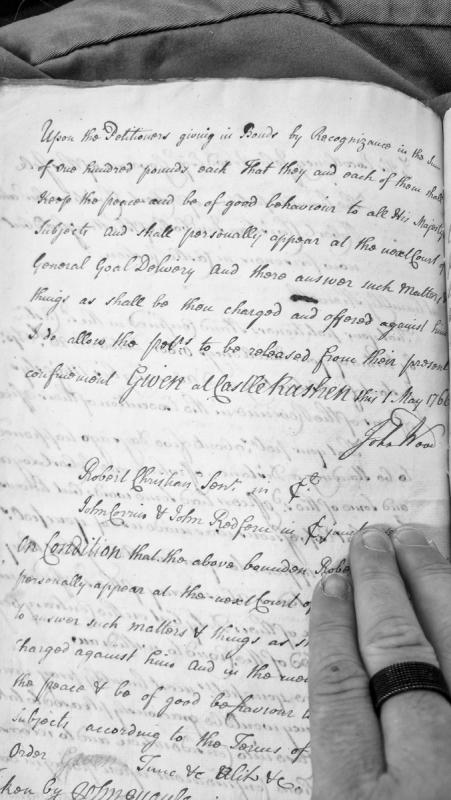
An order authorizing the release of prisoners from confinement at Castle Rushen upon their entering into recognisance bonds of one hundred pounds each, with conditions to keep the peace and appear at the next Court of General Gaol Delivery. Signed by John Wood and witnessed by John Quayle.
A royal order from Charles II dated 16 January 1662, directed to the Earl of Derby, concerning the imprisonment and death sentence of William Christian on the Isle of Man. The King's Counsel has determined Christian is eligible for pardon, and the order directs that Christian be brought before the King and Council to answer the charges of treason. This document is significant for understanding early Stuart governance of Man and the legal authority exercised by the Crown over the island.
A royal order from Charles II directing the Earl of Derby to bring William Christian before the King and Council to be heard on charges of treason. The document records a petition for clemency and the King's decision to review the case personally. This source is relevant to understanding governance structures on the Isle of Man and the Crown's judicial authority over the island during the feudal period under the Earls of Derby.
An order issued by the Earl of Derby directing that funds (£43 19s 10d) collected for repairs to the chancel of Peel Castle Cathedral be held in trust by the Bishop of Man until fuller church repairs or legislative provision can be arranged. The document illustrates the administrative interplay between the temporal and ecclesiastical authorities on the Isle of Man, and the infrastructure challenges faced by the island's governing structures in the late 17th century.
An administrative order issued by the Earl of Derby (Lord of Man) in 1686 regarding funds for repairs to the chancel of Peel Castle Cathedral. The order directs that £43 19s 10d be held in deposit pending either the raising of additional charitable funds for the whole church or the passage of a new law for demolishing the cathedral and enlarging St. Peter's Chapel in Peel town. This document illustrates ecclesiastical administration and property management on the Isle of Man in the late 17th century.
A detailed account of the ceremonial procession and formal appointment of John Wood as Governor of the Isle of Man on 11 July 1765, following the Crown's acquisition of sovereignty. The document records the order of procession, reading of royal proclamation, oath-taking ceremonies, transfer of regalia from the Duke of Atholl's deputies to the Crown, and Wood's inaugural address to the island's inhabitants and magistrates emphasizing loyal obedience and prosperity under royal protection.
A contemporary account of the ceremonial procession and appointment of John Wood as Governor of the Isle of Man on 11 July 1765, following the Parliamentary purchase of sovereignty from the Duke of Atholl. The document records the formal transfer of power, the reading of the Royal Proclamation and Order of Council, the surrender of regalia by the Duke's deputies, and the Governor's inaugural address to the inhabitants emphasizing royal protection, legitimate trade, and obedience to British law.
Administrative order from William, Earl of Salisbury and Lord of Man, to his Treasurer in London, authorizing annual fee payments to various officials and servants. The document establishes William's authority over Man and demonstrates early feudal administrative structures. Relevant to understanding pre-Revestment Manx governance and lordship.
An administrative order issued by William, Earl of Salisbury and Lord of Man and the Isle of Wight, to his Treasurer in London, commanding payment of annual fees to various officers and counsellors retained for his service. The document is presented in both English and Norman French and provides insight into the administrative structure and financial arrangements of the lordship of Man in the late 14th century.
An episcopal order from the Lord of Mann (Edward Stanley, Earl of Derby) dated 1691 regarding the deposit of £43 19s 10d allocated for repairs to Peel Cathedral. The document clarifies that no interest is to be charged on the sum held by the Bishop of Mann, and establishes procedures for future investment of the funds. Relevant to understanding ecclesiastical administration and property management within the Manx feudal structure prior to the 1765 Revestment.
A royal mandate from King Edward I commanding Robert de Joneby, bailiff of Dumfries, to bring Marc, Bishop of Sodor, to the King at Berwick to render allegiance. This document demonstrates early English royal authority over the Isle of Man and its ecclesiastical leadership, predating the 1765 Revestment by nearly 470 years but establishing the constitutional and feudal relationship between the Crown and the island.
A royal writ ordering Sir Thomas Stanley to convey Eleanor Cobham, Duchess of Gloucester, to the Isle of Man and ensure her custody there. Eleanor was convicted of witchcraft and sorcery (attempting to harm King Henry VI through wax image magic) and exiled to the Island. This document demonstrates the Isle of Man's use as a place of confinement for high-status prisoners in the medieval period.
A royal order from Henry VI directing Sir Thomas Stanley to convey Eleanor Cobham, Duchess of Gloucester, to the Isle of Man by land and water. The document is accompanied by historical context explaining that Eleanor was arrested for alleged involvement in necromancy and witchcraft — specifically the creation of a wax image of the king intended to harm him. This source illustrates the Isle of Man's historical use as a place of exile and imprisonment for high-status political prisoners.
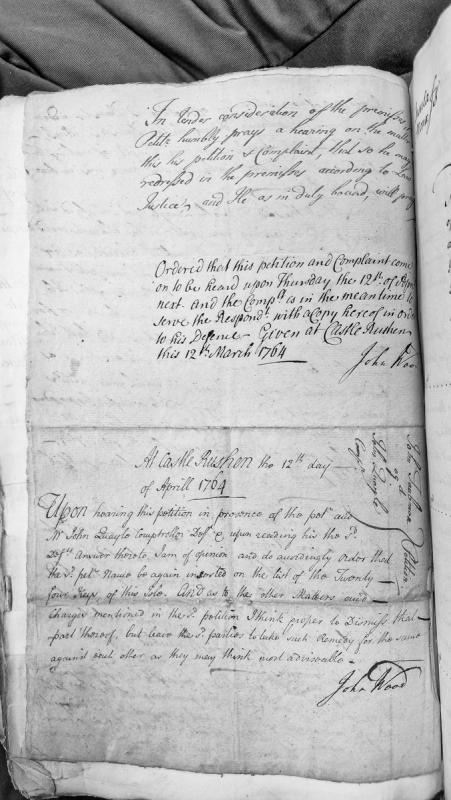
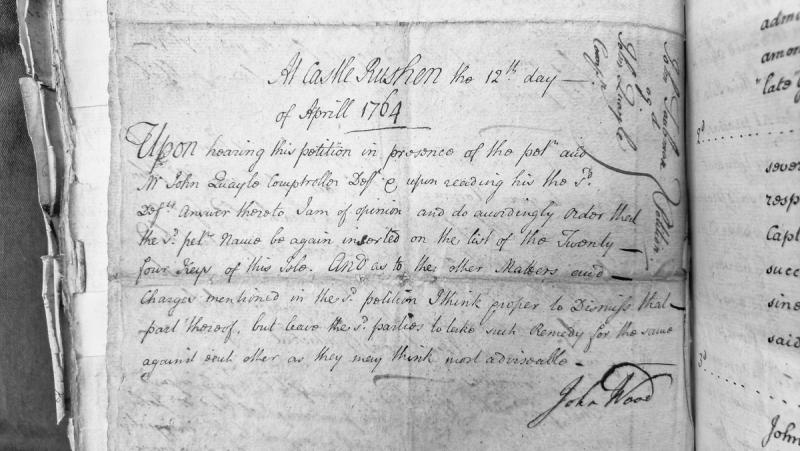
A judicial order from Castle Rushen granting a petition to restore the petitioner's name to the list of the Twenty-four Keys of the Isle of Man. The judgment dismisses other charges mentioned in the petition, leaving the parties to seek remedy against each other as they deem appropriate.
A judicial order issued at Castle Rushen reinstating a petitioner's name on the List of the Twenty-four Keys of the Isle of Man. The court dismisses other charges mentioned in the petition, leaving the parties to seek remedies independently.