Official correspondence from Dublin Castle dated 13 June 1765 detailing orders to embark two troops of Hales Dragoons and a Regiment of Foot under Major General Montagu to the Isle of Man. This document evidences the military deployment ordered by the Crown in response to the Revestment, likely to secure control following the purchase of sovereignty from the Duke of Atholl. It confirms embarkation from Dublin via Douglas.
Official correspondence from Dublin Castle to a senior official (addressed 'My Lord') reporting the implementation of orders to send two troops of Hale's Dragoons and a regiment of foot under Major General Montagu to the Isle of Man. The letter details embarkation arrangements from Dublin, routes for the march from Waterford, and timeline for completion by 24 June 1765. Directly relevant to the military occupation and securing of the island following the 1765 Revestment.
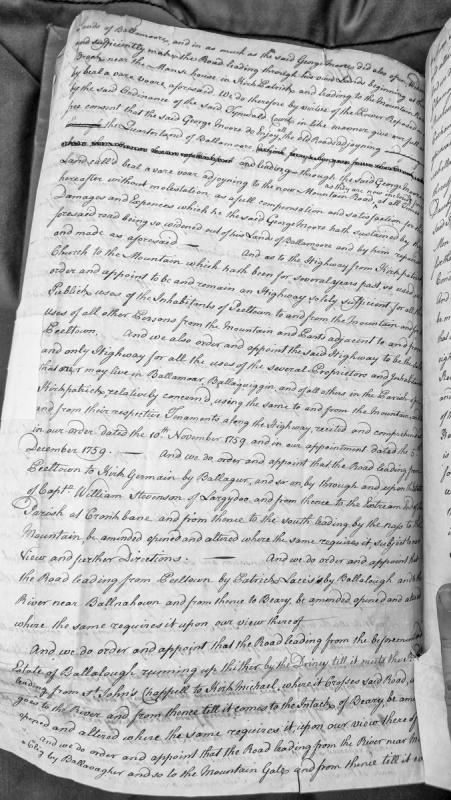
An administrative order concerning road maintenance and land rights in the Kirkpatrick area of the Isle of Man. The document grants George Moore compensation in the form of land rights for road improvements made on his property at Ballamoore, and specifies various highway routes and maintenance responsibilities for roads serving Peeltown and surrounding parishes.
Prehistoric flint scatter.
A single worked prehistoric flint was recovered from Orrisdale Head by CH Cowley.
The description is quite general and the grid reference provided refers to the coastline in this area as it was at the time of his discoveries. On another occasion Cowley recovered finds from the 'Michael Brooghs - Ballaugh', implying that he prospected along the eroding cliffs on more than one occasion (see PRN 3374).
The antiquary Charles Harry Cowley was an avid collector of worked flint and coarse stone artefacts revealed by agricultural activity, mainly on farms located around Peel, and occasionally from further afield. He was active from 1900 until 1943. His entire collection of artefacts, together with a daybook cataloguing his discoveries, was later donated to Manx National Heritage.
The site of a half buried stone which looks as though it has fallen. Its sides are exposed and it is 0.8 metres long by 0.8 metres and 0.5 metres. It may be a fallen standing stone.
Folk Life Survey Air photos show a large circular cropmark which looks like a round house site. The site falls at the bottom of a slight valley on a northeast to southwest axis. The field was partly under the plough and partly under root crops when visited and no certain traces of a round house could be determined. Vague hollows and mounds that existed were thought to be part of the general unevenness of the field.
A possible circular enclosure is discernable on the 2006 Google Earth aerial photograph, measuring circa 75 metres in diameter.
This broken slab was recovered when the previous church was demolished in the 1840s. It dates to the second half of the 10th century, on the basis of the ring-chain pattern shown on the cross shaft. A badly worn runic inscription runs up one edge and translates as, "but Asruthr carved these runes" The other edge bears curved, diagonal marks which are abstract and meaningless.
This cross-fragment was found at the old church of St John's when it was dismantled in the mid-19th century in advance of the construction of the present building. It is the lower part of the shaft of a high cross and displays a ring-chain pattern. There is also has a runic inscription along one edge, which says "but Osruth carved these runes." A cast of the fragment is kept at the Manx Museum (No.107).
Letter from Peter John Heywood, Steward to the Duke of Atholl, reporting on Isle of Man governance arrangements post-Revestment, including a controversial regency proposal to allow non-residence of governors, and disputes over drainage and land rights affecting the Duke's demesne. Written 18 years after the 1765 Revestment, it illustrates ongoing tensions between the Duke's interests and local administration under Lutwidge and other officials.
Letter from Peter John Heywood, Steward to the Duke of Atholl, reporting on the Bishop of Sodor and Man's declining health, Lt Governor succession plans, proposals for a Regency during the Governor's absence, and disputes over land drainage and local administration. Highlights institutional tensions between the Duke's interests and local officials including Lutwidge and Quayle.
Letter from P J Heywood in Douglas to the Duke of Atholl regarding imminent changes in the Isle of Man revenue department, including dismissals of corrupt officers and new appointments. Heywood expresses concern about Charles Lutwidge's continued influence over patronage and recommends the Duke secure control of appointments through Westminster ministers. Contains detailed salary information for revenue officers and commentary on governor Col Smith's expected arrival.
Letter from P J Heywood (Lieutenant Governor's representative) to William Adam seeking intelligence on the status of a Tynwald Act concerning the Duke of Atholl's manorial rights. The bill, originated by the House of Keys in 1781 and submitted to the Secretary of State, has been stalled by the Duke's caveat and is now under review by the Attorney General. Heywood expresses concern that the bill would undermine ducal property rights and fears it could obstruct the Duke's intended operations.
Letter from Peter John Heywood (Isle of Man official) to William Adam reporting on the status of a Tynwald Act regulating the Duke of Atholl's manorial rights, initiated in 1781. Heywood expresses concern that the Keys' Bill will undermine ducal property rights and requests Adam's assistance in blocking or delaying its progress through Westminster until the Duke's arrival in London.
P.J. Heywood was a member of the Heywood family of the Isle of Man, which included Captain Peter Heywood, the Bounty midshipman who was court-martialled and pardoned after the mutiny.
Letter from P.J. Heywood in Douglas to the Duke of Atholl concerning proposed reforms in the Isle of Man Revenue Department, dismissals of corrupt officers, and the critical importance of securing patronage appointments to counter Lutwidge's opposition. Discusses specific officer salaries, Lutwidge's multiple sinecures, and the imminent arrival of Colonel Smith as Governor. Highly relevant to understanding post-Revestment administrative struggles and patronage politics.
Prehistoric flint scatter.
A small quantity of worked prehistoric flint was recovered from Peel by CH Cowley, from 'Paddy's Well'.
The description may possibly refer to St Patrick's well, which lay on Station Road (once Well Brow). The precise location of the well is not now known, and the grid reference relates to the midpoint on the road for indicative purposes only.
The antiquary Charles Harry Cowley was an avid collector of worked flint and coarse stone artefacts revealed by agricultural activity, mainly on farms located around Peel, and occasionally from further afield. He was active from 1900 until 1943. His entire collection of artefacts, together with a daybook cataloguing his discoveries, was later donated to Manx National Heritage.