Prehistoric flint scatter.
A small quantity of worked prehistoric flint was recovered from Peel Hill by CH Cowley, from the 'Old Fort'.
This would appear to relate to the vicinity of Aston's Battery, and the grid reference relates to the earthwork for indicative purposes only.
The antiquary Charles Harry Cowley was an avid collector of worked flint and coarse stone artefacts revealed by agricultural activity, mainly on farms located around Peel, and occasionally from further afield. He was active from 1900 until 1943. His entire collection of artefacts, together with a daybook cataloguing his discoveries, was later donated to Manx National Heritage.
Prehistoric flint scatter.
A single worked prehistoric flint was recovered from Peel Hill by CH Cowley, from the 'Quarry Road'.
No further details concerning the discovery were recorded and the grid reference relates to the corner of the road where it crosses the ridge of the hill for indicative purposes only. The object may have been found at any point along the length of the track, although the proximity of the track at this point to the nearby earthwork battery, in the vicinity of which Cowley made several other finds (see PRN 0864.89 and 0864.93) may be significant.
The antiquary Charles Harry Cowley was an avid collector of worked flint and coarse stone artefacts revealed by agricultural activity, mainly on farms located around Peel, and occasionally from further afield. He was active from 1900 until 1943. His entire collection of artefacts, together with a daybook cataloguing his discoveries, was later donated to Manx National Heritage.
A modern narrow-gauge railway station. The Isle of Man Railway Company completed its first line between Douglas and Peel in 1873. The 3-foot narrow-gauge system was extended by the completion of a second line between the main station at Douglas and Port Erin in the south-west of the island in 1874.
Separately, the Manx Northern Railway constructed a line from St John's (on the route between Douglas and Peel) in 1879 and from 1886 operated another short line between St John's and Foxdale, exploiting the mining traffic arising from the latter. The railway companies amalgamated in 1904.
The Peel line closed to passenger services in 1968, and to goods traffic the following year; the track was lifted in 1975.
The railway station buildings and platforms remained during the 1980s and 1990s whilst part of the site was used as a seasonal boat-park and boat-yard. The goods shed was adapted as a boathouse for the replica Viking longship, 'Odin's Raven', which sailed from Norway to the Isle of Man in 1979 as part of the Tynwald Millennium celebrations.
In 1995 the site was redeveloped. The construction of the House of Manannan heritage centre incorporates the former railway station building and goods shed.
The Ordnance Survey 1:2500 large scale mapping of 1868 shows a rope works at the grid reference provided, together with the annotation, 'Rope Works'. The grid reference is centred on the site of the building and the rope walk extended for 300m in a SSE direction.
The site is now partially occupied by hardstanding, housing and a decommissioned power station.
Modern saw mill.
The Ordnance Survey 1:2500 first edition mapping of 1868 records a building centred at the grid reference provided, together with the annotation, 'Saw Mill'.
The building was constructed from local red sandstone rubble (quarried from the east end of Peel Bay), and was latterly used for fish processing, before being demolished in the late 1990s.
The site is today occupied by an industrial unit.
A scatter of Mesolithic or Neolithic flints found on the estate of G. Clementson. The exact findspot is unclear but is thought to have been at the old school playground centred on SC249840.
Letter from Thomas and Richard Penn to Benjamin Franklin agreeing to allow the Lieutenant Governor to assent to a money supply act for Pennsylvania's defence and public services, despite ongoing disputes between the Proprietors and the Provincial Assembly before the Attorney and Solicitor General. The letter references a previous act for raising £60,000 and striking £55,000 in bills of credit, indicating financial and constitutional tensions in mid-18th-century Pennsylvania governance.
Two related documents from the Penn Proprietors responding to Benjamin Franklin's 'Heads of Complaint' (August 1757) on behalf of the Pennsylvania Assembly. Ferdinand John Paris's formal Answer (27 Nov 1758) addresses grievances over proprietary instructions, taxation of quit-rents, and the Proprietors' contribution to colonial defence. The Penns' Message (28 Nov 1758) criticises Franklin's procedures and proposes free conferences with authorised representatives. These documents reveal the constitutional conflict between proprietary prerogative and assembly authority in Pennsylvania.
This cave is situated on the rock-face of a minor headland bounding the westerly side of the small beach of Traie Coan near Port St Mary. The site was excavated in 1969-70 and 1975-76 by FJ Radcliffe, who found a midden sealed under slate slabs that had fallen from the roof and overlying an apparently undisturbed beach deposit. A very low 'inner cave' held a similar beach deposit.
The midden contained a considerable number of limpet shells as well as bird and mammal bones. Human bones, apparently from a single adult skeleton, were recovered together with worked bone points. The remains were thought to represent either a prehistoric burial or a victim of a shipwreck.
Radiocarbon dating of carbonised wood in the midden material by Birmingham University suggested a date 1880 +/- 150 BP, or a mean of 70 AD.
Nothing was found to prove that the cave was inhabited but this does not preclude its use for a shelter.
This cave is situated on the rock-face of a minor headland bounding the westerly side of the small beach of Traie Coan near Port St Mary.
The site was excavated in 1969-70 and 1975-76 by FJ Radcliffe, who found a midden sealed under slate slabs that had fallen from the roof and overlying an apparently undisturbed beach deposit, together with human bones, apparently from a single adult skeleton, were recovered together with worked bone points.
The remains were thought to represent either a prehistoric burial or a victim of a shipwreck. Radiocarbon dating of carbonised wood in the midden material suggested a date 1880 +/- 150 BP, but this does not directly date the human remains.
Site of late Iron Age or early medieval promontory fort.
The full extent of the fort was recorded by the Ordnance Survey First Edition 1:2500 mapping of 1868. The promontory is naturally defensible, with rocky cliffs to the north-west and south-east. The approach from the landward direction is artificially defended by substantial earthwork defences consisting of an outer ditch 70m long. Additional earthwork banks and ditches within the defended area created a causeway leading to the most westerly tip of the headland. No corresponding causeway or entrance through the outer defences was recorded by the OS. Today a fragment of the outer ditch survives at its south-eastern end, and still measures 10m wide and 3m deep.
Around 1900, a house was been built in the centre of the fort and the outer ditch was largely filled in except for the remains described above. Faint traces of the inner earthworks are still apparent, again on the south-easterly side of the promontory, but otherwise other features have been obscured or destroyed, leaving few if any intelligible surface remains.
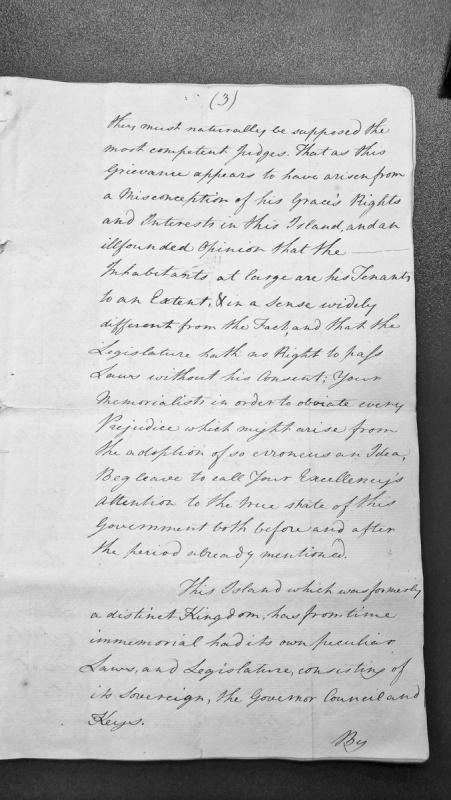
This is a formal petition (page 3) addressing misconceptions about the Duke's (His Grace's) rights and interests in the Isle of Man, and clarifying the island's legislative independence. The memorialists argue that the inhabitants are not tenants to the extent claimed, and that the Legislature has the right to pass laws without the Duke's consent, referencing the island's historical status as a distinct kingdom with its own laws and government.
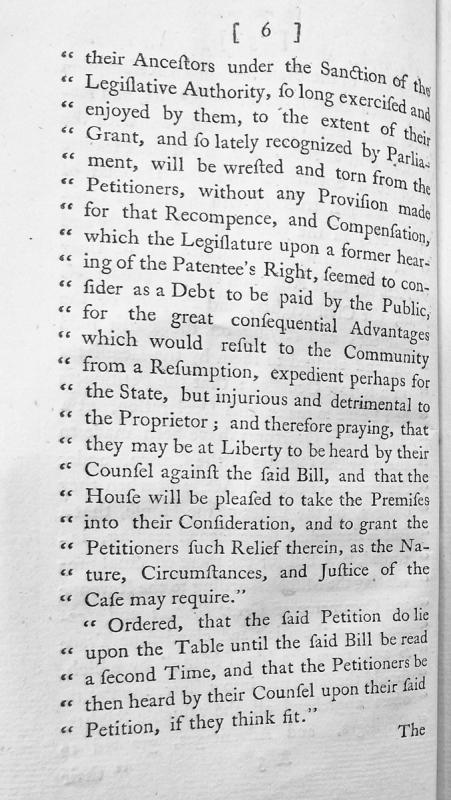
This is a petition (likely to Parliament) from proprietors objecting to a bill that would rescind their long-exercised legislative rights and grants. The petitioners argue that Parliament previously recognized their patent rights and seek compensation for the loss of privileges that have been held since their ancestors' time, requesting to be heard by counsel against the bill.
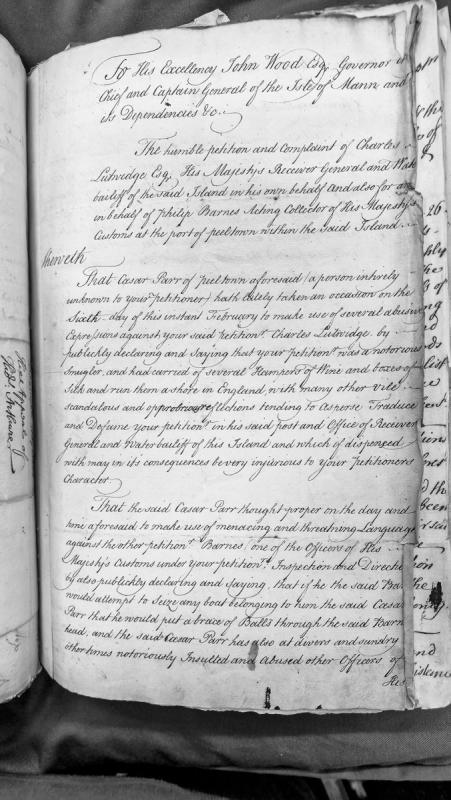
A petition to the Governor of the Isle of Man from Charles Lutwidge (Receiver General and Water Bailiff) and Philip Barnes (Acting Collector of Customs) complaining of defamatory statements and threats made by Caesar Parr of Peeltown on 6 February. Parr allegedly called Lutwidge a smuggler and threatened to shoot Barnes if he attempted to seize Parr's boat.
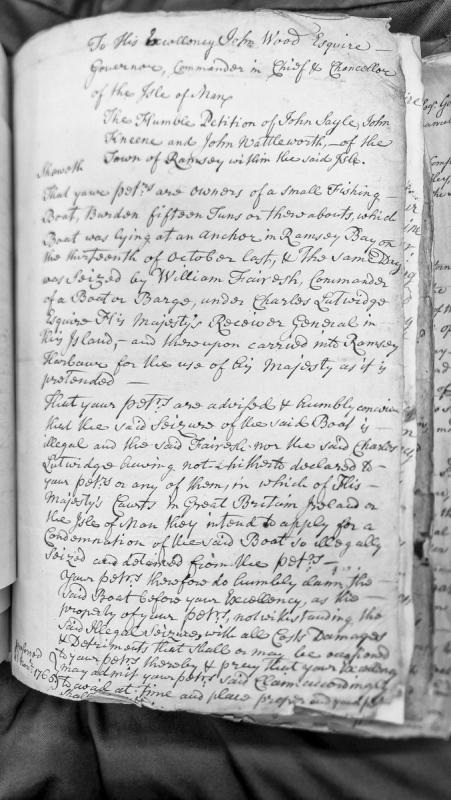
A petition by three Ramsey men (John Sayle, John Kneene, and John Wattleworth) to Governor John Wood protesting the illegal seizure of their fishing boat by William Fairish on 13 October 1765, acting under authority of Charles Lutwidge (His Majesty's Receiver General). The petitioners claim no court jurisdiction has been declared and seek recovery of their vessel with damages.
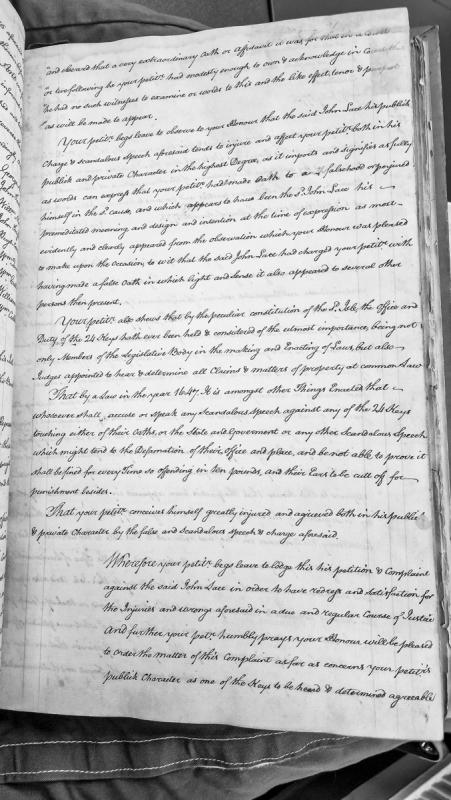
A petition lodged by a member of the House of Keys against John Lace for making false and scandalous accusations regarding a perjured oath. The petitioner seeks redress for injuries to both public and private character, citing Manx law of 1647 which prescribes penalties for scandalous speech against members of the Keys.
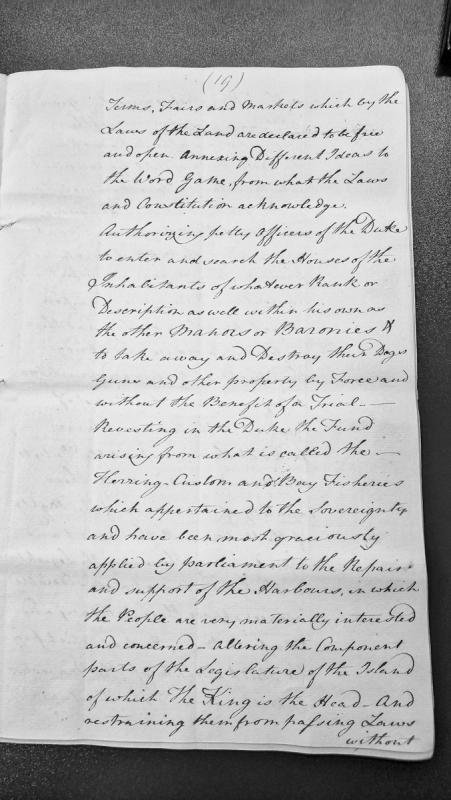
A petition objecting to proposed changes to Manx law, including restrictions on free markets and fairs, new definitions of 'game', authorization for officers to search homes and seize property, reallocation of herring customs revenue, and alterations to the island's legislature. The document expresses concern about loss of parliamentary protections and sovereignty.
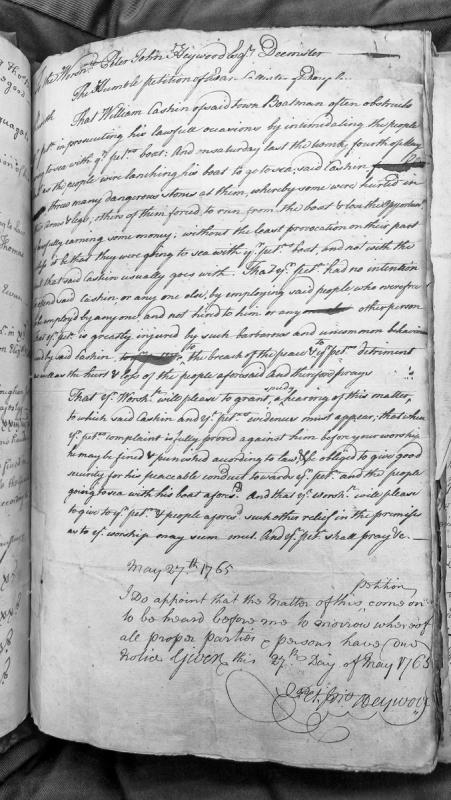
A petition from Daniel Laimster of Ramsey to Deemster Peter John Heywood alleging that William Cashin, a boatman, has obstructed his lawful business by intimidating people and throwing stones at those boarding Laimster's boat on 24 May 1765, causing injury and loss of earnings. The petitioner seeks a hearing, fine, and security for future peace.
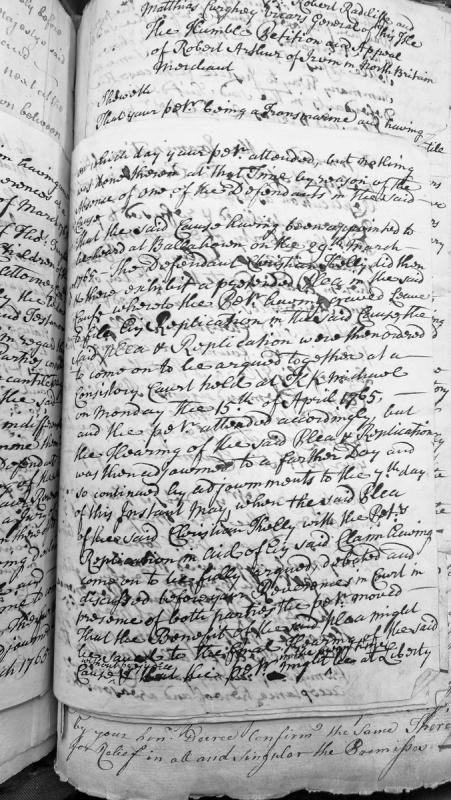
A petition and appeal by Robert Arthur, a transmarine merchant from Irvin in North Britain, to the Vicars General of the Isle of Man regarding an ecclesiastical cause involving defendant Christian Kelly. The document describes proceedings held at Ballahorn on 29 March 1765 and at a Consistory Court at Kirk Michael on 15 April 1765, with arguments heard on 9 May 1765.
This is an excerpt from a petition by members of the House of Keys asserting their indispensable constitutional role in the Court of Gaol-Delivery (criminal court). The petitioners cite historical precedent from 1668 onwards, including fines for non-attendance, judicial recognition of their right to examine witnesses, and instances where proceedings were halted due to insufficient Keys members present.