The first person met on a journey, or the first person to enter a house on New Year's Day. The qualtagh carried significance: a dark-haired man was lucky, a woman or a red-haired person less so. The custom shaped behaviour at the turning of the year and reflected the Manx understanding that thresholds and beginnings carried particular power. The qualtagh tradition connects to the wider Celtic belief in the significance of first encounters and first footings.
The Ordnance Survey First Edition 1:2500 map of 1868 records a net factory at this location. The factory was owned by the Qualtrough family. The building still stood in 2016.
Modern net factory.
The Ordnance Survey First Edition 1:2500 map of 1868 shows a net factory at this location off Athol Street.
The factory was owned by the Qualtrough family.
Neolithic pottery.
The fragmentary remains of a second round-based late Neolithic pot of Ronaldsway type was found 1.5m to the south of the complete example found in the garden of the property 'Tregenna' in 1933.
Neolithic pottery.
A round-based late Neolithic pot of Ronaldsway type was found in the garden of the property 'Tregenna' in 1933.
The fragmentary remains of a second vessel of similar type were found 1.5m to the south.
Further to the south again, a thick layer of burnt and charcoal-rich was also observed.
Neolithic pottery.
A round-based late Neolithic pot of Ronaldsway type was found in the garden of the property 'Tregenna' in 1933. It was found upright and was covered by a small slab of stone.
The vessel stands 420mm high and was undecorated except for some irregularly placed dots on the lip. It was found under a flat slate and contained fragments of a smaller vessel, possibly a food vessel.
The vessel is in the Manx National Heritage collections, accession no. 1954-3214.
Manx garrison family who served in the Lord of Mann's military establishment. One of the families whose generations of service were swept aside when the Board of Ordnance took over after 1765.
Elizabeth I (1533-1603) was Queen of England and Ireland from 1558 to 1603. During her reign, the lordship of Mann continued under the Stanley Earls of Derby, and the Island was affected by the religious and political changes of the Elizabethan era.
This terrace of two storey cottages forms a significant unbroken series on the west side of Queen Street and is matched by a broken and less uniform series of cottages on the east side (toward the sea). The break in the east side takes the form of a pleasant public open space which affords a view of the open sea and enhances what would otherwise be a narrow and confined street with no appertures. The buildings along the street are varied in expression although the fundamental proportions of the original structures have been maintained. Most cottages have been modernised, some being cement rendered others with exposed stonework on the front facade. Similarly the roofs have been replaced in many instances but there remains a general uniformity of slate pitch. There are no front gardens to any private dwelling, each front door being directly onto the road since there are really no pavements which could be regarded as suitable for pedestrians. It is suggested that the entire street on both sides be listed for preservation as a grouping. Such a category should not prohibit individual buildings being renovated to the owners own taste provided that the fundamental character and proportions of the street frontage are retained in their present manner. By this it is intended that dormer windows for example should be strictly resisted and certainly any substantial alteration of roof pitch or variation in the alignment of the front elevation of the terraces (such as might be proposed if garages were introduced).
The above description was prepared ahead of the registration of any buildings in Castletown and prior also to the creation of a conservation area within the town. The grid reference provided aims to mark the mid-point of that part of the street that was here suggested be protected, which extends for a distance of approximately 700m.
Inscription reads as follows: "For King and Country / Roll of honour / Queen Street / Castletown, IOM."
Illustrated framed list containing three columns of names, listed alphabetically with two additions at the end. Some names are underlined, probably emphasizing those that fell. Underneath columns reads "God save the King."
First World War.
Information provided by the Isle of Man Government Preservation of War Memorials Committee.
The Roll of Honour was originally located in Queen Street Mission Hall. The Mona's Herald, 13 September 1916 states that: "The movement to get a Roll of Honour for Queen Street was initiated by the Rev G.A. Bayley, and an offer was made by a Castletown gentleman, who wishes to remain anonymous, to pay the cost of getting it up. The names were beautifully inscribed by Mr R.W. Moore, of the Lancashire & Yorkshire Bank, Castletown, and the Roll was enclosed in a heavy oak frame. Thanks were expressed to the various gentlemen responsible for bringing the idea to fruition."
Queen Victoria (1819-1901) was Queen of the United Kingdom and Lord of Mann from 1837 to 1901. She visited the Isle of Man in 1847, and her long reign saw significant social and economic changes on the Island, including the growth of tourism, the reform of the House of Keys, and the development of the Island's infrastructure.
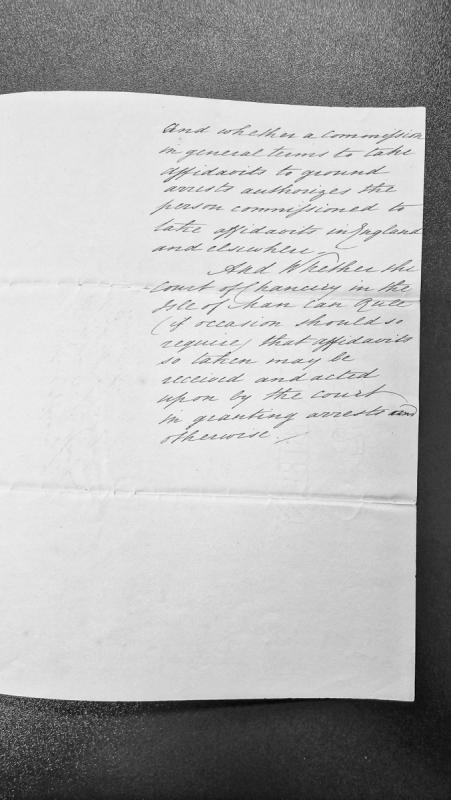
A legal document posing two questions about the scope of a general commission to take affidavits for arrest proceedings: whether such a commission authorizes taking affidavits in England and elsewhere, and whether the Court of Chancery in the Isle of Man can rule on the admissibility of such affidavits in arrest proceedings.
John Quilliam was born in Castletown — the old capital where Castle Rushen stood with its lead roof stripped and its barracks crumbling. He grew up in the post-Revestment economy of sixpence-a-day wages and collapsed commerce. He was pressed into the Royal Navy. He rose through the ranks until by 1805 he was First Lieutenant of HMS Victory, Nelson's flagship. When the wheel was shot away during the battle, Quilliam organised the tiller ropes that steered the ship through the engagement — skills learned on the Irish Sea saving Nelson's flagship at Trafalgar. He came home to Mann. He sat in the House of Keys. The pressed fisherman from a ruined harbour became one of the most distinguished naval officers of his age, and then returned to serve the island that had formed him.
Single storey, double-fronted cottage, originally constructed before 1868 (present on Ordnance Survey 1:2500 1st edition map of that date).
Acquired by the Manx Museum and National Trust in 1999, and converted for educational use.
Single storey, double-fronted thatched cottage, originally constructed before 1868 (present on Ordnance Survey 1:2500 1st edition map of that date).
Acquired by the Manx Museum and National Trust in 1999, and converted for educational use.
Prehistoric flint scatter.
A single worked prehistoric flint was recovered from Raby by CH Cowley.
No further details concerning the discovery were recorded and the grid reference relates to the farmstead for indicative purposes only.
The antiquary Charles Harry Cowley was an avid collector of worked flint and coarse stone artefacts revealed by agricultural activity, mainly on farms located around Peel, and occasionally from further afield. He was active from 1900 until 1943. His entire collection of artefacts, together with a daybook cataloguing his discoveries, was later donated to Manx National Heritage.